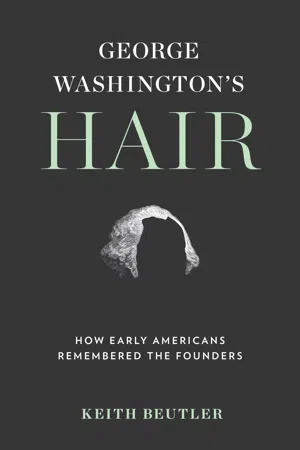
Mostly hidden from public view, like an embarrassing family secret, scores of putative locks of George Washington's hair are held, more than two centuries after his death, in the collections of America's historical societies, public and academic archives, and museums. Excavating the origins of these bodily artifacts, Keith Beutler uncovers a forgotten strand of early American memory practices and emerging patriotic identity.
Between 1790 and 1840, popular memory took a turn toward the physical, as exemplified by the craze for collecting locks of Washington's hair. These new, sensory views of memory enabled African American Revolutionary War veterans, women, evangelicals, and other politically marginalized groups to enter the public square as both conveyors of these material relics of the Revolution and living relics themselves.
George Washington's Hair introduces us to a taxidermist who sought to stuff Benjamin Franklin's body, an African American storyteller brandishing a lock of Washington's hair, an evangelical preacher burned in effigy, and a schoolmistress who politicized patriotic memory by privileging women as its primary bearers. As Beutler recounts in vivid prose, these and other ordinary Americans successfully enlisted memory practices rooted in the physical to demand a place in the body politic, powerfully contributing to antebellum political democratization.
Conservative Roots of American Memory from the 1790s
1
The Taxidermist
In July of 1789, Benjamin Franklin—bedridden in his Philadelphia home—was physically failing. On the 17th, the American Philosophical Society, pained at the impending loss of its founder, “Resolved, that a portrait of Dr. Franklin, the president of the society[,] shall as speedily as is convenient be executed in the best manner—to be perpetually kept in one of their apartments: and that [the Society] . . . shall apply to Mr. Peale to prepare and execute the same.”1 News of their request reached Charles Willson Peale—a Philadelphia museum owner, portraitist, and taxidermist with a penchant for natural history—as he was washing “birds and beasts” in arsenic, preparing the dead specimens for inclusion in his museum’s displays.2 Eager to accommodate the Philosophical Society, of which he was proudly a member, Peale was soon at Benjamin Franklin’s bedside. Too ill for a formal sitting, Franklin asked the artist to model the new portrait after a likeness that Peale had rendered years before. Should he regain strength, the expiring sage promised, the newer painting could be finished from life.3 As it was, Benjamin Franklin endured only one fifteen-minute session. Peale largely recopied his 1785 rendition of the old man’s famous visage, and the Philosophical Society passed on acquiring it—preferring another one of Peale’s earlier portraits of their founder.4
Several months later, on 17 April 1790, Benjamin Franklin was in the throes of death. The doctor’s relative Samuel Vaughan, who four years earlier had sponsored Charles Peale’s admission to the Philosophical Society, felt overwhelmed.5 Vaughan tried to control himself, tried to suppress his “grief” at what he was witnessing at the old man’s bedside. Yet, having “never before been so much affected,” he suffered “histerick fits,” and had to withdraw. Later, he wrote to his wife conveying a “melancholly tale”: though at first Franklin “squeezed my hand, his eyes remarkably bright and piercing,” his body was giving out. The doctor “brought up much phlegm, taken from his mouth in handkerchiefs,” his “hand convulsed,” and there was a distinct “rat[t]ling in his throat.” Soon, Dr. Benjamin Franklin, “Our Dear Friend the Philanthrophist, Philosopher, Patriot, and Politician” was “no more.”6
Philadelphians lamented en masse. Vaughan witnessed a procession to Franklin’s burial that was “half a mile in Length, the streets on each side lined with people five or six deep, the whole way. The doors and windows all crouded, numbers upon the . . . tops of houses & even chimnies.”7 As Charles Willson Peale later wrote, it seemed that “the whole City . . . collected at” Franklin’s “interment.”8 In the evening, one of Charles’s sons—Rembrandt Peale—kept vigil on a wall overlooking the burial ground at Christ Church where Franklin’s body—one of the most physically recognizable in the world—had just been entombed.9 Grief-stricken, Vaughan sought an extant relic from that body—a bit of the deceased scientist’s “venerable hair.” He hoped that one day those remains would be part of a larger personal collection of locks that would include hair from two other “Worthies” of the American Revolution: George Washington and Patriot financier Robert Morris.10
For his part, Charles Willson Peale—perhaps recalling his own frustrating efforts to artistically capture a dying Franklin’s features—went on to insist that more of the good doctor could and should have been preserved than tresses or an image on painted canvass. In 1792, Peale published a broadside boasting of his museum’s displays of animal specimens preserved by taxidermy and arranged beneath “portraits of many of the persons . . . highly distinguished . . . in the late glorious [American] revolution.” Contrasting the efficacy of painting to taxidermy as means of memorialization, Peale allowed that though it was by means of “Good and faithful paintings” that “the likeness of man is . . . with the greatest precision handed down to posterity,” there were also “other means,” such as “use of powerful anticeptiks,” to materially “preserve, and hand down to succeeding generations, the reliks of such great men,” and to protect “their bodies from . . . being the food of worms.” Admittedly, taxidermical preservation of the United States’ Founders might, from a purely aesthetic standpoint, not achieve “that high perfection of form, which the well-executed painting in portrait and sculpture can produce,” yet all “who reverence the memory of such luminaries” would prefer to preserve and display the “actual remains” of the Framers. “Sorry I am,” Peale lamented, “that I did not propose the means of such preservation to that distinguished patriot . . . Dr. Franklin, whose liberality of soul” would have encouraged him to “suffer the remains of his body to be now in our view.”11
Peale meant what he wrote; his words were not hyperbole. The museum founder was indeed evincing enthusiasm for preserving the bodies of the Founders, like so many arsenic-soaked “birds and beasts.”12 Anyone who would name one son Titian, and others Rembrandt, Linnaeus, and Franklin, was presumably serious in advocating such a commingling of art, zoology, and patriotic commemoration, as his scheme for embalming and displaying Franklin and other Founders in his museum would have involved.13 Though Peale did not specify the protocol he had in mind, stuffing “Dr. Franklin,” or any of the Founders, would necessarily have been invasive. He might have to do, as he had done with numerous animals, the following: take “off the skin from the carcase [sic] except from the head and feet, from which all the flesh that could be taken with a knife or hooks” is “removed”; then, “with a . . . blunted hook,” pull out more “flesh”; cut “away . . . interior parts of the skul [sic],” remove “the brains, Eyes, and tongue”; insert “into the body, where the bowels had been taken out, a piece of cork”; rub special antiseptic powders “into the skin”; and push them “into all” of the body’s evacuated “cavities.”14
Physiognomy
Admittedly, Peale’s first efforts to juxtapose natural history specimens with painted likenesses of leading American Revolutionary leaders in his museum had been, at least in part, an effort to boost attendance at his gallery after the artist’s brother in-law, Colonel Nathaniel Ramsay, observed that paintings were one thing, exotic natural artifacts quite another. Few could be expected to make great efforts to see the former. Many would willingly travel twenty miles to behold the latter.15 Yet, whatever his initial motivations in collecting them, Charles Willson Peale’s private correspondence makes clear that he soon developed a quasi-religious reverence for the facility of natural history specimens in his museum to exult “the soul to” God, and inspire “congenial goodness, and that love of order so indispensable to public and private prosperity.”16
While the organization of Peale’s “world in miniature,” as the Philadelphian styled it, was that of a great chain of being, with the American Founders at the top spatially, and, by implication, ideally, the epistemology of Peale’s “school,” as the latter was also wont to call his museum, was suffused with the physiognomic theories of Swiss clergyman Johan Caspar Lavater (1741–1800).17 Lavater defined physiognomy as “the science or knowledge of the correspondence between the external and visible man, the visible superficies, and the invisible contents.” “Each part of an organized body,” he insisted, “is an image of the whole.” Metaphorically, “The human body is a plant, each part of which has the character of the stem.” Any part of a person’s body could be interpreted physiognomically to reveal the “internal motives” of its possessor “which would otherwise be first revealed in the world to come.” Though he was a clergyman, Lavater argued that “physiognomy is more indispensable than the liturgy. It is . . . alike profitable for doctrine, exhortation, comfort, correction, [and] examination.” High priests in the emerging physiognomic faith were portraitists, such as Peale. Lavater wrote that “Portrait painting, is the most natural, manly, useful, noble, and . . . difficult of arts.” Because the face is where a human soul’s “emanations” appear most legibly, as “Sacred to” the portrait painter “should be the living countenance as the text of holy scripture to the translator.”18
Charles Willson Peale, The Artist in His Museum, 1822. (Pennsylvania Academy of Fine Arts, Philadelphia)
Lavater further held that “national character” was reflected in “national physiognomy.” Displaying his penchant for reasoning from parts to wholes, he argued that individual “countenances discover more the characteristic of a whole nation, than a whole nation does that which is national in individuals.”19 Embracing Lavater’s epistemology, Peale believed that representations of individual Founders in his museum would facilitate “a sort of” physiognomic “converse with distinguished [American] Characters” that would encourage museum-goers to cultivate their own latent potentialities as republican citizens. Thus, he kept admission prices to his exhibits low, wishing to make such transforming encounters affordable to visitors from every walk of life.20 Echoing Lavater’s passion for portraitists, Peale enthused that the portrait painter “who can produce a perfect illusion of sight,” so that the “spectator . . . believes the real person is there” deserved “to be caressed by the greatest of mortal beings.”21 A further debt was owed to the able artist for being a skillful practitioner of memory—for drawing upon a “good memory” of physical features of painted subjects to portray their bodies, thereby physiognomically unveiling and archiving their characters for “ages to come.”22
Like Lavater, Peale held that heads were uniquely revelatory. In portraiture, Peale’s first rule was that “the general proportions of the features and other parts of the head should be exact, . . . even in a head size canvis [sic] the air of the head is all important.”23 Comporting with Lavater’s teaching that each part of a body transparently expresses a force of character that animates the whole body, Peale thought that at the first sketching of a person’s face, “it must be determined what will be the [facial] expression, and in this must every feature accord; a unity of the whole.” If “there is a smile in the mouth, the eyes, the nose, the cheeks, and even the forehead must have its share.”24 Thus rendered accurately, “the features of the man” will “represent” that subject’s “mind,” for the “temper of man . . . moulds the features; the constant exercise of any one passion[,] the governing muscles being in constant action[,] fixes the growing form.”25
In 1802, influenced by Lavater’s assertion that tracings of the shadow of a person’s profile were “the . . . truest representation that can be given of man,” Peale began to employ a device called a “physiognotrace,” by which visitors to his museum could have their profiles made.26 In effect, Peale was giving his guests opportunities to scrutinize physiognomically their own characters against the standard of nature’s great chain of being, effectively represented by his museum as an American body politic with the Founders at its pinnacle. Following recommendations by Lavater, Peale had visitors’ silhouettes cut out on doubled-over paper.27 This allowed the museum owner to archive a copy of each likeness. By December of 1808, he was boasting to Thomas Jefferson: “I have upwards of 8,000 profiles on sheets of paper[,] which furnishes a very rational amusement.”28 As Charles Willson Peale physically sorted these records according to what he believed they revealed physiognomically, he was effectively annexing museum visitors to his natural history exhibits—literally putting them in place taxonomically. Ideally, he explained in an 1816 letter to Philadelphia’s Select and Common Councils, visitors would judge themselves. By contemplating concrete natural history “objects” in Peale’s museum, they would come to scientifically “know themselves, and their dependence on others.” In short, Peale meant to use his museum to persuade visitors of a relatively traditional and hierarchical view of the body politic over and against the sort of emerging democratic egalitarianism espoused by his friend Thomas Jefferson.29
Mnemonic Physicalism
Peale believed that the fact that objects in his museum were materially well organized made them more memorable than they would have been otherwise. In 1805, he explained that “a museum fit for a regular system of the Study of Nature” must “contain in good preservation some specimens of every department, arranged in some methodical mode, not huddled together without order with respect to their several Natures. . . . otherwise the more numerous a collection is, the more it will distract the Minds of its Visitors: if it gives [a] little information, that little will soon be obliterated because [of] not [being] stored in its proper place.”30 Popular memory theory agreed. An essayist in an education journal explained: “we” should not clutter the “storehouse” of memory with “all of the broken and useless furniture that we can find room for.”31 A Methodist magazine reprised a seventeenth-century Puritan minister’s assertion that “when notions are heaped incoherently in the memory without order . . . , they confound and overthrow the memory.”32 The Massachusetts Magazine evoked “apartments . . . in which memory stores its merchandize” in an orderly fashion, and the New York Magazine praised Simonides, the ancient Greek father of Classical memory theory, for realizing “how necessary order is in memory.”33 Following Simonides, teachers of memory in the West had long instructed students to imagine rooms, or loci, in their minds in which they were to mentally organize objects representing particular ideas. In the case of Peale’s natural history museum, the loca...
Table of contents
Cover
Title Page
Copyright Page
Dedication
Contents
Preface
Introduction
Part I. Conservative Roots of American Memory from the 1790s
Part II. Democratizing Tousling of American Memory from the 1820s
Notes
Index
Trusted by 375,005 students
Access to over 1.5 million titles for a fair monthly price.
Study more efficiently using our study tools.
Frequently asked questions
Yes, you can cancel anytime from the Subscription tab in your account settings on the Perlego website. Your subscription will stay active until the end of your current billing period. Learn how to cancel your subscription
No, books cannot be downloaded as external files, such as PDFs, for use outside of Perlego. However, you can download books within the Perlego app for offline reading on mobile or tablet. Learn how to download books offline
Perlego offers two plans: Essential and Complete
Essential is ideal for learners and professionals who enjoy exploring a wide range of subjects. Access the Essential Library with 800,000+ trusted titles and best-sellers across business, personal growth, and the humanities. Includes unlimited reading time and Standard Read Aloud voice.
Complete: Perfect for advanced learners and researchers needing full, unrestricted access. Unlock 1.5M+ books across hundreds of subjects, including academic and specialized titles. The Complete Plan also includes advanced features like Premium Read Aloud and Research Assistant.
Both plans are available with monthly, semester, or annual billing cycles.
We are an online textbook subscription service, where you can get access to an entire online library for less than the price of a single book per month. With over 1.5 million books across 990+ topics, we’ve got you covered! Learn about our mission
Look out for the read-aloud symbol on your next book to see if you can listen to it. The read-aloud tool reads text aloud for you, highlighting the text as it is being read. You can pause it, speed it up and slow it down. Learn more about Read Aloud
Yes! You can use the Perlego app on both iOS and Android devices to read anytime, anywhere — even offline. Perfect for commutes or when you’re on the go. Please note we cannot support devices running on iOS 13 and Android 7 or earlier. Learn more about using the app
Yes, you can access George Washington's Hair by Keith Beutler in PDF and/or ePUB format, as well as other popular books in History & Early American History. We have over 1.5 million books available in our catalogue for you to explore.