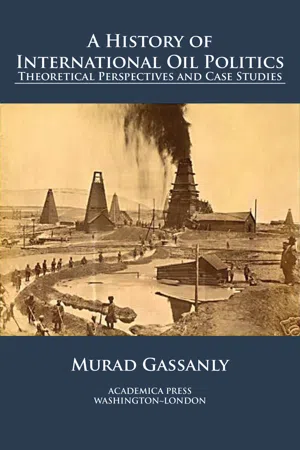
A History of International Oil Politicsis both an argument for multi-theoretical pluralism and a proposal for a theory-synergetic approach in international relations. Murad Gassanly, a distinguished international relations scholar and rising British politician, explores how international relations paradigms could be utilized in approaching the vital field of international oil politics, specifically historical issues of international energy politics and comparative case studies of energy transmission networks – the Baku-Tbilisi-Ceyhan Pipeline and the Southern Gas Corridor. This highly original study explores the historical timeline of global energy to demonstrate how a theory-synergetic analysis might offer a deeper and more holistic understanding. As an academic discipline, international relations now offers a maelstrom of competing epistemological, ontological, and normative contestations. Gassanly, however, argues that theoretical diversity has knowledge-producing and maximizing potential and that pluralism does not impede academic progress. Applying different theoretical models to oil politics reveals different realities, but the synergetic whole is greater than the sum of its constituent paradigmatic parts. Empirical convergences between theoretical accounts provides a broad analytical framework for active theoretical synergy.
eBook - ePub
A history of international oil politics
Theoretical Perspectives And Case Studies
- English
- ePUB (mobile friendly)
- Available on iOS & Android
eBook - ePub
About this book
Information
Subtopic
PoliticsBibliography
Abdurasulov, A. Is Turkmenistan’s gas line a pipe dream? BBC News. 16 July 2015 (Retrieved 20.01.2016 http://www.bbc.co.uk/news/world-asia-32981469).
Abrahamian, E. Communism and Communalism in Iran: The Tudah and the Firqah-I Dimukrat. International Journal of Middle East Studies, Vol. 1, No. 4. (Oct., 1970), pp. 291-316.
Abrahamian, E. 1982. Iran Between Two Revolutions. Princeton: Princeton University Press.
Abrahamian, E. 2008. A History of Modern Iran. Cambridge: Cambridge University Press.
Adams, T. D. Baku Oil Diplomacy and “Early Oil” 1994-1998: An External Perspective. pp. 225-252 in Peterson, A. and Ismailzade F. (Eds.). 2009.
Adelman, M.A. 1972. The World Petroleum Market. Baltimore: The Johns Hopkins University Press.
Agayev, V., Akhundov, F., Aliyev, F. T. and Agarunov, M. World War II and Azerbaijan. Azerbaijan International. Summer 1995 (3.2). Pp. 50-55, 78.
Agayev, Z. .23.12.2011. Pipeline to Ship Azeri Gas to Central Europe, Balkans, WSJ Says. Bloomberg. https://www.bloomberg.com/news/articles/2011-12-23/pipeline-to-ship-azeri-gas-to-central-europe-balkans-wsj-says-retrieved 5.10.2017
American Manufacturer and Iron World (AMIW). 1901. Greater Pittsburgh and Allegheny County, Past, Present, Future. Pittsburgh, Pa. (original at the New York Public Library).
Amin, S., Arrighi, G., Frank, A. G., Wallerstein, I. 1982. Dynamics of Global Crisis. London: New York: Monthly Review Press.
Argyrou, V. 2005. The Logic of Environmentalism: Anthropology, Ecology and Postcoloniality. New York: Berghahn Books.
Ahmadov, A.K. Oil, Democracy, and Context: A Meta-Analysis. Comparative Political Studies. August 2014. Vol. 47, no. 9. Pp. 1238-1267.
Aitken, D.W. 2003. Transitioning to a Renewable Energy Future. White Paper. International Solar Energy Society. (Online: https://ises.org/fileadmin/user_upload/PDF/ISES-WP-72-English.pdf; first accessed: 16.08.2015).
Alao. A. 2007. Natural Resources and Conflict in Africa: The Tragedy of Endowment. New York: University of Rochester Press.
Al-Zoubi, J. 4.12.2017. New Protests Erupt Against Removal of Olive Trees for TAP Pipeline. Olive Oil Times (https://www.oliveoiltimes.com/olive-oil-business/new-protests-erupt-removal-olive-trees-tap-pipeline/61143 – retrieved 20.12.2017).
Alnasrawi, A. 1991. Arab Nationalism, Oil, and the Political Economy of Dependency. Westport, CT: Greenwood Publishing Group.
Andrews-Speed, P. Herberg, M.E, Zhidong, Li and Shobert, B. 2014. China’s Energy Crossroads: Forging a New Energy and Environmental Balance. NBR Reports. Seattle, U.S.: The National Bureau of Asian Research.
Angell, N. 1913. The Great Illusion: A Study of the Relation of Military Power in Nations to their Economic and Social Advantage. New York and London: G. P. Putnam’s Sons
Archer, M., Bhaskar, R., Collier, A., Lawson, T., Norrie, A. 2007. Critical Realism: Essential Readings. London and New York: Routledge.
Armaroli, N. and Blazani, V. 2010. Energy for a Sustainable World – From the Oil Age to a Sun-Powered Future. Wiley-VCH
Asbrink, B. The Nobels in Baku: Swedes’ Role in Baku’s First Oil Boom. Azerbaijan International. Summer 2002 (10.2). Pages 56-59.
Auten, B.J. 2008. Carter’s Conversion: The Hardening of American Defense Policy. University of Missouri Press.
Ayson, R. 2008. Strategic Studies in Reus-Smit, C. and Snidal, D. (eds.) 2008.
Bacevich, A.J. 2013. The New American Militarism: How Americans Are Seduced by War. Oxford: Oxford University Press.
Bamberg, J.H. 1994. The History of the British Petroleum Company, Volume 2: The Anglo-Iranian Years, 1928-1954. Cambridge: Cambridge University Press.
Baran, Z. The Baku-Tbilisi-Ceyhan pipeline: implications for Turkey in Frederick Starr, S. and Cornell, S. E. (Eds.). 2005.
Barnett, M. and Sikkink, K. From International Relations to Global Society in Reus-Smit, C. and Snidal, D. (eds.) 2008.
Barry, A. 2006. “Technological Zones,” European Journal of Social Theory, vol. 9, no. 2, pp. 239-53.
Barry, A. 2013. Material Politics: Disputes Along the Pipeline. Wiley Blackwell.
Bebbington, A. (Ed.) 2011. Social Conflict, Economic Development and the Extractive Industry: Evidence from South America. London and New York: Routledge.
Bell, G. C. 1930. Kentucky Petroleum. Owensboro, Kentucky: Bell Publishing.
Bell, C., Wolford, S. Oil Discoveries, Shifting Power, and Civil Conflict. International Studies Quarterly. Volume 59, Issue 3, pages 517–530, September 2015.
Bennett, A. 2013. The mother of all isms: Causal mechanisms and structured pluralism in International Relations theory. European Journal of International Relations. No 19, pp. 459-482.
Bennis, P. 2006. Challenging Empire: How People, Governments, and the UN Defy U.S. Power. Northampton, Mass.: Olive Branch Press.
Berenskoetter, B. 18.09.2013. Theories Never Die. Guest post in Nexon, D. (Ed.) “End of IR Theory” companion symposium for the special issue of the European Journal of International Relations. The Duck of Minerva. http://duckofminerva.dreamhosters.com/2013/09/19951.html (accessed 27 October 2014).
Betancourt, R., 1978, Venezuela: oil and politics. Houghton Mifflin Company, Boston, MA
Bhaskar, R. 1975, A Realist Theory of Science, London: Routledge.
Bhaskar, R. (1979) 1998. The Possibility of Naturalism A Philosophical Critique of the Contemporary Human Sciences. Routledge: London and New York.
Biro, A. Towards a Denaturalized Ecological Politics. Polity. Vol. 35, No. 2 (Winter, 2002), pp. 195-212
Blair, T. 2011. A Journey. London: Arrow Books.
Blair, J.M. 1978. The control of oil. Vintage Books.
Blaney, D.L and Inayatullah, N. 2008. International Relations From Below in Reus-Smit, C. and Snidal, D. (eds.) 2008.
Blatchford, D. Environmental and social aspects of the Baku-Tbilisi-Ceyhan pipeline in Frederick Starr, S. and Cornell S. E. (Eds.). 2005.
Bohi, D. R., Toman, M.A., Walls, M.A. 1996. The Economics of Energy Security. London: Kluver Academic Publishers.
Bronner, S. E. 2002. Of Critical Theory and Its Theorists. New York: Routledge
Booth, K. and Smith, S. (Eds.) 1997. International Relations Theory Today. Cambridge, UK: Polity Press.
Brenner, A. 1984. The Wind that Swept Mexico. Austin: University of Texas Press
Bridge, G. 2008. “Global Production Networks and the Extractive Sector: governing resource-based development,” Journal of Economic Geography 8 (3) March.
Bridge, G., and Le Billon, P. 2013. Oil. Cambridge: Polity.
Broder, J. M. Climate Change Seen as Threat to U.S. Security. The New York Times. 9 August 2009.
Bromley, S. 1991. American Hegemony and World Oil: The Industry, the State System and the World Economy. The Pennsylvania State University Press.
Simon Bromley, 1994. Rethinking Middle East Politics. University of Texas Press.
Brown, C. 2013. The Poverty of Grand Theory. The European Journal of International Relations September 2013; 19 (3), pp. 483-497.
Brown, O., Hamill, A. and Macleman, R. Climate change as the “new” security threat: implications for Africa. International Affairs. Volume 83, Issue 6, November 2007. Pp.1141–1154.
Buchan, D. and Keay, M. 2016. Europe’s Long Energy Journey: Towards an Energy Union? Oxford University Press.
Buckley, N. and Foy, H. 18.10.2017. EBRD to lend $500m for Azerbaijan gas pipeline. Financial Times. https://www.ft.com/content/533fc822-b3db-11e7-a398-73d59db9e399-retrieved 29.10.2017.
Bucknell, H. 1981. Energy and the National Defence. Lexington: University Press of Kentucky.
Bull, H. 1995. The Anarchical Society. A Study of Order in World Politics. London: Macmillan.
Bülow, Bernhard von. 1932. Memoirs of Prince von Bülow. Vol IV, 1849-1897 (translated from German by Geoffrey Dunlop and F. A. Voight). Boston: Little, Brown and Company.
Burchill, S., Devetak, R., Linklater, A., Patterson, M., Reus-Smit, C., True, J. 1996. Theories of International Relations. New York: Palgrave.
Burchill, S. Introduction in Burchill, S. et al (eds.) 1996.
Burke, A. 2008. Postmodernism in Reus-Smit, C. and Snidal, D. (eds.) 2008.
Burroughs, C. 15.08.2017. Southern Gas Corridor: Pipe dream to pipe reality. TXFNews. https://www.txfnews.com/News/Article/6194/Southern-Gas-Corridor-Pipe-dream-to-pipe-reality-retrieved 19.10.2017.
...Table of contents
- Cover
- Title Page
- Copyright
- Dedication
- Preface
- Contents
- Introduction
- I: Foundational and Theoretical Debates in International Relations
- II: Theory-Synergetic Approach
- III: IR and Politics of Oil (and Gas)
- IV: Rationalist Models
- V: Reflectivist Models
- VI: Synergetic Model
- Conclusion
- Appendices
- Bibliography
- Index
Trusted by 375,005 students
Access to over 1.5 million titles for a fair monthly price.
Study more efficiently using our study tools.
Frequently asked questions
Yes, you can cancel anytime from the Subscription tab in your account settings on the Perlego website. Your subscription will stay active until the end of your current billing period. Learn how to cancel your subscription
No, books cannot be downloaded as external files, such as PDFs, for use outside of Perlego. However, you can download books within the Perlego app for offline reading on mobile or tablet. Learn how to download books offline
Perlego offers two plans: Essential and Complete
- Essential is ideal for learners and professionals who enjoy exploring a wide range of subjects. Access the Essential Library with 800,000+ trusted titles and best-sellers across business, personal growth, and the humanities. Includes unlimited reading time and Standard Read Aloud voice.
- Complete: Perfect for advanced learners and researchers needing full, unrestricted access. Unlock 1.5M+ books across hundreds of subjects, including academic and specialized titles. The Complete Plan also includes advanced features like Premium Read Aloud and Research Assistant.
We are an online textbook subscription service, where you can get access to an entire online library for less than the price of a single book per month. With over 1.5 million books across 990+ topics, we’ve got you covered! Learn about our mission
Look out for the read-aloud symbol on your next book to see if you can listen to it. The read-aloud tool reads text aloud for you, highlighting the text as it is being read. You can pause it, speed it up and slow it down. Learn more about Read Aloud
Yes! You can use the Perlego app on both iOS and Android devices to read anytime, anywhere — even offline. Perfect for commutes or when you’re on the go.
Please note we cannot support devices running on iOS 13 and Android 7 or earlier. Learn more about using the app
Please note we cannot support devices running on iOS 13 and Android 7 or earlier. Learn more about using the app
Yes, you can access A history of international oil politics by Murad Gassanly in PDF and/or ePUB format, as well as other popular books in Politics & International Relations & Politics. We have over 1.5 million books available in our catalogue for you to explore.