The Work of Whiteness
eBook - ePub

The Work of Whiteness

A Psychoanalytic Perspective

  1. 148 pages
  2. English
  3. ePUB (mobile friendly)
  4. Available on iOS & Android
eBook - ePub

The Work of Whiteness

A Psychoanalytic Perspective

About this book

'Whiteness' is a politically constructed category which needs to be understood and dismantled because the system of racism so embedded within our society harms us all. It has profound implications for human psychology, an understanding of which is essential for supporting the movement for change. This book explores these implications from a psychoanalytic and Jungian analytic perspective.

The 'fragility' of whiteness, the colour-blind approach and the silencing process of disavowal as they develop in the childhood of white liberal families are considered as means of maintaining white privilege and racism. A critique of the colonial roots of psychoanalytic theories of Freud and Jung leads to questioning the de-linking of the individual from society in modern day analytic thinking. The concept of the cultural complex is suggested as a useful means of connecting the individual and the social. Examples from the author's clinical practice as well as from public life are used to illustrate the argument.

Relatively few black people join the psychoanalytic profession and those who do describe training and membership as a difficult and painful process. How racism operates in clinical work, supervision and our institutions is explored, and whilst it can seem an intractable problem, proposals are given for ways forward. This book will be of great importance to psychoanalysts, psychotherapists, social workers and all those with an interest in the role of white privilege on mental health.

Frequently asked questions

Yes, you can cancel anytime from the Subscription tab in your account settings on the Perlego website. Your subscription will stay active until the end of your current billing period. Learn how to cancel your subscription.
No, books cannot be downloaded as external files, such as PDFs, for use outside of Perlego. However, you can download books within the Perlego app for offline reading on mobile or tablet. Learn more here.
Perlego offers two plans: Essential and Complete
  • Essential is ideal for learners and professionals who enjoy exploring a wide range of subjects. Access the Essential Library with 800,000+ trusted titles and best-sellers across business, personal growth, and the humanities. Includes unlimited reading time and Standard Read Aloud voice.
  • Complete: Perfect for advanced learners and researchers needing full, unrestricted access. Unlock 1.4M+ books across hundreds of subjects, including academic and specialized titles. The Complete Plan also includes advanced features like Premium Read Aloud and Research Assistant.
Both plans are available with monthly, semester, or annual billing cycles.
We are an online textbook subscription service, where you can get access to an entire online library for less than the price of a single book per month. With over 1 million books across 1000+ topics, we’ve got you covered! Learn more here.
Look out for the read-aloud symbol on your next book to see if you can listen to it. The read-aloud tool reads text aloud for you, highlighting the text as it is being read. You can pause it, speed it up and slow it down. Learn more here.
Yes! You can use the Perlego app on both iOS or Android devices to read anytime, anywhere — even offline. Perfect for commutes or when you’re on the go.
Please note we cannot support devices running on iOS 13 and Android 7 or earlier. Learn more about using the app.
Yes, you can access The Work of Whiteness by Helen Morgan in PDF and/or ePUB format, as well as other popular books in Psychology & Mental Health in Psychology. We have over one million books available in our catalogue for you to explore.

Information

Chapter 1
Whiteness

In her challengingly titled book, Why I’m No Longer Talking to White People About Race (2017), Reno Eddo-Lodge states:
At best, white people have been taught not to mention that people of colour are ā€˜different’ in case it offends us. They truly believe that the experiences of life as a result of their skin colour can and should be universal. I just can’t engage with the bewilderment and the defensiveness as they try to grapple with the fact that not everyone experiences the world in the way that they do. They’ve never had to think about what it means, in power terms, to be white, so any time they’re vaguely reminded of the fact they interpret it as an affront. Their eyes glaze over in boredom or widen in indignation. Their throats open up as they try to interrupt, itching to talk over you but not really listen, because they need to let you know that you’ve got it wrong.
(pp. ix–x)
The concept of ā€˜whiteness’ as applied to humans is full of paradox and contradiction. No human being, even the fairest amongst us, has skin that is actually ā€˜white’, just as the darkest is not ā€˜black’. Yet this crude form of colour coding which came into being in the modern era has divided humanity and ensured white supremacy in the service of domination, colonialism and slavery. Normalised into the default racial status permitting ā€˜whites’ to regard themselves as having no race, it has become both dominant and invisible. Invisible, at least, to those included within its borders, but not to those it excludes and who suffer its violence. As a racial category, ā€˜white’ is defined not so much by what it is but by what it is not. Hence the need for blackness, the racially codified ā€˜other’ which can hold the dark, the shadow, leaving white as pure, heavenly and innocent.
The Jungian analyst James Hillman (1986) notes that:
Our culture, by which I mean the imagination, enactments and values collectively and unconsciously shared by Northern Europeans and Americans, is white supremacist. Inescapably white supremacist, in that superiority of whiteness is affirmed by our major texts and is fundamental to our linguistic roots; and thus our perceptual structures. We tend to see white as best, as most embracing and define it in superior terms.
(p. 30)
ā€˜White’ is a blanket term that erases all differences, all shades, hues and colours. Yet each white individual will have a unique relationship to the concept depending on history, geography, religion, ethnicity, class, gender, language, culture and more. A person of Irish, Southern European or Latin American descent, or those who are Jewish or from other minority religious groups, will have their own historic background of suffering and oppression. Indeed, there have been periods in times and places when each of these groups have been designated as ā€˜non-white’ or ā€˜black’. There are also political and ethical differences within the white group. A white liberal will not have the same relationship to whiteness as will an avowed white supremacist.
There are those who argue for dispensing with the terms ā€˜white’ and ā€˜black’ altogether. The case has a logic in that, if the division is a meaningless, constructed one with no scientific basis, then repair and progress require us to drop these categories altogether and rely instead on the more nuanced one of ethnicity. The proposition is tempting but, in my view, dangerous, as it offers a shortcut which avoids the work that needs to be done if we are to reach a position of genuine equity in our world. It sidesteps the reality of the racist structures of our society which, in turn, allows us white folk to continue in our ways whilst also circumventing the discomfort that comes with the acknowledgement of our whiteness and the privileges to which it gives access. Relabelling those who suffer the iniquities of racism and oppression does not solve the problems of injustice and inequality. Whilst there are near infinite variations of individual stories which impact on our specific relation to whiteness, those of us who walk the world inside what is perceived to be a white skin have important matters in common. Whatever our personal history, wherever we were born, however young or old we are, if we are regarded as ā€˜white’ we have inherited layers of privilege and supremacy from which we benefit at the cost of others.
The sociologist Linda Alcoff (2015) identifies three key aspects of any social identity. These are:
  • Its empirical status, or the ways in which an identity can be objectively located, measured and traced out historically in time and space.
  • Its imaginary status, or the ways in which it constitutes a shared social imaginary that organizes and prescribes normative and accepted lifestyles, both for the in-group as well as for outsiders.
  • Its subject-formation, or the constitution of individual subjects with particular ways of experiencing and perceiving as well as interacting with the social and natural environment.
(p. 74)

Empirical whiteness

Articulated as a category of social identity, whiteness ā€˜was linked to an overt ideology of racial biologism, cultural vanguardism and the legitimation narratives of colonial conquest’ (ibid, p. 76). Affirming its empirical status, she goes on to refer to
the recent empirical scholarship on whiteness [which] is producing a rich trove of information on the history, the economics, the geography, the sociology, and the politics of white identity. Without a doubt, ā€˜whiteness’ as a category has an empirical referent.
(p. 78)
In his introduction to The Invention of the White Race. Vol 1, Theodore Allen (1994) lays out the complexities of the history of ā€˜whiteness’. The gathering of observable variations in human skin colour into the stark polarities of ā€˜white’ and ā€˜black’ emerged within the modern era. The deliberate use of this division for political and economic advantage seems to have been first recorded in seventeenth-century Virginia, when the first Africans arrived on slave ships to work the plantations. Anxious that the indentured European labour force would find common cause with the enslaved Africans, the use of the term ā€˜white’ was used to transform the masters, plantation owners and European labourers into one all-inclusive group. Through a set of laws that privileged whites alone, any class solidarity with the blacks was disrupted, ensuring that power remained in the hands of the ruling white elite.
Almost four centuries later, the divide between ā€˜white’ and ā€˜black’ continues as a powerful form of social partition that has torn through the history of humankind, harming individuals, groups, societies and relationships. Despite developments in scientific knowledge that dismantled the belief that there is an essential, biological difference between these categories, and despite social and political advances towards a more liberal agenda in much of the world, ā€˜whiteness’ remains a powerful socio-economic category which determines how societies are organised and power is distributed.

Imaginary whiteness

Alcoff questions the universality and individualism of a Freudian approach to the ā€˜imaginary’ in ego-formation and uses the term as a more collective, social concept which is based on a shared orientation which may have little to do with the historical facts. This perspective takes account of the societal dynamics – both conscious and unconscious – into which a child is born, alongside those that are familial or related to internal drives and object relations.
Bringing all those with lighter-hued skin within the rubric ā€˜white’ in the emergent, piecemeal way that this occurred not only allowed the illusion of common privilege but also tapped into our unconscious imaginary in relation to ā€˜white’ and to ā€˜black’. These associations – albeit with some local variations – tend to be universal, based as they are in the nature of our bodies and the diurnal rhythms of the planet we inhabit. Mother’s nourishing milk and father’s productive sperm are white; bile and shit are black or brown. White is associated with the ā€˜delights’ of the daytime, the dove of peace and the pure soul, whereas black belongs to the dark terrors of night, to war and sin. Devils inhabit the blackness of Hell and angels the whiteness of Heaven.
This archetypal imagery has been elaborated by James Hillman (1986), who argues that the universality of these images means that, once the fair skinned were labelled as ā€˜white’ and all others ā€˜black’, the former were able to appropriate the ā€˜goodness’ of white, assigning the ā€˜badness’ of black to the rest. Through our language, our religions and our collective imaginings, we were archetypally prepared for white supremacy.
Hillman (1986) suggests that the archetypal uses of ā€˜white’ divide into three broad categories of meaning: as heavenly; as innocence; as anima or spirit. These are whitewashed categories which exclude the dark and the damaged so that any stain dissolves its purity. If colour is added then white ceases to be white, so distinctions, shades and tinctures are rejected as contaminating its purity. ā€˜Innocence excludes: ā€œinnocentā€ literally denotes an absence of noxiousness, without harm or hurt.… Black becomes necessary to whiteness as that co-relative by means of which white takes on its defensive, exclusive definition as im-maculate, un-polluted, in-nocent’ (p. 34).
When applied to humans, this has led to such absurdities as the ā€˜one-drop test’ – the social and legal policy in the US in the twentieth century which asserted that any person with even one ancestor of sub-Saharan ancestry is considered black. Or the ā€˜pencil test’ in South Africa to determine the curl of the hair, with all the racial and racist implications of apartheid.
This inability of white to include the imperfection of colour requires that the ā€˜Other’ is constellated so that the creation of ā€˜whiteness’ forces ā€˜blackness’ into existence and then turns distinctions into oppositions. Hillman points out that phenomena such as night and day, light and dark (or male and female) are different but not opposites. Since ā€˜white’ cannot allow dark to exist within itself, the shadow of whiteness must be rejected and cast into what it deems to be ā€˜black’. Because what is cast out is the unacceptable and unwanted, it is assumed to exist as an opposite, and in opposition to itself. In Hillman’s words:
ā€˜White casts its own white shadow’. This conclusion may be bettered to say, ā€˜white sees its own shadow in black’, not because they are inherently opposite but it is archetypally given to whiteness to imagine in oppositions. To say it again: the supremacy of white depends on oppositional imagining.
(Ibid., p. 41. Italics in original)

Subjective whiteness

The assumption of whiteness as the default position of the human means that the individual may fail to notice that their whiteness affects their sense of identity and patterns of social interaction, taking for granted an entitlement to space, safety and freedom of movement. Such assumptions mostly go unacknowledged forming what Shannon Sullivan (2006) calls the ā€˜ unconscious habits ’ of white privilege. Whilst not a term that appears often in the psychoanalytic discourse, Sullivan uses ā€˜habit’ to mean an unconscious interweaving of psychical and somatic aspects which contribute to the formation of the self. Approaching white privilege and racism from this angle, she argues that:
Because habit is transactional, in a raced and racist world, the psychosomatic self necessarily will be racially and racistly constituted. Race is not a veneer lacquered over a nonracial core, it composes the very bodily and psychical beings that humans are and the particular ways by which humans engage with the world.
(p. 24)
She goes on to say:
The habit of ontological expansiveness enables white people to maximize the extent of the world in which they transact. But as an instance of white solipsism, it also severely limits their ability to treat others in respectful ways. Instead of acknowledging others’ particular interests, needs, and projects, white people who are ontologically expansive tend to recognize only their own, and their expansiveness is at the same time a limitation.
(p.
I shall return to the discussion of the development of ā€˜subjective whiteness’ in a later chapter.

White privilege

Existing as it does on an individual, social, organisational and institutional level, white privilege brings a set of advantages which will include immunity from troubles that other groups may experience. It assumes access to, and unbiased treatment by, private and public institutions. It is being confident that we will be treated fairly by the criminal justice system, the health service, educational and other organisations, and knowing that when we introduce ourselves in a role of authority it will not be questioned. It is not having to be aware of being white the majority of the time and assuming our dress, speech and ways of behaving are racially neutral, when in fact they are white. We will see our own images in the media, in literature and the history books and take our representation there for granted. It is having the luxury to fight racism one day and ignore it the next.
White privilege does not require people’s conscious awareness for it to exist; indeed its very invisibility is key to its continuance as it allows us the freedom to be blind to our own privilege. Thus we can benefit without having to acknowledge how our advantages depend on the disadvantage of others. Its hidden, implicit nature ensures its continuance as we remain ā€˜innocent’ of how our institutions and our social structures favour us as white people, ensuring that the racial hierarchy within society is perpetuated and maintained. Our inability (or refusal) to see how privileged our position is...
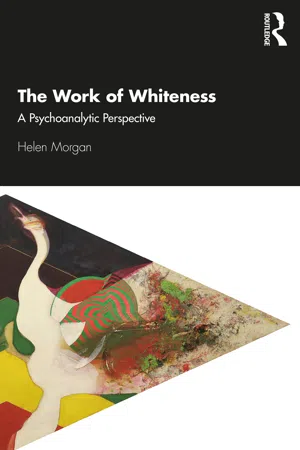
Table of contents

  1. Cover
  2. Half Title
  3. Title Page
  4. Copyright Page
  5. Contents
  6. The book cover
  7. Preface
  8. Acknowledgements
  9. Introduction
  10. 1 Whiteness
  11. 2 The legacy of slavery
  12. 3 Race and racism
  13. 4 The disavowal of whiteness
  14. 5 Freud and Jung
  15. 6 The racial complex
  16. 7 Racism and the psychoanalytic profession
  17. 8 Race and supervision
  18. Epilogue: the work of whiteness
  19. Bibliography
  20. Index