eBook - ePub
Helping Children and Young People Who Experience Trauma
Children of Despair, Children of Hope
- 304 pages
- English
- ePUB (mobile friendly)
- Available on iOS & Android
eBook - ePub
Helping Children and Young People Who Experience Trauma
Children of Despair, Children of Hope
About this book
This groundbreaking new book brings together policy, evidence, practice, service development and children's narrative to provide a far-reaching overview of this vulnerable and traumatised group. It combines powerfully written, moving scenarios and draws on evidence-based research to fully illustrate concepts and present practical ideas for change t
Information
CHAPTER 1
The meaning of developmental theories for traumatised children
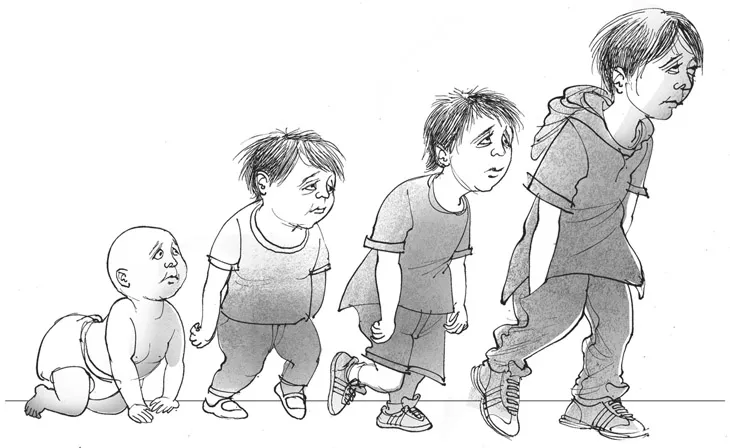
AN OPEN WOUND THAT IS WAITING TO HEAL
The ancient Greek word ‘τρανμα’ meant a wound piercing the skin. Trauma was subsequently associated with any injury that hurts, inflicts pain, and often damage. For a long time it presumably referred to physical complications to tissues, muscles, vessels or, indeed, any human organ. Trauma can be deliberate or accidental, acute or chronic, and usually violent. It can be minor or major, and the latter can be fatal. Wounds usually heal by themselves, can leave variable scarring behind, or need external help – from transportation and stabilization, to surgery of some kind, aftercare and rehabilitation, or non-Western healing practices. The closely knitted ancient origins of body and mind eventually influenced our understanding of human trauma. Early awareness that physical trauma could also affect emotions was followed by observations that wars and disasters dually resulted in physiological and emotional responses.
The concept of psychological trauma is actually not that new. Near the end of the nineteenth century, the French physician, psychologist and philosopher Pierre Janet delved into the human physiological and emotional mechanisms and responses to negative experiences, thus paving the way for psychoanalysis and Sigmund Freud. The latter’s description of traumatic neurosis as a state of unresolved emotional shock broadened the definition of trauma from a specific event, in the light of his developing theories on the importance of biological and sexual drives. That specific psychological effect of traumatic events came back to prominence post Second World War, at treatment centres for military personnel and, later, for war veterans. There was no going back, as attitudes to emotional suffering gradually changed, and a number of schools and theories emerged on when and how therapeutic interventions were indicated and how they could be effective. Evidence and influence of health and welfare services took much longer to emerge, but the die had been cast. Parallel processes to those following physical trauma take place in people’s minds, and so do ways of reversing the blow. We are now the beneficiaries of ample knowledge that a range of practices can accelerate the healing process.
Throughout all these phases, it took longer to relate, adapt or translate the implications for children. This is an interesting note in its own right. Why do most fields usually start from adults and then work their way ‘down’ or ‘backwards’ to children, considering all adults were children to start with anyway? Taking a look at societal views on childhood can offer some explanations. This is essentially an adult world, with individual and collective events viewed through an adult lens, and rules being written by adult hands. Did it cross such authors’ minds that children could be equally affected, if not more, by psychological trauma? It probably did, but often only in passing. Also, their applications faltered because children were invisible in history, arts and science, as well as in the real world of policy and service statistics. During different eras, children could not be distinguished from adults; initially, by contributing to family finances and tasks (which is still prevalent in large parts of the world); and more recently, by being perceived as future adults. When that mindset began to change during the last few decades, the evidence poured out and the camera lenses were readjusted. We can suddenly see a lot more, just by looking at children differently. If one adds the complexity of understanding trauma, then we have the ‘double whammy’ of traumatised children. The obvious crossover between the two most needy groups thus took inexplicably long to draw attention to. Now that some light is on them, let’s use it wisely.
CHILD PSYCHOLOGICAL TRAUMA: CONNOTATIONS IN AN ADULT WORLD
Psychological trauma can be severe and disproportionate, a one-off or more commonly ongoing, recurrent, relentless, and unmitigated. If we add children’s general lack of control to this equation, this takes a whole different meaning. Where a child is brought up to be nurtured and protected, instead s/he is often abused, exploited or abandoned. If we draw again the parallel with physical injuries, just when the skin or body is ready to heal, fresh injuries with different weapons and with increasing force knock this child back. Would one expect human organs to withstand any blow and resulting pain? Then why do we sometimes underestimate the impact of injuries of a different kind on children’s psyche and assume that they will automatically heal? For some groups of children we even expect them to find out ways of being healed in the adult world that injured them in the first instance.
Several terms have been used to distinguish the children we will be talking about in this book. These children are ‘vulnerable’ or ‘at risk’, because they have been exposed to multiple adversities that can lead to immediate or later problems. Although these adversities will not necessarily lead to problems, they have a higher chance of doing so in such children than in the rest of the population. For this reason, we need to give extra attention to ‘vulnerable’ or ‘at risk’ children (any attention would do in some cases), and we need to try to understand why they are different before we contemplate how to help them escape from their cycle of vulnerability. This applies to societies and communities – their attitudes as a whole; those who care for children as natural, substitute or professional carers; and the whole range of people and agencies in contact with children, universally (such as schools and youth services) or targeting those with existing needs (such as social services, special education or mental health services). We will consider in more detail why these children are viewed and treated differently in subsequent chapters. Here, we will revisit the wealth of theories on how these children (should) develop from a trauma perspective – that is, how their short- or long-term trajectories are disrupted when hit hard by trauma.
CHILD DEVELOPMENT THEORIES FROM A TRAUMA PERSPECTIVE
Child development incorporates the different biological and psychological changes and functions that children acquire during young life. Different theorists have proposed frameworks from specific perspectives that explain these transitions, often defining stages (or periods) when these commonly take place, or milestones when certain skills should be achieved, thus enabling the child to move on to the next stage. Whatever model one adopts, and these tend to have more in common than we ever previously believed, stages and milestones are not set in stone for a particular age; nevertheless, the models give a sense of where the child operates in comparison with their peers. Rigid interpretations of the past have given way to current views that child development is not ‘all or nothing’ – that is, each child is likely to vary across his or her developmental domains – and that stages are not critical (e.g. as originally proposed by Freud) but rather sensitive periods in human development, which can be improved and reversed. This is a positive message for helping even the most deprived and needy children, but it should not detract from the negative impact of early trauma and abuse, and how this can transcend into later childhood, adolescence and even young adult life. Rather than describe developmental theories in this text, the aim is to consider the major ones and their key principles, and to apply them to vulnerable children, thus illustrating the importance of understanding and interpreting children’s development in all its complexity and of relating to children based on current observations as well as history. This will lead to appropriate responses to their needs and, ultimately, more effective ways of helping them.
It is useful to consider child development along different domains – namely, physical, emotional, cognitive, social, language/communication and personal skills. These will invariably reach the expected milestones at different points for different children; however, most theories have a framework to gauge approximately when each will be achieved, with children often being grouped into relatively homogenous stages of infancy, preschool, middle childhood and adolescence. These stages are given different meaning and weight according to the underpinning psychological theory. An important shift since early work has been to gradually move from ‘critical’ or even ‘sensitive’ stages, where skills and functions have to be achieved and crises resolved to move to the next stage, to more fluent developmental pathways, where intrinsic and environmental factors constantly interact. In that respect, there are both continuities and discontinuities from what one would anticipate, even for the same child. But what could these developmental frameworks possibly mean for traumatised children?
COGNITIVE AND SOCIALLY DRIVEN THEORIES
Cognitive developmentalists construed children as active rather than passive thinkers and learners. Jean Piaget’s four cognitive stages cover infants up to 18 months responding through sensory and motor skills, younger children up to 6 years who begin to form internal representations but are still largely egocentric (pre-operational), older children of 6–12 years who develop logical but relatively fixed patterns of thinking (concrete operational), and adolescents with abstract capacity that helps them to build on experience and problem-solve (formal operational stage). Children constantly assimilate new knowledge and adapt to their experiences. Lev Vygotsky extended this theory by framing the formation of complex thinking patterns in terms of external influences, thus linking them with and building on social and language development. Practical intelligence, internalisation, play and problem-solving thus became prominent in understanding children.
If we transfer these expectations to a teenager who spent many early years in an abusive and neglectful environment, their process of cognitive development will not have been smooth, and this older-looking child may still be thinking concretely and be unable to predict routine social interactions or to anticipate how to resolve everyday challenges. On top of this, the teenager will not have had the experience and response from his or her environment to facilitate this growth – far from it, having received mixed and confusing signals. If the teenager’s carers or teachers do not bear these processes (or lack of them) and experiences in mind, their expectations will be unrealistic; their strategies out of tune, and they will be puzzled about why the teenager misses vital clues and does not conform. Similar misapplications apply to all other theories of development.
Erik Erikson’s theory of psychosocial development throughout the life span offers good insight into how maladaptive experiences during the six of its eight stages – that is, until young adulthood – can deviate from projected norms. Human growth has to navigate through struggles by constantly learning and adapting to the cultural demands of each age. The stage of basic trust versus mistrust is built as early as the first year, with the stages of autonomy versus doubt and initiative versus guilt taking the child to the beginning of his or her school years. If mistrust permeates from infancy to the next stages, then into middle childhood (competence versus inferiority) and adolescence (identity versus confusion), the path is not irreversible but the building blocks become less solid. Without the necessary adjustments, helped by carers and other adults, our teenager can become a young adult (stage of intimacy versus isolation) who struggles with relationships and holding his or her own in the big world.
MORALITY AND SOCIAL EMPATHY
Our understanding of moral growth has been influenced by both cognitive and social development theories. Children continuously acquire moral understanding, which goes beyond a sense of what is right or wrong, as they apply judgements on context, values and intent, which are often not easy to ascertain – for example, in legal cases. Lawrence Kohlberg described three levels of morality: (1) pre-conventional, guided by reward and punishment; (2) conventional, to gain approval (or conversely to avoid disapproval) and to avoid authority repercussions; and (3) eventually post-conventional morality to conform to expectations for their age group, before consolidating on self-determined ethics and principles. Children who have been victims before becoming perpetrators can appear confusing to courts struggling themselves between disposal and welfare options, by giving seemingly mixed messages. They can appear to understand the societal perceptions of a behaviour or offence but not to fully grasp the implications in order to generate change. If we look at Kohlberg’s three levels of morality, children who have been victims before becoming perpetrators may never, or rarely, have experienced conventional morality within their immediate family and peer group, not to mention that this is where their source of suffering originated from; therefore, they are not equipped to achieve self-determination. Also, they may not be able to understand the consequences for their own victim (lack of empathy), which is the focus of different interventions based on another theory.
Theory of mind has particularly evolved during the last 3 decades. It is well established that children as young as 18 months have a representational capacity of how other people feel, think and behave; or what they expect of them. Between 3 and 5 years of age they begin to distinguish between their past and their current representation of an object, person or state, which in turn allows them to evaluate their environment. This is followed by the distinction between fantasy and reality (around 6 years), inference (middle childhood) and hypothesis-testing (in adolescence). Our interpretation of a toddler engaging in conversations with an imaginary friend will thus be different from an abused older child who wraps him-or herself up in fantasy because he or she is not able and does not wish to distinguish it from the painful and dangerous reality, even after he or she has been removed to a place of safety. This can leave adults perplexed at times, as they automatically expect the child to be reset to his or her new life circumstances. Understanding where certain behaviours or younger play comes from is a start for them to adapt in order to help the child, rather than the other way round. Also, in order to do so they need to look at the whole range of the child’s functioning – in particular, his or her emotional capacity, even if developmental theories originally concentrated on cognitions and/or social influences in isolation.
EMOTIONS AND THEIR IMPLICATIONS THROUGHOUT CHILDHOOD
Children move from recognising simple emotional states such as anger and fear in early years to more complex ones, like embarrassment or disappointment. They simultaneously learn to express those emotions in accordance with their immediate family and wider peer environment – in particular, by modelling and observing their primary caregiver. Focus on emotional development is particularly significant for children who suffered trauma, as this largely affects the child’s inner world and is subsequently translated to most of his or her behaviours and social functions. This is why pioneers in this field influenced the establishment and evolution of key psychological therapies, none less so than Freud before the turn of the nineteenth century.
The truly innovative context of Freud’s proposed psychosexual stages of development at the time is sometimes lost and its implications oversimplified in our modern context. Freud set the scene for most psychodynamic therapies, as we will discuss in the next chapter, and he was the catalyst for the emergence of now seemingly opposed theories. The six stages, from birth to late adolescence and beyond, are influenced by the child’s intrinsic, basic, unconscious and largely sexual-driven drive (energy or libido), which thus form the basis of behaviours. These lead to fixations that usually get resolved, otherwise defence mechanisms become the child’s way of avoiding anxiety, and these can result in emotional problems throughout life. Energy assimilates in the child’s part of body that is most commonly used at each age. For example, in the oral stage until the age of 18 months, the child is mainly gratified through feeding and the use of his or her mouth. Human behaviour is thus formed by the dynamic interaction between conscious and unconscious processes. We all drift between the two at times, and we tend to use defence mechanisms in lesser or more severe forms – for example, to rationalise by putting forward an acceptable reasoned explanation for a not-so-wise behaviour or decision. Abused and other traumatised children demonstrate how such dysfunctional processes take effect over a course of years and can be easily misread.
Of the different classifications of defence mechanisms, George Vaillant’s four levels are the most widely quoted and used. I will refer to selective def...
Table of contents
- Cover
- Title Page
- Copyright Page
- Contents
- Preface
- About the author
- Acknowledgements
- Dedication Page
- 1 The meaning of developmental theories for traumatised children
- 2 The vulnerability that we cannot miss, and the resilience that we need to unravel
- 3 When should we worry about children?
- 4 Why services for vulnerable children should be different
- 5 Trauma and mental health: what works
- 6 Changing services culture to accommodate those who need them the most
- 7 ‘What are you doing for me?’ A desperate cry from children in public care
- 8 Staying alert: recognising mental health problems among children in care
- 9 Many ways of helping children in public care: yet, we do not often make the most of them
- 10 Interventions for children in care: top-down and bottom-up evolution
- 11 I have arrived for the rest of our life: creating an adoptive family
- 12 Adoptive families: making sense and moving forward
- 13 Interventions for adopted children and their parents
- 14 Invisible and on the move: the story of homeless children and families
- 15 Mrs Jones plus three: unpicking homeless children’s and families’ needs
- 16 ‘Have I met you before?’ ‘Yes, I am the boy from Chapter 7!’ Young people do not become homeless out of the blue
- 17 Homeless youth: don’t let them run away from help
- 18 Asylum-seeking and refugee children: a challenge to our beliefs and systems
- 19 Asylum-seeking and refugee children: a step beyond conventional interventions
- 20 From young victim to perpetrator
- 21 Therapeutic approaches for young offenders
- 22 Child trauma in low-income countries and traumatised communities
- Conclusions on ensuring that Hope prevails
- Bibilography
- Index
Trusted by 375,005 students
Access to over 1.5 million titles for a fair monthly price.
Study more efficiently using our study tools.
Frequently asked questions
Yes, you can cancel anytime from the Subscription tab in your account settings on the Perlego website. Your subscription will stay active until the end of your current billing period. Learn how to cancel your subscription
No, books cannot be downloaded as external files, such as PDFs, for use outside of Perlego. However, you can download books within the Perlego app for offline reading on mobile or tablet. Learn how to download books offline
Perlego offers two plans: Essential and Complete
- Essential is ideal for learners and professionals who enjoy exploring a wide range of subjects. Access the Essential Library with 800,000+ trusted titles and best-sellers across business, personal growth, and the humanities. Includes unlimited reading time and Standard Read Aloud voice.
- Complete: Perfect for advanced learners and researchers needing full, unrestricted access. Unlock 1.5M+ books across hundreds of subjects, including academic and specialized titles. The Complete Plan also includes advanced features like Premium Read Aloud and Research Assistant.
We are an online textbook subscription service, where you can get access to an entire online library for less than the price of a single book per month. With over 1.5 million books across 990+ topics, we’ve got you covered! Learn about our mission
Look out for the read-aloud symbol on your next book to see if you can listen to it. The read-aloud tool reads text aloud for you, highlighting the text as it is being read. You can pause it, speed it up and slow it down. Learn more about Read Aloud
Yes! You can use the Perlego app on both iOS and Android devices to read anytime, anywhere — even offline. Perfect for commutes or when you’re on the go.
Please note we cannot support devices running on iOS 13 and Android 7 or earlier. Learn more about using the app
Please note we cannot support devices running on iOS 13 and Android 7 or earlier. Learn more about using the app
Yes, you can access Helping Children and Young People Who Experience Trauma by Panos Vostanis in PDF and/or ePUB format, as well as other popular books in Medicine & Family Medicine & General Practice. We have over 1.5 million books available in our catalogue for you to explore.