Gladys Malvern uses her celebrated talent for prose to share the stories of Henry VIII's wives with immense personality and captivating drama.
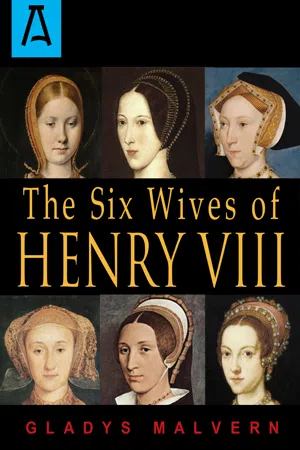
Henry VIII was married to six women during his reign as the King of England. Gladys Malvern characterizes them as The Saint (Catherine of Aragon); The Egotist (Anne Boleyn); The Diplomat (Jane Seymour); The Housewife (Anne of Cleves); The Coquette (Catherine Howard); and The Mother (Catherine Parr). Malvern masterfully tells each of their personal histories and how they intertwined through rivalry, vying for power, political maneuvering, and the hardships of losing favor with the man that seceded the Church of England from Rome for a divorce.
- 141 pages
- English
- ePUB (mobile friendly)
- Available on iOS & Android
eBook - ePub
The Six Wives of Henry VIII
About this book
Information
Print ISBN
9781504030212
1
On December 15, 1485, the church bells of Spain rang out proclaiming the birth of a daughter to Queen Isabella of Castile and King Ferdinand of Aragon. They named the Infanta Catalina. She was three years old when the first of a series of proxy marriages took place with Arthur, Prince of Wales, son of England’s King, Henry Tudor. Arthur had been born on September 26, 1486, which made him nine months younger than the Infanta.
Catalina’s future was already settled, and except for the fact that she would eventually have to leave her beloved country and her fond family, she must be content with this fate.
Elizabeth of York, Queen of England, and Isabella, Queen of Castile, had decided to permit the young people to correspond so they could become better acquainted. Since Arthur knew no Spanish and Catalina no English, their letters were written in Latin. These stilted missives, carefully scrutinized by tutors and bishops, served no purpose except to improve the Latin of the writers. The children had been reared to do their duty to the state, and they corresponded because they had been told to do so, just as one day they would marry for the simple reason that their parents had decided such an alliance would be beneficial to both countries.
Meanwhile, for Catalina there were lessons and lessons, since Isabella firmly believed in education. The little Infanta was taught to embroider; to read and speak Spanish, Greek, and Latin; to have excellent manners; to walk with grace; to be devout. But, oddly, the study of English was omitted.
As preparations for Catalina’s departure progressed, she was relieved to learn that she would not have to face her new country and new relatives alone. Her mother had carefully chosen the suite that would decorously group around her at that first meeting. Among them was her governess, Doña Elvira de Manuel, and the Queen’s own trusted lady-in-waiting, Anna Maria de Salazar, who, devoted to the Infanta, would serve her loyally.
“My Princess must get accustomed to being called Catherine,” said Doña Elvira one day when the preparations were nearing an end, “for that is the English translation of your name.”
The Princess sighed. “England seems so far away. The people will have strange ways, and besides, I cannot speak the language.”
“You will soon learn it. We shall probably like England. Elizabeth of York, your future mother-in-law, is said to be a good and gentle lady. It is also said that Prince Arthur is well liked. There is nothing to fear.”
Finally the exciting day came when, with elaborate ceremony, the court at Granada received the ambassadors who had been delegated by the English King to escort the Princess to England. If Catalina — now called Catherine — and her beloved mother sobbed when the time came to say farewell, their tears were shed in private.
Catherine left Spain and all that was dear to her on May 21, 1501 — a lovely girl of sixteen with long, lustrous russet hair and fair skin.
Because of the violent winds and blinding rains, the journey seemed endless, for again and again the ship was driven back toward Spain. It was as if all the elements had conspired to prevent Catherine from reaching her destination. Not until October did her party arrive at Plymouth.
Compared to colorful Granada, the English countryside seemed drab. The skies were dour and the rain — chill, fall rain now — continued to pelt the earth and the weary voyagers mercilessly. Nevertheless, the people of Plymouth had prepared feasts and jousts to welcome their future queen.
It rained constantly. The roads were seas of mire as the party left Plymouth on its way to London. Catherine, longing for home, was sure she would never like England.
Arthur, a pale, shy, spindly youth, was at the palace in East Hampstead, bent over his books as was usual for him. His father, having braved the rain to come from the castle of Shene, burst into the room with the announcement that the boy’s fiancée had arrived.
Arthur, always somber, was not much moved. Would he have to go and welcome her in all this rain? Couldn’t he wait until the roads dried up? His father frowned, annoyed at the boy’s obvious lack of interest in his bride-to-be.
There was a singular lack of warmth in the appearance of Henry VII. He was a thin-faced man with a sharp nose and a tall, lean body. His mouth was a cold, thin line, tightly compressed, and his small gray eyes had a glint of greed in them.
“Of course we must go and welcome her,“ he declared firmly. “Change your clothes and we’ll be off. Why do you frown? Have you no interest in this matter?”
Always obedient, Arthur merely shrugged, gave a low bow, and left the room. He had but recently passed his fifteenth birthday and had no wish to marry.
Finally, dressed for the journey, he and his father, with a large retinue, rode full speed through the rain. Reaching the village of Dogmersfield, they were told that the Princess and her suite had arrived from Plymouth only a few hours before. Catherine had gone to bed.
“Awake, my Princess,” called Doña Elvira excitedly. “His Majesty is here!”
Aching with fatigue, Catherine rose and had herself dressed in clothes that, though elaborate, were creased from their long confinement and the dampness that had seeped into everything. Meanwhile her attendants had respectfully informed the King that in Spain it was not customary for a bride to meet her husband-to-be prior to the wedding.
“She’s in England now,” Henry retorted. “I rule here!”
Finally he agreed that Arthur should be absent from the first interview.
He was delighted with his future daughter-in-law, although his greeting was characteristically cool. Because he could not boast of being a Latin scholar and did not speak Spanish, the two could speak only through an interpreter.
“Sire,” asked Arthur when the King had returned from that first interview, “are you satisfied with her?”
“Decidedly. She is extremely pretty. You are to meet her in an hour.”
When the two young people were presented to each other, they smiled, bowed, and spoke a few sentences in Latin. The King and numerous attendants standing by beamed approvingly.
Carefully Catherine masked her disappointment. True, Arthur was handsome in a way, but he was ill-at-ease with her and was unsmiling. Could she ever love this stiff and solemn prince who obviously found no pleasure in meeting her?
But there was little time for such private thoughts. The minstrels were summoned, and the King, determined that this should be a gala occasion, ordered dancing. But Catherine knew only Spanish dances, so with a fixed smile she sat beside the King.
Next morning the young people parted. Catherine and her party went to Lambeth, where she was met by various dignitaries who, with their men-at-arms, had come to give her an impressive greeting and escort her to Kensington Palace.
Here she met the rest of her future in-laws—Margaret and Mary, Arthur’s sisters; his mother, Queen Elizabeth, who, though they spoke through an interpreter, showed a sincere fondness for her; and Henry, Arthur’s handsome younger brother.
Henry, Duke of York, was only ten, but he was tall and gay, and appeared to be much older than his brother. He made no attempt to conceal his admiration for Catherine.
The court ladies, while criticizing her Spanish clothes, agreed that she was a handsome princess. They especially admired her eyes — lovely, expressive eyes — and wondered how Arthur could remain so blind to her obvious qualities.
As preparations for the wedding advanced, Arthur became more and more listless. The magnificence of his own marriage garments left him unmoved—jewels worth fifteen thousand pounds had been imported from France; his shirts were embroidered in fine Spanish needlework. Unenthusiastic, he obeyed his father like an automaton, forcing himself to smile when smiles were called for, but pointedly avoiding his fiancée, even when he attended the various pageants given in her honor.
On the wedding day, young Henry, “Prince Hal,” escorted Catherine to St. Paul’s Cathedral. To him, she made a lovely picture in her gold-and-white Spanish costume. On her head was a white silk coif from which hung a scarf bordered with gold and pearls. Her white gown was extended at the hips by hoops, in the Spanish fashion. English ladies called it a farthingale, and so many of them copied it that it soon became the style.
Arthur, in white satin, facing his bride glumly, put his cold, thin hand in hers and, surrounded by the nobility, the pair of strangers was pronounced man and wife.
The ceremony over, everyone attended Mass, after which the groom took leave of his bride. Gallant young Henry escorted her to the banquet room.
When the long day was finally over and the company had gone, the newlyweds found themselves alone. Even now they had nothing to say to each other. They were unspeakably weary, and tomorrow they would be forced to take part in more pageantry.
Alone, Catherine knelt before her private shrine and implored her patron saint to help her love this sickly-looking youth, to let her be a good wife to him—to let her feel at home in this England!
Watching the newlyweds during that lengthy round of celebrations following the wedding, King Henry and Queen Elizabeth were troubled.
At last the pageants ended and Catherine took leave of her in-laws. The Prince and Princess of Wales, attended by their large suite, left on horseback for Wales and Ludlow Castle. It was a long journey, and coming on top of all the arduous pageants, it was too much for frail, anemic Arthur.
It was said that he had caught the plague on the way, and fo...
Table of contents
- Cover Page
- Title Page
- Contents
- The Saint: Catherine of Aragon
- 1
- 2
- 3
- 4
- 5
- The Egotist: Anne Boleyn
- 1
- 2
- 3
- 4
- The Diplomat: Jane Seymour
- The Housewife: Anne of Cleves
- 1
- 2
- The Coquette: Catherine Howard
- 1
- 2
- The Mother: Catherine Parr
- 1
- 2
- 3
- Epilogue
- Copyright Page
Trusted by 375,005 students
Access to over 1.5 million titles for a fair monthly price.
Study more efficiently using our study tools.