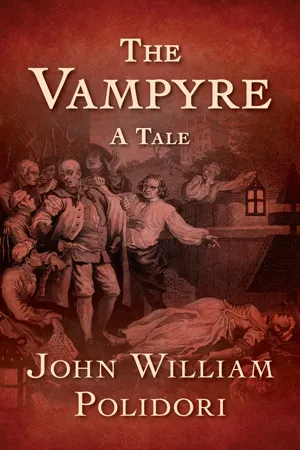
This classic vampire story has inspired generations of authors, from Bram Stoker to Charlaine Harris.
A young English gentleman of means, Aubrey is immediately intrigued by Lord Ruthven, the mysterious newcomer among society's elite. His unknown origin and curious behavior tantalizes Aubrey's imagination. But the young man soon discovers a sinister character hidden behind his new friend's glamorous facade.
When the two are set upon by bandits while traveling together in Europe, Ruthven is fatally injured. Before drawing his last breath, he makes the odd request that Aubrey keep his death and crimes secret for a year and a day. But when Ruthven resurfaces in London—making overtures toward Aubrey's sister—Aubrey realizes this immortal fiend is a vampyre.
John William Polidori's
The Vampyre is both a classic tale of gothic horror and the progenitor of the modern romantic vampire myth that has been fodder for artists ranging from Anne Rice to Alan Ball to Francis Ford Coppola. Originally published in 1819, many decades before Bram Stoker's
Dracula, and misattributed to Polidori's friend Lord Byron,
The Vampyre has kept readers up at night for nearly two hundred years.
This ebook has been professionally proofread to ensure accuracy and readability on all devices.
- 23 pages
- English
- ePUB (mobile friendly)
- Available on iOS & Android
eBook - ePub
About this book
Information
Subtopic
ClassicsIndex
LiteratureTHE VAMPYRE
IT HAPPENED THAT in the midst of the dissipations attendant upon a London winter, there appeared at the various parties of the leaders of the ton a nobleman, more remarkable for his singularities, than his rank. He gazed upon the mirth around him, as if he could not participate therein. Apparently, the light laughter of the fair only attracted his attention, that he might by a look quell it, and throw fear into those breasts where thoughtlessness reigned. Those who felt this sensation of awe, could not explain whence it arose: some attributed it to the dead grey eye, which, fixing upon the object’s face, did not seem to penetrate, and at one glance to pierce through to the inward workings of the heart; but fell upon the cheek with a leaden ray that weighed upon the skin it could not pass. His peculiarities caused him to be invited to every house; all wished to see him, and those who had been accustomed to violent excitement, and now felt the weight of ennui, were pleased at having something in their presence capable of engaging their attention. In spite of the deadly hue of his face, which never gained a warmer tint, either from the blush of modesty, or from the strong emotion of passion, though its form and outline were beautiful, many of the female hunters after notoriety attempted to win his attentions, and gain, at least, some marks of what they might term affection: Lady Mercer, who had been the mockery of every monster shewn in drawing-rooms since her marriage, threw herself in his way, and did all but put on the dress of a mountebank, to attract his notice:—though in vain:—when she stood before him, though his eyes were apparently fixed upon her’s, still it seemed as if they were unperceived;—even her unappalled impudence was baffled, and she left the field. But though the common adultress could not influence even the guidance of his eyes, it was not that the female sex was indifferent to him: yet such was the apparent caution with which he spoke to the virtuous wife and innocent daughter, that few knew he ever addressed himself to females. He had, however, the reputation of a winning tongue; and whether it was that it even overcame the dread of his singular character, or that they were moved by his apparent hatred of vice, he was as often among those females who form the boast of their sex from their domestic virtues, as among those who sully it by their vices.
About the same time, there came to London a young gentleman of the name of Aubrey: he was an orphan left with an only sister in the possession of great wealth, by parents who died while he was yet in childhood. Left also to himself by guardians, who thought it their duty merely to take care of his fortune, while they relinquished the more important charge of his mind to the care of mercenary subalterns, he cultivated more his imagination than his judgment. He had, hence, that high romantic feeling of honour and candour, which daily ruins so many milliners’ apprentices. He believed all to sympathise with virtue, and thought that vice was thrown in by Providence merely for the picturesque effect of the scene, as we see in romances: he thought that the misery of a cottage merely consisted in the vesting of clothes, which were as warm, but which were better adapted to the painter’s eye by their irregular folds and various coloured patches. He thought, in fine, that the dreams of poets were the realities of life. He was handsome, frank, and rich: for these reasons, upon his entering into the gay circles, many mothers surrounded him, striving which should describe with least truth their languishing or romping favourites: the daughters at the same time, by their brightening countenances when he approached, and by their sparkling eyes, when he opened his lips, soon led him into false notions of his talents and his merit. Attached as he was to the romance of his solitary hours, he was startled at finding, that, except in the tallow and wax candles that flickered, not from the presence of a ghost, but from want of snuffing, there was no foundation in real life for any of that congeries of pleasing pictures and descriptions contained in those volumes, from which he had formed his study. Finding, however, some compensation in his gratified vanity, he was about to relinquish his dreams, when the extraordinary being we have above described, crossed him in his career.
He watched him; and the very impossibility of forming an idea of the character of a man entirely absorbed in himself, who gave few other signs of his observation of external objects, than the tacit assent to their existence, implied by the avoidance of their contact: allowing his imagination to picture every thing that flattered its propensity to extravagant ideas, he soon formed this object into the hero of a romance, and determined to observe the offspring of his fancy, rather than the person before him. He became acquainted with him, paid him attentions, and so far advanced upon his notice, that his presence was always recognised. He gradually learnt that Lord Ruthven’s affairs were embarrassed, and soon found, from the notes of preparation in —— Street, that he was about to travel. Desirous of gaining some information respecting this singular character, who, till now, had only whetted his curiosity, he hinted to his guardians, that it was time for him to perform the tour, which for many generations has been thought necessary to enable the young to take some rapid steps in the career of vice towards putting themselves upon an equality with the aged, and not allowing them to appear as if fallen from the skies, whenever scandalous intrigues are mentioned as the subjects of pleasantry or of praise, according to the degree of skill shewn in carrying them on. They consented: and Aubrey immediately mentioning his intentions to Lord Ruthven, was surprised to receive from him a proposal to join him. Flattered by such a mark of esteem from him, who, apparently, had nothing in common with other men, he gladly accepted it, and in a few days they had passed the circling waters.
Hitherto, Aubrey had had no opportunity of studying Lord Ruthven’s character, and now he found, that, though many more of his actions were exposed to his view, the results offered different conclusions from the apparent motives to his conduct. His companion was profuse in his liberality;—the idle, the vagabond, and the beggar, received from his hand more than enough to relieve their immediate wants. But ...
Table of contents
- INTRODUCTION
- THE VAMPYRE
- ACCOUNT OF LORD BYRON’S RESIDENCE, &c.
- Copyright
Trusted by 375,005 students
Access to over 1.5 million titles for a fair monthly price.
Study more efficiently using our study tools.
Frequently asked questions
Yes, you can cancel anytime from the Subscription tab in your account settings on the Perlego website. Your subscription will stay active until the end of your current billing period. Learn how to cancel your subscription
No, books cannot be downloaded as external files, such as PDFs, for use outside of Perlego. However, you can download books within the Perlego app for offline reading on mobile or tablet. Learn how to download books offline
Perlego offers two plans: Essential and Complete
- Essential is ideal for learners and professionals who enjoy exploring a wide range of subjects. Access the Essential Library with 800,000+ trusted titles and best-sellers across business, personal growth, and the humanities. Includes unlimited reading time and Standard Read Aloud voice.
- Complete: Perfect for advanced learners and researchers needing full, unrestricted access. Unlock 1.5M+ books across hundreds of subjects, including academic and specialized titles. The Complete Plan also includes advanced features like Premium Read Aloud and Research Assistant.
We are an online textbook subscription service, where you can get access to an entire online library for less than the price of a single book per month. With over 1.5 million books across 990+ topics, we’ve got you covered! Learn about our mission
Look out for the read-aloud symbol on your next book to see if you can listen to it. The read-aloud tool reads text aloud for you, highlighting the text as it is being read. You can pause it, speed it up and slow it down. Learn more about Read Aloud
Yes! You can use the Perlego app on both iOS and Android devices to read anytime, anywhere — even offline. Perfect for commutes or when you’re on the go.
Please note we cannot support devices running on iOS 13 and Android 7 or earlier. Learn more about using the app
Please note we cannot support devices running on iOS 13 and Android 7 or earlier. Learn more about using the app
Yes, you can access The Vampyre by John William Polidori in PDF and/or ePUB format, as well as other popular books in Literature & Classics. We have over 1.5 million books available in our catalogue for you to explore.