A snapshot of Israel and the West Bank in the 1980s, through the voices of its inhabitants, from the National Jewish Book Award–winning author of
Judas.
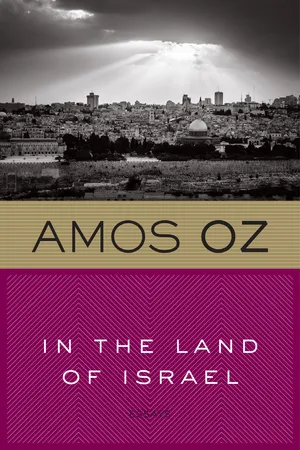
Notebook in hand, renowned author and onetime kibbutznik Amos Oz traveled throughout his homeland to talk with people—workers, soldiers, religious zealots, aging pioneers, desperate Arabs, visionaries—asking them questions about Israel's past, present, and future. Observant or secular, rich or poor, native-born or new immigrant, they shared their points of view, memories, hopes, and fears, and Oz recorded them.
What emerges is a distinctive portrait of a changing nation and a complex society, supplemented by Oz's own observations and reflections, that reflects an insider's view of a country still forming its own identity.
In the Land of Israel is "an exemplary instance of a writer using his craft to come to grips with what is happening politically and to illuminate certain aspects of Israeli society that have generally been concealed by polemical formulas" (
The New York Times)
.
- 304 pages
- English
- ePUB (mobile friendly)
- Available on iOS & Android
eBook - ePub
About this book
Information
Glossary
Agnon, Shmuel Yosef (1880–1970)
Israeli Hebrew novelist who won the 1966 Nobel Prize for literature.
Agudat Yisrael
International ultraorthodox political and religious movement founded in 1912. Originally opposed to the establishment of the State of Israel, it later became one of Israel’s political parties. The small minority among the ultraorthodox that refuses to recognize the State of Israel condemns Agudat Yisrael for having “sold out” to the Zionists.
Alignment (Labor Alignment)
Alliance of the Israel Labor Party and the left-wing socialist Mapam, formed in 1969. It was the ruling alliance of the State of Israel until its defeat in the election of 1977.
Alton, Yigal (1918–80)
Israel’s minister of Labor under Premier David Ben-Gurion and foreign minister under Premier Yitzhak Rabin.
Almogi, Yosef Aharon (1910– )
Former Israeli cabinet minister and mayor of Haifa, past chairman of the Executive of the World Zionist Organization.
Altennan, Natan (1910–70)
Hebrew poet and translator whose poetry had a powerful impact during the period of Palestine Jewry’s struggle against British rule.
Amidar
Israeli national housing company, founded in 1049 to construct housing for new immigrants.
Ashkenazim
Jews of German and Eastern European descent.
Bar Kochba, Shimon (died A.D. 135)
Leader of a revolt in Judea against the Roman emperor Hadrian. He was lolled when his last stronghold fell.
Betar
Formerly the international youth movement of the Revisionist Party, now the youth branch of the Herut Party; founded in 1923. The major tenets of Betar’s founders included military preparedness for self-defense, a strict code of personal behavior, and the primacy of the Zionist idea without the admixture of any other political ideology.
Bloc (Hebrew gush)
A political group (as in “Gush Emunim”) or a cluster of settlements (as in “the Tel Mond bloc”).
Bnai Akiva
International religious Zionist youth movement founded in Palestine in 1922.
Buber, Martin (1878–1965)
Internationally known religious philosopher, a member of a small group of Jewish intellectuals who advocated a binational Arab-Jewish state in Palestine.
Bubkes (Yiddish)
“A big nothing.”
Burg, Shlomo Yosef (1909– )
Longtime Knesset member and cabinet minister. The small minority among the ultraorthodox that refuses to recognize the State of Israel regards Burg and his National Religious Party as little better than apostates.
Chich
Popular nickname for Shlomo Lahat, the mayor of Tel Aviv.
Ein Hilweh
Arab refugee camp in Sidon, Lebanon, that was largely leveled by Israeli artillery fire in June 1982.
Eitan, General Raphael (1929– )
Chief of staff of the Israel Defense Forces from 1978 to February 1983, when he retired in the wake of criticism following the massacre at Sabra and Shatilla, Lebanon.
Eliav, Arie (Lyova) (1921– )
Former secretary-general of the Labor Party who advocated Arab rights and insisted that there is room in Palestine for both the State of Israel and a Palestinian-Jordanian Arab state.
Eretz Yisrael
Land of Israel.
Etzel
See Irgun Zvai Leumi.
Etzion Bloc Yeshiva
One of Israel’s foremost Talmudical academies.
Ceva, Eli
Israeli colonel who asked to be relieved of his command during the Israeli invasion of Lebanon (1982) because he was opposed to the army’s taking Beirut by force.
Golani Brigade
One of the seven brigades of the Israel Defense Forces during the War of Independence.
Gordon, Aharon David (1856–1922)
Ideological leader of the Jewish workers’ movement in Palestine, who believed that labor, particularly the tilling of the soil, held the essence of Jewish and universal values.
Goyim naches (Yiddish)
“Gentiles’ delight”—activities or amusements considered un-Jewish or more typical of gentiles than Jews.
Greater Land of Israel Movement
Movement advocating Israel’s retention and annexation of Arab territories occupied during the Six-Day War of 1967.
Green Line
The armistice lines between Israel and its Arab neighbors, 1948–67.
Greenberg, Uri Zvi (1895–1981)
One of Israel’s greatest poets, regarded as a nationalist extremist.
Grunzweig, Emil (1950?–83)
Young scholar killed in Jerusalem in February 1983 when a grenade was thrown into a group of Peace Now demonstrators calling for the dismissal of Defense Minister Ariel Sharon.
Gur, Mordechai (“Motte”) (1930– )
Chief of staff of the Israel Defense Forces from 1974 to 1978, later a Labor member of the Knesset.
Gush Emunim
Spiritual-political movement that seeks to build Jewish settlements throughout the Israeli-occupied territories.
Haddad, Major Saad
Leader of Christian military formations in southern Lebanon.
Haganah
Semiunderground, semiofficial self-defense force of Palestine Jewry from 1920 to 1948, when it was transformed into the Israel Defense Forces.
Hammer, Zevulun (1936– )
Minister of Education and Culture, one of the leaders of the National Religious Party.
Hasidim
Adherents of a Jewish religious movement founded during the eighteenth century in opposition to ritual laxity and what was considered the arid, hairsplitting study of the Talmud among other Orthodox Jews. They rallied around rebbes and tzaddikim (“righteous ones”), whom they regarded almost as intermediaries between themselves and God.
Hazaz, Hayim (1898–1973)
Hebrew novelist whose works dealt in part with Palestine Jewry’s underground struggle against British rule, and the life and customs of the Yemenite Jews.
Hazon Ish (Hebrew “Man of Vision”)
Name given to Abraham Yeshayah Karelitz (1878–1953), an influential rabbi who settled in Palestine in 1935 and was widely consulted on questions of Jewish law. Prime Minister David Ben-Gurion once met the Hazon Ish on the position of Jewish religious law regarding the conscription of young women.
Herat
The right-wing party led by Prime Minister Menachem Begin, which in 1973 became part of the right-wing Likud bloc.
Histadrut
Israel’s general federation of labor and the country’s most powerful organization.
Huleiqat
Abandoned Arab village on Israel’s southern coastal plain, near the site of Israel’s first oil field.
Irgun Zvai Leumi (also known as Etzel)
Palestine Jewish underground military organization active from 1937 to 1948, led most of the time by Menachem Begin, originally founded to retaliate against Arab attacks. It was opposed to the Haganah.
Jabotinsky, Vladimir (Zeev) (1880–1940)
Russian-born writer, orator, and Zionist leader whom Prime Minister Menachem Begin considered his spiritual mentor.
Jewish Agency for Israel
Originally the intermediary between Palestine’s Jewish community and the British Mandatory government and now synonymous with the World Zionist Organization, working as a liaison between the State of Israel and world Jewry.
Jewish Legion
Jewish military units formed during World War I to f...
Table of contents
- Title Page
- Contents
- Copyright
- Author’s Note to the Original Edition
- Author’s Note to the Harvest Edition
- Translator’s Note
- Map
- Thank God for His Daily Blessings
- The Insult and the Fury
- The Finger of God?
- Just a Peace
- The Tender Among You, and Very Delicate
- An Argument on Life and Death (A)
- An Argument on Life and Death (B)
- The Dawn
- On Light and Shade and Love
- A Cosmic Jew
- At the End of That Autumn: A Midwinter Epilogue
- Some Reactions to In the Land of Israel
- A Postscript Ten Years Later: The Middle East Between Shakespeare and Chekhov
- Glossary
- About the Author
- Connect with HMH
- Footnotes
Trusted by 375,005 students
Access to over 1.5 million titles for a fair monthly price.
Study more efficiently using our study tools.
Frequently asked questions
Yes, you can cancel anytime from the Subscription tab in your account settings on the Perlego website. Your subscription will stay active until the end of your current billing period. Learn how to cancel your subscription
No, books cannot be downloaded as external files, such as PDFs, for use outside of Perlego. However, you can download books within the Perlego app for offline reading on mobile or tablet. Learn how to download books offline
Perlego offers two plans: Essential and Complete
- Essential is ideal for learners and professionals who enjoy exploring a wide range of subjects. Access the Essential Library with 800,000+ trusted titles and best-sellers across business, personal growth, and the humanities. Includes unlimited reading time and Standard Read Aloud voice.
- Complete: Perfect for advanced learners and researchers needing full, unrestricted access. Unlock 1.5M+ books across hundreds of subjects, including academic and specialized titles. The Complete Plan also includes advanced features like Premium Read Aloud and Research Assistant.
We are an online textbook subscription service, where you can get access to an entire online library for less than the price of a single book per month. With over 1.5 million books across 990+ topics, we’ve got you covered! Learn about our mission
Look out for the read-aloud symbol on your next book to see if you can listen to it. The read-aloud tool reads text aloud for you, highlighting the text as it is being read. You can pause it, speed it up and slow it down. Learn more about Read Aloud
Yes! You can use the Perlego app on both iOS and Android devices to read anytime, anywhere — even offline. Perfect for commutes or when you’re on the go.
Please note we cannot support devices running on iOS 13 and Android 7 or earlier. Learn more about using the app
Please note we cannot support devices running on iOS 13 and Android 7 or earlier. Learn more about using the app
Yes, you can access In the Land of Israel by Amos Oz in PDF and/or ePUB format, as well as other popular books in History & Middle Eastern History. We have over 1.5 million books available in our catalogue for you to explore.