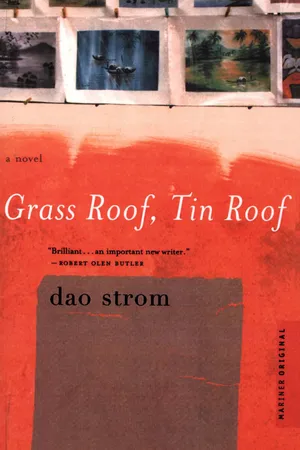
A Vietnamese family flees its war-torn home and resettles in California, in a novel that offers a "brilliant exploration of exile, loss, and identity" (Robert Olen Butler).
Told from multiple perspectives and spanning several decades,
Grass Roof, Tin Roof begins with the story of Tran, a Vietnamese writer facing government persecution, who flees her homeland during the exodus of 1975 and brings her two children to the West. Here, she marries a Danish American man who has survived a different war. He promises understanding and guidance—but the psychic consequences of his past soon hinder his relationships with the family, as the children, for whom the war is now a distant shadow, struggle to understand the world around them on their own terms.
In delicate, innovative prose, Strom's characters experience the collision of cultures and the spiritual aftermath of war on the most visceral level.
Grass Roof, Tin Roof is "an affecting study on the slippery nature of home" (
Los Angeles Times).
"[Strom] explores the mysteries of loss, culture and identity, with skill, poignancy and imagination." —
Detroit Free Press
- 240 pages
- English
- ePUB (mobile friendly)
- Available on iOS & Android
eBook - ePub
About this book
Information
1. Fire Hazards
My mother collected newspapers. Mostly Vietnamese publications sent to her by old friends now living in San Jose or Los Angeles. She clipped articles and stowed them in binders and envelopes, supposedly to be organized into some form of record at some later date. My mother was apt to get lost in a task, so enamored was she by the possibilities—the wealth—of information, and so reluctant, too, to reach any end that might force her to admit unrequited ambitions. Who is to say if she would actually need to look again at any of these papers? Yet she could not throw them away. My father, who had also thrown away a past—his by choice, however—criticized my mother for refusing to let go of pain. He called her selfish.
“Your mother,” our father would say, not unfacetiously, “your mother is afire hazard.”
And I would take this in. Certainly he meant her papers, but in my young mind it was she I saw going up in flames, up into black curling smoke. It was her hair I saw shriveling to ashes and rising, her flesh melting; it was her eyeglasses I saw exploding from the heat and then—as in the movies — only the frames that survived and landed, with a dramatic thunk, at the edge of a circle of ashes. It would be the end of a scene, the glasses in the foreground of a low-angle closeup shot in which smoke and a few glowing embers of orange were a blur in the background. My mother would be gone from me; I feared this constantly. She was vulnerable and a little afraid of the world and smaller than average. She sat on a pillow when she drove and wore high heels everywhere, even at home. Whenever she went alone to a movie or to run an errand, I prayed for her safe return. I worried she might be kidnapped by a strange man as she crossed a parking lot, and we would be left to live with just our father.
It is true my mother almost burned to death once in her childhood. She was playing in the kitchen with her older brothers when they turned on the stove and accidentally set her on fire. It was a gas stove; the flames jumped, or my mother was standing too close. If it had not been for an aunt passing unexpectedly by the house that afternoon, that might have been the end of my mother, then and there. But the aunt threw a blanket over her and saved her. My mother was six years old. She later told me this story as a kind of justification: it was the reason she never taught us how to cook. As for my mother’s collection of newspapers — these have since been thrown away, too.
Papier
I
It was a grand story with many events and an inconclusive ending, and it left her with an ache in her brain and heart, a feeling akin to wanting. Wanting tinged with amazement and understanding—the ending would always be inconclusive—and this was why the story worked as well as it did; this was why it was so affecting and rending and lingering. For many nights afterward, she went to sleep wishing she could live this story and picturing herself after the experience a wiser, sadder, nobler person. Or she liked to imagine meeting a man who had lived through such an experience, a humble, beaten man whose integrity only she would recognize, and she would be his friend. She wouldn’t ask for more than that.
She had been introduced to the story by a man whom she knew only by his first name, Gabriel. He was a French war correspondent living intermittently in her country and his own. When she met him in 1969, she was twenty-four years old, unwed with one son, then a toddler, from a previous relationship, and she was taking French and English literature and language classes at Saigon University, where Gabriel often came to visit the teachers, many of whom worked on the side as interpreters. She had aspirations of being a writer or artist; she hadn’t decided yet which kind. On her first date with Gabriel they saw an American movie about the life of Vincent Van Gogh, starring Kirk Douglas. The theater was mostly full of American GIs and foreign news correspondents and their Vietnamese dates or associates, English-speaking, local advocates of democracy—writers, teachers, print and broadcast news reporters and employees, students, businessmen, travel guides, and ambitious prostitutes. Tran did not align herself with this latter group, and trusted Gabriel did not either, though she knew it would look suspect, a local woman on the arm of a foreign man. Her foreign man, the Frenchman, however, was obviously not a soldier; for her sake, he wore his press jacket (she had insisted on this, wanting the distinction to be clear, but had told him it was because she liked him better in the jacket). His build was also too slight and reserved for a soldier, and he was older, with a long face and faintly smiling, thin lips. Tran thought Gabriel’s deep-set eyes—with their yellowish hazel color, behind wire-framed glasses—held an intellectual, disenchanted cast.
The movie was maudlin and heroic, this in a time when such sentiment in the movies was still cathartic—though it is likely any movie featuring the likes of Kirk Douglas would have been cathartic at that time, at that outpost. Already a sense of hopelessness and consternation pervaded the streets, though people seemed to be laughing, selling, buying, venting opinions, and eating and drinking with all the usual fervor; it was this fervor, in fact, that seemed now volatile and dangerously indifferent. Tran felt watchful in public places. And though she would in all sensible mind claim not to admire any military, she looked with a naive respect, even a deferent longing, toward the American military men, for the very details of their dress and physicality (the size and stoutness of their bodies, the muted colors and fitted cut of their clothes, their sweat-rings that seemed evidence to her of their formidability rather than—as it seemed with the local militiamen, whose uniforms always sagged—their inability to cope) had in her mind aligned themselves with a concept of order.
Tran was wiping her eyes when the lights came up at the end of the film, and when Gabriel asked why, she replied in her cautious French, “I understand very well the melancholy of the life of an artist.” She had actually meant to use the word l’angoisse, but when la milancholie slipped out of her lips she realized this was more right: a more subdued, less violent—more poetic, even—portrayal of the pain she had meant. Suddenly the small theater trembled in a great ground-shudder and there was a muffled boom and the noise of commotion outside. Inside, people began to panic and run for the exits. Gabriel took hold of Tran by both shoulders, pushed her into a corner against the stage. She felt the rough efficiency of his body pressed suddenly, unsexually, against hers—she felt more conscious of this than of the rumbling walls, to which she had already surrendered her fate in the first instant. With intensity Gabriel was watching the crowd, craning his neck. His body blocked Tran’s view and she found herself staring at the fine brown hairs of his chest, visible through the folds of fabric between his shirt buttons. She closed her eyes. Then the shaking stopped. They made their way toward an exit, and when they came out onto the street they saw the throng of people gathered in front of the bookstore and mail depot, its front now blown open and billowing black smoke. Three Vietnamese civilians writhed on the sidewalk in front of the mess, crying in pain; a few local policemen and Americans were running toward them. Gabriel directed Tran to wait at the back of the crowd. “I have to work,” he said. Then he took his camera out of the small canvas satchel he wore slung over his shoulder. Tran watched his back (his shirt half untucked, the seat of his pants rumpled) pushing through the crowd.
Later, much later, they would define the bombing as fate—not necessarily to say that their relationship was doomed, but that this omen was representative of what was to come, or the nature of how things were to open between them.
The novel he had recommended to her was an American classic, Gone With the Wind. They read passages together (“If you want to learn English you must read this story,” he’d said; “there is not much good about the English language except this story”). It was Gabriel’s favorite American novel for a couple of reasons: one, he saw it as a great depiction of “the American insistence upon naivete”; and two, he liked those literary classics by authors who had never intended to be authors, who said all they needed to in one book alone. There was something more honest, more respectable, this way, he theorized, as if the book, the story itself, had forced its way out of the reluctant author, rather than the other method, where the story became tangled up in an author’s ego. This author was a woman (which appealed to Tran) in the 1930s, and the novel had a good dose of everything: the rise and fall of vanities and societies, births and deaths, unrequited loves, illegitimate children, an irrepressible heroine, a scandalous hero. And at the center of it, a civil war between North and South, something relevant. Occasionally Tran and Gabriel would discuss the parallels between life and literature and politics and cultures, which spanned years and seas.
Tran did not always understand Gabriel’s theories but was drawn in by his wry spirit, the nonchalance with which he delivered his well-informed and devastating perceptions about current politics, the same politics that only distressed Tran’s Vietnamese colleagues and sometimes confused Tran; she could easily find merit in every point of view. In fact she somewhat admired Gabriel, his aloofness, his sense of comedy, which was almost cruel and thus took on another quality—acerbic, tragic, self-denying. How did one become like this, she wondered, so intellectual and so resigned yet not resigned, by sheer virtue of a commitment to that very attitude? The more time she spent with him, though, the more she began to see cracks in his mask. When they practiced reading in her language, his accent was slow and clumsy and almost embarrassingly earnest. The way he would point to objects on the street (phone booth, gutter pipe, spokes of a bicycle wheel) or a part of her body, and ask her the words that named these places, these appendages. His candor and his deep, eager, fumbling voice repeating after her at first surprised her; she saw a man who desired to be someone other than he was, whose knowledge and wit encumbered rather than enlightened him. She understood then the grace, the simplicity, he saw in her—and the lack of which he despised in himself. Thus did clumsiness and a hidden vulnerability become the characteristics she associated with white. His white body, covered in dark curling patches of hair, was long and awkward and remorseful when they made love. His white linen shirts, wrinkled and sweat-stained. His white skin that seemed so thin and unsuitable a cover, especially under the tropical sun, and made nudity look unnatural (she soon developed the impression that white people were meant always to be clothed, that it was their more natural state). Yet he was her vessel and gateway both, to a strange vision of power and regret, to so much of the outside world she didn’t know how else she would ever reach. Though she did not think she loved him, at times she felt sympathy for him.
Then she began to experiment with trickery.
Things like: when once he pointed to the arch of her foot, she gave him the word for the palm of her hand, and told him the palm was the arch of the foot. How often would he need these words anyway, she would think, as she swapped other words and objects. Doing this caused her to realize how arbitrary and tenuous the association between an object and its linguistic representation could be, in some cases absurd, even. She did not know why she tricked him like this. It was a joke that paid off only much further down the line, to another audience, and she, the initiator, would never witness or know of its end. The only satisfaction she received was in knowing she was effectively deceiving someone. And these were not outrageous untruths, just pointlessly misdirected facts. Language, she saw, was a thing that relied on faith.
When Gabriel’s assignment in Saigon ended in 1971, he returned to France; someone else had always been there waiting for him. Tran was not mournful and told him confidently that she wished him well and would not miss him, that theirs had been what it was for the time it was—an intimacy enabled yet limited by the temporal circumstances of war, a situation wherein people like him (more than her) could for a period disinhabit the more regulated life to which they must eventually return. Tran was not an impractical woman; back in 1966, when the man who was her son’s father had denied any involvement with her, she had learned her first lesson about the potential disappointments of love. In short, she had learned not to count on reciprocation. He had been a slightly older man, an established schoolteacher in their community, and he had introduced her to much about philosophy and the creative life. For the first few months after discovering she was pregnant with his child she had pursued him, demanding either money or that he marry her, and he had laughed her off, claiming that her relationship with him was merely a schoolgirl fantasy. Where the live proof came from, he had said, he would leave to speculation. Tran had felt crushed, indignant, humiliated. She went to a fortuneteller who informed her she should not try to marry before the age of thirty, as all her lovers would either die or leave her. And a man from far off would come for her one day. “I tell this to many women, it is true, to keep their hearts awake, their hopes up, but to you I mean it,” the fortuneteller had said. And for the first time in her life Tran had experienced the resolve of knowing. Yes, she would have the child, but she did not want or need the father. Her own father was shamed and her mother heartbroken when Tran announced her decision. But they could hardly deny the presence of new life when it arrived.
Tran would not know until many years later that in 1975, not long after she left for America, Gabriel had returned to Saigon looking for her, had gone knocking on doors of old friends asking after her. In the end she would never know for certain if the man from far off she finally reached was even the correct one.
It is said love can move any mountain is how she began her version of the story, and love comes to us when we are not looking, when we have turned our backs on its very possibility, have resigned ourselves to the longing. Yet when it comes, we know it from the first moment the would-be object of our affection appears. We know love by both the dread and excitement in our hearts, by the resistance our minds raise against what our hearts are straining toward; we know it by the fact that we cannot stop it once it starts to happen and suddenly the world is full of a sense of great and imminent change just ahead: the most minute detail overflows our senses now with the indescribable pleasures of hope.
It was heavy-handed and sentimental and she recognized this, but it was the best she could do on a first try. She also believed that what came out first was rawest and truest, and should not be revised, to uphold its integrity. She had no diligence for backtracking. She was a young writer. Eager to expel her words.
Her story was commissioned to appear as a daily serial novel in one of the city’s independent newspapers. A writer friend had secured the assignment for Tran, and it was to be her first citywide publication. A big step, for she had previously published only a few articles and short stories in reviews and smaller papers. “This editor, you have heard of him, he can help you,” her writer friend assured her, “as he has helped many like us.”
The man her friend spoke of was the paper’s chief founder and editor, but because of his notoriety in politics, he and others had decided his affiliation would be best maintained as an unofficial relationship. Only his close colleagues knew his role. He filtered decisions through a young, posing editor in chief, and any actual writing he did he credited to other writers (some of whom existed, some of whom did not). His physical presence in the office was explained as visits to friends or consultations as a technical adviser. He shared a semiprivate office with the senior reporters, and entered and exited the same way most of the staff did, through a back-alley entrance. For the most part, he was not recognized and went about inconspicuously under his assumed name. He had assumed names at least five other times in the past fifteen years, and had still been jailed four times for what the ever shifting government had labeled “the creation and advocation of slander and/or immorality.” He had been dubbed a “gadfly.” But he took no side wholeheartedly when it came to the subject of the war—not the Communist, not the American, not the South Vietnamese—for he believed each to be a flawed system. Rather, he believed the true source of all troubles between humans ran someplace far deeper than politics.
It was under his latest name, Le Hoang Giang—a nom de plume alluding to the evanescent quality of autumn, translated literally from the Chinese as “yellow river”—that Tran met him.
He was thirty-four years old, an unassuming presence, slender, with kind eyes, a long, gentle face, and a warm smile. His hair was black, his skin very brown. A hint of knowing and humor lingered about the edges of all his expressions, as if he were continually assessing but withholding judgment. In a crowd, he was likely to retreat, to stand against a wall or leave without warning or good-bye.
“Tell me your idea,” he said brusquely the first time she sat down before him. As she began to speak, he rested one hand on his cheek and fixed his lucid gaze upon her.
“I want to write a love story based on the American novel Gone With the Wind— you have probably heard of it,” she told him, suddenly unnerved by his attention. “I want to set it in our country, but follow the same story line as the original. At least in essence I want to follow it.”
He smiled as he leaned back in his chair and looked out the window. On the opposite side of the street below was a sidewalk café that was a popular hangout for the paper’s writers and supporters; it occurred to Tran he could have been staring out the window minutes ago and seen her seated at a table down there, awaiting her appointment with him. It was raining, and the sound of water beating on the tin roofs was like nails in a metal can. Rain dripped in heavy streams from the eaves outside the open window.
“I read that book a long tim...
Table of contents
- Title Page
- Contents
- Copyright
- Dedication
- Acknowledgments
- 1. Fire Hazards
- 2. Lucky
- 3. On the Heedlessness of Trees
- 4. Guam, 1975
- 5. Letters
- 6. The Third Form of War
- 7. This Is What Happened upon My Return
- Afterword
- About the Author
- Connect with HMH
Trusted by 375,005 students
Access to over 1.5 million titles for a fair monthly price.
Study more efficiently using our study tools.
Frequently asked questions
Yes, you can cancel anytime from the Subscription tab in your account settings on the Perlego website. Your subscription will stay active until the end of your current billing period. Learn how to cancel your subscription
No, books cannot be downloaded as external files, such as PDFs, for use outside of Perlego. However, you can download books within the Perlego app for offline reading on mobile or tablet. Learn how to download books offline
Perlego offers two plans: Essential and Complete
- Essential is ideal for learners and professionals who enjoy exploring a wide range of subjects. Access the Essential Library with 800,000+ trusted titles and best-sellers across business, personal growth, and the humanities. Includes unlimited reading time and Standard Read Aloud voice.
- Complete: Perfect for advanced learners and researchers needing full, unrestricted access. Unlock 1.5M+ books across hundreds of subjects, including academic and specialized titles. The Complete Plan also includes advanced features like Premium Read Aloud and Research Assistant.
We are an online textbook subscription service, where you can get access to an entire online library for less than the price of a single book per month. With over 1.5 million books across 990+ topics, we’ve got you covered! Learn about our mission
Look out for the read-aloud symbol on your next book to see if you can listen to it. The read-aloud tool reads text aloud for you, highlighting the text as it is being read. You can pause it, speed it up and slow it down. Learn more about Read Aloud
Yes! You can use the Perlego app on both iOS and Android devices to read anytime, anywhere — even offline. Perfect for commutes or when you’re on the go.
Please note we cannot support devices running on iOS 13 and Android 7 or earlier. Learn more about using the app
Please note we cannot support devices running on iOS 13 and Android 7 or earlier. Learn more about using the app
Yes, you can access Grass Roof, Tin Roof by Dao Strom in PDF and/or ePUB format, as well as other popular books in Literature & Literature General. We have over 1.5 million books available in our catalogue for you to explore.