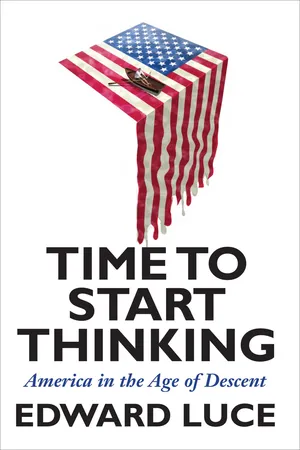
This look at the crisis facing the United States "explores the gaping disconnect between elite optimism and popular bewilderment, anger, and despair" (
Foreign Affairs).
"Gentlemen, we have run out of money. It is time to start thinking." —Sir Ernest Rutherford
In a book destined to spark debate among both liberals and conservatives, journalist Edward Luce advances a carefully constructed argument, backed up by interviews with key players in politics and business, that America is losing its pragmatism—and that the consequences of this may soon leave the country high and dry. Addressing the changing structure of the US economy; political polarization; the debilitating effect of the "permanent election campaign"; and problems in education and business innovation,
Time to Start Thinking takes a hard look at America's dwindling options in a world where the pace is increasingly being set elsewhere.
"A brilliant reporter who has spoken to everyone: CEOs and members of the cabinet, lobbyists and small town mayors, recent MBAs and unemployed teachers. In his acutely observed, often witty, and very humane portraits, he succeeds in converting the abstractions of economics and bringing them to life." —Liaquat Ahamed, Pulitzer Prize–winning author of
Lords of Finance
"Americans need friends who will tell us what we need to hear and how to think about the troubles, many of our own making, that threaten our democracy, prosperity, and leadership in the world. We've got just such a friend in Ed Luce. He's a foreign observer who has not just traveled widely in the United States but listened carefully to a wide array of our citizens." —Strobe Talbott, president, The Brookings Institution
"In a tradition stretching back to de Tocqueville, sympathetic foreigners are often the keenest observers of American life. Edward Luce is one such person. He paints a highly disturbing picture of the state of American society, and of the total failure of American elites to come to grips with the real problems facing the country. It rises far above the current political rhetoric by its measured reliance on facts." —Francis Fukuyama, author of
Identity
- 320 pages
- English
- ePUB (mobile friendly)
- Available on iOS & Android
eBook - ePub
About this book
Information
Subtopic
Political Economy1
The Lonely Middle
WHY AMERICA’S MIDDLE CLASS CONTINUES TO HOLLOW OUT
The best political community is formed by middle class citizens.
Aristotle
A SMALL CROWD jostled at the entrance, straining for a glimpse of the contents within. The ten-by-thirty-foot space, which was shrouded in inky darkness, contained what looked like bubble-wrapped furniture in the front and a pile of nondescript boxes farther back. Since the room was in darkness, the only way of guessing the value of its contents was to scan it by torchlight from the entrance. At any moment there were seven or eight beams frantically sweeping the room hoping to isolate a telling detail before being asked to make way for others. The scene gave off a macabre disco effect except that the floor was piled with inanimate objects rather than dancers. Toward the back you could make out what could have been the handles of a concealed motorbike. Or perhaps they were attached to a lawn mower. It was hard to tell.
The company, ezStorage, insisted on payment in cash only for all of its auctions, which are straightforward fire sales of the belongings of people who have defaulted on their storage rent. It took bids in increments of $25. After about seven minutes the bidding for this unit stopped at $475. The auctioneer took the money and moved down the corridor to the next one. A desultory gathering of roughly fifty people trailed behind him. “After you’ve done this for a while you get a sense of which rooms might have valuable stuff and which are full of junk,” said Chad Shanholtz, a journeyman carpenter from Winchester, Virginia, with a goatee, a wealth of tattoos, and now the owner of the contents of room 1321.
Chad said he once paid $500 for a unit that was piled up to the ceiling with boxes. When he opened them up he saw they were stuffed full of Longaberger baskets, worth between $10 and $100 apiece. He made thousands of dollars that day. One of his friends once found an old Mercedes-Benz buried under a pile of carpets and bric-a-brac. Another said he had discovered cartons of virtually untouched toys from China that he took home for his children. But these were rare exceptions. “Sometimes you find a lot of personal stuff and keepsakes. I’ve found a few birth certificates,” said Chad. “None of that stuff has monetary value.”
Over the past quarter of a century America’s storage industry has grown almost tenfold and now generates revenues of almost $25 billion a year.3 At every busy intersection in the country, and in every strip mall, it is hard to miss the hulking white boxes sporting names like Public Storage, U-Store-It, and Extra Space. In 1984 there were six thousand storage centers in the United States. Now there are almost ten times that number. In addition to the national chains, thousands of mom-and-pop centers have sprung up all over the country. Whether you own a chain or run a stand-alone center, the industry’s future looks stellar. “This business is one hundred percent recession proof,” said the manager at the ezStorage center in Glen Burnie, a suburb of Baltimore. “It doesn’t matter if the economy is going through good times or whether it’s in the doghouse, we just keep growing.”
Over the past few years, since before the onset of the recession, storage companies have seen a sharp rise in defaults. Most of their cash flow comes from the monthly rent for the units. Often proceeds from a fire sale fall short of the renter’s arrears. Under Maryland law, storage companies are required to wait for two months before posting the notice. Requirements vary from state to state. But the trend is national. After the notice goes up, renters are barred from returning to their units unless they pay up. Neither they, nor their relatives, can attend the auction. “We call it the five Ds—debt, divorce, displacement, death, and disinterest [uninterest],” said the branch manger, who was formally prohibited from speaking to the media but happy to help me out. “If we’re auctioning your unit, then you’re going to be one of those Ds.”
Most of the storage renters had likely lost their homes through bank foreclosure. Many dump their things in storage until they can find a new home. Others, in what often amounts to the same thing, have acquired too many possessions. There were also ghosts of small businesses. One of the units contained what looked like the contents of a clerical operation, from the desktop computers to the office crockery and the wall hangings. Another was piled high with garden furniture and equipment, the leftovers perhaps from that large suburban house garden that is now in the bank’s possession. “For the biggest rooms we only charge $240 a month,” said the manager. “If you can’t come up with that kind of money then you’ve got to be desperate, or dead.”
Watching this crew of dollar-store managers, flea market vendors, private collectors, and fortune hunters move from one unit to the next, torches in hand as they picked over the carcasses of people’s lives was an unsettling experience. Everything about the scene, from the long semilit corridors to the CCTV cameras, smelled of loneliness. There was nothing menacing. Just an undertone of deracination. A large share of those with whom I spoke said they either worked part-time jobs or were self-employed. A small hard core moves almost continuously from one auction to the next. Some will drive up to four or five hours to get to auctions in Maryland, southern Pennsylvania, Washington, D.C., and Virginia. Everyone was friendly. But not always about each other. In particular, the hard-core group complained about the “amateurs” who had begun to inflate their numbers.
In 2010 A&E launched a reality TV show called Storage Wars, which netted several million viewers a week. Its popularity spawned a rival show, Auction Hunters, which is featured on the Spike channel. “Since that show people have been turning up thinking they’ll find a Picasso or a $200,000 collection of baseball cards like they saw on TV,” said Jerry Wilkinson, a former railway engineer who now runs a stall at a flea market in Cumberland (about a two-hour drive from Baltimore). Like many of the others Jerry, whose large ruddy face is crowned by a mop of graying blond hair, was wearing shorts, a T-shirt, and flip-flops. The show clearly rankled him. “It took them [A&E] two years to shoot six episodes. But if it’s on TV then it must be true,” he said.
Unaware until then of Storage Wars I downloaded a couple of episodes. It offered a somewhat different picture than what I had seen. To the backdrop of “Money Owns This Town,” the show’s husky theme song, the featured bounty hunters are introduced one by one walking toward the camera, their designated monikers flashing up sequentially on screen: the Gambler, the Mogul, the Young Gun, the Collector. “You don’t know what you’re going to be up against,” says the Collector, assessing the coming auction as though talking about a gunfight. “When I see a room, I want to see dust on the boxes, no footprints, no evidence anyone has been there [to remove their valuables].”
Each time someone wins a bid it is posted on-screen next to the actual value of the room’s contents. The latter is usually a multiple of the former. One of the characters reveals he paid $2,700 for a unit that contained a collection of comic books worth $130,000. Another discloses that he has four Picasso sketches at home that he found in an auction. To succeed in this game, he says, you need cojones. “A lot of people are just collectors,” says the Mogul. “The only thing I collect is Benjamins [dollars].” The show left an imprint. Had I not already been to a couple of auctions, I might have been tempted to buy a pair of Stetson boots and head for the nearest showdown. It was harder to shake off what I saw in Glen Burnie.
Since the 2008 financial meltdown Washington has lapsed episodically into feuds over the chief causes of the subprime bubble. How could so many cash-strapped Americans have convinced themselves they could repay the 100 percent and even 110 percent home mortgages they took out? Millions were persuaded to sign up for so-called Ninja loans (“no income, no assets”). On the ground-level causes of the bubble, most of the Democratic Party focuses on the brokers who tricked people into signing loans that buried the interest rate kickers in the small print. They also highlight the unwillingness, or inability, of the U.S. Federal Reserve and other Washington agencies to regulate housing finance.
In contrast, Republicans continue to blame high-minded and/or self-enriching bureaucrats in charge of the Federal Housing Administration and at Fannie Mae and Freddie Mac, the government-sponsored mortgage providers, for allegedly stuffing mortgages down the throats of the urban poor. Their culprits are the liberal class of social engineers, an abiding phobia of the conservative imagination. In spite of the sharp philosophical differences between the two, they both place heavy emphasis on regulation or its absence. What they see is what they get.
In contrast, both parties, but in particular the Republicans, tiptoe softly around what readers will forgive me for describing as the giant elephant in the room, specifically, the sharp rise of economic insecurity among the American middle classes of the past generation or so, of which the subprime housing bubble was merely a symptom, albeit a very dangerous one. In contrast to the “golden years” of the 1950s and ’60s when almost a quarter of Americans were in secure manufacturing jobs, life has become steadily less predictable for the middle class over this period; the median income has largely stagnated in real terms since 1973 while simultaneously the economy’s ability to generate new jobs has been steadily contracting.
Manufacturing now accounts for less than a tenth of private sector American jobs, its lowest share since the early twentieth century. Moreover, the service sector jobs that have arisen in their place often come without health and pension benefits. People who move from manufacturing to the service sector take a pay cut of more than 20 percent, according to the Bureau of Labor Statistics. Based on what they had earned, rather than what they borrowed, or what they thought they owned, few Americans would have been able to participate in America’s long consumer boom.
According to the Economic Security Index, which tracks the number of Americans who experience a drop in their annual income of at least a quarter, the rate has almost doubled since Reagan was president.4 In 1985 just over one in eight Americans suffered an income loss of a quarter or more. By the time the financial meltdown hit, almost one in five Americans were affected. Since then, that number has grown sharply. Losing your job is not the worst that can happen—more bankruptcies are caused by medical emergencies.
Since one year’s casualties are mostly different than the next, much more than one in five Americans now live in semipermanent fear of falling off the precipice. In the decade leading up to the collapse of the subprime market, more than half of Americans experienced an income loss of a quarter or more in one or more of those years. Think of the General Motors worker with his pension and health care plan. In the 1960s he earned $60,000 a year in today’s prices. Walmart, which as the largest employer in the United States is GM’s equivalent in today’s economy, pays its 1.1 million mostly female employees on average $17,500 a year, most of them without attached pension or health care benefits.5 One may imagine that many of Walmart’s “associates” have their possessions locked up in storage.
There was a time, until relatively recently, when belonging to the American middle class brought with it a basic level of security. Many of those certainties have gone or continue to erode. Yet there has been little appreciable decline in the cultural yen to consume. “We live in an overwhelmingly consumer-driven society that is marked by levels of capriciousness and insecurity we haven’t seen since the 1930s,” says Jacob Hacker, a Yale professor who helped devise the Economic Security Index. The change, in his view, was the result of the continuing morphing of the U.S. economy over the past thirty years from one based on investment to an economy driven by consumption.
It is an economy in which most Americans have had to borrow in one form or another—particularly against their homes—in order to be able to join the game. With the collapse of the long property boom in 2008 that option is now closed. The credit has run out but the problem of stagnating income is deepening. As Warren Buffett once said: “When the tide goes out you see who has been swimming naked.” Much of the debris from the age of easy credit is piled up in storage centers around America. “Over the last thirty years we have progressively shifted more and more of the big risks in life onto the individual, which has resulted in a steady atomization of American society,” says Hacker. “Play the lottery, watch reality TV, hunt for bargains in the mall. But don’t expect secure health care or a comfortable retirement. Those luxuries have gone.”
Carl Camden has met the future and she works; indeed, she seems to be working almost all of the time. She no longer takes paychecks from a company but is working alone, sometimes from home, and is often self-employed. She is also arranging and increasingly funding her own, almost continuous, technical education, often by doing online courses at night. Much of what she picked up in community college or university five years ago is obsolete. She needs to upgrade. The future holds fond, mostly borrowed, memories of the days when employers used to look after her. But she knows—for better or worse—that she is basically on her own.
I first spoke with Camden, chief executive of Kelly Services, America’s second largest staffing agency (formerly known as temping), over a glass of California wine in a bar in downtown Washington. We spoke many times after that. Everyone has a view of how to respond to the deep structural changes in the character of the U.S. economy. Camden, whose industry has grown nearly as fast as the storage business over the previous two or three decades, can think of little else.
Although hardly reassuring, Camden’s view may be better grounded. The era of secure employment is over, he said. Welcome to the era of mass casualization. It is still in its early days. “If you are smart, entrepreneurial, and highly educated, the new world offers you more options than ever before,” said Camden. “For everyone else, I feel pessimistic.” Something of a former hippie, Camden is a rare type of chief executive. He studied linguistics rather than for an MBA and is more libertarian than conservative. Yet these days, his abiding fear of big government is outweighed by rising concern over its incompetence.
Camden’s company, which is headquartered in Troy, Michigan, no longer farms out coiffured “Kelly girls” to do the typing in executive offices. Those days have faded into sepia. “You’ll be flying high as a Kelly girl earning top pay!” states a corporate leaflet from 1950. “Stenos, Typists, Machine operators or Girls with any office skills. Start now for that Easter Bonnet or those vacation expenses!” Today, with 530,000 people on its books and annual revenues of $5 billion, Kelly Services plays an intimate role in the operations of some of America’s leading companies.
Many large U.S. companies no longer do their human resources in-house. Instead they pay Kelly Services, or its larger rival Manpower Services, to hire new employees, manage their payroll, and process their tax returns. Companies also routinely outsource “talent management” and warehousing to staffing agencies like Kelly. They even offload entire projects. When Camden started at Kelly in the mid-1990s, the agency was winning $50 million in business contracts. Now $1 billion is normal. “On some of our contracts you can work on the full life-cycle of a project without ever meeting someone from the company that you’re working for,” says Camden.
In this rapidly evolving world everything keeps getting “leaner,” more “flexible,” and “streamlined.” If companies cannot replace an employee with automation or a less expensive hire from Asia, they will farm the permanent job out to a contractor. If improving...
Table of contents
- Cover
- Time to Start Thinking
- Also by Edward Luce
- TIME TO START THINKING
- Copyright © 2012 by Edward Luce
- Contents Page
- Epigraph
- Time to Start Thinking
- Introduction: The Graduations
- Chapter 1
- Chapter 2
- Chapter 3
- Chapter 4
- Chapter 5
- Chapter 6
- Chapter 7
- Acknowledgments
- Notes
Trusted by 375,005 students
Access to over 1.5 million titles for a fair monthly price.
Study more efficiently using our study tools.
Frequently asked questions
Yes, you can cancel anytime from the Subscription tab in your account settings on the Perlego website. Your subscription will stay active until the end of your current billing period. Learn how to cancel your subscription
No, books cannot be downloaded as external files, such as PDFs, for use outside of Perlego. However, you can download books within the Perlego app for offline reading on mobile or tablet. Learn how to download books offline
Perlego offers two plans: Essential and Complete
- Essential is ideal for learners and professionals who enjoy exploring a wide range of subjects. Access the Essential Library with 800,000+ trusted titles and best-sellers across business, personal growth, and the humanities. Includes unlimited reading time and Standard Read Aloud voice.
- Complete: Perfect for advanced learners and researchers needing full, unrestricted access. Unlock 1.5M+ books across hundreds of subjects, including academic and specialized titles. The Complete Plan also includes advanced features like Premium Read Aloud and Research Assistant.
We are an online textbook subscription service, where you can get access to an entire online library for less than the price of a single book per month. With over 1.5 million books across 990+ topics, we’ve got you covered! Learn about our mission
Look out for the read-aloud symbol on your next book to see if you can listen to it. The read-aloud tool reads text aloud for you, highlighting the text as it is being read. You can pause it, speed it up and slow it down. Learn more about Read Aloud
Yes! You can use the Perlego app on both iOS and Android devices to read anytime, anywhere — even offline. Perfect for commutes or when you’re on the go.
Please note we cannot support devices running on iOS 13 and Android 7 or earlier. Learn more about using the app
Please note we cannot support devices running on iOS 13 and Android 7 or earlier. Learn more about using the app
Yes, you can access Time to Start Thinking by Edward Luce in PDF and/or ePUB format, as well as other popular books in Politics & International Relations & Political Economy. We have over 1.5 million books available in our catalogue for you to explore.