"An exquisitely detailed account of the 400-year history of Harlem." —
Booklist, starred review
Harlem is perhaps the most famous, iconic neighborhood in the United States. A bastion of freedom and the capital of Black America, Harlem's twentieth-century renaissance changed our arts, culture, and politics forever. But this is only one of the many chapters in a wonderfully rich and varied history. In
Harlem, historian Jonathan Gill presents the first complete chronicle of this remarkable place.
From Henry Hudson's first contact with native Harlemites, through Harlem's years as a colonial outpost on the edge of the known world, Gill traces the neighborhood's story, marshaling a tremendous wealth of detail and a host of fascinating figures from George Washington to Langston Hughes. Harlem was an agricultural center under British rule and the site of a key early battle in the Revolutionary War. Later, wealthy elites including Alexander Hamilton built great estates there for entertainment and respite from the epidemics ravaging downtown. In the nineteenth century, transportation urbanized Harlem and brought waves of immigrants from Germany, Italy, Ireland, and elsewhere. Harlem's mix of cultures, extraordinary wealth, and extreme poverty was electrifying and explosive.
Extensively researched, impressively synthesized, eminently readable, and overflowing with captivating characters,
Harlem is a "vibrant history" and an impressive achievement (
Publishers Weekly).
"Comprehensive and compassionate—an essential text of American history and culture." —
Kirkus Reviews, starred review
"It's bound to become a classic or I'll eat my hat!" —Edwin G. Burrows, Pulitzer Prize–winning coauthor of
Gotham: A History of New York City to 1898
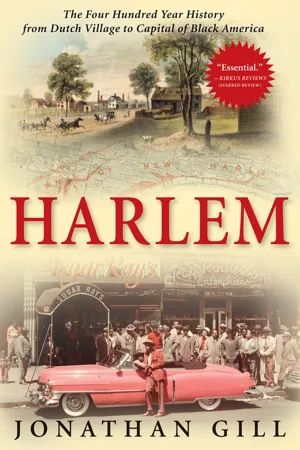
eBook - ePub
Harlem
The Four Hundred Year History from Dutch Village to Capital of Black America
- 448 pages
- English
- ePUB (mobile friendly)
- Available on iOS & Android
eBook - ePub
About this book
Information
1
UNRIGHTEOUS BEGINNINGS
From Muscoota to Nieuw Haarlem, 1609–1664
The first Harlemites didn’t quite know what to make of the strange object that sailed up the river in the late summer of 1609. Was it some sort of gigantic flying fish, or a huge swimming bird? And what of the strange, bearded creatures on board? Where did they come from? What did they want? As the earliest residents of the hilly island they called Manahatta would soon learn, the strange object was the Half Moon, a boat belonging to the Dutch East India Company and piloted by the English explorer Henry Hudson. For his part, Hudson seems to have been just as perplexed by the native creatures he saw lining the banks of the waterway they called Mahicanituk, or the River that Flows Both Ways.
Hudson had little time to get to know these people. He was already supposed to be in Asia, and he suspected that the silks and spices of China might lie just upstream. The Half Moon, an eighty-five-foot-long, shallow-bottomed boat suitable for ocean travel as well as for exploration of the uncharted North American rivers that might offer a shortcut to the riches of the Orient, had survived the terrors of the Atlantic crossing, but by the time Hudson first glimpsed what would become the city of New York on September 3, 1609, the vessel had wandered far off course. He anchored for several days at what is now Sandy Hook, in the lower New York bay, and sent a party ashore. There Hudson found the same fertile wilderness that he had seen all along the Atlantic coast that summer, with plenty of food and water for the taking. He also found copper-skinned people with black hair and black eyes—the men beardless, the women tall, all ready to trade and quick with laughter and anger. The encounter turned threatening and one member of the landing party was killed by an arrow while racing back to the Half Moon. Hudson and his crew of twenty pressed on to China.
By September 11, 1609, when the Half Moon entered the mile-wide river, the “great streame” that would eventually bear its captain’s name, news of the strange vessel had already reached the indigenous inhabitants of the richly wooded lands just off starboard. Crowds of the natives, including women and children, filled canoes and fearlessly paddled alongside the ship, sensing an opportunity to trade with the crew, offering beans and oysters in return for beads and mirrors. Hudson ordered his men to keep their distance, but the next day he regained his confidence and, as the Half Moon reached the shores of the upper part of the island, he decided to anchor. The next morning, just off an inlet at what is now West 125th Street, a crowd of Indians again approached. At the invitation of Hudson, two climbed on board, staying long enough for Hudson to dress them in red jackets and then try to kidnap them. The two visitors broke free and jumped overboard, mocking Hudson and his crew from shore. The first Harlemites learned early on that white men were not to be trusted.
Hudson continued north, encountering numerous native people over the next eleven days, many of them far less suspicious than those downriver. As the mountains lining either side of the waterway grew higher the natives, who quickly fell under the influence of Hudson’s wine, seemed ever more willing to swap their corn and pumpkins for trinkets, tools, or textiles. After a hundred miles it became clear that the narrowing river would not lead to Asia, so the captain turned the Half Moon around and headed downstream, away from the safety of the upper Hudson Valley and back down the river to more unpredictable territory.
On October 2, as the Half Moon passed what is now West 140th Street, the two natives that Hudson had tried to kidnap several weeks earlier led an attack on the ship which, like all East India Company vessels bore a brass tablet fixed to the forecastle reading “Do not fight without cause.” Hudson now had cause. One of his crewmen wrote: “two Canoes full of men, with their Bows and Arrowes shot at us after our sterne: in recompense whereof we discharged six Muskets, and killed two or three of them.” The natives were not deterred, and they sent another canoe full of men armed with bows and arrows. Hudson’s men continued to fire their muskets, aiming their cannons at the Indians on the banks as well. By the time it was all over the blood of nine more native Harlemites stained the river’s shores.
The encounters between Henry Hudson and the residents of northern Manhattan in 1609 were but a foretaste of Harlem’s future. The clash of words and worlds, the allure of blood and money, the primacy of violence and fashion, the cohabitation of racial hatred and racial curiosity—they have always been part of what uptown means. But from its days as a frontier outpost, to the time when it seemed like the navel of the black universe, to the era when it became the official symbol of poverty in America, Harlem has always been more than a tragedy in the making. Uptown’s reputation as the soul of the American century is indisputable. Yet even before the 1920s, when the distinctive beat of Harlem’s drummers made the whole world march to a new, syncopated rhythm, Harlem featured one of the largest Jewish communities in the world, counting George Gershwin and Harry Houdini as residents. In the nineteenth century, Harlem represented Manhattan’s future, as city planners built trolley, elevated train, and subway lines uptown in hopes of attracting a middle class that could provide the labor for New York’s industrial revolution. Before that, John James Audubon, Aaron Burr, and Alexander Hamilton all looked to Harlem for respite from the relentless noise, filth, and danger of downtown Manhattan. In the eighteenth century, George Washington capitalized on his intimate knowledge of the area’s topography—he had unsuccessfully wooed Martha’s predecessor there years before—to defeat the British in the battle of Harlem Heights, one of the key early conflicts of the Revolutionary War. Peter Minuit’s legendary purchase of Manhattan Island in 1626 took place uptown, not far from the fateful first contacts between Henry Hudson and local Indians in 1609. Through it all, Harlem’s contending forces of power and protest, intention and improvisation, greed and generosity, and sanctity and suspicion decisively shaped the American character. In that history lies the map of Harlem’s even more complex future, though the precise contours of the delicate and yet brutal imperatives of the uptown–downtown relationship, of the changing meanings of race and ethnicity, of the swinging dance of social crisis and economic opportunity have yet to be fixed.
It took millions of years to make Harlem—longer than money, religion, nationality, or race. By the time of Hudson’s arrival, Harlem consisted of a broad, arable plain with thickly forested hills along its western boundary, but for countless eons the region had been buried under an enormous inland sea, until about 220 million years ago, when the Appalachian Mountains burst skyward, lifting most of what would become New York City above sea level. Dinosaurs, other reptiles, and mammals roamed northern Manhattan until cycles of warming and cooling entombed the island under a thousand-foot-high glacier moving south along the eastern seaboard. When the ice began receding about twenty thousand years ago, the runoff wore away both the mile-wide estuary that came to be called the Hudson River and the sluggish waterway now known as the Harlem River. As it retreated, the glacial ice also scraped away topsoil and exposed raw bedrock, leaving the soaring cliffs, majestic ridges, and gigantic boulders that still captivate Harlemites. Forests of birch and pine sprung up, followed by fir, spruce, chestnut, oak, maple, and hickory trees. Mastodons, saber-toothed tigers, bison, bear, and beavers attracted humans from across the Hudson River. These original Harlemites, who had been following their prey across the continent since crossing the Bering Strait about thirty-five thousand years ago, tilled the largest, flattest, most fertile spot on the island, a plain that stretched across the upper part of Manhattan. They also took to fishing on both sides of the island as well as in the hundred-foot-wide creek that cut diagonally across that plain and emptied into a marsh on the island’s eastern shore.
In the seventeenth century, uptown’s native people considered themselves members of the Wappinger band of the Lenni Lenape or Munsee Delaware group, all of whom were technically Algonquins, which is less an ethnic category than a linguistic classification that applies to all Native Americans of the eastern seaboard. Beyond this broad grouping it is hard to say which specific subgroup could be found in Harlem, nor is much known about their daily lives. Most of the information gathered directly from Harlem’s Indians in the early seventeenth century was tainted by ignorance or prejudice, and few native informants survived the measles, smallpox, influenza, whooping cough, mumps, typhoid, and bubonic plague brought by the new arrivals. Many also died by the sword. In general the Dutch exhibited almost no interest in Indians beyond ways to make money from them. Where the Spanish and French explorers and settlers who claimed lands to the south and north saw souls waiting to be saved, and languages and customs worth understanding, the Dutch saw gullible rubes with no idea of the value of the beaver, otter, mink, and lynx pelts they plucked effortlessly from the wilderness. The first minister sent by the Dutch found the natives both “uncivil and stupid as garden poles” and “as thievish and treacherous as they are tall.” Dutch settlers considered the Delaware language akin to the barking of dogs or the babbling of children. “Even those who can best of all speak with the Indians and get along well in trade,” that minister wrote in 1628, “are nevertheless wholly in the dark and bewildered when they hear the Indians speaking with each other by themselves.” That may have been deception on the part of the Indians, who in turn found the Dutch as stupid as they were ugly, hairy, smelly, and weak, and who taught the newcomers only enough of their language to gain an advantage in trade. In this respect the Dutch, handicapped by a crippling combination of colonial destiny, tragic incuriosity, and raw greed, had met their match.
It didn’t seem that way at first. Harlem’s natives had no knowledge of metallurgy, writing, or textiles. The men wore animal-skin breechcloths in the warm weather and the women had knee-length dresses. In the winter everyone wore moccasins with deerskin leggings and robes made from elk, deer, bear, beaver, or fox pelts. They adorned themselves with turkey feathers, painted abstract or animal designs, scarification, tattoos made from the juice of berries, and shell pendants or copper beads. Women greased their long hair with animal fat, while the men shaved with the edges of shells or burned the hair off their heads, except for a braid in back or a strip of hair that came to be known as a “mohawk.” They led seminomadic lives, which meant there were few social conflicts based on material possessions. When hostilities did break out, Harlem’s Indians put on war paint and adapted stone hunting tools for human adversaries, using bows and arrows, clubs, axes, spears, and knives; there were also special blades for scalping. In battle they proved proud, quick-witted, swift to rise to the defense of their loved ones, and virtually impervious to suffering. Tied to the stake to meet death by fire, Indians would sing boastfully about their bravery even as the flames engulfed them. Unlike the Dutch, these Indians practiced no slavery, although they did take women and children as prisoners of war. Such hostages were treated with respect—the Dutch observed no such graces—but male captives were routinely tortured, usually by the women. The important public roles given Indian women were evidence of their savagery, according to the Dutch, who understood the rationale behind women taking responsibility for agricultural activities, and who had no trouble recognizing the matrilineal descent of political leadership, but who were shocked at the prospect of negotiating military matters with females.
Dutch propaganda seeking to lure settlers to the territory called New Netherland emphasized the economic opportunities of supposedly unoccupied fertile farmlands uptown. In fact, as many as several hundred Indians farmed northern Manhattan. There were three main plots: Schorrakin in what is now central Harlem, Konykast in lower East Harlem, and Muscoota in what is now lower central Harlem, which included a warm-weather village—actually just a group of temporary huts—called Konaande Kongh, or “Place of the Waterfall at the Hill,” referring to the waterway that still feeds Central Park’s Harlem Meer. Winter camps were more substantial groups of circular or longhouses built with hickory frames and covered with bark. Several families lived in each house, sleeping on leaf and straw mats with fur blankets. Linking everything was a network of footpaths. The main trail from downtown, later transformed into the New England Post Road and then Broadway, came up the east side of the island, veered west into what is now Central Park, and forked at Konaande Kongh, with one branch heading to the East River, where another warm-weather village was set up at what is now East 125th Street. The other path led to the northernmost tip of the island.
The Dutch may have doubted the humanity of the Indians but they admired their mastery of Harlem’s natural bounty. After an agricultural festival coinciding with the first full moon in February, Harlem’s Indians reinhabited the huts that had been abandoned the year before and burned their fields in order to prepare them for the new season—the Dutch made a tradition out of watching the conflagrations from canoes in the Hudson. In March and April the women sowed corn, followed in May by beans that would grow up symbiotically along the corn stalks. Pumpkins, sunflowers, squash, tobacco, and melons were also in the ground before the arrival of summer. Spring was fishing season, with men using spears, milkweed nets, or lines with bone or stone hooks cast from the eastern and western shores of the island or from dugout canoes made from tulip trees. Harvest took place in September and October, with the corn and beans being combined in enormous ceramic pots to make succotash. They also ground corn into meal for a porridge called sappaen. Each autumn apple and plum trees bore fruit, and berries of all sorts were abundant. From December through February, most of the group moved north, to the winter hunting grounds of what is now Westchester County. The men who remained on the island were occupied with trade, repairing or building tools or homes, and also hunting birds and waterfowl with hickory bows and arrows. Deer were herded into the water and killed with stone knives, or forced one by one into narrow, palisaded passages and clubbed to death. Bears and wildcats were stalked in the forest and brought down with spears. Industrious as Harlem’s natives were—they rotated plantings or raised certain crops side by side in order to maintain the soil’s chemical balance—early-seventeenth-century observers still described upper Manhattan as an untouched paradise of natural fertility. One of Harlem’s earliest European settlers described killing 170 blackbirds with a single blast of his shotgun. Nonetheless, on such a small island, game and firewood were easily exhausted, and by the time Europeans arrived most large animals seem to have been hunted to local extinction. The arrival of white men was both timely and tragic.
Because the Dutch were interested primarily in making money, they were baffled by the spirituality that dominated the lives of the first Manhattanites. Far from being a people “proficient in all wickedness and godlessness,” serving “nobody but the Devil,” as the Dutch believed, Harlem’s Indians were committed monotheists, worshipping the god Manitou, who was responsible for animating all material things. This great spirit was generous, according to ancient beliefs, and could be supplicated with offerings that might bring victory in battle, a successful harvest, or a healing experience in a sweat bath. Manitou was also responsible for defeat and death, and funerals were among the most conspicuous of Indian rituals. Dutch accounts noted that while the men grieved in silence, the women wailed, tearing their hair and ripping at their skin. If it was a child being mourned, or a great warrior killed in battle, the women would shave off their hair and burn it, sometimes wearing black makeup to display their sorrow. Corpses were dressed splendidly in a sitting position, surrounded by food and tools for the journey in the hereafter, and placed in leafy graves that were buried under a large hill of dirt and stones. After the burial, there was a festival, and the names of the dead were never spoken again. There would be much silence to come.
Stories of bearded men who came from far away, carrying sticks that could spit thunder and lighting, had long been common among Harlem’s inhabitants when Henry Hudson’s Half Moon arrived. At least three explorers had left their marks in the region, but it wasn’t until the dawn of the seventeenth century, with the English founding Jamestown in 1607 and the French settling Quebec in 1608, that Europe committed to the commercial potential of the New World. The English twice sent Hudson on missions to find a Northwest Passage before losing interest, but the Dutch still saw an opening. Hudson’s employer on his third try was the Netherlands East India Company, a business founded in 1602 for the purpose of conducting the spice trade with Asia. The company’s twenty-one-year charter covered the area from the Strait of Magellan to the Cape of Good Hope, a monopoly that carried with it the right to conquer and settle a quarter of the known world. The venture was enormously profitable almost from the start—by 1607 investors were receiving an annual 75 percent rate of return—so it could afford to take a chance on Hudson, a well-connected adventurer who counted among his friends John Smith, the hero of the Virginia colony. Politics also inspired the Dutch. When the Half Moon left Amsterdam, Hudson was representing not only the investors of the East India Company but the pride and anxiety of the Dutch Republic, whose citizens hoped that their presence in the Americas would allow the Netherlands to strike an indirect blow against the Spanish, who had so brutally occupied their country for four decades before recognizing Dutch independence in 1609.
Hudson was mostly good at getting lost. The 1609 voyage, with its bloody encounter at Harlem, was as unsuccessful as his two earlier attempts, at least in terms of finding the Northwest Passage. But his reports of fertile lands occupied by docile and gullible natives spurred the East India Company to invest more heavily in the region. The relative proximity of Hudson’s discovery promised even greater opportunities than the Asia trade, leading to a clamor among investors for more vessels to explore the region and set up trading posts and settlements. North America may not have been a shortcut to the spices, dyes, and silks of Asia, but Hudson’s reports of dense populations of beaver, otter, marten, muskrat, mink, and fox confirmed that there was plenty of money to be made in meeting the ever-growing demand in Europe for fur hats and cloaks.
Dutch merchants with ties to the East India Company outfitted a ship and sent it to Manhattan within weeks of the return of the Half Moon in late 1609, but there was no immediate attempt to capitalize on Hudson’s discovery on a larger scale. It wasn’t until two years later that a Dutch lawyer turned explorer named Adriaen Block explored Manhattan, buying furs from the Indians and kidnapping two of them for exhibition back in Europe. Two other Dutch adventurers also explored Manhattan before 1613, when Block returned and glimpsed the village at East 125th Street before heading home to Amsterdam—he produced the first map to identify an island between the Hudson and East rivers and called it Manhattes. Block’s map helped inspire the establishment of settlements on the southern tip of the island, though speculation persists that the first groups of fragile huts were actually located uptown.
While the English were putting down roots in Massachusetts and Virginia, the Dutch still considered Manhattan nothing more than a cash machine. That was supposed to change in 1618, when the Dutch instituted a policy of free trade along the northeastern seaboard, which meant that anyone who could afford to outfit a boat, fill it with men, and send it across the ocean was at liberty to do business in the region now called New Netherland. Not many took up the venture, but when hostilities with Spain revived in 1621 the Dutch decided to fight back economically, founding a new business enterprise modeled after the spectacularly successful East India Company. While previous Dutch efforts targeted the region from the Chesapeake Bay to Cape Cod, as well as up the Hudson, Delaware, and Connecticut rivers, the West India Company had a broader mandate: the entire western hemisphere of the known world. Moreover, the West India Company had almost unlimited powers, meaning not just economic activities like the trade in fur, tobacco, sugar, land, and slaves but politics, the military, and religion as well. It was essentially a for-profit nation.
It wasn’t until a year later that the first five ships of the West India Company sailed for New Netherland. Agents scouted out business opportunities along the rivers, where they found Indians eager to barter fur and tobacco for tools and textiles. By 1623 there were enough investors to start planning a proper settlement at the mouth of the Hudson River, which was prey to neither the frigid winters of Massachusetts nor the sweltering, malarial summers of Virginia. Moreover, the raw materials that could be exported from New Netherland required no great investment of time and money. Unlike tobacco or rice, fur required little more than the cultivation of relations with expert hunters who were happy to do business.
By 1625 a handful of traders and a few dozen families, mostly French-speaking refugees from Flanders known as Walloons, had made the two-month journey across the ocean, settled at the southern tip of Manhattan, and named it New Amsterdam. They set up log and sod cabins, sided with chestnut bark, covered with thatched roofs, and topped off by the orange, white, and blue flag of the West India Company. The experience of the English in Massachusetts and Virginia made the West India Company aware of the dangers of sending settlers into the wilderness without proper preparation, so the tiny outpost was provided with everything needed to make it through the first harvest: saws, shovels, axes, panes of glass, wheels, plows, and millstones, as well as barley, wheat, and rye that could be cultivated on plots farmed by Indians on the island’s northern plains. The company recruited enterprising, motivated workers, including a mason, a carpenter, and a blacksmith, assuring them that the dozens of company boats cruising the coasts of Africa, South America, and the West Indies would now be at the service of New Netherland, for both business and battle.
Money if possible and war if necessary were on the mind of the mustachioed gentleman who, on a summer day in 1626, stepped off a skiff moored in the salt marsh that lined the uptown banks of the Hudson River and sank in the mud. It covered the silver buckles of his boots, soaked his white silk stockings, and reached all the way to the bottom of his velvet breeches; he made sure the pistol and sword strapped to his lace and fur-trimmed waistcoat remained dry. By the time he clambered up the banks, Peter Minuit no longer quite looked the part of the director general of the flagship settlement of the West India Company. But it was the contents of the trunk he brought, not his uniform, that impressed the Indians waiting in a clearing in what is now Inwood Hill Park. As Minuit had previously arranged with Penhowitz, leader of the group of Indians, the Dutch offered sixty guilders’ worth of knives, needles, scissors, axes, hoes, pots, blankets, beads, and buttons. In exchange, the West India Comp...
Table of contents
- Cover Page
- Title Page
- Copyright Page
- Dedication
- Contents
- 1 Unrighteous Beginnings
- 2 Strange Bedfellows
- 3 Sweet Asylum
- 4 The Future Is Uptown 1811–1863
- 5 The Flash Age 1863–1898
- 6 Nostra Harlem, Undzere Harlem
- 7 “To Race With The World”
- 8 “The Kingdom of Culture”
- 9 “Moon Over Harlem”
- 10 “Tempus Fugue-It”
- 11 Harlem Nightmare 1965–1990
- 12 Old And New Dreams
- Illustration Credits
- Sources And Further Reading
- Index
- Photo Insert
Trusted by 375,005 students
Access to over 1.5 million titles for a fair monthly price.
Study more efficiently using our study tools.
Frequently asked questions
Yes, you can cancel anytime from the Subscription tab in your account settings on the Perlego website. Your subscription will stay active until the end of your current billing period. Learn how to cancel your subscription
No, books cannot be downloaded as external files, such as PDFs, for use outside of Perlego. However, you can download books within the Perlego app for offline reading on mobile or tablet. Learn how to download books offline
Perlego offers two plans: Essential and Complete
- Essential is ideal for learners and professionals who enjoy exploring a wide range of subjects. Access the Essential Library with 800,000+ trusted titles and best-sellers across business, personal growth, and the humanities. Includes unlimited reading time and Standard Read Aloud voice.
- Complete: Perfect for advanced learners and researchers needing full, unrestricted access. Unlock 1.5M+ books across hundreds of subjects, including academic and specialized titles. The Complete Plan also includes advanced features like Premium Read Aloud and Research Assistant.
We are an online textbook subscription service, where you can get access to an entire online library for less than the price of a single book per month. With over 1.5 million books across 990+ topics, we’ve got you covered! Learn about our mission
Look out for the read-aloud symbol on your next book to see if you can listen to it. The read-aloud tool reads text aloud for you, highlighting the text as it is being read. You can pause it, speed it up and slow it down. Learn more about Read Aloud
Yes! You can use the Perlego app on both iOS and Android devices to read anytime, anywhere — even offline. Perfect for commutes or when you’re on the go.
Please note we cannot support devices running on iOS 13 and Android 7 or earlier. Learn more about using the app
Please note we cannot support devices running on iOS 13 and Android 7 or earlier. Learn more about using the app
Yes, you can access Harlem by Jonathan Gill in PDF and/or ePUB format, as well as other popular books in History & North American History. We have over 1.5 million books available in our catalogue for you to explore.