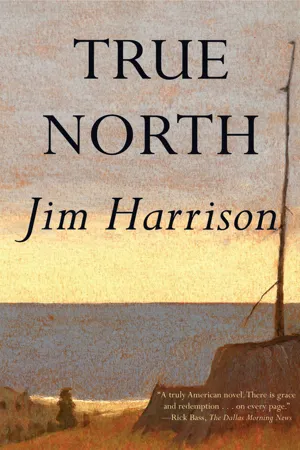
One of American literature's most significant authors delivers "a coming-of-age story, a familial saga of estrangement . . . A slow-burning revenge tragedy" (
The New York Times Book Review).
An epic tale that pits a son against the legacy of his family's desecration of the earth, and his own father's more personal violations, Jim Harrison's
True North is a beautiful and moving novel that speaks to the territory in our hearts that calls us back to our roots.
The scion of a family of wealthy timber barons, David Burkett has grown up with a father who is a malevolent force and a mother made vague and numb by alcohol and pills. He and his sister Cynthia, a firecracker who scandalizes the family at fourteen by taking up with the son of their Finnish-Native American gardener, are mostly left to make their own way. As David comes to adulthood—often guided and enlightened by the unforgettable, intractable, courageous women he loves—he realizes he must come to terms with his forefathers' rapacious destruction of the woods of Michigan's Upper Peninsula, as well as the working people who made their wealth possible.
Jim Harrison has given us a family tragedy of betrayal, amends, and justice for the worst sins.
True North is a bravura performance from one of our finest writers, accomplished with deep humanity, humor, and redemptive soul.
"A provocative tale that explores the roots of wealth and privilege in America . . . Harrison's writing is superb, as always, rippling with thematic leaps and poetic insights." —
The Oregonian
eBook - ePub
True North
About this book
Information
Part III
1980s
21
I was ashamed about forgetting Carla whom I had put in the truck before I walked down to the tavern the evening before. Clarence and Jesse after admiring the pup had found a small sky kennel to put her in while I slept and then had given me a few dog-raising tips I hadn’t listened to. She bolted into my arms when I opened the pickup door. For lack of food she had chewed on the upholstery of the new truck, and shit and peed all over the seat. Rather than write my intended letter to Vernice I fed Carla puppy chow with warm milk and then cleaned up the mess. Carla was still irritated at me for leaving her alone all night so I held her while I drank coffee and studied a local map. I felt drowsy from my night on the beach but was more eager to get started than for a nap. I packed a small knapsack with a notebook, sardines, crackers, cheese, water, and a sack of puppy chow for Carla.
An hour later I was on the Kingston Plains, an area Fred had shown me years before. This was to be the first of 123 straight days in the field, a tribute to my mania rather than my good sense. The main feature of the Kingston Plains was the thousands of acres of white pine stumps, some of them very large, which had been cut at waist or chest height probably during the winter when it was easier to skid the trees out on snow-covered trails which they dampened to form ice so that the draft horse–drawn log sleighs could be more easily pulled. Earlier they had used oxen but oxen, unlike horses, had to be lifted totally off the ground to be reshod while horses could be reshod one foot at a time.
I had walked less than a mile among these stumps when I noted that Carla was no longer trotting alongside me. I turned around and there she was about thirty yards behind, curled up and sleeping. That was fine because my bad ankle already hurt from stumbling on the beach in the night and my ankle wrap and tape were back at the cabin. I sat down against a nearby stump and watched her sleep, gradually lifting my eyes to study the landscape around me.
A very quiet voice was saying “stupid” in my left ear. I remembered a fellow student in an American literature class who had returned from a summer in Haight-Ashbury in San Francisco with his head shaved. Many of us more orthodox creatures were envious of this daffy young man in his tie-dyed shirts and ragged trousers. Even sorority girls were drawn to him. The previous year he smoked dope constantly and drank a great deal but now along with his bald head he neither drank nor smoked and had become a vegetarian. One autumn afternoon I walked along the Red Cedar River with him and he told me he was “having satoris thick and fast," satori a Zen term meaning an awakening that clarified his own true nature. Leaning against the stump half asleep I was having one of my own, a girlish lisp whispering “stupid.” Aside from the slightest smattering of knowledge the landscape was incomprehensible other than the sleeping Carla.
I took out my notebook and drew an absolute blank with my poised ballpoint. The “stupid” I was hearing wasn’t contemptuous, just true. I had flushed a number of sandhill cranes when I drove down the two-track into the area and now one was returning with its curious and loud prehistoric honk and squawk. Carla leapt to her feet and scooted to my lap for protection. I felt thoroughly comic. I had been in similar areas hundreds of times on the way to trout fishing but then your mind is on the approaching river and chances of luck and far less so on the landscape around you.
I swiveled around until I had completed a 360-degree view, suppressing any anger I felt over the idea that they might have left a few trees for those in the future to look at. Maybe to try to imagine the trees was like asking a contemporary Lakota to imagine a million buffalo. There was an eerie sense of the gray stumps as ghost trees and I planned on visiting the area in the full moonlight. There is a beauty in desolation because that’s all we have, I thought, the land shorn of its native self with the soil far too depleted to reenact its former glories.
Despite these melancholy thoughts I was relieved of my “self” and my head felt lighter than I could remember. I flopped over on my side at the same moment the sandhill crane squawked again and Carla buried her nose in my neck with her butt aimed at the air, her little tail curled downward in fear. I felt no less stupid than minutes before but it had occurred to me that this could be corrected by study. I had read a hundred books about God and couldn’t remember a single thing of import, but the heart of nature and greed were far more accessible. I remembered coming home from college and Clarence asking what I was studying and when I said English he said, “I thought everybody knows English?” It helped when I added literature though I said “stories” because Clarence was quite a storyteller though he could neither read nor write. Being a mixed-blood he knew hundreds of both Chippewa and Finnish stories that were so long they exasperated Jesse whose tales of love and death from the province of Veracruz tended to be terse though poetic.
Of course I had high school and college courses in many aspects of the natural sciences but they didn’t enable me to put together the whole picture of what I was seeing around me. It had long been obvious to me that I wanted to know too much, perhaps more than anyone was capable of, and my religious conversion at fifteen was mostly a powerful desire to know God. Once on the way home from trout fishing my friend Glenn had said, “People don’t know why they fuck, they just do it.” I learned in my anthropology course that people prayed in every single culture. But where did the urge to know everything come from? In my case it started close to home by wanting to know everything my ancestors had done in the Upper Peninsula. This seemed to include everything bad my father had done to our family. For the time being I had to exclude everything bad my family had done to the population of the Upper Peninsula because that meant my project would slop over the edges of my known world.
My immediate response to these thoughts was to put on some more mosquito dope because my sweat had washed off the previous application and all manner of bugs including blackflies and deerflies were coming in to feed. I got up with a twinge in my ankle but Carla decided to continue sleeping. I opened a can of sardines and that enlivened her. We shared the whole tin and I carried her back to the truck slowly. On the way I began counting the visible stumps until I reached the truck, then wrote in my notebook “547 stumps.” The world had opened up for me in a significant way, however untraceable.

I reached the cabin by midafternoon and loaded the rowboat. The temperature was in the eighties with a south wind driving the cooler air of Lake Superior to the north. It was tempting to sleep but my mind was a whirl of reality rather than self-concern. Perhaps I was reaching my youthful ambition of not spending my time thinking about myself. On the way back to the cabin from the Kingston Plains I had conceived of a new kind of prayer that didn’t attempt to make exceptions for myself from the human condition but was a simple request to understand the world and consequently what was happening to me. To this I added a request to not get greedy about the matter because it had dawned on me that the sin of greed was deeper than money. At the end of the prayer when I was turning into the cabin’s driveway I was startled by a teenage girl walking toward the village in the shortest of shorts. My modest speech to the creator of the universe was interrupted by a butt in blue shorts. So it goes. She turned and smiled, then came back and gave Carla a pat on the head before continuing on. She smelled like Ivory soap.
At Au Sable Lake Carla was upset when I launched the rowboat and then went swimming. It was clear she didn’t understand what a lake was. Cynthia had likely kept her away from the dangerous St. Mary’s River. I caught her with some difficulty and off we went in the rowboat with Carla heading under my seat. After a half hour she emerged and stood with her paws on the gunwale watching the oars and the passing water. I thought that she probably felt in cognitive disarray as I had on my first trip to downtown Chicago. We usually landed at O’Hare and then were picked up to go to my father’s mother’s house in Lake Forest, but when I was seven we landed in a private plane at Meigs Field and drove through the heart of the city which tightened my stomach and put a lump in my throat. Naturally Cynthia was delighted by it all.
Back at the cabin I took out stationery and began my letter to Vernice partly to keep my mind off the girl who had walked past a couple of hours before.
Dear Vernice,
I know that the odds on this aren’t good what with our having spent only two hours together but I think of you often. I can’t begin to answer all of the questions you posed on the phone when I was over at my sister’s on Sugar Island near Sault Ste. Marie. If I did so I would have to write a relatively eventless autobiography. As a poet you depend on the vicissitudes of your consciousness, your self-awareness, and the infinite variances of your perceptions, while I’m mainly occupied with studying the social and economic history of the Upper Peninsula. This may very well not sound interesting to you but it ties in with an ancestor who came over from England four generations ago and he still seems to have a profound effect on my life. (It’s hard to look for skeletons in the family closet because they are all skeletons now.) There was certain questionable economic behavior on my father’s side while my mother’s family was involved in the Great Lakes shipping industry in transporting iron ore to Cleveland and also the steel mills of Gary, Indiana.
I sensed you were interested in me and I in you, or you wouldn’t have gambled on your phone number. Should you care to get out of the heat of Chicago this is a beautiful area. You might also like the puppy my sister Cynthia gave me. I like blues music and jazz much better than rock and roll. I don’t cook well but I can catch trout for you to eat. I’m not too knowledgeable about your profession but at Michigan State I liked Wordsworth’s “Prelude,” Walt Whitman, and Allen Ginsberg’s “Howl.” My only real contribution to the world of poetry is to send you money for a ticket.
Yrs. truly, David
What stilted, underwhelming bullshit! Stored in my brain cells was the sound of her thighs detaching themselves from the plastic seated chair in the Chicago tavern. This actually made my dick hard sitting there in the overwarm cabin. I took three one-hundred-dollar bills for her ticket from the stack in my duffel and put Carla in the sky kennel which made her break out weeping. I made the post office minutes before closing and sent my letter special delivery, then walked down to the tavern for a hamburger. It occurred to me that I could save a lot of money if I learned how to cook beyond the U.P. basics of frying this or that. It had been disappointing to discover in restaurants that no one cooked as well as Mrs. Plunkett. Besides my being hungry, every female on the street or in the tavern between the ages of fourteen and seventy looked somewhat desirable. The girl who stopped to pet Carla was playing partners pool with three friends and a dozen men lined up along the bar watched while pretending it was of no particular interest. Her friends called her Shirley and when she bent over in her tight blue shorts and brown legs a young logger yelled “bull’s-eye” and she turned around a gave him the finger. When the game was finished she came over to me to say hello and ask how Carla was doing. My mouth went dry and I swallowed a bite of food with difficulty. She said she worked nights in the bar but would be glad to babysit Carla sometime if I wished. Mick came up from the basement with dirty hands from fixing a coolant pump. Shirley left to play another game and Mick said we had better hurry with our fishing because a big front was coming in from the west. We packed our gear in his rickety old Jeep because he said the road was too narrow and brambly for my “pretty pickup.” The Jeep had the interesting feature of a hole in the floor so that you could see the road passing down near your feet. Before we headed to the river we drove down to the pier to see if the front was visible. Lake Superior was fairly peaceful but far to the west there was a rumpled black line and Mick figured we had about an hour and a half or two to fish before the “shit hit the fan.”
It is utterly soothing to fly-fish for trout. All other considerations or worries drift away and you couldn’t keep them close if you wanted. Perhaps it’s standing thigh deep in a river with the water passing at the exact but varying speed of life. You easily recognize this mortality and it dissipates into the landscape. If there are flying insects and trout are feeding on them you fish with dry flies. If there’s no surface activity you fish with streamers which imitate minnows or with nymphs which imitate the insect larvae that emerge from the streambed and float along with the current.
We were well down in a semi-gorge with steep clay-and-sand banks sprinkled with cedars. I had felt a moment’s hesitation wondering if I could climb back up with my bad ankle but there was a succession of deep pools below made by deadfalls which formed logjams. In a riffle corner below one I could see brook trout feeding and I couldn’t resist. It was very warm and still in the gorge and there were clouds of mosquitoes around my head. After an hour or so I heard the wind far above me and saw branches swaying. Mick waded toward me from downstream with a nice rainbow of about three pounds which would normally have made its way back to Lake Superior well before late June. I kept two brook trout, enough for supper.
On the half-hour drive through the woods to the river I called out the names of trees and got about seventy-five percent right, what is contemptibly called a gentleman’s C. I intended to ask Jesse to send my largely unopened field guide books my mother bought for me when I was wearing out the Bible. Despite her evident imbalances she often sensed my own tangents and tried to correct them. With tree varieties, maple, also beech, birch, oak, and hemlock were easy while white and red pine, jack pine, spruce and fir were dicey, and so were the bushes such as sugar plum, dogwood, and chokecherry. When I put on my hip boots I thought for the first time that it was a little strange that we choose not to know all the ingredients of where we live.
Mick hauled me the last twenty feet up and over the edge of the bank when my ankle turned rubbery. By then the sky was dark an hour before sunset and the wind gusting to fifty knots. A deadfall had come down and we stopped while Mick took a chain saw out of the back of the Jeep and cut the two-track clear. When we came out into an open marsh we saw lightning hit a tamarack and burst into flames and we sat there watching the sheets of rain douse the fire.
We had talked about my intention of camping all summer which he described as “bullshit.” Camping was for pleasure, he said, and if I was going to get any work done I needed something better. By then we were drinking out of a schnapps bottle he’d drawn from under the seat and I had become more voluble. We detoured for a mile and he showed me a tar-papered deer cabin I could stay in owned by friends of his from downstate if I would reroof it and shore up the foundation. How to do so was beyond me but he said he would tell me how. A couple of more gulps of the schnapps and I confessed my long-range intentions of being there and he said “get at it, do it, forget it.” Otherwise I’d eat myself up with my resentments. He sounded like Riva.
22
It was my second strange night in a row. I fed Carla, then fell asleep with her on the bed, waking about three A.M. to a high solid roar which it took me a minute to recognize as Lake Superior. Now the cabin was cold and I turned on the electric heater, then fried the brook trout and heated a can of beans. Carla loved the crisp brown skin of the trout. It was clear to her that I was her substitute mother.
I took out my notebook and was pleased at the single entry of the stumps I had counted. What a stroke! This number could very well rise to hundreds of thousands. I felt entirely ordinary in terms of mental temperature, say like someone who had graduated from the university and had their first day on a career job. Nothing had any particular focus but I was doing what I was supposed to do. I read in a volume of Sprague’s journal I had brought along how early loggers, featuring my great-grandfather, had created leases to cut native property which would be signed by a witnessed “X,” then slipped in a land deed and took ownership for the minimal lease price. I passed over Sprague’s irate gloss on this matter hurriedly. I was far more interested in what had happened than I was in the emotion of anger, at least for the time being.
I fell asleep over the small desk then awoke after a nightmare in which Polly was making love to someone else. Well, of course, but then the dream memory revealed that her partner bore some resemblance to my father in a younger reincarnation which meant a resemblance to myself but then it was him not me. I straightaway wished him dead in his Florida jail cell.
I took Carla out to pee and to shake the dream out of my head. There was a strong cool wind out of the northwest and in the moonlight I could see huge waves breaking over the pier and questioned whether the village was a bleak outpost or a paradise. The timber was gone by the First World War, and then overfishing and the lamprey had wiped out the large commercial fishery for lake trout by the 1950s. Now the village survived on tourism and by pulp logging of second- and third-growth timber for the paper mills. Maybe it wasn’t as bad as I thought because the real money always went elsewhere in an extractive economy.
There was an image of my father being strangled in jail by poor white trash or an angry black. Once in a sober moment Fred had told me that I was unable to have compassion for my father to the degree that I was unable to have compassion for myself. Of course this made me angry. What did it mean that he would get drunk and fuck girls that were too young among various other crimes and misdemeanors? In a dreary introductory psychology course that masqueraded as science it occurred to me that you could explain everything away but the behavior remained. He may have regretted raping Vera but what could this regret possibly mean to Vera? What did he feel when he stole my cabin, or bilked the trust money due to Cynthia and myself? He didn’t hit my mother but his language to her was often icily violent so that Cynthia would hold her hands to her ears and scream until she was about ten, and then she simply stayed out of his presence as much as possible. This taunted him because everyone in Marquette who didn’t know him well thought of him as gracious, charming, generous. After the Duluth incident I was outside the screen door of the work shed and heard Clarence say to Jesse that my father would fuck a rock pile if there was a snake in it.
How well had I treated Polly? The sound of our marriage had been my subdued whine. I had driven her away as surely as if I had wielded a club. Even on our marriage day I was vaguely aware that I was doing the wrong thing. I think both Cynthia and my mother were also aware but remained hopeful. There was the definite possibility that after the separation when Polly and my mother had continued seeing each other my mother had said, “You must forgive my son.” For what? For trying so hard to be unlike his father that he had no idea who he was.
Riva had disturbed me because though she was clinically hardheaded and knowledgeable she had said that there were invisible fibers between certain people and they couldn’t do much about it but try to control them. She had said that after I had told her about Laurie from start to finish. This was during our breaks between lovemaking when she asked me about my sexual experience. I wrote it down when Jesse had referred to Laurie as a “plumita” and years later I had asked a Mexican girl who was a graduate student what it meant. She was embarrassed but laughed saying it meant that whomever was a “fast little feather,” a girl who could be from a good family but liked “intimacy,” not necessarily whorish but “available.” I told Riva all of this and she said people didn’t have to be i...
Table of contents
- Cover
- Title Page
- Copyright Page
- Dedication
- Part1
- Part2
- Part3
- Epilogue
- Acknowledgement
Trusted by 375,005 students
Access to over 1.5 million titles for a fair monthly price.
Study more efficiently using our study tools.
Frequently asked questions
Yes, you can cancel anytime from the Subscription tab in your account settings on the Perlego website. Your subscription will stay active until the end of your current billing period. Learn how to cancel your subscription
No, books cannot be downloaded as external files, such as PDFs, for use outside of Perlego. However, you can download books within the Perlego app for offline reading on mobile or tablet. Learn how to download books offline
Perlego offers two plans: Essential and Complete
- Essential is ideal for learners and professionals who enjoy exploring a wide range of subjects. Access the Essential Library with 800,000+ trusted titles and best-sellers across business, personal growth, and the humanities. Includes unlimited reading time and Standard Read Aloud voice.
- Complete: Perfect for advanced learners and researchers needing full, unrestricted access. Unlock 1.5M+ books across hundreds of subjects, including academic and specialized titles. The Complete Plan also includes advanced features like Premium Read Aloud and Research Assistant.
We are an online textbook subscription service, where you can get access to an entire online library for less than the price of a single book per month. With over 1.5 million books across 990+ topics, we’ve got you covered! Learn about our mission
Look out for the read-aloud symbol on your next book to see if you can listen to it. The read-aloud tool reads text aloud for you, highlighting the text as it is being read. You can pause it, speed it up and slow it down. Learn more about Read Aloud
Yes! You can use the Perlego app on both iOS and Android devices to read anytime, anywhere — even offline. Perfect for commutes or when you’re on the go.
Please note we cannot support devices running on iOS 13 and Android 7 or earlier. Learn more about using the app
Please note we cannot support devices running on iOS 13 and Android 7 or earlier. Learn more about using the app
Yes, you can access True North by Jim Harrison in PDF and/or ePUB format, as well as other popular books in Literature & Literature General. We have over 1.5 million books available in our catalogue for you to explore.