This "provocative and profoundly disturbing" history of US election rigging "details political corruption reaching to the highest levels of government" (
Skeptic Files).
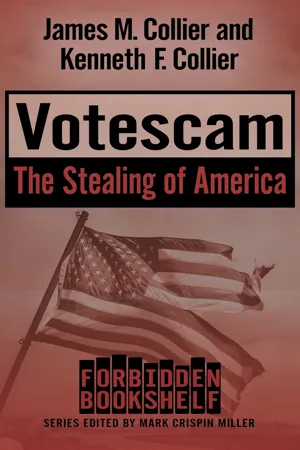
This book is the culmination of a twenty-five-year investigation into computerized vote fraud in the United States. Journalists James and Kenneth Collier pose the question, "Why can't we vote the bastards out?" Their answer: "Because we didn't even vote the bastards in."
Votescam fills in the blanks for anyone who senses that their ballot is worthless, but does not know why. It tracks down, confronts, and calls the names of Establishment thieves who silently steal votes for their own profit. It comes face-to-face with the Supreme Court justice who buried key vote fraud evidence; the most powerful female publisher in America, who refused to permit her newspapers and television stations to expose vote rigging; the Attorney General who jailed Jim Collier to avoid an investigation into vote fraud; and a cast of weak-kneed, corrupt politicians, lawyers, and members of the media entangled in a massive crime, but who have yet to be held accountable.
First published in 1992, this groundbreaking exposé has been updated by journalist Victoria Collier, daughter and niece, respectively, of the late James and Kenneth Collier, and editor of Votescam.org, to reflect modern threats to American democracy. As computers grow ever more powerful, the need to read
Votescam is increasingly urgent.
- 538 pages
- English
- ePUB (mobile friendly)
- Available on iOS & Android
eBook - ePub
About this book
Information
Book One
1970–1989
“Who shall stand guard to the guards themselves?”
—Juvenal
The Premise
Votescam asserts the unthinkable.
It is a strange and frightening true detective story. It contains fact, film, documents and visions seldom seen by the public. It is troubling look at the corruption of the American vote that most Americans cannot bear to believe is even partly true.
The authors assert, and back it up with daring reporting, that your vote and mine may now be a meaningless bit of energy directed by preprogrammed computers—which can be fixed to select certain pre-ordained candidates and leave no footprints or paper trail.
In short, computers are covertly stealing your vote.
- For almost three decades the American vote has been subject to government-sponsored electronic theft.
- The vote has been stolen from you by a cartel of federal “national security’s bureaucrats, who include higher-ups in the Central Intelligence Agency, political party leaders, Congressmen, co-opted journalists—and the owners and managers of the major Establishment news media, who have decided in concert that how America’s votes are counted, by whom they are counted and how the results are verified and delivered to the public is, as one of them put it, “Not a proper area of inquiry.”
- By means of an unofficial private corporation named News Election Service (NES), the Establishment press has actual physical control of the counting and dissemination of the vote, and it refuses to let the public know how it is done.*
This book also contends that the theft of your vote or Votescam, is part of a supposedly patriotic “collaboration” between federal officials and the news media that began shortly after the assassination of John F. Kennedy in 1963, when the “responsible” American press was persuaded by American intelligence services to hide from the American people the actual implications of the Kennedy murder.
My brothers, Jim and Ken Collier, report this story as if the “hounds of hell,” as Ken used to put it, were snapping at their journalistic heels.
I, too, am a journalist and editor by profession, and a skeptic by training. Yet, as hard as I have tried not to, I now believe they were actually holding the tail of an elephantine conspiracy that they uncovered, inch by heart-rending inch.
After reading Votescam, the impatient citizen may well ask: “Why, if there is truth in the charges, are there no indictments?”
That question is one of many provoked by Votescam’s reporting, and if Americans actually value their vote then there will be indictments based on this book’s data and documentation.
My brothers peeked behind Oz’s curtain and into a voting booth where people of power had secret hold of all the levers—as well as all the keys on the computer keyboard.
Yes, that’s one hell of a conspiracy, and it—as Jim and Ken uncorked it doesn’t stop there. You may be shocked, annoyed, angry, astounded or alarmed to find out where and how deep my brothers feel it penetrates.
Votescam is one of the weirdest trips 1990s Americans may take. My hope is that you will suspend disbelief for a while and read it with an open mind. If it raises questions you will demand answers.
Answers to “improper inquiries” is what this book is about. It’s what excellent journalism, in its best days, is also about.
Barnard L. Collier
New York City, 1992
* In 1964 it was born News Election Services (NES), a consortium of ABC, CBS, NBC, AP, and UPI. In 1994 NES merged with Voter Research and Survey (VRS) to become Voter News Service (VNS), which included CNN and Fox News. In 2002 it morphed again to become News Election Pool (NEP).
1
Electronic Hoodwink
“We can now speak the most majestic words a democracy can offer: ‘The people have spoken’…”
First words spoken by President-elect, George Bush, November 8, 1988 victory speechin Houston, Texas, 11:30 PM EST.
“Once, during the time when days were darker, I made a promise. Thanks, New Hampshire!”
Same speech, final words.
It was not “the People” of the United States of America who did “the speaking” on that election day, although most of them believed it was, and still believe so.
In fact, the People did not speak at all, and George Bush may have known it or, at least, strongly suspected it.
The voices most of us really heard that day were the voices of computers—strong, loud, authoritative, unquestioned in their electronic finality. The computers counted more than 55 million American votes in 1988—more than enough to swing election after election across the nation. In that election, a difference of just 535,000 or so votes would have put Dukakis into the White House.
The computers that spoke in November 1988 held in their inner workings small boxes that contained secret codes that only the sellers of the computers could read. The programs, or “source codes,” were regarded as “trade secrets,” The sellers of the vote-counting software zealously guarded their programs from the public, from election officials, from everyone—on the dubious grounds that competitors could steal their ideas if the source codes were open to inspection.
You may ask: What “ideas” does it require to count something as simple as ballots?
Can the “ideas” be much more complex than, let’s say, a supermarket computerized cash register or an automatic bank teller machine?
The computer voting machines do not have to do anything complicated at all; they simply must be able to register votes for the correct candidate or party or proposal, tabulate them, count them up, and deliver arithmetically correct additions. People with no formal training, even children, used to do it all the time.
So why can’t the public know what those secret source codes instruct the computers to do? It only makes common sense that every gear, every mechanism, every nook and cranny of every part of the voting process ought to be in the sunlight, wide open to public view.
How else can the public be reasonably assured that they are participating in an unrigged election where their vote actually means something?
Yet one of the most mysterious, low-profile, covert, shadowy, questionable mechanisms of American democracy is the American vote count.
There is so profound a public despair about keeping the vote system honest that a man with immaculate academic credentials can sound the alarm on Dan Rather’s CBS Evening News—charging that America’s elections are being compromised by computer felons—and still get only three calls about it.
Dr. Howard Strauss, a Princeton computer sciences professor and a member of a tiny nationwide group of worried citizens who call themselves “Election Watch,” says:
“The presidential election of 1992, without too much difficulty and with little chance of the felons getting caught, could be stolen by computers for one candidate or another. The candidate who can win by computer has worked far enough ahead to rig the election by getting his ‘consultants’ to write the software that runs thousands of vote-counting computers from coast to coast. There are so many computers that use the same software now that a presidential election can be tampered with—in fact, may already be tampered with. Because of the trade secrecy, nobody can be the wiser.”
Computers in voting machines are effectively immune from checking and rechecking. If they are fixed, you cannot know it, and you cannot be at all sure of an honest tally.
In the 1988 Republican primary in New Hampshire, there was no panel of computer experts who worked for the people and thoroughly examined the source codes before and after the voting. It is likely tha...
Table of contents
- Cover
- Title Page
- Dedication
- Book One: 1970–1989
- Book Two: 1990–1992
- Epilogue
- Appendix
- Acknowledgments
- About the Authors
- Copyright
Trusted by 375,005 students
Access to over 1.5 million titles for a fair monthly price.
Study more efficiently using our study tools.
Frequently asked questions
Yes, you can cancel anytime from the Subscription tab in your account settings on the Perlego website. Your subscription will stay active until the end of your current billing period. Learn how to cancel your subscription
No, books cannot be downloaded as external files, such as PDFs, for use outside of Perlego. However, you can download books within the Perlego app for offline reading on mobile or tablet. Learn how to download books offline
Perlego offers two plans: Essential and Complete
- Essential is ideal for learners and professionals who enjoy exploring a wide range of subjects. Access the Essential Library with 800,000+ trusted titles and best-sellers across business, personal growth, and the humanities. Includes unlimited reading time and Standard Read Aloud voice.
- Complete: Perfect for advanced learners and researchers needing full, unrestricted access. Unlock 1.5M+ books across hundreds of subjects, including academic and specialized titles. The Complete Plan also includes advanced features like Premium Read Aloud and Research Assistant.
We are an online textbook subscription service, where you can get access to an entire online library for less than the price of a single book per month. With over 1.5 million books across 990+ topics, we’ve got you covered! Learn about our mission
Look out for the read-aloud symbol on your next book to see if you can listen to it. The read-aloud tool reads text aloud for you, highlighting the text as it is being read. You can pause it, speed it up and slow it down. Learn more about Read Aloud
Yes! You can use the Perlego app on both iOS and Android devices to read anytime, anywhere — even offline. Perfect for commutes or when you’re on the go.
Please note we cannot support devices running on iOS 13 and Android 7 or earlier. Learn more about using the app
Please note we cannot support devices running on iOS 13 and Android 7 or earlier. Learn more about using the app
Yes, you can access Votescam by James M. Collier,Kenneth F. Collier in PDF and/or ePUB format, as well as other popular books in Politics & International Relations & North American History. We have over 1.5 million books available in our catalogue for you to explore.