
eBook - ePub
Edison's Concrete Piano
Flying Tanks, Six-Nippled Sheep, Walk-on-Water Shoes, and 12 Other Flops from Great Inventors
- 272 pages
- English
- ePUB (mobile friendly)
- Available on iOS & Android
eBook - ePub
Edison's Concrete Piano
Flying Tanks, Six-Nippled Sheep, Walk-on-Water Shoes, and 12 Other Flops from Great Inventors
About this book
Not even geniuses get it right the first time . . . An "entertaining" look at the failures of great inventors ( Booklist).
To achieve great things, you have to be willing to take risks—and as Edison's Concrete Piano reveals, some of the most famous names in history experienced plenty of flops and face-plants in the course of their careers. Thomas Edison, for example, not only revolutionized the world with the light bulb, but also designed a concrete piano, a nonoperational helicopter made from box kites and piano wire, and a machine to speak to the dead. Alexander Graham Bell, inventor of the telephone, actually devoted most of his time to his sheep farm in Nova Scotia—devising a multi-nippled sheep somewhere along the way. You'll also read about Leonardo da Vinci's walk-on-water shoes, George Washington Carver's miracle peanut cure, and much more. The ludicrous ideas, faulty designs, and offbeat hobbies in this volume will inspire laughs—and serve as a reminder that even the very best minds make mistakes.
"Captivating . . . This book is full of lessons for inventors and non-inventors alike." —Henry Petroski, author of Success through Failure
Trusted by 375,005 students
Access to over 1.5 million titles for a fair monthly price.
Study more efficiently using our study tools.
Information
Subtopic
Scienza generaleTHE MODERN ERA
PAY ATTENTION TO DETAILS
DANNY HILLIS'S PAINT CAN ROBOT
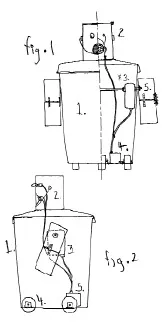
Artist interpretation of Danny Hillis's robot made from paint cans. (See endnote.)
Each year, the MIT computer science department picks a few theses out of its graduate student harvest for publication. In 1985, Danny Hillis's landmark development in computer hardware was one of them. His Connection Machine was revolutionary. It was a “computing engine” in which processing was accomplished concurrently through a massive number of simple processors, with a resulting substantial increase in speed and efficiency. Simply put, processing in the Connection Machine occurs in parallel, as opposed to the sequential processing of a linear processor. In a basic scenario, one instruction is executed at a time in linear processing, whereas in parallel processing, numerous instructions are executed simultaneously, which saves time. If a computer is a restaurant and the processor is the kitchen, then Hillis's parallel computer is like having a team of cooks to prepare the meals, instead of a single chef; the food gets served a lot faster.
Despite its success, Hillis says the parallel computer was ahead of its time. While Hillis foresaw a market for it from the outset and set up the company Thinking Machines to sell it, it did not do as well as expected, and the company eventually dissolved. He says that there was so much emphasis and investment in the personal computer back then that the market was unwilling to change the software. It took more than 20 years, but parallel processors now predominate modern personal computer architecture (i.e., dual-core or quad-core processors), and they have been used for years in “supercomputers” for a wide variety of research and commercial applications.
In contrast, the raid (redundant array of independent disks) hard-drive system Hillis developed for the Connection Machine, which uses multiple hard drives simultaneously, was a big commercial success from the outset. Hillis, however, almost did not patent it. He thought that such a clunky system, which uses mechanical motors, was surely technology on its way out. Boy was he wrong. It just goes to show that inventors “live in the future.”
Such forward thinking is evident in Hillis's other activities. In fact, he's a founding member of the Long Now Foundation, which promotes long-term thinking. The organization is bent on adjusting our idea of time and stretching it well beyond our own puny experience to the vast, and more realistic, timescale of the Earth. The concept was Hillis's:
The future has been shrinking by one year per year for my entire life. I think it is time for us to start a long-term project that gets people thinking past the mental barrier of an ever-shortening future. I would like to propose a large (think Stonehenge) mechanical clock, powered by seasonal temperature changes. It ticks once a year, bongs once a century, and the cuckoo comes out every millennium.
The first prototype of a 10,000-year clock-of-the-long-now, completed by Hillis in 01999, is housed in the Museum of Science, London. Another clock is in progress that measures the same time frame but works on the basis of a sun and planet model — a modern astrolabe. The workings of the clock are technologically unique; it has a precision equal to one day in 20,000 years, and it self-corrects daily according to the noon sun. Hillis has several patents from this work. The final design for the clock will be very large. It will eventually rest on a mountain in Nevada with a white limestone face, which has been purchased by the foundation for this purpose.
Hillis has also turned his attention to the Internet, with the creation of a new project, www.freebase.com. The website is described as a “social database about the things you know and love,” and it was publicly launched in beta phase in 2007. This public database is to Wikipedia what the Connection Machine is to the von Neumann computer. While Wikipedia's database has a hierarchical structure, with each bit of information having its own place as a subset of a bigger category, Freebase is flexible. Each collection of information is thought of as a hub, with each hub connected to many others. Bits of information can belong to however many hubs people decide they do. To this Internet grazer, who is a gentle herbivore, so to speak, rather than an autotroph or carnivore of Web technology, Freebase seems to be powerful stuff. It has a graphic feel to it and gives the impression of a leap forward in how knowledge is stored and used. Freebase encourages users to create novel applications that use the database and provides some tools to do so. With Freebase, Hillis is taking his ideas of a brain machine one step further — he seems to be aiming for a global brain with this invention that is analogous to the prefrontal lobe or hippocampus or perhaps an altogether unique kind of neural network. Hillis shared something along this line of thought with the web magazine Edge:
One might suppose that, with all its zillions of transistors and billions of human minds, the world brain would be thinking some pretty profound thoughts. There is little evidence that this is so. . . . For the most part, the Internet knows no more about the information it handles than the telephone system knows about the conversations that take place over its lines. Most of those zillions of transistors are either doing something very trivial or nothing at all, and most of those billions of human minds are doing their own thing. . . . The hierarchical teams that built these [pyramids] were an extension of the pharaoh's body, the pyramid a dramatic demonstration of his power to coordinate the efforts of many. Pyramid builders had to keep their direct reports within shouting distance, but electronic communication has allowed us to extend our virtual bodies, literally corporations, to a global scale. The Internet has even allowed such composite action to organize itself around an established goal, without the pharaoh. The Wikipedia is our Great Pyramid. . . . What is still missing is the ability for a group of people (or people and machines) to make collective decisions with intelligence greater than the individual.
There are other works in Hillis's oeuvre, and he holds 50 United States patents to date, ranging from simple devices like a laptop computer desk stand to more sophisticated lens systems, sensors, and an apparatus to maintain eye contact during teleconferencing. He has two patents for methods of masking speech, with applications for anyone who wants to speak on the phone with privacy. There's also an atmospheric spectrometer for use by planetary satellites, a method for locating and identifying underground structures, a control wand, a robot for military use on the field, a 360-degree awareness system for drivers in a car (instead of just rear and side-view mirrors), and more.
Many of Hillis's inventions, including the parallel computer, have been part of a broad interest in artificial intelligence (AI). In the introductory pages of his PhD thesis, The Connection Machine, he compares the human brain to the computer, pointing out the ostensibly disparate attributes of the brain, its relatively slow operating speed coupled with its ability to outthink a machine with ease:
What the human mind does almost effortlessly would take the fastest existing computers many days. . . . As near as we can tell, the human brain has about 1010 neurons, each capable of switching no more than a thousand times a second. So the brain should be capable of about 1013 switching events per second. A modern digital computer, by contrast, may have as many as 109 transistors, each capable of switching as often as 109 times per second. So the total switching speed should be as high as 1018 events per second, or 10,000 times greater than the brain. Thus the sheer computational power of the computer should be much greater than that of the human. Yet we know the reality to be just the reverse. Where did the calculation go wrong?
The excitement and frustration in Hillis's words about the potential and challenges of AI is almost tangible. His fascination was nurtured in tandem with efforts made in inventing robotics. Hillis's first robot was a spectacular piece of engineering. Standing several feet tall, the humanoid had a head made from an empty 1-gallon paint can sitting on a trash-can body. Its four limbs were made from 1-quart paint cans. The Christmas tree–bulb eyes lit up, and it had a speaker for a mouth, wired for sound. Its arms moved via the use of a rotisserie motor, which was rescued from a discarded barbecue. Hillis built this robot with the explicit purpose of having a companion to walk with him, or at least bring him orange juice in the morning, and he was exceedingly disappointed when the invention failed. Like all inventors, Hillis had a vision, and he built that vision. But as is common in the inventor's process, he had neglected to visualize a key detail required to make the invention functional. In this case, he'd forgotten to give his robot a brain. Danny Hillis was only nine years old at the time, so his spectacular failure is probably forgivable. Besides, in the broader context, this particular paint-can robot served a very useful purpose. For in that pivotal moment when the robot did not do his bidding, Danny realized the importance of the “machine brain,” and his lifelong interest in computers began. We have this paint-can robot to thank for that interest, and the substantial benefits to society it later produced.
At a much later date, Hillis did make a working robot, fulfilling his childhood dream — and, in a sense, repeating his childhood failure. While vice president of research and development for Walt Disney Imagineering from 1996 to 2000, Hillis wanted to create a unique attraction for theme park visitors, something sensational that would provide thrills and entertainment in keeping with Disney's philosophy. Hillis wanted to build a robot dinosaur that wandered around the park, interacting with the public as it did so. The executives were not convinced this was such a good idea. Compared to riding a roller coaster, a wandering metal dinosaur sounded a little low on the thrills side of the equation. But Hillis was given a green light to build a prototype.
When the day arrived to reveal his masterpiece machine, Hillis knew he had a challenge ahead of him. He needed to prove to his colleagues that being approached by a metal dinosaur was indeed a thrill worth paying for, one that would evoke wonder and awe. Hillis pl...
Table of contents
- Cover
- ACKNOWLEDGMENTS
- INTRODUCTION
- THE HISTORIC AGE
- THE GOLDEN AGE
- THE MODERN ERA
Frequently asked questions
Yes, you can cancel anytime from the Subscription tab in your account settings on the Perlego website. Your subscription will stay active until the end of your current billing period. Learn how to cancel your subscription
No, books cannot be downloaded as external files, such as PDFs, for use outside of Perlego. However, you can download books within the Perlego app for offline reading on mobile or tablet. Learn how to download books offline
Perlego offers two plans: Essential and Complete
- Essential is ideal for learners and professionals who enjoy exploring a wide range of subjects. Access the Essential Library with 800,000+ trusted titles and best-sellers across business, personal growth, and the humanities. Includes unlimited reading time and Standard Read Aloud voice.
- Complete: Perfect for advanced learners and researchers needing full, unrestricted access. Unlock 1.5M+ books across hundreds of subjects, including academic and specialized titles. The Complete Plan also includes advanced features like Premium Read Aloud and Research Assistant.
We are an online textbook subscription service, where you can get access to an entire online library for less than the price of a single book per month. With over 1.5 million books across 990+ topics, we’ve got you covered! Learn about our mission
Look out for the read-aloud symbol on your next book to see if you can listen to it. The read-aloud tool reads text aloud for you, highlighting the text as it is being read. You can pause it, speed it up and slow it down. Learn more about Read Aloud
Yes! You can use the Perlego app on both iOS and Android devices to read anytime, anywhere — even offline. Perfect for commutes or when you’re on the go.
Please note we cannot support devices running on iOS 13 and Android 7 or earlier. Learn more about using the app
Please note we cannot support devices running on iOS 13 and Android 7 or earlier. Learn more about using the app
Yes, you can access Edison's Concrete Piano by Judy Wearing in PDF and/or ePUB format, as well as other popular books in Tecnologia e ingegneria & Scienza generale. We have over 1.5 million books available in our catalogue for you to explore.