The final volume of the acclaimed official biography: "A meticulously detailed and annotated account of Churchill's declining years . . . A contemporary classic" (
Foreign Affairs).
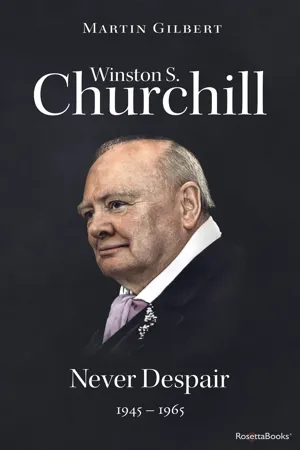
The eighth and final volume of Winston S. Churchill's official biography begins with the defeat of Germany in 1945 and chronicles the period up to his death nearly twenty years later. It sees him first at the pinnacle of his power, leader of a victorious Britain. In July 1945 at Potsdam, Churchill, Stalin, and Truman aimed to shape postwar Europe. But upon returning home, was thrown out of office in the general election.
Though out of office, Churchill worked to restore the fortunes of Britain's Conservative Party while warning the world of Communist ambitions, urging the reconciliation of France and Germany, pioneering the concept of a united Europe, and seeking to maintain the close link between Britain and the United States.
In October 1951, Churchill became prime minister for the second time. The Great Powers were navigating a precarious peace at the dawn of the nuclear age. With the election of Eisenhower and the death of Stalin, he worked for a new summit conference to improve East-West relations; but in April of 1955, ill health and pressure from colleagues forced him to resign.
In retirement Churchill completed his acclaimed four-volume
History of the English-Speaking Peoples and watched as world conflicts continued, still convinced they could be resolved by statesmanship. "Never despair" remained his watchword, and his faith, until the end.
"A milestone, a monument, a magisterial achievement . . . rightly regarded as the most comprehensive life ever written of any age." —Andrew Roberts, historian and author of
The Storm of War
"The most scholarly study of Churchill in war and peace ever written." —Herbert Mitgang,
The New York Times
- 1,425 pages
- English
- ePUB (mobile friendly)
- Available on iOS & Android
eBook - ePub
Winston S. Churchill: Never Despair, 1945–1965
About this book
Information
Subtopic
Historical BiographiesIndex
HistoryVictory
1
‘An iron curtain is drawn down’
Tired by the celebrations and concerns of victory, Churchill slept late into the morning of 9 May 1945. He awoke to news of the capture of Rangoon, ‘the splendid close of the Burma campaign’, as he telegraphed that day to Admiral Mountbatten.1 After the liberation of Burma, the struggle against Japan would continue, in the Pacific, in Indo-China, in China, and in due course on mainland Japan, but, Churchill wrote to his constituency Chairman, Sir James Hawkey, ‘our greatest and most deadly foe is thrown to the ground’.2
After lunching in bed, Churchill set off by car, together with his daughter Mary, for the United States, Soviet and French Embassies. ‘At the Russian Embassy,’ noted his Private Office, ‘the Prime Minister made a short speech and toasts were drunk. At the other Embassies, the arrangements were less formal but equally cordial.’3 As he drove on to the French Embassy, Churchill’s progress was witnessed by a large crowd, among which was the writer Peter Quennell, who later recalled: ‘Around him, their horses hooves ringing over the tarmac, mounted policemen slowly cantered. Although his cherubic face shone, and he waved his hat and his cigar, he had a remote and visionary look, an air of magnificent self-absorption, as he rode in triumph high above the crowd.’4
In Moscow, Clementine Churchill was at the end of her long, exhausting, but equally triumphal tour of the Soviet hospitals which had been helped by her Red Cross fund. That noon, as Russia celebrated victory, she telegraphed to Churchill: ‘We all assembled here drinking champagne at twelve o’clock, send you greetings on Victory Day.’5
Among those whom Churchill remembered on that first day of peace in Europe were three former French Prime Ministers whom he had known before the war, and who had been held by the Germans for possible use as hostages: Léon Blum, Edouard Daladier and Paul Reynaud. ‘I send you my warmest congratulations on your liberation,’ Churchill telegraphed. ‘I need not tell you how often my thoughts were with you during the long years of your captivity nor how glad I am to be able to rejoice with you on this day of victory.’6 Churchill also telegraphed that day to Harry Hopkins, whose visit to him in January 1941 had marked the start of a close harmony of interests and activity. ‘Among all those in the Grand Alliance,’ Churchill telegraphed, ‘warriors or statesmen, who struck deadly blows at the enemy and brought peace nearer, you will ever hold an honoured place.’7
That night Churchill dined alone with his daughter Mary. He then appeared, as he had done on the night of May 8, on the balcony of the Ministry of Health, overlooking Whitehall. The crowd was equally large, and to its cheers he declared: ‘London, like a great rhinoceros, a great hippopotamus, saying, “Let them do their worst, London can take it.” London could take anything.’ He wished to thank the Londoners, he said, ‘for never having failed in the long, monstrous days and in the long nights black as hell’.8
Returning to No. 10 Annexe at Storey’s Gate, his principal home since the Blitz of 1940, Churchill worked until the early hours of the morning. Among the telegrams which he sent was one to President Truman in which he praised the ‘valiant and magnanimous deeds’ of the United States, first under Roosevelt and then, since Roosevelt’s ‘death in action’, under Truman. These deeds, Churchill declared, ‘will forever stir the hearts of Britons in all quarters of the world in which they dwell, and will I am certain lead to even closer affections and ties than those that have been fanned into flame by the two World Wars through which we have passed with harmony and elevation of mind’.9
Churchill had already telegraphed to Truman that day about the need for a meeting of the three heads of Government. ‘In the meantime,’ he noted, ‘it is my present intention to adhere to our interpretation of the Yalta Agreements and to stand firmly on our present announced attitude towards all questions at issue.’10 One of these questions was the control of the Italian province of Venezia Giulia, into parts of which Marshal Tito’s Yugoslav partisan forces had marched, but where the Allied forces under Field Marshal Alexander were in almost complete control. Tito’s forces had, however, entered the southern part of the Austrian province of Carinthia. ‘Trouble brewing with Yugoslavia,’ noted the First Sea Lord, Admiral Sir Andrew Cunningham, in his diary on May 10. ‘Tito refusing to give way and occupying up to the Isonzo River and beyond. Also crossing the borders of Austria.’11 To Tito, Churchill telegraphed that day, about Alexander’s armies: ‘It would be a great mistake I am sure for you to make an attack upon him. In such circumstances he has already the fullest authority to reply.’ This ‘trial of strength’, Churchill suggested, should be ‘reserved for the Peace Table’.12
That night, Churchill was due to broadcast to the nation. ‘I shall be listening to you tonight my darling,’ Clementine Churchill telegraphed from Moscow, ‘and thinking of you and the glorious five years of your service to the nation and to the world.’13
***
The first days of victory in Europe coincided with the news that fifteen Polish leaders, approved by Britain as possible members of a future Polish Government, had been arrested by the Soviet authorities and taken to Moscow, not as political negotiators, but as prisoners. ‘I do not see what we can do now in this interlude of joy-making,’ Churchill minuted to the Deputy Under-Secretary of State at the Foreign Office, Sir Orme Sargent, on May 10. ‘Obviously this is a most grave question between the victorious States,’ Churchill added: ‘I do not feel I can say anything more to Stalin at the moment; but it may be a speech should be made in Parliament in the near future.’14 To Anthony Eden, who was then in San Francisco discussing the future of the United Nations World Organization, Churchill telegraphed on May 11:
Today there are announcements in the newspapers of the large withdrawals of American troops now to begin month by month. What are we to do? Great pressure will soon be put on us at home to demobilise partially. In a very short time our armies will have melted, but the Russians may remain with hundreds of divisions in possession of Europe from Lübeck to Trieste, and to the Greek frontier on the Adriatic. All these things are far more vital than the amendments to a World Constitution which may well never come into being till it is superseded after a period of appeasement by a third World War.15
In a second telegram to Eden on May 11, Churchill discussed two possible months for the General Election, June and October. June, he wrote, was thought by ‘general consensus’ to be better for the Conservative Party; October would leave Government ‘paralysed’ for too long and would result in the ‘many questions requiring settlement’ in the international sphere being ‘looked at from Party angles’. Eden had earlier been in favour of June, Churchill reminded him. ‘On the other hand,’ Churchill added, ‘the Russian peril, which I regard as enormous, could be better faced if we remain united.’16
Churchill set out his anxieties about Soviet policy, and the future of Europe, in a telegram to Truman, stressing the need to reach an immediate ‘understanding’ with Russia. The telegram, as sent on May 12, began:
I am profoundly concerned about the European situation. I learn that half the American Air Force in Europe has already begun to move to the Pacific theatre. The newspapers are full of the great movements of the American armies out of Europe. Our armies also are, under previous arrangements, likely to undergo a marked reduction. The Canadian Army will certainly leave. The French are weak and difficult to deal with. Anyone can see that in a very short space of time our armed power on the Continent will have vanished, except for moderate forces to hold down Germany.
Meanwhile what is to happen about Russia? I have always worked for friendship with Russia, but, like you, I feel deep anxiety because of their misinterpretation of the Yalta decisions, their attitude towards Poland, their overwhelming influence in the Balkans, excepting Greece, the difficulties they make about Vienna, the combination of Russian power and the territories under their control or occupied, coupled with the Communist technique in so many other countries, and above all their power to maintain very large armies in the field for a long time. What will be the position in a year or two, when the British and American Armies have melted and the French has not yet been formed on any major scale, when we may have a handful of divisions, mostly French, and when Russia may choose to keep two or three hundred on active service?
Churchill’s telegram continued:
An iron curtain is drawn down upon their front. We do not know what is going on behind. There seems little doubt that the whole of the regions east of the line Lübeck–Trieste–Corfu will soon be completely in their hands. To this must be added the further enormous area conquered by the American armies between Eisenach and the Elbe, which will, I suppose, in a few weeks be occupied, when the Americans retreat, by the Russian power. All kinds of arrangements will have to be made by General Eisenhower to prevent another immense flight of the German population westward as this enormous Muscovite advance into the centre of Europe takes place. And then the curtain will descend again to a very large extent, if not entirely. Thus a broad band of many hundreds of miles of Russian-occupied territory will isolate us from Poland.
Meanwhile the attention of our peoples will be occupied in inflicting severities upon Germany, which is ruined and prostrate, and it would be open to the Russians in a very short time to advance if they chose to the waters of the North Sea and the Atlantic.
Only ten days before Churchill used the phrase ‘Iron Curtain’ in this telegram to Truman, it had been used by the German Foreign Minister, Count Schwerin von Krosigk, in a broadcast to the German people. The broadcast, made on May 2, had been reported in The Times on the following day, the Count telling his listeners: ‘In the East the iron curtain behind which, unseen by the eyes of the world, the work of destruction goes on, is moving steadily forward.’17
Churchill ended his ‘iron curtain’ telegram:
Surely it is vital now to come to an understanding with Russia, or see where we are with her, before we weaken our armies mortally or retire to the zones of occupation. This can only be done by a personal meeting. I should be most grateful for your opinion and advice. Of course we may take the view that Russia will behave impeccably, and no doubt that offers the most convenient solution. To sum up, this issue of a settlement with Russia before our strength has gone seems to me to dwarf all others.18
On the most immediate cause of tension, Venezia Giulia, Churchill had received from President Truman what he described to Alexander as a ‘most robust and encouraging telegram’.19 ‘I must regard this as one of the most far-sighted, sure-footed and resolute telegrams which it has ever been my fortune to read,’ Churchill informed Lord Halifax, the British Ambassador in Washington.20 In the telegram, Truman commented on reports that Tito had ‘no intention’ of abandoning the territory he had occupied in Venezia Giulia. ‘I have come to the conclusion,’ Truman wrote, ‘that we must decide now whether we should uphold the fundamental principles of territorial settlement by orderly process against force, intimidation or blackmail.’
The problem, Truman told Churchill, ‘is essentially one of deciding whether our two countries are going to permit our Allies to engage in uncontrolled land grabbing or tactics which are all too reminiscent of those of Hitler and Japan.’ It was therefore Truman’s wish that Alexander should obtain ‘complete and exclusive control’ of Trieste and Pola, the line of communication through Gorizia and Monfalcone, and an area ‘sufficiently to the east of this line to permit proper administrative control’. Truman also suggested that Stalin be informed of the Anglo-American view. ‘If we stand firm on this issue,’ Truman’s telegram ended, ‘as we are doing on Poland, we can hope to avoid a host of other similar encroachments.’21
In a telegram to Eden on that day Churchill stressed the need to keep before Stalin the Polish situation, including the plight of the fifteen prisoners. This should be done, Churchill explained, ‘by a vigorous press campaign and by the outspokenness which will no doubt be in any case necessary in Parliament’.22
Truman’s telegram of May 12 confirmed a harmony of Anglo-American interests towards Russia which had not existed during Roosevelt’s wartime Presidency. It was an exchange, Churchill told Truman, ‘which shows how gravely we both view the situation’, and he added: ‘If it is handled firmly before our strength is dispersed, Europe may be saved another bloodbath. Otherwise the whole fruits of our victory may be cast away and none of the purposes of World Organization to prevent territorial aggression and future wars will be attained.’23
***
Clementine Churchill now prepared to return to London. ‘I know of the international difficulties which have not been surmounted,’ she wrote to Stalin on May 11, before leaving Moscow, ‘but I know also of my Husband’s resolve & confidence that a complete understanding between the English Speaking World & the Soviet Union will be achieved and maintained as this is the only hope of the World.’24
Early on the morning of May 12 Clementine Churchill reached Northolt. ‘Winston was determined to go and meet her himself,’ their daughter Mary has recorded, ‘but he did not leave Storey’s Gate quite in time, and Skymaster had to make a few extra tours round the airfield to allow a loving but tardy Winston to be on the tarmac to welcome home his Clemmie.’25
From Northolt, Churchill and his wife drove to Chequers. The principal problem confronting Churchill there was that of the date of the General Election. He had already spoken to his principal Conservative Party colleagues on May 11, abou...
Table of contents
- Cover
- Frontispiece
- Title Page
- Copyright
- Dedication
- Contents
- Illustrations
- Maps
- Preface
- Acknowledgements to the New Edition
- Part One: Victory 1945
- Part Two: In Opposition 1945–1951
- Part Three: Second Premiership 1951–1955
- Part Four: Final Decade 1955–1965
- Epilogue
- Maps
- Endnotes
Trusted by 375,005 students
Access to over 1.5 million titles for a fair monthly price.
Study more efficiently using our study tools.
Frequently asked questions
Yes, you can cancel anytime from the Subscription tab in your account settings on the Perlego website. Your subscription will stay active until the end of your current billing period. Learn how to cancel your subscription
No, books cannot be downloaded as external files, such as PDFs, for use outside of Perlego. However, you can download books within the Perlego app for offline reading on mobile or tablet. Learn how to download books offline
We are an online textbook subscription service, where you can get access to an entire online library for less than the price of a single book per month. With over 1.5 million books across 990+ topics, we’ve got you covered! Learn about our mission
Look out for the read-aloud symbol on your next book to see if you can listen to it. The read-aloud tool reads text aloud for you, highlighting the text as it is being read. You can pause it, speed it up and slow it down. Learn more about Read Aloud
Yes! You can use the Perlego app on both iOS and Android devices to read anytime, anywhere — even offline. Perfect for commutes or when you’re on the go.
Please note we cannot support devices running on iOS 13 and Android 7 or earlier. Learn more about using the app
Please note we cannot support devices running on iOS 13 and Android 7 or earlier. Learn more about using the app
Yes, you can access Winston S. Churchill: Never Despair, 1945–1965 by Martin Gilbert in PDF and/or ePUB format, as well as other popular books in History & Historical Biographies. We have over 1.5 million books available in our catalogue for you to explore.