Intimate behind-the-scenes recollections of Ronald Reagan by those who knew him during his early political career in California—photos included!
People often wonder: "What was Reagan like privately?" "How did he treat his children?" "How did he handle pressure?" "How did he handle danger?" "How did he treat his staff?" "How did he handle difficult, almost impossible to deal with, legislators?" This book collects reminiscences from those who were there, working in a wide variety of positions, recounting how the former actor, governor of California, and future president of the United States used humor to disarm his most ardent critics and tenacious opponents.
In this book, you'll discover observations about the close bond between Ronald and Nancy Reagan; the gentlemanly character of the governor who "never equated disagreement with disloyalty;" the way Reagan thrived on being underestimated; the untold story behind the secret plan hatched by former Air Force Secretary Thomas C. Reed and a handful of dedicated insiders to launch Reagan's unequivocal, arguably first campaign for President of the United States in 1968; and much more.
- 336 pages
- English
- ePUB (mobile friendly)
- Available on iOS & Android
eBook - ePub
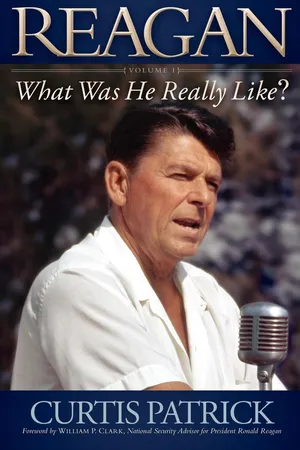
Reagan: What Was He Really Like? Volume I
About this book
Information
Chapter One
FLIGHT OF THE
“TURKEY BIRD”
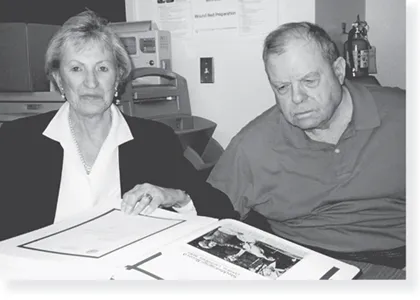
“Mr. Amerine has done more to ease my concerns about flying than anybody!”
Governor Reagan once declared to a group of visitors in his Capitol office, when Merv Amerine dropped by.
During WWII Mervin Amerine flew B-29 Superfortress bombers. He and his fellow airmen of the 3rd Photo-Reconnaissance Squadron took some of the original photos before and after the Atomic bombing of Hiroshima and Nagasaki, Japan.
Twenty-some years later, during Ronald Reagan’s 1966 Campaign for Governor of California, Amerine with his wife, Nancy as stewardess, flew the actor who had refused to fly—Ron Reagan—to previously unreachable campaign stops in as many out-of-the-way towns and hamlets in the boonies of the huge state as possible—with Reagan seated in the co-pilot’s seat at the controls, in what has been described as Donald Douglas’s greatest aeronautical achievement—a lumbering DC-3—# N-63440! A refinement of the DC-2—the DC-3 was originally designed and built in 1935, and was the first commercial airliner to fly passengers and make a profit. The Reagan 1966 Campaign transport plane, N-63440 was not built in the 1950’s as an airliner as we were originally told, but was constructed, as our research later proved, at Douglas Aircraft Co. in Long Beach, California in 1943 for the U.S. Army Air Corps as a C-47, for troop and cargo transport, and was easily interchangeable.
This tail-dragging, shiny classic with the huge, twin, radial engines, however, had one more unique feature: Normally, it was used to haul up to forty-eight thousand live baby turkeys at a time, all over the country.
These pioneers in the breeding, raising and mass-delivery of turkeys in North America decided, ‘out of the blue’, cold-turkey, that they wanted to help this uncommon man whom they had never met, Ronald Reagan, run for Governor of California. Merv had been watching RR for some time as he grew into a dynamic speaker.
“We had just come back from the midwest after delivering another load of baby turkeys.” Merv then mused, I thought, ‘What am I going to do to help Mr. Reagan get elected governor?’ “This was the Winter of 1965 / ’66.” “I had heard parts of a speech or two that he had made. I was a life-long Republican and I was tired of Democrats.” “I thought, I’ll take one of these three DC-3’s of mine. I had all of these seats, twenty-eight, put away in a hangar at our little airport in Oakdale (CA Central Valley) and we’ll fly Mr. Reagan wherever he needs to go for his campaign.” “ So I told Nancy about it when I got back.” And she said, ‘Yeah, and you’re going to go to the moon, huh?’
Then Nancy chimed in to confirm she had also said, ‘Oh, you are, huh?’
Merv said he didn’t know anybody connected with the campaign—anybody!
“I just took my Airline Pilot’s credentials and license, went up to San Francisco to the Reagan for Governor Campaign Committee headquarters” (at that time it may have been the Northern CA offices of Spencer-Roberts & Associates, frequented by Northern CA Chairman Tom Reed who would have thought this was a most fortuitous gift from the heavens). The words: ‘Airline Transport Pilot DC-3’ were written across the license.’ Merv said, “I presented these, told the staff about my airplanes down at Oakdale, California, and told them I’d like to help them out flying Mr. Reagan, wherever he needed to go.” Nita Wentner Ashcraft, former Vice Chairman of Finance for the Northern California Campaign, confirmed this in 2006. “Now Ronald Reagan didn’t like to fly. He refused to fly—until this campaign started!” “Then he realized he had to fly (due to the size and shape of California) with San Francisco up here so far from Los Angeles.” “Amerine not only presented his credentials but also mentioned his county Reagan chairman where he had come from and he knew a number of people who were easily checked out and who knew Reagan people. We accepted him right after his visit,” Wentner said. “I remember the jokes about how Merv would have to clean out the turkey poop to get ready for the next campaign flight.”
Wentner spent many hours with Reagan driving him around northern California. “We decided to go up the coast one time, and I had a 1964 Lincoln Town Car and Ron loved it. This was before he announced as a candidate for governor. We’d go to little towns and GOP Central Committee meetings—when he said that he wanted to make a tour of the state to see whether people would accept an actor. That was his big problem! He was putting his ‘toe-in-the-water.’
I asked Nita how he was received.
“Oh!” “Curtis!” “Like a movie star—with the aura.” “People knew him—he had name recognition. It was immediate; with everyone. His days in television helped.”
I probed deeper: Without trying to think of the exact words which you and he used, how did he treat you—how did he respond to you?
“He was an absolute gentleman with a great sense of humor! Never as a boss to an employee. No, no, no! Just a genuinely nice person. He had an heroic aura about him! Therefore, when Mervin Amerine came into the office and presented his “Turkey Bird”—We accepted!”
“It wasn’t just Amerine and his airplane who were in awe of RR, Paul Haerle, an attorney, Marin County Reagan Chairman and later to become Appointments Secretary, following Tom Reed, and still later, an Associate Justice of the California Court of Appeals, came to his first meeting, along with other business people, with a check in his hand to help give the fledgling campaign a ‘jump-start,’” Nita said. (See Paul’s chapter in Vol.2.)

The “Turkey-Bird” takes off: filled with press, media crews, advance-staff and candidate Reagan; sometimes at the controls.
“Well, I can remember the first place that I picked candidate Reagan up was in a little town called Calistoga up in the heart of the Napa Valley. We met—walked around the airplane, talked about the airplane, where we were goin’ that day, got in, cranked her up and away we went! I knew that the runway at Calistoga was short (about 1,000 feet long / modern jet airliners need eight to ten thousand feet of runway) gravel and asphalt and used mainly by people who were flying gliders and sail-planes. And to this day they still hook their little gliders to ‘tug’ planes and tow them into the air to catch the thermals coming up from the ridges ringing the manicured, verdant vineyards of the Napa Valley.”
I asked Merv how he got permission to land and takeoff on that short little field.
Merv said, “I called the glider clubs and told them, ‘Hey, I plan to come in there with a DC-3.’” And they said, ‘Hey, you’re crazy!’ I said, ‘No I’m not, I fly in and out of Oakdale all the time and we’ve only got a little over a thousand feet of runway here so I’m not concerned about your airport.’ “All I can remember is; at the end of the runway was the main street in Calistoga! So, when I got ready to take off, I remember looking back and —Boy!—I really had that dust roiling up—(clouds of dust from the props on those thundering, thousand-horsepower, radial engines which sounded like a dozen crop- dusting bi-planes all revving their engines at the same time)—but I never heard anything (adverse or negative) so I got away with it! I had pulled my gas load way down so the airplane was lighter than normal, so that I could get airborne quicker.”
I asked Merv how he thought the candidate’s advisors and campaign consultants had been able to talk Ronald Reagan into agreeing to do this; because he didn’t want to fly in anything. He wanted to drive, take a bus or the train. The only thing that we could come up with was the fact that Merv had impeccable flying credentials, with years of experience in all types of multi-engine aircraft and that the DC-3’s had a reputation for being some of the toughest planes in the air; both as cargo-transports and commercial passenger liners. The military loved them, i.e., The C-47’s flying over the ‘Hump’ in Indochina in WWII.
Pertaining to the ‘stamp-of-approval,’ Merv, the handsome, no-nonsense, quintessential pilot found an affinity with Reagan from their first encounter in the California Wine Country.
He said, “We got along just great from the moment we met. I don’t remember anything special.” Referring to the reason he, Nancy Amerine and the “Turkey Bird” were accepted almost immediately.
It may have been Reagan’s optimism, after meeting the Amerines.
Merv said, “I can remember, Mr. Reagan rode in the co-pilot’s seat—he wondered about this and that on the control panel—we just chatted and talked like we’re talkin’ right now.”
“After he was elected governor, we were at a meeting in his office in the Capitol one day—I happened to be there and I don’t know why he happened to say this but when he saw me he said, ‘Mr. Amerine has done more to ease my concerns about flying than anybody!’ “He really got a kick out of it!” “We’d be comin’ in to land and we were just like—seasoned pilots and old friends—I mean—there he was just sitting right up there in the cockpit with me—he was only three feet away from me on the other side of the cockpit—watching everything that went on—all the procedures.” I’d say, ‘Now, we’re going to make a power change—I’d tell him why—that we’re going to go back to level flight, to a cruise speed and I’m going to reduce my power.’ “I’d pull the throttles back slowly—change the RPM, and that didn’t bother Mr. R. a bit. And that old DC-3 would just be pluggin’ along—like a Caterpillar tractor. There has never been another plane built like it—and there never will be, again!”
I reminded Merv that he carried numerous members of the media and the working press along with three or four members of the candidate’s staff, including myself; on most flights. Sometimes the plane was full.
Merv said, “You remember, Curtis, it got to be kind of a joke—but it was just part of the process, too: If I happened to make a landing that was a little better than the normal bounce—why, everybody aboard would gobble (shrill) like turkeys and clap and then go ‘gobble—gobble—gobble!’”
Yes! It was wild, I recalled; a live turkey call from twenty-eight people in unison.
“Unfortunately, I never got a recording of that—but I should have,” Merv said. He went on, “But I sure remember the gobbling that came forward from the back end of the plane; if I made a nice, smooth landing.”
It was priceless and loud and put everyone in a jovial mood. I questioned Merv about landing in those little towns all over the back-country of California, since a lot of folks came out to the airports and landing strips to see us when we would arrive or depart.
“Oh, Yeah!” “There’d be people who’d come out to see the landing and takeoff operations—and get a chance to get a little closer to the candidate—or maybe chat with him for a second. Going back for a moment, after this takeoff from Calistoga, we went to San Andreas (the heart of the Mother Lode Gold Country on the Western slope of the High Sierra) where RR had an evening speech to make at the fairgrounds. Almost any place you could go with a (smaller) general aviation airplane; you could go with that DC-3.”
“It was night by the time the speech was over—it was dark when we took off—it may have been one of the few times I took him back to Los Angeles, where he went home to rest for a few days from the rigors of the campaign trail. We’d land as close as we could to where he wanted to go—home, of ...
Table of contents
- Cover
- Title
- Copyright
- Table of Contents
- Foreword
- Acknowledgments
- Introduction
- Chapter 1. Flight of the “Turkey Bird”
- Chapter 2. Pillar of Strength/Voice of Reason
- Chapter 3. Media Magic
- Chapter 4. The Scheduler: A Tough Balancing Act
- Chapter 5. The Creative Society
- Chapter 6. The Iconic Receptionist
- Chapter 7. Inspiration from the Top
- Chapter 8. Dedicated Youth Key to Victory
- Chapter 9. Environmental Cornerstone
- Chapter 10. ‘Go-Fer’ Makes Good
- Chapter 11. Rumpled Reporter Key Insider
- Chapter 12. Never Intimidated
- Chapter 13. Chp Officer and a Gentleman
- Chapter 14. The Architect
- Chapter 15. Phone Man Extraordinaire
- Chapter 16. Brown Bag Campaign Begins
- Chapter 17. L.A. Cop Volunteered
- Chapter 18. Advancing Reagan
- Chapter 19. The Press Photographer
- Chapter 20. The Non-Handler
- Epilogue
Trusted by 375,005 students
Access to over 1.5 million titles for a fair monthly price.
Study more efficiently using our study tools.
Frequently asked questions
Yes, you can cancel anytime from the Subscription tab in your account settings on the Perlego website. Your subscription will stay active until the end of your current billing period. Learn how to cancel your subscription
No, books cannot be downloaded as external files, such as PDFs, for use outside of Perlego. However, you can download books within the Perlego app for offline reading on mobile or tablet. Learn how to download books offline
Perlego offers two plans: Essential and Complete
- Essential is ideal for learners and professionals who enjoy exploring a wide range of subjects. Access the Essential Library with 800,000+ trusted titles and best-sellers across business, personal growth, and the humanities. Includes unlimited reading time and Standard Read Aloud voice.
- Complete: Perfect for advanced learners and researchers needing full, unrestricted access. Unlock 1.5M+ books across hundreds of subjects, including academic and specialized titles. The Complete Plan also includes advanced features like Premium Read Aloud and Research Assistant.
We are an online textbook subscription service, where you can get access to an entire online library for less than the price of a single book per month. With over 1.5 million books across 990+ topics, we’ve got you covered! Learn about our mission
Look out for the read-aloud symbol on your next book to see if you can listen to it. The read-aloud tool reads text aloud for you, highlighting the text as it is being read. You can pause it, speed it up and slow it down. Learn more about Read Aloud
Yes! You can use the Perlego app on both iOS and Android devices to read anytime, anywhere — even offline. Perfect for commutes or when you’re on the go.
Please note we cannot support devices running on iOS 13 and Android 7 or earlier. Learn more about using the app
Please note we cannot support devices running on iOS 13 and Android 7 or earlier. Learn more about using the app
Yes, you can access Reagan: What Was He Really Like? Volume I by Curtis Patrick in PDF and/or ePUB format, as well as other popular books in History & Historical Biographies. We have over 1.5 million books available in our catalogue for you to explore.