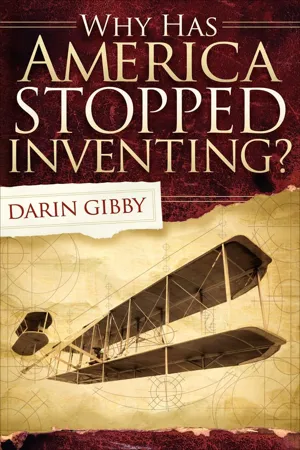
A thoughtful look at our history of innovation, the problems with the patent system, and the prospects for America's future.
America loves innovation and the can-do spirit that made this country what it is—a world leader in self-government, industry and technology, and pop culture. Everything about America has at one point or another been an experiment and a leap of faith. And one such experiment—upon which all others depend for success—is the US Patent System.
Why Has America Stopped Inventing? takes a close look at why this experiment appears to be failing, and why America has all but stopped inventing. Our belief that we are the most innovative people on earth is mistaken. Statistics show that today we invent less than half of what our counterparts did a hundred and fifty years ago.
Where are the groundbreaking inventions comparable to those from the Industrial Revolution? Why have we been using the same mode of transportation for over a century? Why are we giving trillions to hostile foreign nations for imported oil when we have the talent to solve the nation's energy crisis? We don't have these desperately needed technologies because regular Americans have given up on inventing.
This book explains why, comparing the experiences of America's most successful nineteenth-century inventors with those of today and sharing fascinating historical anecdotes: Jefferson refusing to waste any more weekends examining patent applications; Whitney being robbed of his fortune while the South's wealth exploded; the patent models that kept British soldiers from burning Washington's last-standing federal building; the formation of Lincoln's cabinet; and Selden crippling the entire US auto industry. It also tells the story of the Wright brothers' airplane monopoly, the Colt revolver's role in the Mexican American War, the Sewing Machine wars, the last six months of Daniel Webster's life, and the fraudulently created Bell Empire.
- 239 pages
- English
- ePUB (mobile friendly)
- Available on iOS & Android
eBook - ePub
Why Has America Stopped Inventing?
About this book
Information
Chapter One
LIFE COULD BE BETTER
Pick a thoroughfare through any major city in the world—Fifth Avenue in New York, the Champs Elysees in Paris, Knightsbridge in London, Market Street in San Francisco, Avenida Atlântica in Rio de Janeiro—and if the weather’s nice, you’ll see thousands of people strolling along, listing to their portable music player, chatting on cell phones, tapping out text messages, or reading email. Occasionally, a runner may zip past, checking her distance and speed with a GPS device strapped to her wrist. Most are oblivious to airplanes whizzing overhead or the street traffic—sleek modern vehicles carrying passengers who surf the web on their PDAs, watch videos on their mobile phones, or slug out a home run on a Nintendo. Some cars even talk to their drivers, directing them to their programmed destinations. It looks as if we’re in the golden age of technology, a time like none other in the history of the world. Some say there’s even too much, that we’re in a state of technology overload.
But today’s impressive technological gadgets blind people to the fact that more, much more, is yet to be invented—world-changing technologies that we’ve yet to see. Because of the accumulation of technologies over the last several centuries, we’ve become desensitized, fooled into thinking that we are the greatest inventive generation of all time. But we have lulled ourselves into thinking we are greater than we really are. Somewhere yet to be invented are groundbreaking technologies that would make today’s gadgets seem trivial. We’re so complacent with what we have that no one realizes what our lives could be like … if Americans really began to invent.
Imagine the first part of the twentieth century—a time without television, microwave ovens, cell phones, computers, satellites, or the space shuttle. That world seems so different from our own that we tend to think of it as belonging to a type of Dark Age. Yet most of today’s technological marvels are small improvements over what was already invented by then. By 1900, our nation’s inventors had already produced the steam engine, the train, the automobile, the telegraph, steel making, photography, the typewriter, dynamite, the telephone, the electric motor, the light bulb, the facsimile, and the phonograph. Why don’t we see those breakthroughs today? Inventions of this kind were so significant that in 1843 Henry J. Ellsworth, Commissioner of the U.S. Patent Office, stated that, “The advancement of the arts, from year to year, taxes our credulity and seems to presage the arrival of that period when human improvement must end.” Although ridiculed and often misquoted for his intentional embellishment, to some extent his statement has proved to be prophetic.
Nearly three decades ago, a hypnotist came to my high school for an after-school assembly. He placed a dozen students under hypnosis and asked them several questions. The most provocative was futuristic: What would the automobile fuel of the future be? The answer, without exception, was water. While most of us weren’t smart enough to understand the chemistry behind this, that the useful fuel was really the hydrogen in the water that needed to be split from the oxygen atoms, somehow in our subconscious minds, running a car on water was a real possibility. While scientifically this is a viable alternative fuel, I’m still patiently waiting for my local gas station to install distilled water pumps. And a water-fueled car isn’t the only invention we can’t get our arms around. What about real-time language translation, cures for cancer—anything other than radiation and chemotherapy—the ability to store light, a replacement for paper, a bed to cure back aches, a replacement for the light bulb, a way to heat houses without a forced air furnace, toilets without water, and what I want most of all, a car like the one on the Jetsons? At this point, though, I’d be happy for a car that gets a hundred miles per gallon.
The “American Dream” was built on the notion that with hard work and ingenuity, and with the support of a strong economy based on the rule of law, anyone could make it in the United States. Is the American dream still a reality, or is it slipping away? In America, we love to envision ourselves as a forward-looking culture, the culture that gave the world the automobile, the airplane, space flight, the computer, and too many medical breakthroughs to count. Few of us realize that the number of patents being issued on our shores has plunged in recent decades. In fact, today Americans on a per capita basis are granted fewer than half the number of patents issued a hundred and fifty years ago. It is a shocking fact. We’ve been using the same mode of transportation for over a century. And why are we still using coal, gasoline, and natural gas as our major energy sources? We’ve evolved from the steam engine, the automobile, and the airplane to what? Those who should be today’s inventors prefer to focus on downloadable applications for a smart phone rather than on a car that can run on water. It’s no wonder we call our economy a “services” economy. Manufacturing is out of vogue.
Don’t get me wrong. I love my smart phone and all my clever apps—ones to track my stocks, give me updates on my favorite teams, tell me the weather, and make sure I never get lost while driving. But these “entertainment” inventions mask the real problems facing America. How can we stop the spending of $1 trillion annually on foreign oil? Why can’t we invent a solution to our country’s energy problems—issues so significant they could lead to our downfall? It’s not a trifling matter.
All of this raises a critical question: Why has America stopped inventing? Why are we unable to continue the tradition of groundbreaking inventions of the kind that made our country great? In recent decades technological development has waned, along with our economic strength. After a century and a half of decline, we should be asking ourselves: how can we make this technology explosion happen again?
The answer may well lie in the lives of the great innovators of the nineteenth century, such as Eli Whitney, Samuel Colt, Charles Goodyear, Isaac Singer, Cyrus McCormick, Samuel Morse, and Wilbur Wright, to name of few. Learning what drove these individuals to invent and then feverishly ward off masses of copiers is a key to understanding how America can revive its innovative spirit.
Few realize that our own computer revolution during the 1980s and 1990s closely parallels the series of events that unfolded during the 1830s to the 1850s. To illustrate the point, consider just five industries that emerged from 1830 to 1860: rubber, revolvers, the telegraph, sewing machines, and reapers. Their counterparts can be found in today’s semiconductors, the Internet, smart bombs, telecommunications, and ethanol production. During the 1830s, speculation surrounding rubber as the new miracle material rivaled the speculation during our own dotcom era. Throughout this period, our nation laid thousands of miles of telegraph cables that opened instant communication over long distances. America also had its share of defense contractors, like Samuel Colt, hoping to cash in on foreign wars. Add to that an agricultural revolution where machines such as the reaper changed how Americans produced their food, and the sewing machine radically changed the efficiency of its factories.
But back then, the amount of innovation was on a much broader scale, raising the important question as to why we have failed to replicate that scale of innovation. One significant difference is that the vast majority of inventors during the nineteenth century were ordinary individuals working alone, often on farms or in shops. That all changed a century later when researchers flocked to the safety of corporations. It was so much easier to take a regular salary, enjoy a fully stocked research lab, and have the corporation fight the patent battles.
The good news is that with such close technology parallels, it is possible to return to America’s golden era of innovation. But to appreciate how this can happen, we first need to understand what happened to Eli Whitney.
Chapter Two
HOW AMERICA’S INNOVATION BEGAN—ELI WHITNEY
As the eighteen century waned, the South was in deep trouble. They needed a new cash crop—something they could export to Britain. Without this, many plantation owners faced certain ruin. With no available work, there was talk among even Southerners about emancipating the slaves. Indigo was no longer in demand, tobacco had raped their soil, and an oversupply had sent prices plummeting. Large tracts of land went uncultivated.
The situation isn’t far removed from what America faces today. Though we may not spend our money to import manufactured goods from Britain as the early Americans did, we do send our treasure to countries that don’t like us so that we can fuel our insatiable appetite for energy. We too are in deep trouble.
But back in America’s early days, there was hope for the future—and it had to do with cotton. The craze for cotton started in the 1780s when wool and flax went out of fashion in England. The new material in vogue was cotton, made available by English mill owners who developed a way to mechanically spin and weave the cotton into cloth.
The frenzy also reached America when Alexander Hamilton in 1791 released his Report on Manufacturers and speculated that the cotton textile industry could be brought to America, especially after a man named Samuel Slater escaped England with intimate knowledge of how to build the weaving machines used by the cotton textile mills in England. Of course, all of America believed they were innovative enough to replicate these spinning machines.
Regardless, whether in England, America, or both, cotton was going to be the next big thing for America’s planters.
While Southerners sensed the looming demand for cotton and smelled the sweet scent of money that came with it, they faced one major problem. The cotton England wanted—a kind that was easily cleaned—didn’t grow in the American south.
In 1790, there were generally two varieties of cotton: long-staple and short-staple. The long-staple, Sea Island variety, was easy to clean, but it grew only in limited locales, particularly in America’s northeastern coastal regions. Short-staple cotton, also called green cotton, could be grown anywhere—it grew like a weed. But the problem with the upland, green cotton, was that it had sticky seeds that were almost impossible to remove. It took a slave an entire day to clean a single pound. The economics didn’t work. For this reason, the total amount of cotton produced in the U.S. during 1791 was a mere two million pounds.
But Eli Whitney was about to change all of that. His cotton gin could efficiently remove the seeds, exponentially increasing America’s annual cotton production to nearly a hundred million pounds in just twenty years. Never in the history of the world has one change in technology impacted the world’s economy in such a rapid manner.
How Whitney ended up in a position to invent the cotton gin is a tale in itself. Whitney grew up as a tinkerer. As a teenager, he lugged a pail of his own hand-made nails from his family farm near Westboro, Massachusetts in hopes of secretly peddling his wares without his father’s knowledge. Yet as he reached adulthood, Whitney sensed a bigger future than sticking around the family farm. At age nineteen, Whitney decided he needed to move on and approached his father about attending college. At first his father was reluctant, perhaps because of the cost associated with a higher education. But eventually his father relented and agreed to let Whitney attend Yale College.
Following graduation, Whitney faced the dilemma of most college graduates: He still didn’t know what he wanted to do with his life, but he did need a job. His student loans were coming due. Whitney initially secured a teaching position in New York, and when that fell through, he took the only thing he could find: a job as a private tutor for a bunch of rich kids—“gentlemen’s” kids—who lived on an estate in South Carolina. Whitney took the job reluctantly because he viewed the South as merely a place with an unhealthy climate. But at least it would help him repay his father and give him some time to read as he considered his future and the possibility of a career in law.
The plan was for Whitney to sail to New York, then take another ship from New York to Savannah, where he would meet his new employer. Arrangements had been made to travel with one Phineas Miller, Catherine Greene, and her five children. This must have excited Whitney as Catherine Greene was somewhat of a celebrity. She was the widow of Revolutionary War General Nathaniel Greene and was returning to her Savannah plantation—a reward for her husband’s service during Washington’s Valley Forge campaign. She herself had also served beside Washington on those bitter nights, attending to the needs of the soldiers. As Whitney would soon learn, Mulberry Grove, like most Southern plantations, was floundering. The job of keeping the plantation afloat fell to Miller who was hired by Nathaniel Greene to be his children’s tutor. After Nathaniel Greene’s death, Ms. Greene asked Miller to stay on to oversee management of the plantation.
When Whitney arrived in New York, he encountered a man covered with small pox. Fearful that he would break out during the voyage, Whitney consulted with Miller and Ms. Greene, who suggested that Whitney get inoculated before leaving. This Whitney did, with Ms. Greene patiently looking after Whitney for two weeks while he recovered. When Whitney was finally ready to travel to Georgia, he began to stew over his future lost wages due to his illness. Ms. Greene sensed Whitney’s anxiety and offered to pay his fare. That would be the first of many payments she would provide to Whitney on her way to becoming his benefactress.
Upon their arrival in Georgia, Whitney was in for another surprise. He was informed that his tutoring position was no longer available. Not to worry: Ms. Greene offered to let Whitney stay with her until he got back on his feet. The arrangement was somewhat awkward and embarrassing for Whitney. He—a small town Puritan—was staying with an older widowed woman on a large Southern plantation. He didn’t pay rent and wasn’t really expected to do anything. Ms. Greene, however, made Whitney feel important, and he felt obligated to help out as he could, inventing a knitting frame for her and toys for the children.
It was at Mulberry Grove that Whitney learned of the cottonseed problem. It was the talk of the South; solving it could save them all from a slow and agonizing death. When several neighbor planters were at her home discussing the problem of the seeds, Ms. Greene offered up Whitney’s assistance. He can “do anything” she said, probably thinking about the creative toys he’d created for her children.
Whitney could hardly turn down the challenge from his benefactress, though he had never even seen a cotton boll. Phineas Miller sent him down to a basement room where Whitney went to work. What is remarkable is that ten days later Whitney emerged with his first prototype—one that would do the work of fifty pickers. To add to the greatness of the feat, Mulberry Grove was isolated and Whitney had few tools or materials at his disposal. Most of his time was spent building the tools he would need to make the cotton engine.
The basic idea behind the cotton gin was to create a rotating cylinder with a series of teeth. An iron guard with narrow slits was placed over the cylinder so that the teeth projected through the slits. The cotton was fed over the rotating cylinder so that the teeth would tear the seeds from cotton as they became trapped against the guard. The seeds then fell into a box positioned below the cylinder. To remove the cleaned cotton from the teeth, Whitney used a second cylinder covered with a brush to sweep the clean cotton from the teeth on the first cylinder.
Crude as it was, he’d done it—invented a machine that could revolutionize the nation’s economy. He knew it. Catherine Greene knew it. And Phineas Miller knew it.
What to do next? Miller, Ms. Greene, and Whitney struggled with the situation. Miller, the businessman, saw dollar signs. Ms. Greene, the socialite, wanted to show it off. Whitney was just plain scared and confused. All the talk made him nervous. Like nearly every other inventor, the moment Whitney realized what he’d invented, he became paranoid. He was certain that somebody was going to steal his idea. Whitney’s reaction wasn’t unique. Most inventors feel the same way—that they’ve invented the most revolutionary invention that world has ever seen, and that all of humanity is already conspiring against them. Whitney’s initial reaction was to lock the gin up so that nobody could see it. Later, his business plan would reflect this same sensitivity. Instead of commercially selling gins, or even licensing them, Whitney’s initial plan was to build regional processing plants where the planters could bring their seeded cotton for processing.
None of Whitney’s initial ideas to keep his gin secret worked. It was like discovering gold and trying to hide it beneath the floorboards—a scenario in which only a Silas Marner could find satisfaction. And it wasn’t realistic. Almost immediately, the secret was out. Some of it may have come from Ms. Greene’s friends that she invited to Mulberry Grove to see the contraption. Whitney, guest as he was, could hardly deny them entrance. Later, there would be break-ins, and soon everyone knew how Whitney’s gin operated.
Beyond feeling paranoid, Whitney felt other surges of emotion, those common to nearly every inventor. The creation of something new brings with it not only a sense of pride, but also a notion that this idea is going to change the world. And if it’s that important, the financial reward isn’t far behind. Unrealistically or not, most inventors feel their invention is going to make them millions—no, billions. Never mind whether the idea is another heated windshield wiper or self-cleaning toilet seat. The emotions are the same. It never hurts to dream big. Whitney was no exception. He wrote to his father that, “Tis generally said by those who know anything about it, that I shall make a Fortune by it.” And the more the three discussed their futures and the role that Whitney’s cotton gin would play, Whitney was “now so sure of succ...
Table of contents
- Cover
- Title Page
- Copyright
- Dedication
- Table of Contents
- Preface
- Introduction: The Patent Game
- Chapter One: Life Could be Better
- Chapter Two: How America’s Innovation Began—Eli Whitney
- Chapter Three: The U.S. Gets Her First Patent Office
- Chapter Four: America’s Laws Get Broken In
- Chapter Five: In Come the Models
- Chapter Six: America Gets Rubber Fever
- Chapter Seven: A New Patent Office and Patent Statute
- Chapter Eight: The Patent Office Rescues Colt and Morse
- Chapter Nine: McCormick and Goodyear Secure Their Rotunda Fame
- Chapter Ten: Singer Starts the Patent Wars
- Chapter Eleven: Colt Turns to the Courts
- Chapter Twelve: Goodyear Seeks Out Daniel Webster
- Chapter Thirteen: The Legal Elite Join the Fight: Lincoln and his Future Cabinet Take Sides on the McCormick Reaper Case
- Chapter Fourteen: Morse Encounters Salmon P. Chase
- Chapter Fifteen: The Aftermath
- Chapter Sixteen: The Old Curiosity Shop Is Mothballed
- Chapter Seventeen: The Telephone and the Automobile
- Chapter Eighteen: The Patent Office Confronts the Ether
- Chapter Nineteen: In Come the Wright Brothers
- Chapter Twenty: Where Did the Inventors Go?
- Chapter Twenty-One: The Staggering Cost of Inventing
- Chapter Twenty-Two: How Do We Fix This?
- About the Author
- Resources
- References
Trusted by 375,005 students
Access to over 1.5 million titles for a fair monthly price.
Study more efficiently using our study tools.
Frequently asked questions
Yes, you can cancel anytime from the Subscription tab in your account settings on the Perlego website. Your subscription will stay active until the end of your current billing period. Learn how to cancel your subscription
No, books cannot be downloaded as external files, such as PDFs, for use outside of Perlego. However, you can download books within the Perlego app for offline reading on mobile or tablet. Learn how to download books offline
Perlego offers two plans: Essential and Complete
- Essential is ideal for learners and professionals who enjoy exploring a wide range of subjects. Access the Essential Library with 800,000+ trusted titles and best-sellers across business, personal growth, and the humanities. Includes unlimited reading time and Standard Read Aloud voice.
- Complete: Perfect for advanced learners and researchers needing full, unrestricted access. Unlock 1.5M+ books across hundreds of subjects, including academic and specialized titles. The Complete Plan also includes advanced features like Premium Read Aloud and Research Assistant.
We are an online textbook subscription service, where you can get access to an entire online library for less than the price of a single book per month. With over 1.5 million books across 990+ topics, we’ve got you covered! Learn about our mission
Look out for the read-aloud symbol on your next book to see if you can listen to it. The read-aloud tool reads text aloud for you, highlighting the text as it is being read. You can pause it, speed it up and slow it down. Learn more about Read Aloud
Yes! You can use the Perlego app on both iOS and Android devices to read anytime, anywhere — even offline. Perfect for commutes or when you’re on the go.
Please note we cannot support devices running on iOS 13 and Android 7 or earlier. Learn more about using the app
Please note we cannot support devices running on iOS 13 and Android 7 or earlier. Learn more about using the app
Yes, you can access Why Has America Stopped Inventing? by Darin Gibby in PDF and/or ePUB format, as well as other popular books in Technology & Engineering & Intellectual Property Law. We have over 1.5 million books available in our catalogue for you to explore.