An account of the spiritual direction of our country from the time the Puritans landed in the new world up to today.
Exploring our loss of faith in God and how that loss has impacted our society, this book includes quotes from some of the people who had the most influence on the growth of our once great nation and some of the people and events that have caused our nation to decline economically, socially, and morally.
One Nation Under God includes many landmark court cases that have affected the way the American people can worship the Lord in public and in private.
One Nation Under God is a map of our rise to greatness and our decline to the potential oblivion of this onetime light on the hill for all the world to follow. It also is a guide on how to reclaim our greatness by turning back to God for His forgiveness and guidance. The farther away we move from God the worse our society becomes.
One Nation Under God sets out to prove to the country—possibly the world—that we are a Christian nation.

- 192 pages
- English
- ePUB (mobile friendly)
- Available on iOS & Android
eBook - ePub
About this book
Information
Topic
Theology & ReligionSubtopic
North American HistoryChapter One

THE FOUNDING OF A CHRISTIAN NATION
_____________________
Before we can bring our nation back to the Glory of God we must first understand how and why our country was created for the Glory of God.
We have been hearing from our political leaders that we are not a Christian nation. It seems we are heading that way. Our children can’t pray in school, displaying the Ten Commandments in a courthouse is being challenged and we can’t even have the Cross displayed on government land! The list goes on and on. Some people in this country want to forbid displaying the name of God or practicing his teachings in public.
Just as Peter and the other disciples were forbidden from preaching in the name of Jesus by their religious leaders, we too are being forbidden from honoring Jesus in public by our government and some atheist groups.
We must be like the apostles and pray, worship, and honor God no matter what the government says. We must change our government so we can truly be like the apostles.
Then the captain went with the officers, and brought them without violence, for they feared the people, lest they should be stoned. And when they had brought them, they set them before the council: and the high priest asked them, Saying, Did not we straitly command you that ye should not teach in this name? and, behold, ye have filled Jerusalem with your doctrine…Then Peter and the other apostles answered and said: “We ought to obey God rather than men….
Acts 5:26-32 (KJV)
When Israel turned away from God, He delivered them to the Philistines. Then the Philistines captured the Ark of the Covenant, which was for the Glory of God. 1 Samuel 4:21 says “…The glory has departed from Israel”. This could we be true of our nation, if like Israel, we continue to turn our back on God.
There has been a lot written in recent years to try to dismiss the fact that America was founded upon Judeo-Christian principles and ethics. Anyone who examines the original writings of our Founding Fathers will find an abundance of quotations showing the profound extent to which Christianity influenced their thinking and lives.
Between 1629 and 1640 the Puritans moved to the New World in order to establish a country where they were free to worship as they chose. Puritans were members of a number of religious groups advocating more “purity” of worship and doctrine. In other words, they believed in truth from the Bible, not the pulpit.
The colonies were established precisely to serve as religious sanctuaries for various denominations of the Christian church; Pennsylvania, a Quaker state; Maryland, a Catholic state; and Massachusetts, a Puritan state.
THE FIRST “GREAT AWAKENING”
During the late seventeen and early eighteenth century, Colonial America saw some major changes. American cities became important seaports and the southern part of America was becoming a major contributor to the Colonial American’s economy. In addition, the population was increasing with immigrants coming in large numbers due to the growth of plantations. As a result of this economic and population boom people were beginning to question the role of government with regard to religion and human nature. This brought about a major religious revival to Colonial America. Referred to as “The Great Awakening and Enlightenment” it revived interests in education, science and literature. “The Enlightenment” also challenged the role of religion and divine right. This helped Colonial America to see that it was possible to challenge the king and his divine right.
The movement fulfilled people’s need for reassurance, direction and religious purpose, which was otherwise missing. People united in the understanding of the Christian faith and life. The movements also led to creation of different sects and denominations, and advocated religious tolerance. This movement saw traditional authority of the clergy being challenged and their success made it easier to challenge the authority of the King.
Jonathan Edwards (1703–1758)
In 1726, Edwards succeeded his grandfather, Solomon Stoddard, as the pastor of the church in Northampton, Massachusetts, the largest and most influential church outside of Boston.
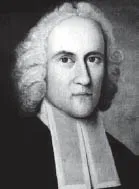
From 1734 to 1735, Edwards oversaw some of the initial stirrings of the First Great Awakening. He gained international fame as a revivalist and “theologian of the heart” after publishing A Faithful Narrative of the Surprising Work of God (1738), which described the awakening in his church and served as an empirical model for American and British revivalists alike.
The widespread revivals of the 1730s and 1740s stimulated one of the two most fruitful periods for Edwards’s writings. In this period, Edwards became very well known as a revivalist preacher who subscribed to an experiential interpretation of Reformed theology that emphasized the sovereignty of God, the depravity of humankind, the reality of hell, and the necessity of a “New Birth” conversion. While critics assailed the convictions of many supposed converts as illusory and even the work of the devil, Edwards became a brilliant apologist for the revivals. In The Distinguishing Marks of a Work of the Spirit of God (1741), Some Thoughts Concerning the Present Revival (1742), A Treatise Concerning Religious Affections (1746), and The Life of David Brainerd (1749), he sought to isolate the signs of true sainthood from false belief.1
Jonathan Edwards was considered by many to be the greatest theologian America produced. When he began preaching in Northampton, Massachusetts in 1734, the moral conditions were at an extreme low, as was prevalent throughout most of the American colonies. Under his preaching that stressed the importance of an immediate personal spiritual rebirth, a revival began in his church among the youth and then spread to the adults. Edwards wrote that:
In the spring and summer following, anno 1735, the town seemed to be so full of the presence of God; it never was so full of love nor of joy, and yet so full of distress, as it was then.
In two years, three hundred converts were added to the church, and the news of the revival spread throughout New England.
Edwards’ writings are pondered and evaluated to the present day. His famous sermon “Sinners in the Hands of an Angry God” is still being read and studied in America’s public schools as a specimen of eighteenth-century literature. Students of American history pay much attention to Edwards’s scientific, philosophical, and psychological writings; theologians and church historians regard Edwards’s work on revivals as unexcelled in analysis and scope. Christians continue to read his sermons with great appreciation for their rich doctrine, clear and forceful style, and powerful depiction of the majesty of God, the sinfulness of sin, and Christ’s power to save.
For us to see Jonathan Edwards ascend his pulpit today, a candle in one hand and his sermon manuscript in the other, would cause a titter in the congregation. From our modern foam-cushioned church seats, with carpeted aisles and soothing background music, we can scarcely capture the old-time dignity of the unpretentious church where Edwards and others held captive the hearts and minds of their hearers.
When Jonathan Edwards “uttered” in the Spirit, the expressionless face, the sonorous voice and the sober clothing were forgotten. He was neither a dullard nor a sluggard. His was a devoted heart intent on rightly dividing the word of truth. But in doing it, Edwards flamed. Yet to him, sensationalism was an abomination. To make an impression was never the thought behind any of his preaching. Scholarship on fire for God is what Edwards had.
The tongue of Edwards must have been like a sharp two-edged sword to his attentive hearers. His words must have been as painful to their hearts and consciences as burning metal on flesh. Nevertheless, men gave heed, repented, and were saved.
“Knowing the terror of the Lord” (a thing seemingly forgotten in our day both by pulpit and pew), Edwards smoldered with holy wrath. Impervious to any consequences of such severity, he thundered these words from his pulpit:
The bow of God’s wrath is bent, and His arrows made ready upon the string. Justice points the arrow at your heart and strings the bow. It is nothing but the mere pleasure of God (and that of an angry God without any promise or obligation at all) that keeps the arrow one moment from being made drunk with your blood.
To utter truth like that with tears and tenderness takes an anointed and therefore fearless and compassionate man.
In the hearts and minds of the hearers there must also have been some prevenient grace at work. Apart from this, men would have rebelled at this stern sweep of power on their souls. As it was, before Edwards’ spiritual hurricane, the crowd collapsed. Some fell to the earth as if pole-axed. Others, with heads bowed, clung onto the posts of the temple as if they were afraid of falling into the nethermost depths of hell.2
Behold, the day of the LORD cometh, cruel both with wrath and fierce anger, to lay the land desolate: and he shall destroy the sinners thereof out of it.
–Isaiah 13:9 (KJV)
George Whitefield (1714–1770)
America’s “Great Awakening” was really started by George Whitefield mostly due to his 1739–1740 preaching tour. Whitefield made seven separate trips in nine years preaching all across the colonies. Little known today, Whitefield was America’s first celebrity. According to historical documents, about 80 percent of all American’s heard him preach at least once. When George Whitefield was in the area, farmers and shopkeepers alike would stop what they were doing and go to the field where he was preaching. Every where he went, Whitefield was followed with people clamoring to hear him preach.
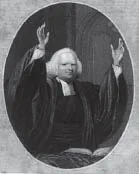
Whitefield pioneered most methods used in the 1700s evangelical revivals, including preaching in fields instead of churches. His farewell sermon on Boston Common drew 23,000 people (more than the entire population of Boston). In one week he would often preach a dozen or more times and spend forty to fifty hours in the pulpit. He was an orator without equal in the pulpit. His delivery was not the classical oratory with finely ornamented style, soaring flights of fancy and elegance of taste. His preaching was marked by biblical content, doctrinal emphasis and rhetorical simplicity. His delivery, however, was dramatic.
George Whitefield became a close friend of Benjamin Franklin who once estimated that Whitefield could be heard by thirty thousand people without amplification.
Whitefield pushed himself so hard and preached with such intensity that often afterward he had “a vast discharge from the stomach, usually with a considerable quantity of blood.”3
In the fall of 1770, Whitefield was on an exhausting New England preaching tour, preaching in Boston, Portsmouth, and Exeter. When he reached Newbury Port, he was too tired to get out of the boat. With help, he made it to the parsonage of Old South Church. As evening came he regained a measure of strength and took supper with his host family. A crowd began to gather at the door. Some of them pushed on into the house in hope of hearing his voice again.
“I am too tired,” Whitefield said “and must go to bed.” He took a lighted candle and started climbing the stairs. But the sight of the patient people crowding into the hall and the street was too much to refuse. He paused on the staircase to say a few words. Soon he was preaching or “exhorting” as he called these impromptu addresses. As he urged them to trust the savior, he grew stronger, then weaker, then stronger again. He preached until the candle burned down to the socket and flickered out. Then one of the greatest of all preachers and evangelists went up to bed and died.4
In his lifetime, Whitefield preached at least eighteen thousand times. He addressed perhaps ten million people wanting to hear the Gospel and come to know Jesus Christ.
And the LORD commanded me at that time to teach you statutes and judgments, that ye might do them in the land whither ye go over to possess it.
–Deuteronomy 4:14 (KJV)
John Locke (1632–1704)
John Locke was considered the father of “liberalism” (belief in the importance of liberty and equality) and was regarded as one of the most influential of “Enlightenment” thinkers. His contributions to classical republicanism are reflected in o...
Table of contents
- Cover
- Title Page
- Copyright
- Dedication
- Table of Contents
- Preface
- Acknowledgments
- Chapter One: The Founding of a Christian Nation
- Chapter Two: Leading a Christian Nation
- Chapter Three: Educating a Christian Nation
- Chapter Four: The Decline of a Christian Nation
- Chapter Five: Outlawing Religious Education in a Christian Nation
- Chapter Six: Taking Back Our Christian Nation
- Endnotes
Trusted by 375,005 students
Access to over 1.5 million titles for a fair monthly price.
Study more efficiently using our study tools.
Frequently asked questions
Yes, you can cancel anytime from the Subscription tab in your account settings on the Perlego website. Your subscription will stay active until the end of your current billing period. Learn how to cancel your subscription
No, books cannot be downloaded as external files, such as PDFs, for use outside of Perlego. However, you can download books within the Perlego app for offline reading on mobile or tablet. Learn how to download books offline
Perlego offers two plans: Essential and Complete
- Essential is ideal for learners and professionals who enjoy exploring a wide range of subjects. Access the Essential Library with 800,000+ trusted titles and best-sellers across business, personal growth, and the humanities. Includes unlimited reading time and Standard Read Aloud voice.
- Complete: Perfect for advanced learners and researchers needing full, unrestricted access. Unlock 1.5M+ books across hundreds of subjects, including academic and specialized titles. The Complete Plan also includes advanced features like Premium Read Aloud and Research Assistant.
We are an online textbook subscription service, where you can get access to an entire online library for less than the price of a single book per month. With over 1.5 million books across 990+ topics, we’ve got you covered! Learn about our mission
Look out for the read-aloud symbol on your next book to see if you can listen to it. The read-aloud tool reads text aloud for you, highlighting the text as it is being read. You can pause it, speed it up and slow it down. Learn more about Read Aloud
Yes! You can use the Perlego app on both iOS and Android devices to read anytime, anywhere — even offline. Perfect for commutes or when you’re on the go.
Please note we cannot support devices running on iOS 13 and Android 7 or earlier. Learn more about using the app
Please note we cannot support devices running on iOS 13 and Android 7 or earlier. Learn more about using the app
Yes, you can access One Nation Under God by Leon G. Stevens in PDF and/or ePUB format, as well as other popular books in Theology & Religion & North American History. We have over 1.5 million books available in our catalogue for you to explore.