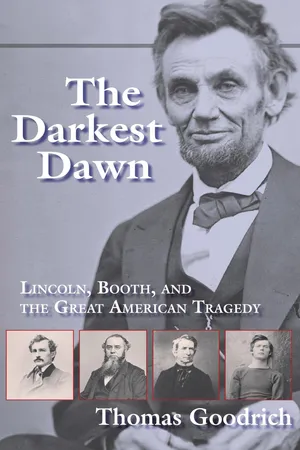
The story of the Lincoln assassination and its aftermath, captured with you-are-there immediacy.
It was one of the most tragic events in American history: The famous president, beloved by many, reviled by some, murdered while viewing a play at Ford's Theater in Washington. The frantic search for the perpetrators. The nation in mourning. The solemn funeral train. The conspirators brought to justice.
Coming just days after the surrender of the Confederate Army at Appomattox, the assassination of Abraham Lincoln has become etched in the national consciousness like few other events. The president who had steered the nation through its bloodiest crisis was cut down before the end, just as it appeared that the bloodshed was over. The story has been told many times, but rarely with the immediacy of
The Darkest Dawn. Thomas Goodrich brings to his narrative the care of the historian and the flair of the fiction writer. The result is a gripping account, filled with detail and as fresh as today's news.
"Among the hundreds of books published about the assassination of our 16th president, this is an exceptional volume." —Frank J. Williams, founding Chair of The Lincoln Forum
- 374 pages
- English
- ePUB (mobile friendly)
- Available on iOS & Android
eBook - ePub
About this book
Trusted by 375,005 students
Access to over 1.5 million titles for a fair monthly price.
Study more efficiently using our study tools.
Information

PROLOGUE

THE OMEN

THOSE WHO WITNESSED THE PHENOMENON that day would never forget it. The sight was so sudden and unexpected that most could only look to the sky, then to their neighbors, then shake their heads in stony disbelief. Some, those of a religious strain, stared in awe and considered what they were witnessing as nothing short of a heavenly message sent from on high. Others in the throng, those earthbound souls less prone to flights of fancy, nevertheless viewed the event as utterly amazing. Whichever the persuasion, whoever the viewer, no one in the crowd that day would ever forget what they beheld at noon, Saturday, March 4, in the year of their Lord 1865.
The day was all the more remarkable because it had such an evil onset. The sun did not smile down on Washington that morning. At 6 A.M., following a week of nearly uninterrupted gray and gloom, a furious storm burst upon the nation’s capital from the south.1 Although the blast—which uprooted trees and toppled outbuildings—ended in only a matter of minutes, torrential rain soon followed in its wake.2 When the deluge eased around nine that morning, it seemed to many as if the worst had passed. A short time later, though, as thousands of elegantly dressed men and women ventured cautiously up Pennsylvania Avenue toward the Capitol, again the rain came.3
“Such a wet, dirty morning as this . . . hardly ever dawned upon Washington,” wrote one depressed reporter covering the day’s ceremony. “[T]he proverbially filthy streets of the political metropolis [are] filthier and more unpleasant than ever.”4
“Mud, mud everywhere,” cursed another journalist, “and not a dry spot to set foot upon.”5
For the tens of thousands of men and women who had arrived by train throughout the week from Baltimore, Philadelphia, New York, and all points north, there was little to do but tuck pants into boots or loop hoop skirts and endure the agony in mute misery. About them on the wide street, rain-soaked flags and bunting drooped in soggy silence.
For many of these Americans, some of whom had made the very same trek four years earlier, the irony was inescapable. Back then, although the weather was dry, high winds had swept the streets.6 Even to those at the time, the dusty tempest sending dirt and grit into everyone’s eyes seemed to presage an awful accounting ahead—an omen of a terrible scourge awaiting America. And for sure, a mighty maelstrom of blood, fire, and iron did indeed ravage the face of the land soon after. Now, four years later, the very heavens seemed to be frowning again, showing that, all reason and logic to the contrary, the end was not yet; that the great national trial would continue, perhaps for another four years, perhaps forever.
By noon, a great crowd of spectators stood huddled around the Capitol, silent and shivering. Among all, there was an air of dejection and defeat.7 “Men, women and children soaked about quietly, caught cold, and waited,” wrote one depressed observer. “The rain had taken all the starch out of them.”8 Contributing to the grim and gloomy mood was the knowledge that should more rain now fall, the ceremony all had come for would be held indoors, where only a favored few would be able to attend.9
Just when the miserable assemblage felt that it could get no worse, the black clouds above began to thin somewhat, then soften. Soon, the startled thousands pointed to streaks of blue smiling through the parting gray. Within minutes, a sweet breeze from the northwest rippled the surfaces of ponds and puddles all around and swept away the dark, dank smells that had plagued the capital all week. Color returned to the land. From a drab and seemingly lifeless landscape, the first buds on trees reappeared. Grass was green again. Almost on cue, songbirds awakened, and their beautiful music began to sparkle the world.10
And then, as if some unseen hand had staged the entire performance, the massive doors of the Capitol building swung open. A tall, gaunt man appeared. Dressed in black, he walked onto the portico, followed by the government of the nation. At that precise moment, the sun suddenly burst from the clouds and spread a blinding light over the entire Capitol grounds. Above, the newly completed dome glowed “snow white” in the brilliant display.11
“Every heart beat quicker at the unexpected omen,” noted an amazed newsman, Noah Brooks.12
At length, the tall man in black approached the podium. As he did so, he paused for a moment, then smiled to himself, as if he, too, was aware of the miracle.13 Around him, a loud, explosive cheer rose up from the tens of thousands who were startled by the strange and wonderful coincidence. “Finally,” wrote a witness, “the tumult subsided . . . and in the universal hush, the President addressed the people as follows”:
Fellow-countrymen: At this second appearing to take the oath of the Presidential office, there is less occasion for an extended address than there was at the first. . . . The progress of our arms, upon which all else chiefly depends, is as well known to the public as to myself, and it is, I trust, reasonably satisfactory and encouraging to all. With high hope for the future, no prediction in regard to it is ventured. . . . Both parties deprecated war, but one of them would make war rather than let the nation survive; and the other would accept war rather than let it perish. And the war came.14
With excitement racing through the throng, many anxiously pressed forward, eager to catch every sound.15 “His voice was singularly clear and penetrating,” recalled one man mere yards away. “It had a sort of metallic ring. His enunciation was perfect.”16
Unfortunately, only a fraction of the estimated thirty thousand in attendance could actually hear the address.17 For most, however, mood was everything. A burst of optimism and hope had suddenly swept over the multitude, and all applauded spontaneously, though they heard not a word.18
“The crowd kept pushing nearer and nearer the platform,” recorded a reporter for the New York Herald. “Negroes ejaculated ‘Bress de Lord’ in a low murmur at the end of almost every sentence. . . . [The president’s] face glowed with enthusiasm, and he evidently felt every word he uttered.”19
Fondly do we hope—fervently do we pray—that this mighty scourge of war may speedily pass away. Yet, if God wills that it continue until all the wealth piled by the bondman’s two hundred and fifty years of unrequited toil shall be sunk, and until every drop of blood drawn with the lash shall be paid by another drawn with the sword, as was said three thousand years ago, so still it must be said, “The judgements of the Lord are true and righteous altogether.”20
Of all the many viewers in that vast sea of faces, of all those who felt they were witnessing the dawn of a new day, none was so swept with emotion or so flooded with words as Walt Whitman. Too old for active service, the white-haired poet served as a volunteer at a local military hospital. As he scanned the crowd around him searching for what he did not know, the old man eventually glanced toward heaven. There, to his astonishment, the poet saw that for which he sought.
“A curious little white cloud, the only one in that part of the sky, appeared like a hovering bird, right over him,” wrote Whitman.21 Whether the object was indeed a cloud, or a bird, or a God, or even a figment of the imagination, it mattered not—the poet saw it, and he, like everyone else this day, looked for signs, longed for signs, prayed for signs. To Walt Whitman, the ethereal vision meant that he would no more hear the shattering, ear-splitting screams of the broken bodies he ministered to daily. For others this day, some who spotted noonday stars overhead, the portents meant they would no longer need search the long lists of names issuing from the fields of slaughter to the south. For all, the signs meant a merciful end to the national nightmare.
With malice toward none, with charity for all, with firmness in the right, as God gives us to see the right, let us strive on to finish the work we are in; to bind up the nation’s wounds, to care for him who shall have borne the battle, and for his widow, and his orphan—to do all which may achieve and cherish a just and lasting peace among ourselves and with all nations.22
As the last word echoed across the crowd, the ripple of reflexive applause soon swelled to a thundering roar when the full weight of the beautiful sentiments sank in. After taking the oath of office and kissing the Bible, the president smiled warmly to his people, bowed politely, then turned and quietly departed.23 After one final burst of cheers and shouts, the huge throng thereupon began to disperse.24 Unlike the gloomy mood before the ...
Table of contents
- Cover
- Half title
- Title
- Copyright
- Dedication
- Contents
- Preface
- Part I
- Part II
- Part III
- Acknowledgments
- Notes
- Bibliography
- Index
Frequently asked questions
Yes, you can cancel anytime from the Subscription tab in your account settings on the Perlego website. Your subscription will stay active until the end of your current billing period. Learn how to cancel your subscription
No, books cannot be downloaded as external files, such as PDFs, for use outside of Perlego. However, you can download books within the Perlego app for offline reading on mobile or tablet. Learn how to download books offline
Perlego offers two plans: Essential and Complete
- Essential is ideal for learners and professionals who enjoy exploring a wide range of subjects. Access the Essential Library with 800,000+ trusted titles and best-sellers across business, personal growth, and the humanities. Includes unlimited reading time and Standard Read Aloud voice.
- Complete: Perfect for advanced learners and researchers needing full, unrestricted access. Unlock 1.5M+ books across hundreds of subjects, including academic and specialized titles. The Complete Plan also includes advanced features like Premium Read Aloud and Research Assistant.
We are an online textbook subscription service, where you can get access to an entire online library for less than the price of a single book per month. With over 1.5 million books across 990+ topics, we’ve got you covered! Learn about our mission
Look out for the read-aloud symbol on your next book to see if you can listen to it. The read-aloud tool reads text aloud for you, highlighting the text as it is being read. You can pause it, speed it up and slow it down. Learn more about Read Aloud
Yes! You can use the Perlego app on both iOS and Android devices to read anytime, anywhere — even offline. Perfect for commutes or when you’re on the go.
Please note we cannot support devices running on iOS 13 and Android 7 or earlier. Learn more about using the app
Please note we cannot support devices running on iOS 13 and Android 7 or earlier. Learn more about using the app
Yes, you can access The Darkest Dawn by Thomas Goodrich in PDF and/or ePUB format, as well as other popular books in History & American Civil War History. We have over 1.5 million books available in our catalogue for you to explore.