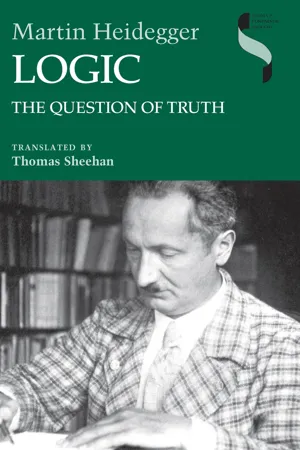
Heidegger's radical thinking on the meaning of truth in a "clear and comprehensive critical edition" (
Philosophy in Review).
Martin Heidegger's 1925–26 lectures on truth and time provided much of the basis for his momentous work,
Being and Time. Not published until 1976—three months before Heidegger's death—as volume 21 of his Complete Works, it is nonetheless central to Heidegger's overall project of reinterpreting Western thought in terms of time and truth.
The text shows the degree to which Aristotle underlies Heidegger's hermeneutical theory of meaning. It also contains Heidegger's first published critique of Husserl and takes major steps toward establishing the temporal bases of logic and truth. Thomas Sheehan's elegant and insightful translation offers English-speaking readers access to this fundamental text for the first time.
The problem of truth in the decisive origins of philosophical logic, and the seedbed of traditional logic (focused on Aristotle)
Prefatory remark
[127] As we now discuss this question with a glance back to some texts of Aristotle, it does not mean that we are trying to give a complete interpretation of those texts. Let’s presuppose such an interpretation as having already been carried out. Then, using our guiding question, let us simply focus on some individual theses of Aristotle. Our investigation aims at an original understanding of the problem of truth and a radical way of solving it, one in which our investigation of the problem up to now will gain its legitimacy, and in which its positive content will come to light.
We begin our concrete investigation of the current determinations of truth by characterizing the truth of propositions. This is hardly accidental or arbitrary. We do so because according to the traditional report, the proposition or judgment is the proper place of truth. What is the connection here?
In §11, we will deal with the place of truth and with the proposition (
). Out of those preliminary discussions will come the need to discuss the basic structure of
and, in connection with that, to clarify the phenomenon of meaning.1
§11. The place of truth, and
(proposition)
The thesis that the proper place of truth is the proposition or judgment must be understood as an image insofar as “place” is a spatial term, whereas
is not extended in space. [128] What the expression means is: the proposition is where truth originally and properly belongs. The proposition is what makes truth possible as such. When this thesis is asserted and taken unquestioningly as the basis of every explanation of truth, it is most often accompanied by a second thesis, one concerned with content—namely, that the thesis about the proposition as the place of truth was first enunciated by Aristotle. And usually this second thesis is connected with a third, namely, that Aristotle was the one who first determined the concept of truth—as the correspondence of thought with things. However (so this thesis usually affirms), since this concept of truth cannot stand up against critical reflection, Aristotle is the originator of this naïve concept of truth.2
To put it another way, we have three theses:
1. The place of truth is the proposition.
2. Truth is the correspondence of thought with beings.
3. These two statements originate with Aristotle.
These three theses, which are widespread today and have been for a long time, are so many prejudices. It is not the case that Aristotle enunciated the first two theses, nor does he directly or indirectly teach what these theses assert. He originates theses (1) and (2) only in the sense that these came into circulation through an appeal to Aristotle that was based on an inadequate interpretation of him; and it continues unabatedly, even today, to determine the conception of the problem.
What does Aristotle say about truth and its relation to
as proposition?
In the first place, we must keep in mind the basic point: Aristotle never determined “truth” as such by going back to the proposition. Rather, if he ever makes any connection between
(proposition) and truth, he does so in such a way that he determines the proposition through [129] truth, or more precisely, through the ability-to-be-true. But even this way of putting it is inadequate. The propositional statement is determined by Aristotle as speech that can be true or false.
All speech is about something {i.e., in general terms, it means something} . . . but not all speech is indicative {i.e., lets something be seen}, but only speech in which being-true or being-false is present {as the ways of speaking}.3
This makes it clear in principle that being-true is the distinguishing feature of a certain kind of speech, the kind that states or asserts something. The proposition is determined by its reference to truth—not vice versa, as if truth were derived from the proposition. When Aristotle emphasizes that the statement is a special kind of speech because of its reference to truth, we need to understand this correctly. The statement has a reference to the ability to be true or false. Being-true simpliciter and being true or false, are entirely different phenomena.
According to Aristotle this “either/or,” this “either-true-or-false,” is intrinsic to the proposition. Therefore, for him the proposition certainly does not have to be there in order for truth to be what it is; and if a proposition is true, it is true as something that also can be false.
Of course, we have not yet established what this either/or really means or why the proposition can be characterized in terms of it. We have not even shown what it is about the proposition that requires that it be caught in this alternative.
This either/or is what distinguishes speech qua statement and delimits it from other kinds of speech. [130] What other kinds? Aristotle gives a brief indication of those other kinds when he continues the sentence previously cited:
. (ibid., chap. 4, 17a4)
But being-true-and-false is not present in every kind of speech. A request, for example, is a form of speech, but it is neither true nor false.
Here Aristotle envisions (although he does not name) a rich variety of other forms of speech, including wishes, commands, and questions. Aristotle merely mentions in passing that the proper disciplines for studying them are
, rhetoric or poetics.4 Sentences like “Please pass me the scissors” or “Get off this land!” or “Was there another storm today?” are not statements, because they are neither true nor false. This division that Aristotle makes within the various forms of speech has not always been maintained. In fact, it has been strongly challenged—by Bolzano, for example,5 and in a certain sense even by Husserl—to the effect that even sentences expressing wishes, commands, and questions are thought to have the property of statements.
The question is still debated, and yet anyone can see that getting a clear resolution of the question is a basic presupposition [131] for any scientific grammar.6 Here we will not pursue the question as a matter of controversy. Instead, we will try to see whether discussing the phenomenon of truth can lead us to a foundation on which we can at least correctly pose (if not resolve) the much-debated question about the expression of objectivizing and non-objectivizing acts. Let us simply get a bit clearer on the distinction Aristotle established.
What does it mean to say that being-true and being-false are not present in an
, a request? If I say, “Please give me the scissors that are on the table,” when in fact there are no scissors on the table, what I say does not correspond with what is the case. My speech is objectively false. I am deceived, and my utterance expr...
Table of contents
Cover
Half title
Title
Copyright
Contents
Translator’s Foreword
Introduction
Prolegomenon.
Part I.
Part II.
Editor’s Afterword
Glossaries
Abbreviations
Trusted by 375,005 students
Access to over 1.5 million titles for a fair monthly price.
Study more efficiently using our study tools.
Frequently asked questions
Yes, you can cancel anytime from the Subscription tab in your account settings on the Perlego website. Your subscription will stay active until the end of your current billing period. Learn how to cancel your subscription
No, books cannot be downloaded as external files, such as PDFs, for use outside of Perlego. However, you can download books within the Perlego app for offline reading on mobile or tablet. Learn how to download books offline
Perlego offers two plans: Essential and Complete
Essential is ideal for learners and professionals who enjoy exploring a wide range of subjects. Access the Essential Library with 800,000+ trusted titles and best-sellers across business, personal growth, and the humanities. Includes unlimited reading time and Standard Read Aloud voice.
Complete: Perfect for advanced learners and researchers needing full, unrestricted access. Unlock 1.5M+ books across hundreds of subjects, including academic and specialized titles. The Complete Plan also includes advanced features like Premium Read Aloud and Research Assistant.
Both plans are available with monthly, semester, or annual billing cycles.
We are an online textbook subscription service, where you can get access to an entire online library for less than the price of a single book per month. With over 1.5 million books across 990+ topics, we’ve got you covered! Learn about our mission
Look out for the read-aloud symbol on your next book to see if you can listen to it. The read-aloud tool reads text aloud for you, highlighting the text as it is being read. You can pause it, speed it up and slow it down. Learn more about Read Aloud
Yes! You can use the Perlego app on both iOS and Android devices to read anytime, anywhere — even offline. Perfect for commutes or when you’re on the go. Please note we cannot support devices running on iOS 13 and Android 7 or earlier. Learn more about using the app
Yes, you can access Logic by Martin Heidegger, Thomas Sheehan in PDF and/or ePUB format, as well as other popular books in Filosofía & Fenomenología en filosofía. We have over 1.5 million books available in our catalogue for you to explore.