There's no detour from terror on this creepy thrill ride down part of America's historic highway—from the author of
Haunted Ozarks.
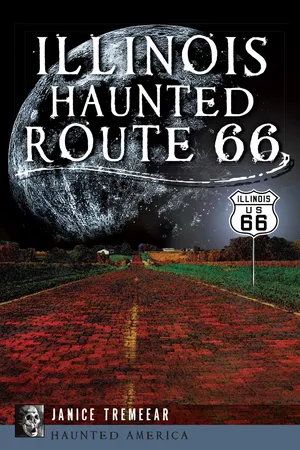
Route 66 is no longer the main thoroughfare between Chicago and St. Louis, but if local lore is to be believed, ghostly traffic along the Mother Road continues unabated. Janice Tremeear chases down accounts of a man executed for witchcraft, the demon baby of Hull House, and the secrets of H. H. Holmes's "Murder Castle." Native American legends place the piasa bird in the skies above the highway's southern stretch with the same insistence that characterize contemporary UFO sightings in the North. In between, spirits such as Resurrection Mary join the throng of hapless souls wandering the roadside of the Prairie State's most famous byway.
- 113 pages
- English
- ePUB (mobile friendly)
- Available on iOS & Android
eBook - ePub
Illinois Haunted Route 66
About this book
Trusted by 375,005 students
Access to over 1.5 million titles for a fair monthly price.
Study more efficiently using our study tools.
Information
CHAPTER 1
ILLINOIS AND ROUTE 66
FROM THE BEGINNING
Get Your Kicks on Route 66,” the famous song written by Bobby Troup, brings to mind the freewheeling, fun attitude of vacationing families seeking adventure and new sights as they traveled along the “Middle Road” or the more oft-turned phrase, “Mother Road of North America,” as coined by John Steinbeck. The call for adventure lured with promises of spicy sights and racy tales of roadside dives.
Called the “most magical road in all the world” with its roadside giants, campsites, mini museums, mom-and-pop businesses, motor courts and eateries topped with miles upon miles of glowing neon, Route 66 was a lighted pathway enticing the weary, delighting the wide-eyed seekers of the wonder of the open road. Cozy Dog Drive-in, the historic eatery in Springfield, Illinois, is the home to the original hot dog on a stick. Established in 1949, the drive-in served as one of the enticing oddities people loved.
Some believe Route 66 embodies a part of the “dragon lines,” a very powerful energy grid located at specific longitude and latitude lines, known as ley lines, which create sacred geometric grid patterns on the globe where many ancient sites and spirit roads exist, such as the Mayan and the Egyptian pyramids. In between Chicago and Los Angeles runs the shattered spine of America, the broken ley line of Route 66, with the main break appearing in Kansas.
A growing population during the 1920s and a growing number of automobiles forced highway officials to admit to the impracticality of disjointed trails. Legislation for public highways first appeared in 1916. Congress enacted an even more comprehensive version of the act in 1925 and executed its plan for national highway construction. Cyrus Avery, a Tulsa, Oklahoma resident, teamed with highway proponent John Woodruff of Springfield, Missouri, to lobby for the creation of a diagonal roadway running from Chicago to Los Angeles.

The American Association of State Highway and Transportation Officials (AASHTO) named the road Route 60 and then changed it to Route 62. Avery “strenuously objected” to the switch, sending an impassioned letter to AASHTO executive secretary William Markham that read, “You are making a joke of the interstate highway.” On April 30, 1926, the route became Route 66. Avery gained fame as the “Father of Route 66,” the birthplace of which was located in Springfield, Missouri.
Illinois begins the great roadside culture with the 2,448-mile-long asphalt python starting in the downtown Chicago loop at the “slabbed” Pontiac Trail, SBI 4. Like the tip of the Yellow Brick Road in The Wizard of Oz, the section of Route 66 constructed during 1926 to 1930 is the most scenic part in Illinois, slanting through a densely populated, developed state with a fairly level alignment thanks to the scraping of Ice Age glaciers—unlike the twists, switchbacks, cuts and roller-coaster terrain it takes in Missouri, west of St. Louis. As early as the mid-1920s, the Prairie State boasted that its segment of the Old Road was mud-free and slab all the way.

Postcard image of the Muffler Man.
“Muffler Men” were gentle giants bordering the road in front of tourist shops, service stations or restaurants. Once common in the heyday of Route 66, only a few of them survive. The most iconic one, “Tall Paul,” holding a giant hotdog, is located in Atlanta, Illinois. It was moved (it originally stood in Cicero, Illinois) and beautifully restored by the Route 66 Association. Route 66 soon became the road of choice for Capone and other Chicago gangsters in the pursuit of wealth. During Prohibition, bootleg whiskey, speakeasies and roadhouses were at every turn. Tales spawned of rumrunners, gangsters and ladies of the evening lent a mythic, romantic image to the highway, giving it the wild quality some people sought to alleviate the boredom of daily life. They dared to take flight from the humdrum as they sought the riches of California on an exhilarating quest where a discovery of the unknown, unusual and bizarre was synonymous with fun and adventure. The fairy-tale charm of Route 66 was its idiosyncratic personality, spreading forth like a giant carnival midway. This corridor of neon signs and gaudy roadside attractions was widely embraced by the eager traveling public.
The status of Route 66 in American culture cannot be replaced by the soulless super-highway systems of today, yet it was extremely dangerous as “Bloody 66” twisted through congested cities, crossed busy railroads on grade and was riddled with blind corners or hazardous cross traffic. Most accidents happened at intersections with county roads or railroad crossings. A bad stretch north of Pontiac held the nickname Dead Man’s Alley.
The Mother Road has been glorified in countless classic books, movies and even a TV series. The song “Route 66” has been covered over two hundred times by artists including Rosemary Clooney, the Andrew Sisters, Michael Martin Murphey, the Rolling Stones, Nat King Cole and the Cramps. Its legendary status in pop culture is justified: America’s soul is laid out in a line for everyone to see. Illinois was the first state to hard surface the highway and the first to replace it with interstate. It was where Route 66 began and, finally, where it was officially ended. Nothing can completely dull the allure of the “Main Street of America.” Traveling this road was and is an extraordinary experience, a vital part of our American culture, the bloodline of the nation.
Indian tribes once roamed plains of prairie grass and wild onion bog, and the mounds of Illinois are objects of curiosity, controversy and mystery, as they were in Missouri. Even the first settlers yielded theories of the “mound-builders”—people who migrated from Asia or Mexico—and linked the structures to “faeries” or speculated that they were used as burial sites. Among the most intriguing of these sites are the effigy mounds that represent various animals. The Bureau of American Ethnology conducted a survey of the mounds in the eastern United States late in the twentieth century, resulting in a scientific view of the anomalies that described them as “raised both towns and places of worship on these artificial eminences. The human remains found in the mounds that have been excavated to date, are all of the American Indian type, and represent only the recent period of geologic time.” Some are prehistoric, while others are proven by their contents as post-Columbian. Ancestors of the Winnebago and Sioux stock seem to be the closest in origin.

Route 66 Red Brick Road in an Illinois postcard.
Add the haunted roads and wooded areas of Illinois or the ghosts in private homes as the Mother Road winds down to cross the Mississippi River in Missouri, and Route 66 is a hotbed of history and lore. From the first installment of the road in Illinois, it carried its history of ghosts and weird anomalies to the Show Me State and on into California, encompassing eight states and leaving behind a bloody past and hauntings still being researched today. For instance, take the now famous curse of the Billy Goat Tavern, located at 430 North Lower Michigan Avenue. William “Billy Goat” Sianis owned and operated the Billy Goat Tavern in Chicago, and he’d bring the tavern’s mascot, his pet goat, to public events. In 1945, the Chicago Cubs played in the World Series against the Detroit Tigers. Sianis showed up with his pet goat and was denied admission. P.K. Wrigley, owner of the Cubs, stated that he didn’t want the goat in the ballpark due to its smell. Sianis promptly placed a curse on the Chicago Cubs: they would never again win a pennant or World Series. It often appears the Cubs have broken the curse, but then they lose again. Efforts to dispel it have failed, and it remains in effect to this day (so the legend persists). The Billy Goat Tavern also experienced fame and glory though a Saturday Night Live skit featuring Dan Aykroyd and John Belushi.
Another odd tale is of Givins Castle, sitting snugly tucked in the south side neighborhood of Beverly. The castle was built by a man from Ireland for his wife, who never got to see the structure. She remained behind in Ireland and died before its completion, but she’s now seen walking up the hill toward a home she never viewed.
Unidentified mysterious animals (UMAs) or cryptids dot the serene countryside; the famous flying cryptids are the thunderbirds, or piasa birds (pronounced PIE-a-saw and meaning “devourer of men”), in written accounts from Louis Joliet and Father Jacques Marquette. According to Joliet’s diary, the piasa “was as large as a calf with horns like a deer, red eyes, a beard like a tiger’s, a face like a man, the body covered with green, red and black scales and a tail so long it passed around the body, over the head and between the legs.” A representation of the birdlike monster is painted high on the bluffs along the Mississippi River, where the city of Alton, Illinois, now stands. Thunderbirds have been reported throughout time and in many states and could create peals of thunder by the mere flap of their wings and shoot lighting from their eyes. The Cahokia Indians depicted this bird on the bluffs, perhaps as a warning from a tribe that conducted human sacrifice. This huge bird lives in legends of the Illini Indians, as well as the Sioux, Yaqui, Hoh, Quileute, Mayan, Yek and Corentyn. Often described with horned heads, scales, great beaks and claws large enough to pluck whales out of the sea, other legends say they were giant man-eating bats or large flying serpents. These creatures may have been condors or pterosaurs, judging by their descriptions. Another possibility is that the animal was a Quetzalcoatuls.
According to the autobiography of Blackhawk, a Sauk warrior, there was a cave containing the bones of the victims of this enormous bird. Large enough to carry off a man or deer, the bird preyed on the Native Americans. The painting above the river was called the Storm Bird or Thunder Bird. The piasa painting and description show the body of a dragon, mane of a lion, head of a bearded angry man with sharp teeth, deer antlers and a twelve-foot tail. Some pictures give the creature spiny wing scales, four birdlike legs and eagle talons. This beast developed a taste for humans after eating dead flesh and is a relative to the horned serpent.
One of the earliest official reports of a thunderbird attack was made in Tippah County, Missouri, just over the Mississippi River from Illinois in 1868. In 1948, sightings of thunderbirds came in a few times a month from Alton, Illinois. In 1977, in Lawndale in Logan County, Illinois, two giant birds attacked three young boys playing in their backyard. Near Delevan, Illinois, in 1977, a thunderbird snatched a sixty-pound hog from a pasture, flew to a telephone pole and proceeded to enjoy a leisurely meal, leaving the remains in the ditch.
Shawnee National Forest covers miles and miles of territory in the southern portion of the state and is referred to as the “Devil’s Kitchen,” a designation given to it by Native Americans and early settlers by reason of the strange sights, sounds, unexplained balls of light, apparitions, screams in the night and other various unsettling phenomena experienced here. The Native Americans considered these sites to be sacred, whereas the settlers believed them to be cursed.
The “Enfield Horror” remains one of the strangest creatures chronicled in cryptozoological lore. On April 25, 1973, in Enfield, Illinois, a young Greg Garrett was attacked by a four-and-a-half-foot-tall tripedal being covered in a grayish, slimy epidermis with stubby arms, short claws and reddish eyes. This creature stamped on the boy’s feet with its own clawed, foot-like appendages, ripping his tennis shoes to shreds. Greg’s encounter was the first on record, but the sighting bringing this creature to notoriety came when Garret’s neighbor Henry McDaniel returned home at 9:30 p.m. to find two of his children, Henry Jr. and Lil, in a terrified stupor after their own face-to-face encounter with this unbelievable entity. The children claimed that while their parents were gone, a “thing” tried to break into the house through the door and a window-mounted air conditioner. Then they all heard a “scratching” sound at the front door, and upon opening the door to investigate, McDaniel faced the beast. Quickly slamming the door, he retrieved his .22-caliber revolver and then opened the door to confirm it wasn’t a hallucination. He then opened fire on the creature. McDaniel claimed he hit it with all four rounds. The beast then reportedly “hissed like a wildcat” and fled across the McDaniel property and away into the darkness. McDaniel reported, “It had three legs on it, a short body, and two little short arms coming out of its breast area and two pink eyes as big as flashlights. It stood four and a half feet tall and was grayish-colored…it was trying to get into the house! When I fired that first shot, I know I hit it.”
Illinois state troopers called to the scene did not see the creature itself but found scratches on the house’s siding and a bizarre set of prints described as being dog-like, but with six toes and, importantly, a tripedal gait. On May 6, McDaniel was awoken by barking and howling from the neighborhood dogs. Grabbing his gun, he opened the front door to observe the creature moving through the rail trestles near his home. County Sherriff Roy Poshard Jr. threatened to incarcerate Mr. McDaniel for causing a panic, but McDaniel was exonerated when armed local groups patrolling the rail tracks sighted a similar being with a hairy pelt. It fled at high speed after they fired repeatedly at it. The final sighting was by a local radio news director, Rick Rainbow. He and three others (who requested anonymity) reported a five-foot-tall stooping creature near the Garret and McDaniel homes. Before the Enfield sighting, during the years of 1941 and 1942, Mt. Vernon, a sleepy little village less than forty miles away, experienced a similar spate of encounters.
In the 1970s, a rash of reports were filed regarding an upright walking bear, stories of giant black cats or a huge furred bipedal ape-like creature with glowing eyes terrorizing the state.
UFO sightings were often reported in the 1800s. On April 10, 1897, the St. Louis Post-Dispatch published a story reporting that one W.H. Hopkins encountered a grounded airship about twenty feet in length and eight feet in diameter near the outskirts of Springfield, Missouri. Among the most famous newspaper articles in the nineteenth century of airship sightings was written in the St. Louis Democrat on October 19, 1865. That same article appeared two weeks later in the Cincinnati Commercial, bringing more public awareness to UFOs. The account was of an old Montana fur trapper by the name of James Lumley who saw a UFO fly over him and crash into the forest, exploding like a rocket. The story was picked up by the Missouri Democrat and other newspapers, which contributed to national attention or awareness of alien spacecraft. During this era, there was a wave of activity. (A “UFO wave” is an unexplained increase in the number of UFO sightings over a certain period of time, usually building to a peak and then decreasing to normal. Waves generally cover a wide area. A “concentration” generally covers a much smaller area.)
On May 28, 1979, a Boy Scout leader took thirteen boys on a hike up Blueberry Hill in Franklin Park. At 3:45 p.m., after reaching the top of the hill, a high-pitched whine was heard coming from above. As the campers looked up, they saw a pulsating, metallic saucer twenty feet in diameter hovering fifty to sixty feet above the ground.
The famous “St. Clair Triangle,” “UFO over Illinois,” “Southern Illinois UFO” or “Highland, Illinois UFO” are nicknames for a UFO flap (an outbreak or flurries of UFO activity that can be quite intense and concentrated to localized areas) occurring about 4:00 a.m. on January 5, 2000, in St. Clair County, Illinois. Eight different police departments witnessed and pursued a huge triangular craft that “jumped” over twenty miles in mere seconds, traveling over the towns of Highland, Dupo, Lebanon, Summerfield, Millstadt and O’Fallon. Five on-duty Illinois police officers in separate locales and various other witnesses reported the massive, silent aircraft operating at an unusual range of movement from near-hover to incredible high speed at treetop altitudes. This incident was examined in the hour-long special UFOs Over Illinois, produced by Discovery Channel; an ABC special titled Seeing Is Believing, by Peter Jennings; and a Sci Fi Channel special entitled Proof Positive.
On July 12, 2000, in Downers Grove, Illinois, a building security guard witnessed a grouping of bright lights and “a huge object that was trying to land in the parking lot” at 8:00 p.m. He said, “It was as long as eight buses and almost as high.” He described the object as dark silver/blue in color with a “goldish” stripe across it and a concave underside.
On February 2, 2002, just before midnight, students and residents of twin college towns Urbana-Champaign observed clusters of amber-hued lights flashing in a southwest to northeast line across the sky. A police officer watched the objects hover above Memorial Stadium, and he said there were all kinds of chatter about unidentified objects on his scanner that night. One witness noticed some buildings illuminated by spotlights originating from the objects.
In addition to the UFO sightings listed in this chapter, mythical Route 66 harbors hitchhiking ghosts, macabre horse-drawn hearses, encounters with the devil himself and whispered tales of black magic rituals in Chicago. The following chapters contain a smattering of the tales of the unknown that one can find linked to the state of Illinois, birthplace of President Abraham Lincoln.
CHAPTER 2
CHICAGO
It is hopeless for the occasional visitor to try to keep up with Chicago. She outgrows his prophecies faster than he can make them.
—Mark Twain, 1883
Chicago ghosts wander the streets, but not all are the spirits of Depression-era gangsters. Indeed, the Windy City hosts wild haunts of ordinary men and women who continue to call Chicago “home” and cannot or will not leave the city. They are a lively, boisterous and rowdy congregation—for being dead.
Accounts from the 1600s indicate the Illinois Indians were the first people to claim a land they named “Chicaugou,”...
Table of contents
- Front Cover
- Title Page
- Copyright
- Contents
- Acknowledgements
- Introduction
- 1. Illinois and Route 66: From the Beginning
- 2. Chicago
- 3. Joliet
- 4. Watseka
- 5. Bloomington
- 6. Springfield
- 7. New Salem
- 8. Cahokia
- Bibliography
- About the Author
Frequently asked questions
Yes, you can cancel anytime from the Subscription tab in your account settings on the Perlego website. Your subscription will stay active until the end of your current billing period. Learn how to cancel your subscription
No, books cannot be downloaded as external files, such as PDFs, for use outside of Perlego. However, you can download books within the Perlego app for offline reading on mobile or tablet. Learn how to download books offline
Perlego offers two plans: Essential and Complete
- Essential is ideal for learners and professionals who enjoy exploring a wide range of subjects. Access the Essential Library with 800,000+ trusted titles and best-sellers across business, personal growth, and the humanities. Includes unlimited reading time and Standard Read Aloud voice.
- Complete: Perfect for advanced learners and researchers needing full, unrestricted access. Unlock 1.5M+ books across hundreds of subjects, including academic and specialized titles. The Complete Plan also includes advanced features like Premium Read Aloud and Research Assistant.
We are an online textbook subscription service, where you can get access to an entire online library for less than the price of a single book per month. With over 1.5 million books across 990+ topics, we’ve got you covered! Learn about our mission
Look out for the read-aloud symbol on your next book to see if you can listen to it. The read-aloud tool reads text aloud for you, highlighting the text as it is being read. You can pause it, speed it up and slow it down. Learn more about Read Aloud
Yes! You can use the Perlego app on both iOS and Android devices to read anytime, anywhere — even offline. Perfect for commutes or when you’re on the go.
Please note we cannot support devices running on iOS 13 and Android 7 or earlier. Learn more about using the app
Please note we cannot support devices running on iOS 13 and Android 7 or earlier. Learn more about using the app
Yes, you can access Illinois Haunted Route 66 by Janice Tremeear in PDF and/or ePUB format, as well as other popular books in History & North American History. We have over 1.5 million books available in our catalogue for you to explore.