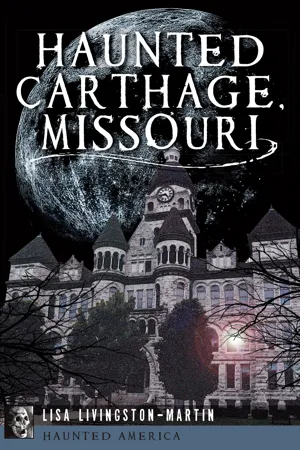
The author of
Civil War Ghosts of Southwest Missouri takes the paranormal pulse of this rustic city in the heart of the Ozarks.
A rich mixture of inexplicable history and eerie happenstance runs through the portion of the Ozark Plateau that Carthage has carved out for itself. Woodland cabins greet visitors with phantom hosts or vanish into the night entirely. Rumors tell of lost Spanish treasure caravans haunting the hills with the same persistence as the Confederate guerrillas who were run aground there. But the town itself isn't immune from the encroachment of the supernatural; the drama of tragic death continues to find a stage in an opera house, a hospital, and an elegant residence. Lisa Livingston-Martin tracks down the fiercest and most fascinating specters from Carthage's past.
Includes photos!
"According to the book
Haunted Carthage, Missouri by Lisa Livingston-Martin, there have been many sightings and various paranormal events in and around Carthage." —
The Joplin Globe
- 145 pages
- English
- ePUB (mobile friendly)
- Available on iOS & Android
eBook - ePub
Haunted Carthage, Missouri
About this book
Information
KENDRICK HOUSE
ANTEBELLUM ELEGANCE AND HAUNTING SPIRITS
Antebellum homes are rare in southwest Missouri due to the scorched-earth policies employed by both sides during the Civil War. The term conjures images of large plantations as are found in the Deep South. Though plantations were located along the Mississippi and Missouri Rivers in Missouri, the land in southern Missouri did not lend itself to large-scale crop farming. Nonetheless, elegant antebellum homes were built here. The oldest surviving example is Kendrick House, on the northern edge of present-day Carthage, at the intersection of Garrison Avenue and VV Highway. When built, it was considered a mansion and one of the most beautiful homes in the area. It was one of three homes in the Carthage area to survive the Civil War and is the oldest standing house in Jasper County. The house was built beginning in 1849 and completed in its current state by 1856.
When the house was built, there were no roads leading to its site. There was a trail off to the east, and the trail that would become Garrison Avenue would be forged from an Indian trail that led to Fort Scott, Kansas, and later would be part of the original Route 66. However, in the 1840s, there was nothing but prairie grass and trees outlining Spring River, several hundred yards to the south.
Sennett Rankin was drawn to this spot in the mid-1840s, building a small log cabin on the northern bank of Spring River just southeast of the house, on which he began construction but that never bore his name. A prosperous farmer with large holdings in the area, Rankin broke ground on the rolling hill above the river in 1849, as slaves tended a forty-acre field carved out of the prairie by horse and man. We have no idea what plans Sennett Rankin and his wife had when they started building what later became known as the “Mansion.” After a couple years, Sennett and his wife moved back to their large farm near present-day Jasper, Missouri, some fifteen miles north, without finishing or ever living in the house. The partially constructed house was sold to Sennett’s son-in-law, Thomas Dawson. Soon, the lure of gold took Dawson to California to seek his fortune. Dawson did not find gold in California. He didn’t finish construction either and never lived in the house. Perhaps as a means of recouping his losses from that search for gold, Dawson sold the still unfinished house and 640 acres of future farmland and orchards to William and Elizabeth Kendrick for the sizeable sum of $7,000 in 1856. At the same time in Jasper County, farmland was selling for approximately $1.25 an acre ($800 for 640 acres). The Kendricks finished the house on the hill and made it their home. They turned the 640 acres of virgin prairie grass into cropland and orchards and operated a successful blacksmithing and gunsmithing business for many years. The Kendrick family and their descendants, including several generations of the Janney family, lived in the home continuously for approximately 130 years, until it was sold to Victorian Carthage in the 1980s, which still owns the home. Approximately 20 acres of the original 640 acres remain with the house.
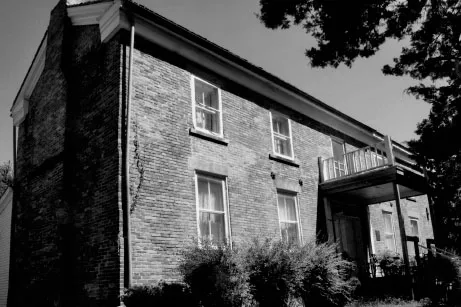
Kendrick House, Carthage. Built in 1849, it is the oldest standing home in Jasper County.
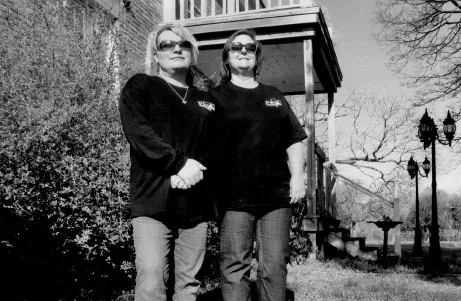
Lisa Livingston-Martin and Mistie Cole, Paranormal Science Lab team leaders, in front of Kendrick House. Courtesy of Paranormal Science Lab. Jordyn Cole, photographer.
Victorian Carthage is a nonprofit group that has as its purpose the preservation and maintenance of Kendrick House as a living museum. Victorian Carthage restored the home in the 1980s to the appearance it would have had in the mid-1800s. Care was taken to use colors, patterns and materials that are representative of the period. For instance, the wallpaper patterns in the home are consistent with those used in the mid-1800s. The wide-plank wood floors appear a pinkish-red color. While they are painted with ordinary house paint today, when first built, the planks were painted with hand-mixed paint tinted with oxen blood to give it the pinkish-red color. The woodwork you see in the house is original, and most is solid walnut from trees felled on the property. The woodwork was hand cut and hand finished by carpenters laboring on site. The limestone windowsills as well as the limestone slabs in the fireplaces and hearths are native limestone or “Carthage marble” quarried just over the hill to the west on what was originally part of Kendrick farm but later became the Carthage Marble quarry. The limestone is hard enough to be polished and in that state is referred to as Carthage marble; it has been used for numerous buildings throughout the state and nation, including the Missouri State Capitol in Jefferson City, Missouri.
Although the city of Carthage had been established by the time Kendrick House was built, it was still a small collection of houses and buildings. It was not readily accessible from Kendrick House, as there were no bridges across Spring River or in all of Jasper County until the 1870s. Everything that was used in construction of the house except for glass for the windows was either material found on the property or items that were made by the workers. For instance, there were no store-bought nails available, so each nail was made by hand by a blacksmith in a forge. The outer walls are red brick, made from the clay from the banks of Spring River, just a few hundred yards from this spot. Sennett Rankin, as well as Dawson and the Kendricks, owned slaves. Rankin was the largest slaveholder in Jasper County, and his slaves built the brick walls. The bricks are concave on the interior side so as to hold more mortar. The exterior walls are three bricks thick, very unusual for construction of the time in the region, where a small log cabin with a hole cut out of one of the logs for a year-round open window was a symbol of permanence. The thickness of the walls meant that the house was better insulated than most buildings of the time. If you look closely, you will find bricks with areas of gray glazing, which was caused when a brick was too close to a hot spot in the wood-fired kilns.
The house is Federal-style architecture, which means that there is an entryway and staircase with symmetrical wings on either side. Although the house looks large from the outside, the original structure consists of four rooms: the dining room and parlor on either side of the entryway on the ground floor and two bedrooms on the second floor. There was no running water in the home until 1954. Water was originally available from the hand-dug well beside the house and a cistern that collected rainwater. There were various outer buildings on site, including a kitchen, slave quarters, blacksmith shop, smokehouse, barns and, later, homes for family members and rental homes for men working in the nearby quarry. The old outhouse still stands out back near the slave cabin. The original slave quarters were brick, like the house, but were demolished sometime in the past. The slave quarters on site were moved from the Miller, Missouri area when Victorian Carthage opened Kendrick House to the public. There have been reports of an African American man wearing a white shirt standing and looking out one of the windows in the slave quarters, staring off into the distance. The sound of harmonica music has been recorded in the slave quarters as well.
Kendrick House drew in people even before the Civil War, known as a stopping point for settlers heading west, where they engaged the blacksmithing and gunsmithing services of William Kendrick and his son Joshua, as well as obtaining supplies and food for their journey. It was considered a mansion for several reasons. First, it was brick and large compared to the log cabins that were standard accommodations for the area. It was outfitted with a full complement of glass windows. Glass had to be hand blown and was a luxury item and quite expensive. It also was not available locally and had to be shipped in from St. Louis, overland by oxen wagon. Imagine crossing nearly four hundred miles of natural brush, prairie and rivers without any graded roads and few bridges—all while trying to keep panes of glass from breaking. That is why houses of the period had shutters—not to keep wind or sun out but to protect the glass from breaking. A broken window meant months of exposure to the elements until it could be replaced. As glass became more common and was available locally, the expense came down, and shutters were no longer a necessity. Photos of Kendrick House taken in the 1890s show that the shutters were in disrepair and some had fallen off the house. Hand-blown glass is made by the craftsman blowing through a glass tube; the air then causes the molten glass to change shape. A consequence of the process was that air bubbles would form in the glass as it cooled and hardened. There are original hand-blown panes of glass in the cabinets in the dining room.
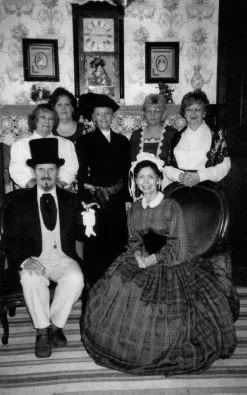
A glimpse of antebellum living in the parlor at Kendrick House. Reenactment photo.
Springfield, Missouri, served as a jumping-off point heading west in southern Missouri. Many wagons would stop at Kendrick House or farther south at the Ritchey House in Newtonia, Missouri, for supplies and water. At Kendrick House, pioneers could obtain goods ranging from bullets to horseshoes to guns. They could also purchase food grown by the Kendricks and produce from their orchards. For many, Kendrick House was the most impressive house they had come into contact with in hundreds of miles. The house also served as a community sick house in the days before hospitals or doctors. People who were seriously ill would be brought to Kendrick House to be cared for until they recovered or passed away. It is unknown how many people died in the house over the years, but it could be considerable, as outbreaks of diseases such as smallpox, malaria and tuberculosis were recurring perils.
With the Kansas state line only twenty miles away, it was only a matter of time before the hostilities in Kansas intruded on the Kendricks’ lives. On the Kendrick farm, tranquility and a lifetime of labor were interrupted on July 5, 1861, when the first large-scale land battle of the war unfolded yards from their front door. Federal troops engaged Jackson at Dry Fork about eight miles north of the Kendrick farm, with fighting coming south and passing along the trail just west of the house, now Garrison Street. Family accounts of the battle say that troops moved south toward Spring River just yards west of the house, causing the men to drop tools and run from the fields in which they were working. During the course of the day’s fighting, Kendrick House was commandeered by Union troops as a hospital, and during the days after the battle it served as a field hospital for Confederate wounded as well.
Kendrick House witnessed its share of brutality from occupation by both armies and raids from bushwhackers. The Kendricks’ slave woman was tortured and hanged by Confederate guerrillas who believed she was hiding a Union soldier. These same guerrillas also tortured the slave woman’s young daughter, Rose, and left her for dead. After the guerrilla raiders left, the family nursed Rose back to health. Rose elected to stay at Kendrick House after the war and worked for the Kendrick family until her death at age ninety-two.
It was common in southwest Missouri for guerrilla fighters as well as regular troops to come to a house and take food and other supplies and livestock, torch crops and buildings and often kill the man of the house. It was not uncommon for the wife and children to recognize members of the lynching party as neighbors and former friends. Some of the Kendricks’ close neighbors suffered this fate, including one man shot sixteen times on his front porch before he could say a word. As a consequence, the Kendricks cut a trapdoor into the floor of the parlor, covered by the rug. The family could hide under the house until danger had passed.
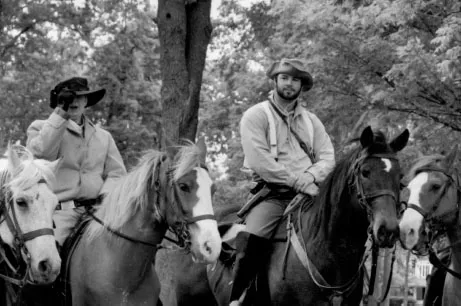
Bushwhackers and raiding parties from both armies were a constant threat to the safety of the civilian population in southwest Missouri during the Civil War. Reenactment photo.
The old Rankin log cabin on the bank of Spring River was occupied by distant Kendrick family members by the name of Ennis. Bushwhackers came through looking for money and valuables. Mr. Ennis was shot dead. Convinced that Mahilia Ennis was hiding money, the bushwhackers tortured her by burning her feet in a fire, to no avail, as she had no money. The men rode on, but Mrs. Ennis was left crippled, unable to ever walk again. The Kendricks brought her to the mansion, and she lived there the rest of her life, helping to care for the Kendrick grandchildren after Joshua’s wife, Elvira, died. Another close call occurred when bushwhackers set fire to the front porch. Horses were hitched to the porch, and the burning timber was pulled away from the house. The family did not rebuild the porch as a reminder of what had happened. Victorian Carthage rebuilt the porch as it originally appeared more than 120 years later.
Confederate general Joseph Shelby used the Kendrick farm as his headquarters and camp in 1863 as he pushed back into Missouri. Kendrick House still bears witness to this presence. A large number of horses was a sign that soldiers were present, so often the horses were brought inside a building to conceal them from notice. Wanting the horses ready to ride in a hurry, they were boarded in the Kendricks’ parlor, where built-in cabinet drawers served as troughs and the horses ate corn gathered from the family’s fields. The family kept some of the ears of corn they found when the soldiers departed, and they can be seen by visitors now, still stored in the parlor. The horses also left hoof prints in the wood floor near the fireplace where they stamped their feet. Again, the family left the floor as it was as a reminder of the past.
It has been speculated that the Kendrick family, despite Confederate leanings, was able to avoid much of the brutal violence, burning and plunder suffered by most of their neighbors due to their profession as blacksmiths and gunsmiths; their services were valuable to the troops and bushwhackers who came through, so they were more valuable alive than dead as long as they didn’t provoke violence. However, William Kendrick, then sixty-five years old, came very close to death at the hands of Union soldiers in late 1864. In the course of carrying out the Federal General Order Number 11—which mandated that all men in southwest Missouri known to have Southern sympathies, or who had not taken the oath of allegiance to the Federal government, vacate the region—a Union unit came to Kendrick House looking for Joshua, known to be a Southern sympathizer.
Joshua and other men had been warned of the approaching soldiers while he was away from home. He decided to head to Newton County for safety. The commanding officer demanded William tell them where his son was, but the elder Kendrick was quite deaf and couldn’t hear what the man had said. Frustrated, the commander drew his pistol, put it to William’s head and pulled the trigger. William’s wife, Elizabeth, rushed forward and placed her thumb under the hammer of the gun, preventing it from firing and saving her husband from a gunshot to the head. The commander became enraged and wildly threatened to kill the Kendricks. His men, appearing embarrassed, pulled him out of the house, with the commander yelling that he would return and kill the whole family. His men apologized to Elizabeth, saying the commander was just drunk and they wouldn’t be back. The family abandoned their home and followed Joshua to Neosho, where they stayed for the last seven months of the war.
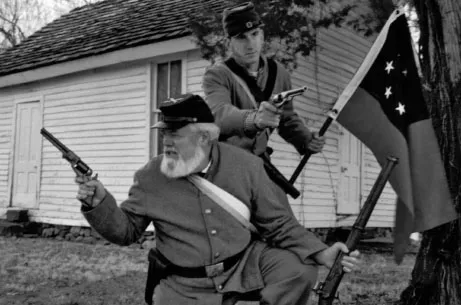
Despite repeated attempts, the Confederates never regained control of southern Missouri after the defeat at Pea Ridge, Arkansas, in 1862. Reenactment photo.
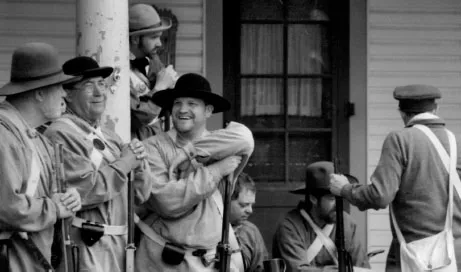
Troops often commandeered homes, food and other supplies from the civilian population, causing more hardship and inflaming hostility. Reenactment photo.
The end of the war marked the resumption of normalcy, and the Kendricks thrived, adding businesses over the years, from a mill to a general store and gas station. The house continued to be used as a sick house for years after the Civil War and was used as the Jasper County Courthouse at times after the war and before a new courthouse was constructed on the square almost thirty years later.
Death was a frequent visitor to the Kendrick-Janney family. Three of William and Elizabeth’s sons died while the Civil War raged around the family: Richard, Alex and Austin, all in their early twenties. William passed away in 1868, followed by Elizabeth in 1878. Joshua’s wife, Elvira, followed in death in 1884. Joshua and Elvira’s daughter, Fannie, with her husband, Carl Janney, raised their family in the mansion. Tragedy struck again in 1899, when Fannie and Carl’s four-year-old daughter, Pauline, died in the house of an unspecified spinal disease. Joshua died in 1901, and Fannie inherited the house and farm.
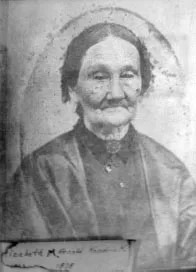
Portrait of Elizabeth Kendrick that hangs in Kendrick House.
The last person to die in Kendrick House was Carol Sue Janney, Fannie and Carl’s granddaughter, who lived ...
Table of contents
- Front Cover
- Half Title
- Title Page
- Copyright
- Dedication
- Contents
- Acknowledgements
- Spiritualism and Southern Culture: Making of Haunted Carthage
- War Descends on Carthage: Fire and Depredation
- Kendrick House: Antebellum Elegance and Haunting Spirits
- Civil War Stories: Whispers around the Campfire
- Battle of Carthage Park: Eternal Reconnoiter
- Haunted Downtown: Postwar Growth
- Logan Landmark: Family Fortune and Tragedy
- Nighttime Visitors: The Watchers
- Prosperity School Bed and Breakfast: Ghostly Lessons
- Jasper County Courthouse: The Past Refuses to Fade Away
- Haunted Schools and Hospitals: Past and Present
- Burlingame & Chaffee Opera House: Cannons, Theater and Murder?
- Paranormal Investigation Methods
- Bibliography
- About the Author
Trusted by 375,005 students
Access to over 1.5 million titles for a fair monthly price.
Study more efficiently using our study tools.
Frequently asked questions
Yes, you can cancel anytime from the Subscription tab in your account settings on the Perlego website. Your subscription will stay active until the end of your current billing period. Learn how to cancel your subscription
No, books cannot be downloaded as external files, such as PDFs, for use outside of Perlego. However, you can download books within the Perlego app for offline reading on mobile or tablet. Learn how to download books offline
Perlego offers two plans: Essential and Complete
- Essential is ideal for learners and professionals who enjoy exploring a wide range of subjects. Access the Essential Library with 800,000+ trusted titles and best-sellers across business, personal growth, and the humanities. Includes unlimited reading time and Standard Read Aloud voice.
- Complete: Perfect for advanced learners and researchers needing full, unrestricted access. Unlock 1.5M+ books across hundreds of subjects, including academic and specialized titles. The Complete Plan also includes advanced features like Premium Read Aloud and Research Assistant.
We are an online textbook subscription service, where you can get access to an entire online library for less than the price of a single book per month. With over 1.5 million books across 990+ topics, we’ve got you covered! Learn about our mission
Look out for the read-aloud symbol on your next book to see if you can listen to it. The read-aloud tool reads text aloud for you, highlighting the text as it is being read. You can pause it, speed it up and slow it down. Learn more about Read Aloud
Yes! You can use the Perlego app on both iOS and Android devices to read anytime, anywhere — even offline. Perfect for commutes or when you’re on the go.
Please note we cannot support devices running on iOS 13 and Android 7 or earlier. Learn more about using the app
Please note we cannot support devices running on iOS 13 and Android 7 or earlier. Learn more about using the app
Yes, you can access Haunted Carthage, Missouri by Lisa Livingston-Martin in PDF and/or ePUB format, as well as other popular books in History & North American History. We have over 1.5 million books available in our catalogue for you to explore.