Drink in the spooky spiritual history of this charming Rocky Mountain town—from the author of
Colorado Legends & Lore.
Manitou Springs has long been known as a spiritual hot spot. From the healing waters of the local springs to the town's patron spirit, the benevolent Emma Crawford, whose life and afterlife is celebrated annually at Halloween, Manitou Springs takes pride in its legends and legendary residents. Join haunted tour guide Stephanie Waters as she uncovers the stories behind some of Manitou's most famous ghostly tales: the historic spirit lights on Pikes Peak, the specters of Red Stone Castle where poor Emma's sister went mad and the phantoms of the stately Cliff House and Briarhurst Manor.
Includes photos!
"Stephanie Waters, author of
Haunted Manitou Springs, theorizes that the greenstone rock, which is plentiful at Red Crags, attracts extra energy in a town that's already no stranger to the mystical. The word Manitou even means spirit." —Manitou Marquee
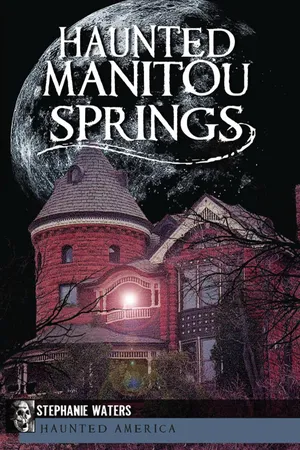
- 115 pages
- English
- ePUB (mobile friendly)
- Available on iOS & Android
eBook - ePub
Haunted Manitou Springs
About this book
Trusted by 375,005 students
Access to over 1.5 million titles for a fair monthly price.
Study more efficiently using our study tools.
Information
MANITOU’S DR. FRANKENSTEIN AND HIS CEMETERY MUMMY
We went to Crystal Hills Cemetery that night on a dare. I never believed the stories of the Manitou mummy until I saw him with my own eyes.
–Darell Smith, Colorado Springs, Colorado
There are many spooky old historic cemeteries scattered about the Pikes Peak region. However, none of them could be more frightening than the Crystal Hills Cemetery in Manitou Springs. The ancient graveyard is older than anyone really knows, as it was used as an Indian burial ground long before the Victorians laid claim to the valley. Several American Indian artifacts such as cradle boards, beads and arrowheads were found when graves were dug on the property.
Native Americans are taught that a person’s spirit remains on earth until their bones disintegrate. Therefore, burial grounds are especially revered in their culture. It is important, they believe, not to disturb the deceased remains because doing so can cause the spirit to become restless and prevent the life force from moving toward the Great Spirit.
The Indian burial ground was known as “Crystal City” by early prospectors, who were looking for gold but instead found a treasure-trove of crystal and various minerals. Beds of smoky quartz crystals, purple amazonite and yellow topaz were in abundance. The hillside was an ideal spot to put the town cemetery but was not the first choice. The Iron Mountain Cemetery earned that distinction. It was established in the 1850s for early French trappers, explorers and pioneers. Most of the graves were relocated to the new Crystal Hills Cemetery on Plainview Place. The isolated cemetery houses the remains of some of the town’s most illustrious citizens. Founding fathers Jerome Wheeler and Dr. Creighton, as well as Dr. Isaac Davis and his extensive clan, are all buried in its keep.
The scenic land is a natural fortress. It is bordered by mountains on three sides, while the north side of the property sweeps down the hillside, exposing picturesque views extending all the way to the Garden of the Gods Park. Cottonwood and evergreen trees are abundant, and bears, deer and other wildlife are just about the only visitors to the secluded grounds. The wrought-iron gates outside the forbidding graveyard are rumored to have been put there to keep someone from leaving the property, rather than for keeping trespassers out.
Speculation about Crystal Hills Cemetery being haunted began when newspapers headlined: “MUMMY ESCAPES FROM CRYSTAL HILLS CEMETERY.” Rumors of the escaped mummy fueled speculation that the new cemetery was haunted. The astonishing news was heralded because a maintenance crew discovered that the burial site of a corpse had been disrupted. Looking into the vacant grave, they found that the cadaver had vanished. The discovery caused alarm among the citizens of the small mountain community of Manitou. Neighbors began locking their doors and windows out of fear that the living dead man was wandering the hillsides. Rumors of the resurrected man spread all the way to Old Towne and Colorado Springs.

A hearse photographed in Crystal Hills Cemetery. Courtesy of Jason Lopez.
The legend of the escaped mummy began in Old Town, which is now known as Old Colorado City. The blue-collar railroad and mining hub was located halfway between Manitou and Colorado Springs. The railroad men and miners from the Golden Cycle Mill frequented the many blue-collar saloons, gambling halls and a few notable whorehouses that were located in the red-light district of Old Town. Cheating in poker and games of chance was common, and tempers would flare. Most of the time these altercations escalated to violence. It was the wild, wild West, and gunfights were commonplace, as were battles with knives, clubs, fists and beer bottles.
Thirty-five-year-old Thomas James O’Neel was a redheaded, bucktoothed Irishman with a bad temper and a propensity toward violence. He was known to conceal a six-inch knife in his boot, which earned him the menacing nickname of Jack Knife Tom. The Irishman was known as a mean, cheating drunk who had once slit the throat of a man because the man made the mistake of winning Tom’s rent money in a game of cards. Witnesses to the macabre scene claimed that wicked Jack Knife Tom laughed while his helpless victim bled dry on a dirt road.
One fateful day, Jack Knife Tom met his match when he cheated the wrong miner out of his hard-earned pay. Tom was asked to step outside and was shot dead on the spot. Lesson? You don’t bring a knife to a gunfight. Jack Knife Tom was kept on ice for the standard three-day holding period while an attempt was made to locate friends or family members of the deceased. When no one stepped forward, El Paso county coroner Dr. Isaac Davis took the dead man into custody.
Dr. Isaac Davis was a founding father of Manitou Springs who lived above his drugstore with his wife and their fifteen children. Davis held positions from undertaker to chief of police. He was also a popular mayor for several terms and the town trustee. Despite all of Dr. Davis’s civil and charitable work, whispers of the man being a demented mad scientist sadly followed him until the end of his days. Dr. Davis was also compared to the fictional Dr. Frankenstein. The similarities between the two mad scientists were hard to ignore, as both doctors liked to demonstrate their art on freshly acquired cadavers, and both of them turned human corpses into monsters.
Dr. Davis believed that the corpse of Jack Knife Tom would make the perfect specimen for his new pet project. The doctor called it a “pet project” because it started with pets—his pets.
Spot was Dr. Davis’s best friend. The wiener dog could hunt, fish, run and swim better than any man he had ever known. The doctor and “his Spot” were constant companions. Davis felt horrible when he let the hound outside for a potty break and the dog didn’t come back. He whistled for his loyal friend several times during the subzero arctic winter storms, but the pup did not return.
Dr. Davis found Spot the next morning frozen to a fence, with his back leg still hiked in midair. The distraught doctor pried the pooch off the wooden post and attempted to revive his frozen body by the fireside. However, when his loyal companion failed to respond, the devastated doctor could not bear the thought of being without his hapless pooch. So during his state of grief, he devised a plan to make his loyal friend immortal. Chemicals were at his disposal, and after only two hours of processing, Spot became pet project no. 1 in a jar labeled “OPPS. Spot 1-20-1880.”
Pickles, his wife’s loudmouthed parrot, was next to be “jarred.” Pickles had had it coming for a long time. The brazen bird resided at the Davis shoe store and would inadvertently offend the customers by screeching, “Stink alert…pretty boy…fat feet…peeeeeeuuuuu.”
Dr. Davis’s pet projects grew to include domestic and nondomestic animals. Mice, snakes and rabbits were common. The various species were pickled in jars and labeled as to their various contents, date and specific embalming recipe. Within time, the good doctor tired of animals and began harvesting human organs from live donors. Dr. Davis was thrilled beyond belief when he delivered Mrs. Whitehurst’s sixth child, a girl after she had given birth to five precocious boys. On that joyous occasion, he proudly announced, “Congratulations, Mrs. Whitehurst. You now have the beautiful baby girl that you have longed for. She is healthy, a nice weight and she has strong lungs. She does, however have an extra ear, but that can be remedied, and at no extra charge.”
The doctor’s favorite hobby was collecting pickled body parts of animal and human organs and appendages. His unusual collection became so large that it expanded from the confines of the scientist’s laboratory. His wife often complained about what a fright it was to find glass jars with floating body parts in them hidden in kitchen cupboards, chamber drawers and closets. She often pleaded with her husband to find more suitable accommodations for his menagerie of monstrosities. Finally, the eccentric physician found the perfect location to conduct his scientific experiments.

A hut in Crystal Hills Cemetery where the mummy of Jack Knife Tom is still seen today. Courtesy of Elizabeth Clinger.
The obvious place to build his secret chamber of horrors was the remote Crystal Hills Cemetery. Dr. Davis donated the cemetery land to the city, so it seemed reasonable to him that he could build his new laboratory there. He built a beautiful stone house under several expansive shade trees. The small rock home had to be kept cool and without much variation in temperature so that the preserved animals and human organs would not decompose in the pickling jars. A fireplace was added to warm the hut during the winter. Wooden shelves and a small desk were installed so that Dr. Davis could work there without being disturbed by his large, extended household. Davis enjoyed the solitude of the stone hut in Crystal Hills Cemetery. He would often bring a picnic lunch to eat as he worked on his projects. The doctor also liked to relax in his hammock outside his laboratory and smoke a corncob pipe while reading science periodicals.
Davis filled the stone abode with an impressive collection of preserved oddities. He had several scalped hairpieces, a few birds’ nests and a collection of crystals, arrowheads and vacated birds eggs. The most cherished part of his collection were the many glass jars that contained unusual artifacts, like the two-headed snake, a six-legged kitten and a stillborn human fetus. All of the specimens floated in glass jars, filled with his secret preservation formula, and were sealed with clear canning wax.
Dr. Davis did not have a jar big enough for Tom O’Neel. After contemplating the dilemma, Davis began to realize that he could possibly mummify an entire human corpse. He began to consider how he could alter the pickling recipe to make the formula viable for human mummification. Next, he took Tom to his stone hut laboratory in Crystal Hills Cemetery and placed Tom’s body in a galvanized bathtub filled with chipped ice, menthol, salts and formaldehyde—the rest of the ingredients were labeled “TOP SECRET.” The work was demanding. All of Tom’s internal and external organs had to be removed, labeled and put into pickling jars. Then his shaved, naked corpse had to be soaked in the secret sauce for five hours a day, after which five more hours were required in the sunlight to air dry the body, ensuring a hard, durable exterior. The process, though time-consuming and tedious, was also rewarding. Davis liked discovering new chemical equations. His newest discovered compound allowed the body to dry at a slower speed, thus ensuring a tighter exterior seal. It was essential that the treatment be repeated on a daily basis without exception. The rotting or molding of the corpse was a constant threat, especially in the early stages of the mummification process. Therefore, many times Davis had to strap Tom to a drying board in front of his drugstore at 104 Canon Avenue, as he was too busy to tend to the mummy elsewhere. The townsfolk were flabbergasted on these occasions. There was no one to file a complaint with, as Dr. Davis was chief of police, town judge and mayor.
After nearly two years of experimenting, Tom O’Neel was declared by Dr. Davis to be the most perfect mummy since the time of the Egyptian pharaohs. There were some understandable differences between the real Tom and the mummified one. Tom weighed nearly two hundred pounds when Davis claimed his corpse. Tom’s mummy weighed only thirty pounds. The mummy was also about four inches shorter and had to wear a wig to hide the small .22-caliber bullet hole in his skull. However, Davis was proud of his creation, despite its minor flaws. He took the mummy of Tom O’Neel everywhere with him. If the distance was short, he would just throw the mummy over his shoulder like a sack of potatoes. Other times, he would pull him in the little wagon that he had built especially for his ever-ready sidekick.
Tom was an interesting conversation piece. The doctor liked to joke that Tom was a much better man dead and embalmed than he ever was alive. He never drank too much, cheated at poker or picked fights like the old Tom. Dr. Davis also teased that his mummy didn’t argue, eat much or snore, thus making him a more suitable companion than his dearly loved wife. Davis was often seen with Tom having lunch in the park, drinking beer at the saloon or hanging out with the old-timers at the barbershop. Leon Jenkins enjoyed propping Tom in the barber’s chair and lathering him up for a shave just to watch the reaction of people passing by the shop window. Davis also found it amusing to dress Tom as a woman and pose him as if he were kissing the cigar store Indian in front of his drugstore.
If it was attention that Davis wanted by carting Tom everywhere, he sure got it. The mummy attracted not only the local tourists but the attentions of several drug and cosmetic companies as well. Davis had big plans for the new secret pickling formula. He planned to market the prized fluid to cosmetic and drug companies. The secret solution worked wonders as a mummification formula—just think what it could do for crow’s feet, liver spots and piles. Unfortunately, his miracle formula never attained a patent, and his dreams of building a pharmaceutical empire were extinguished. In 1891, Dr. Davis, one of the town’s founding fathers and a true Renaissance man, died from brain disease at the age of fifty-five. His last request was that he be buried where he spent his happiest days, in Crystal Hills Cemetery, not far from the stone house he built for his buddy Tom. Hundreds of people attended Dr. Davis’s funeral. While at the graveside services, a group of curious children wandered into Davis’s unlocked stone hut laboratory and ran shrieking from the building after discovering its gruesome secret.
A few weeks after Dr. Davis’s funeral, people in town requested that the grieving widow rid the little stone house in Crystal Hills Cemetery of its awful contents and that she finally give the battered and abused Tom a respectable funeral. The mummified remains of Tom were finally buried not far from Dr. Davis, in the pauper section of Crystal Hills Cemetery.
Tom did not rest in peace for long. Shortly after his retirement and burial, the mummified corpse became the victim of two callous grave robbers. The thieves responsible for the hijinks were a day laborer from Kansas named Bruce Kring and a local homeless man, down on his luck, known as Bryan Kiper. The desperados became fast friends after bonding over an arm-wrestling match and a round of beer. Kiper joked with Kring about a funeral that had been held that afternoon for a mummified man in Manitou. The two men had a good laugh while pondering all of the funny things one could do with a used mummy. Then Kring had a bright idea. He confided to his newfound friend that he had heard about a two-headed calf back in his home state. He figured that if they combined the calf and the mummified man, they could have a traveling freak show. They could make up a story about finding the mummy in a Manitou cave, dress him up like a Native American and market their creation as the petrified Indian from the Grand Caverns of Manitou Springs.
Late that very night, the sleazy pair of opportunists stole a wagon from the livery and drove to Crystal Hills Cemetery. It was not hard to find the mummy, as the grave had just been covered with fresh, dark soil. Next they dressed Tom up as an Indian chief and sealed him in a pine box. Then the dynamic duo hastily made their way to the train depot. While waiting for the train to depart, Kring and Kiper went across the street to a saloon, where the two men bought a round for the house and toasted to their new business venture. The partners had so much fun celebrating that they missed the train, and Tom left without them.
Officials at the railroad depot in Kansas City grew suspicious days later when the coffin-like box went unclaimed. When they pried the box open and discovered the mummy, they immediately suspected grave robbery. Two days later, Kring and Kiper arrived at the Kansas City train station to claim their hard-earned prize and were immediately arrested, booked on charges of grave robbery and thrown in the slammer. Tom’s new owners sat in county jail for several days until officials received affidavits stating that there had been no grave robberies in the vicinity. Without a doubt, the responding authorities in Manitou were glad to have the buffoons out of the region and didn’t want to sign an extradition to bring the fugitives back. When the thieves were released from jail, they sold Tom to a traveling carnival.
Tom’s second career in life was a great success. He fulfilled his long-held dream of traveling to distant places and meeting interesting people with his lesser-known companions, a two-headed calf and a headless chicken. Tom was a curiosity and was promoted as the Petrified Indian of the Manitou Caverns. Tom O’Neel became the first mummified human to hold a full-time job. He became a celebrity and was seen all over the country. Sometimes he would have signs hung around his neck advertising a grand opening of some sort. In 1942, he was seen propped outside a bakery in Julian, California. He was photographed wearing an apron and peddling homemade cookies. Tom would be gratified to know that he finally got to visit the Pacific Ocean.
In September 1967, the Frontier Times Newspaper quoted Manitou historian Bill Crosby:
I heard nothing further of him [the mummified Tom O’Neel] until the turn of the century, when my wife, our small son and I attended the Portland Fairway, were walking down the midway and heard a barker in front of a concession inviting people to see the Petrified Indian from Manitou Grand Caverns in Colorado. I suggested that we go take a look, for I thought I’d know that Indian; chances are it would be old Tom. It was. He was decked out in the same fashion buckskin clothes, stone beads, and arrowheads scattered around his body, tomahawk in one hand, only now he wore a black wig to make him look more authentic. After the barker had delivered a short lecture and the crowd had gone on, I told him that I knew the history of the “Indian,” and told him the story. He finally admitted that he’d purchased Tom in Minneapolis for $2,600. That’s the last I ever heard or saw Tom O’Neel. He looked so genuine, though. I bet he’s still on display somewhere and making lots of money for someone.
Over the last century, the menacing ghost of the mummified Jack K...
Table of contents
- Front Cover
- Title Page
- Copyright
- Dedication
- Contents
- Acknowledgements
- Introduction: Why Did I Become a Manitoid?
- The Benevolent Spirit of Red Mountain
- The Dramatic Phantoms of Iron Mountain
- The Naked Hitchhiker of Pikes Peak
- The Residual Phantom of the Cliff House Hotel
- The Crisis Apparition at the Barker House
- Terror at Historical Red Crags and the Briarhurst Manor
- Haunted Hill and Miramont Castle Museum
- Séance at Onaledge
- Haunted Midland Railroad Tunnels
- Manitou’s Dr. Frankenstein and His Cemetery Mummy
- Cave of the Winds Spirits and the Huccies Witches
- The Eggman: Manitou’s Most Menacing Ghost
- Other Hauntings
- Afterword
- Bibliography
- About the Author
Frequently asked questions
Yes, you can cancel anytime from the Subscription tab in your account settings on the Perlego website. Your subscription will stay active until the end of your current billing period. Learn how to cancel your subscription
No, books cannot be downloaded as external files, such as PDFs, for use outside of Perlego. However, you can download books within the Perlego app for offline reading on mobile or tablet. Learn how to download books offline
Perlego offers two plans: Essential and Complete
- Essential is ideal for learners and professionals who enjoy exploring a wide range of subjects. Access the Essential Library with 800,000+ trusted titles and best-sellers across business, personal growth, and the humanities. Includes unlimited reading time and Standard Read Aloud voice.
- Complete: Perfect for advanced learners and researchers needing full, unrestricted access. Unlock 1.5M+ books across hundreds of subjects, including academic and specialized titles. The Complete Plan also includes advanced features like Premium Read Aloud and Research Assistant.
We are an online textbook subscription service, where you can get access to an entire online library for less than the price of a single book per month. With over 1.5 million books across 990+ topics, we’ve got you covered! Learn about our mission
Look out for the read-aloud symbol on your next book to see if you can listen to it. The read-aloud tool reads text aloud for you, highlighting the text as it is being read. You can pause it, speed it up and slow it down. Learn more about Read Aloud
Yes! You can use the Perlego app on both iOS and Android devices to read anytime, anywhere — even offline. Perfect for commutes or when you’re on the go.
Please note we cannot support devices running on iOS 13 and Android 7 or earlier. Learn more about using the app
Please note we cannot support devices running on iOS 13 and Android 7 or earlier. Learn more about using the app
Yes, you can access Haunted Manitou Springs by Stephanie Waters in PDF and/or ePUB format, as well as other popular books in History & North American History. We have over 1.5 million books available in our catalogue for you to explore.