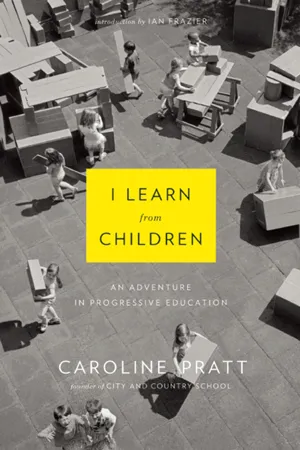
The memoir of an innovative American educator and the remarkable school she built—"a lucid presentation of what progressive education can accomplish" ( The New York Times ). Over a century ago, American educator Caroline Pratt created an innovative school that fosters creativity and independent thought by asking the provocative question: "Was it unreasonable to try to fit the school to the child, rather than... the child to the school?" A strong-willed small-town schoolteacher who ran a one-room schoolhouse by the time she was seventeen, Pratt came to viscerally reject the teaching methods of her day, which often featured a long-winded teacher at the front of the room and rows of miserable children sitting on benches nailed to the floor. In this "persuasive presentation of progressive education, " Pratt recounts how she founded what is now the dynamic City and Country School in New York City, invented the "unit blocks" that have become a staple in classrooms around the globe, and played an important role in reimagining preschool and primary-school education in ways that are essential for the tumultuously creative time we live in today ( Kirkus Reviews ).
- 320 pages
- English
- ePUB (mobile friendly)
- Available on iOS & Android
eBook - ePub
About this book
Information
Topic
EducationSubtopic
Elementary EducationCHAPTER ONE
What Is a School?
Often during my three decades in the City and Country School I have thought we should have a doctor on hand at all times. Not for the children (we took care of that) but for innocent visitors to our classrooms. Sometimes, emerging from a morning of observation, they have seemed visibly to be suffering from shock!
This was not likely to be true of mothers—a mother more often came away from her first visit with a look of bewildered pleasure. She had watched a group of happy children without always knowing what they were happy about, but for the moment it was enough that they were happy.
Occasionally a father looked jolted, worried; how, in that turmoil, would his son ever get ready for Harvard?
But the sharpest reaction could be counted on to come from the good teacher whose entire life had been spent in a traditional classroom.
“Do you call this a school?” She would ask the question in terms more or less politely veiled depending on how far her principles had been outraged. And I could sympathize with her, having served my time in the kind of classroom where each child sits on a bench nailed to the floor, at a desk as firmly fixed in its place, incommunicado as far as all the other children are concerned—and the teacher at the front of the room sternly bound to maintain the discipline without which, it is assumed, the work will not get done.
I have put such a teacher among, say, our sixth graders, the Elevens, to share a part of their full and busy day. By contrast to the nailed-down dependability of her own classroom, here nothing was fixed, nothing stayed put, not even the furniture—above all, not the children!
Some would be in the print room, turning out a job. There they were anchored at least to the presses; yet through the wide doorway there would be a constant movement of active young bodies round and round among typecases and stock shelves, with a chatter of voices as continuous as the hum and clatter of the presses. Orders, comments, criticisms, a shouted question to the teacher from the foreman of the week: “We finished the Sevens’ reading work—shall we start on the library card order or the Parents’ Association letterheads?”
Within the classroom itself there would be no stillness, either visual or auditory. Treble howls of disagreement might be rising from the corner where the editorial committee of the Elevens’ magazine, soon going to press, debated the literary merits of a nine-year-old’s story—or a Thirteen’s, the more sharply criticized because of the author’s advanced age. A pigtailed Eight bounded into the room, her small face solemnly on duty bent, a canvas mail pouch hanging from her shoulders; postman from the Eights’ post office, she carried a special delivery letter, an invitation to the Elevens from the Tens to attend a performance of their play in the gym the next morning. Two Elevens returned, laden with packages of paper, pencils, notebooks, jars of bright paints, supplies bought for the group at the school store run by the Nines. A tall Twelve, splotches of mimeographing ink competing with the freckles on his nose, carried in a stack of copies of The Yardbird, the weekly newspaper published by his group, to be sold later at 1¢ apiece. (The price, I understand, has recently risen to 3¢—another case of rising costs of production.)
Half a dozen Elevens might now bang in from work in the science room, the clay room, the shop, and you could tell which, for the marks of their labors would be plain on their worn and stained dungarees. With the new arrivals there would be a shifting of tables and chairs, a foraging in lockers to get out an arithmetic book which needed correcting, a linoleum cut to be finished, a topic—Astronomy in the Middle Ages—to be written up in a notebook. The teacher might be asked, “How much time before Yard?” but rarely, “What shall we do now?” Each child apparently knew what unfinished work he had on hand and promptly applied himself to it. From the class treasurer of the week, pushing a lock of brown hair behind an ear while she worked on her accounts, there might come a piteous wail—“We’ll have to stop losing pencils! If we have to buy pencils again this week we can’t afford the trip to Chinatown!”
And swirling around the visitor’s head, beating against her unaccustomed ears, there was noise, until the walls of the room must bulge with it. Of twenty souls in the room, only one was quiet—the teacher.
Of course the visitor was right in her complaint: this did not look or sound like any schoolroom. But it was very much like something else. It was like a segment of grown-up activity, an office, a small factory, or perhaps office and factory combined. Nor did these children look like schoolchildren, starched and clean-faced, the boys in white shirts, the girls in crisp frocks. These children wore work clothes, dungarees or overalls, boys and girls alike (occasionally a dress, the exercise of individual prerogative), and they and their work clothes bore the evidences of their work. “Do they have to get so dirty?” mothers have been asking for thirty years. But was there ever a printer without ink on his trousers and his cheek, a cook without flour on her elbows and aprons?
This classroom was a place where work was done. The workers could not be fastened down; they had to come and go about their various jobs, fetch supplies, seek advice, examine, compare, discuss. The work got done, not in proportion to the silence in the room, but in proportion to the responsibility of each worker to his job and to the group. Some were more able, more responsible workers than others—as among adults. And, as among adults, there was a supervisor (not a boss, however) directing, counseling, channeling the abundant energies of these young workers, keeping the balance among personalities, keeping the schedule of the day’s program and its constantly varying tasks, checking the accomplishment of both group and individual.
No wonder the visitor was confounded. The movement bewildered her; the noise came between her and the work. But she was the only one in the room who was bewildered. She could not see the pattern, so unlike the traditional one with which she was familiar, so much more complex. Yet it was an obvious and familiar pattern, seen everywhere except in the traditional schoolroom. It was the traditional pattern, rather than this one, which was strange and unfamiliar. This one was the normal pattern of human activity, adult or child. Because these were children, the noise was louder, the movement more explosive. And because these were children, the task of the teacher and her student-teacher assistant was so much more than merely that of a shop foreman or a supervisor in an adult project that here, in truth, the analogy breaks down. This teacher had a task so subtle, so exacting, that a traditionally trained teacher could scarcely hope to comprehend it at a glance.
And if she asked us, as in one way or another she always did, is this a school—we could ask in our turn, what is a school?
To answer that a school is a place of learning is no answer at all, but only another way of stating the question. A place of learning what? A place of learning how?
I was seventeen when I taught my first class—a one-room school in the country—and I had had none of the benefits of normal school, teacher training, nor even, possibly, had ever heard the word pedagogy. What I did have was a deep conviction, unspoken, indeed unconscious until much later, that a desire to learn was as natural and inevitable in children as the desire to walk in babies.
_fmt-plgo-compressed.webp)
_fmt-plgo-compressed.webp)
How could anyone doubt that it was? Once beyond the eating-sleeping stage, every day, every hour of a young child’s waking life is devoted to adventure, exploration, discovery of the world around him. His fiercest struggles are to learn—to turn over, to sit up, to walk, to climb; later, to grasp a toy, to shake a rattle, to roll and recapture a ball; still later, to investigate the working of light switches, telephones, clocks. (“Why must he be so destructive?” protests the dismayed mother, but our forefathers had to see their houses burned down before they knew how fire worked.) His greatest frustrations, aside from his own limitations, are the restrictions placed upon him by the adult world in his effort to touch, to feel, to see and smell and taste. And his method of learning? The first and best one, the one used by Neanderthal man and by the atomic scientist—trial and error.
No one who has watched a baby return to his lessons day after day—and persist in them despite bumps and bruises—can doubt the drive of the young human being to learn. And indeed if man did not have this compulsion to explore, to understand, and to conquer or at least come to t...
Table of contents
- Cover
- I LEARN from CHILDREN
- Title Page
- Copyright Page
- Dedication
- Contents
- INTRODUCTION by IAN FRAZIER
- AUTHOR'S FOREWORD
- I LEARN from CHILDREN
- CHAPTER ONE What is a School?
- CHAPTER TWO First Experiments
- CHAPTER THREE Trial Flight
- CHAPTER FOUR School Begins
- CHAPTER FIVE New Teachers for a New School
- CHAPTER SIX We Leave MacDougal Alley
- CHAPTER SEVEN Sevens-A Growing-up Year
- CHAPTER EIGHT The Eights Take a Job
- CHAPTER NINE More Jobs for Children
- CHAPTER TEN Book-Learning Has Its Turn
- CHAPTER ELEVEN Plays-By and for Children
- CHAPTER TWELVE Democracy in Miniture
- CHAPTER THIRTEEN A Teacher Cooperative
- CHAPTER FOURTEEN The Education of Parents
- CITY AND COUNTRY AT ONE HUNDRED by Kate Turley
- REFERENCES
- Caroline Pratt, City and Country School, and Progressive Education in the United States
- Acknowledgments
- List of Illustrations
- Back Cover
Trusted by 375,005 students
Access to over 1.5 million titles for a fair monthly price.
Study more efficiently using our study tools.
Frequently asked questions
Yes, you can cancel anytime from the Subscription tab in your account settings on the Perlego website. Your subscription will stay active until the end of your current billing period. Learn how to cancel your subscription
No, books cannot be downloaded as external files, such as PDFs, for use outside of Perlego. However, you can download books within the Perlego app for offline reading on mobile or tablet. Learn how to download books offline
Perlego offers two plans: Essential and Complete
- Essential is ideal for learners and professionals who enjoy exploring a wide range of subjects. Access the Essential Library with 800,000+ trusted titles and best-sellers across business, personal growth, and the humanities. Includes unlimited reading time and Standard Read Aloud voice.
- Complete: Perfect for advanced learners and researchers needing full, unrestricted access. Unlock 1.5M+ books across hundreds of subjects, including academic and specialized titles. The Complete Plan also includes advanced features like Premium Read Aloud and Research Assistant.
We are an online textbook subscription service, where you can get access to an entire online library for less than the price of a single book per month. With over 1.5 million books across 990+ topics, we’ve got you covered! Learn about our mission
Look out for the read-aloud symbol on your next book to see if you can listen to it. The read-aloud tool reads text aloud for you, highlighting the text as it is being read. You can pause it, speed it up and slow it down. Learn more about Read Aloud
Yes! You can use the Perlego app on both iOS and Android devices to read anytime, anywhere — even offline. Perfect for commutes or when you’re on the go.
Please note we cannot support devices running on iOS 13 and Android 7 or earlier. Learn more about using the app
Please note we cannot support devices running on iOS 13 and Android 7 or earlier. Learn more about using the app
Yes, you can access I Learn from Children by Caroline Pratt in PDF and/or ePUB format, as well as other popular books in Education & Elementary Education. We have over 1.5 million books available in our catalogue for you to explore.