An expert in business turnaround shares his inspiring approach to problem-solving: "A fascinating read" (Mitt Romney).
Visionary leader Greg Brenneman believes that true business success and personal fulfillment are two sides of the same coin. The techniques that will grow your business will also help you achieve a rich, purposeful, and integrated life. Here, Brenneman takes what he's learned from turning around or tuning up many businesses—including Continental Airlines and Burger King—and distills it into a simple, clear, five-step roadmap that anyone can follow. He teaches you how to:
*prepare a succinct Go Forward plan
*build a fortress balance sheet
*grow your sales and profits
*choose all-star servant leaders
*empower your team
For more than thirty years, Brenneman has seen these steps foster dramatic results in a variety of business environments. But he also came to realize that he could apply these same principles to improve his life and build a lasting moral legacy. He found he could make better decisions by carefully taking the most important facets of his life—faith, family, friendship, fitness, and finance—into consideration. Brenneman's inspiring examples, from both his business and his life, demonstrate the astounding effects these steps can have when you apply them—right away and all at once.
eBook - ePub
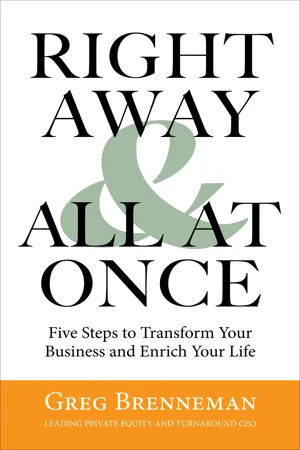
Right Away & All at Once
Five Steps to Transform Your Business and Enrich Your Life
- 240 pages
- English
- ePUB (mobile friendly)
- Available on iOS & Android
eBook - ePub
About this book
Information
Step 1
Have a Plan and Track Your Progress

Take the first step in faith. You don’t have to see the whole staircase, just take the first step.Dr. Martin Luther King Jr.
One of my good friends, Erik Weihenmayer, often tells me, “Great plans allow you to accomplish difficult tasks with measured risk.” He should know, because he’s constantly off somewhere in the world on some amazing adventure—and without a plan, he probably would have crashed and burned a long time ago.
Erik has climbed all seven of the highest summits in the world, including Everest, Denali, and Kilimanjaro. He’s climbed the rock wall of El Capitan in Yosemite National Park, one of the toughest in the world. He paraglides. Last fall he finished a 277-mile kayak voyage down the Grand Canyon, including all its dangerous rapids. He also climbs ice waterfalls while hanging hundreds of feet in the air.
And did I mention that Erik is blind?
Erik is now in his mid-forties and every year adds to his long list of adventures. That he’s still alive is a testament to his superb planning.
Erik and I first met at a Pepsi CEO event in Venice, where I heard him speak along with a lot of other top-shelf communicators including Tony Blair, Deepak Chopra, and Newt Gingrich. Erik topped them all, by far. By the time he finished his talk, you could have heard a pin drop.
Erik had synced his speech with a video playing behind him. I’ll never forget the scene shot in his own backyard in Golden, Colorado. He set up a ladder a foot above the ground and then practiced walking across it. He fell down a lot, got back up, and continued to practice. Suddenly the video switched to some dramatic footage of his climb over the Khumbu icefall on Mt. Everest. He had to walk on rickety ladders across deep crevasses plunging thousands of feet. I watched, almost breathless, as Erik slowly made his way across those shaking ladders, loaded down with his massive backpack. And I kept thinking, he’s blind!
A short while later, at my invitation, he and his ski guide came up to Beaver Creek and we skied together for a day, in the process becoming fast friends. Ever since, he and his family ski with us a few times a year.
Erik has been a huge inspiration to me. Not only does he humiliate me into embracing a no-barriers mindset—last summer we climbed three 14,000-foot peaks together in one day—but whether he’s skiing, kayaking, or presenting, I’ve never seen a guy work harder on developing a sound, well-researched plan. And yes, that includes surrounding himself with great teammates and guides, such as Eric Alexander, who led him up Everest, and Jeff Ulrich, who guides him when skiing. Erik does this because he knows that if his plans fail, he may not make it. And so he always has a rigorous plan.
The same is true in business. If you want to make it, you must have a solid plan.
The Importance of a One-Page Plan
It’s critical that you develop a very simple, one-page plan to help you reach whatever business destination you have in mind. This is the all-important Step One of my five-step process.
When I worked at Continental, we used to tell our pilots, “We are going east today. East is 090 on the compass. You could go 070 to 110 (directionally east) and I’d be okay with that. But if you decide to go 270, you’ll have to turn your butt around.”
Stephen Covey emphasized a similar principle in his book The 7 Habits of Highly Effective People. He insisted on the importance of “beginning with the end in mind.” The main point of developing a one-page plan is that it helps you to begin with the end in mind. It permits you to say with utter clarity, “This is where we want to be three years from now with our company.” In a powerfully succinct way, it lays out how you intend to get “there.”
Where to begin? First you need to identify the three to five critical levers that drive your business. (I’ll talk more about this important concept in a bit.) If you require more than one page to lay out the key parts of your plan, then you’ll have almost no chance of actually executing it. You must pinpoint the key activities that, once accomplished, will take you most of the way to becoming a great company. Many call this the 80/20 rule, where 20 percent of the identified actions yield 80 percent of the results. In most businesses, I think it’s probably more like 90/10.
Every year, I sit down with CEOs of the new businesses we buy and ask them to bring me their strategic plans. Most of the time, they bring one of two things: either a huge, thick document with enormous detail that requires a forklift to move (which you know hasn’t come off the shelf since it was written), or four to six pages of tiny script filled with long lists of to-do items. Neither is a strategic plan. Nobody in a company can communicate, action, or track that many items.
Studies show that our brains are pretty good at remembering three or four major categories and then recalling three to five elements categorized beneath each of those categories. If we try to remember fifteen to twenty strategic goals without any categories, or without subdividing them, we almost always fail. Your one-page plan should be so clear, so condensed, and so potent that everyone in your company can remember these key items and take appropriate action on them.
Let others help you develop your plan. Invite your board and management team to comment on it, discuss it, and change it. In the end, they need to own the plan too. Their input will make it better. I’d even encourage you to ask some of the younger, high-potential men and women in your company to give you feedback. You will be surprised by the fresh perspective that they bring. If you’re not the CEO, no worries. A one-page plan can be applied to a division, department, or function to achieve similar results.
Once you finish, assign each item on the one-page plan to an executive or a team, who creates even more detailed plans about how to achieve that particular objective. They should also develop a target and a “stretch” goal so you can measure progress. I ask them to develop a plan for the first one hundred days to make sure they get off to a fast start. As Peter Drucker said, “what gets measured gets managed.” Measurement is critical.
You’ll see a good example of a one-page plan later in this chapter for a company called Generac (and another in the appendix for Continental).
The Necessity of Identifying Value Drivers
The key to being able to get your plan on one page is to thoroughly understand the value drivers of your business. What is a value driver? You already know of about a million tasks you could pursue to improve your business. These are actually pretty easy to identify. It’s difficult, however, to boil down that long list to the three or five actions that really matter, that really drive profitability. When I talk about value drivers, I’m talking about that short list.
Do you have businesses, for example, that are losing money? Stop doing that. The fastest way to make money is to stop doing things that lose it. Do you have businesses you should acquire, businesses that fit perfectly with yours? By all means, pursue them. Are you providing your customers with the type of service they want and will pay for? If not, figure out how to do so. You must be able to clearly identify the levers that, once pulled, will make your business hum. Sound easy? It really isn’t.
To help you identify the correct value drivers, I’ll recommend some strategic planning tools in a bit. If this reads too much like a trip back to business school, then just skim the material. But remember, your plan has to be right or you may end up destroying your company.
I began learning how to identify value drivers for businesses at Harvard Business School, where I pored over hundreds of business cases. I received seven additional years of excellent training at Bain, one of the top consulting firms in the world. I then spent several more years leading a succession of high-profile turnarounds and did a very similar thing on boards. My last seven years at a large private equity firm have further sharpened my proficiency at this skill—and yet I still struggle at times to identify this or that company’s key value drivers.
Think of the Domino Theory you experimented with as a kid. The key value drivers are like the lead domino in a complicated design. When the lead domino falls, all the other dominos fall, in order. If you get the value drivers right in your company, it’s like knocking over that lead domino and watching all the others fall. It’s a beautiful thing. If you get them wrong, however, it’s like having spent hours setting up the dominos individually and knocking them over one at a time. Not so beautiful.
Let’s start by examining the value drivers of two very different companies: PricewaterhouseCoopers Consulting (PwCC) and Generac.
PwCC: Two Levers and a Quick Sale
PricewaterhouseCoopers Consulting found itself battling gale-force headwinds in 2002. As the information technology consulting industry contracted, three external factors caused the firm to lose a full third of its business in just a few months.
First, Y2K had ended (and the world did not come to an end, despite many projections to the contrary), and focus on the worrisome change from 1999 to 2000 was over.
Second, the original dot.com bubble burst.
And third, the implosion of companies like Enron, Global Crossing, WorldCom, and others prompted the SEC to require companies to get their consulting services from anyone but their auditor. That meant that the audit clients of PricewaterhouseCoopers had to stop using PwCC’s consulting services—and almost half of PwCC’s business came from those audit clients. Without a dramatic turnaround, the company’s very survival seemed in doubt. Its dire situation became even more difficult when the SEC started breathing down the firm’s neck, requiring it to fix the business in just three months.
I had been brought on as CEO to apply the five steps. We managed to do the heavy lifting in just a month. The process ended not in an IPO as planned, but in a very attractive $4 billion sale of the company to IBM. Ginni Rometty, the current chairman and CEO of IBM, did a great job navigating the deal and successfully integrating the two companies.
To get to that point, I had to sit down and very quickly figure out the key value drivers so I could write a one-page plan and lead the PwCC partners toward the planned IPO. Almost immediately, I found two primary value drivers that would allow us to take the business from a 4 percent margin business to a 12 percent margin business (nearly matching the margins of Accenture, our largest competitor), which would allow the company to go public.
The first value driver allowed us to get PwCC to the appropriate number of partners it needed to support its smaller business. I looked at revenue per partner in 1999—right before Y2K, the dot.com boom, and the fraud that prompted the SEC changes—and then at revenue per partner in 2002. I found that we had about a third too many partners, some ...
Table of contents
- Title Page
- Praise for Right Away and All At Once
- Copyright
- Dedication
- Acknowledgments
- Introduction: Looking for Results
- Who Needs a Turnaround?
- The Five Steps
- Step 1
- Step 2
- Step 3
- Step 4
- Step 5
- Right Away and All At Once
- Epilogue: Act Now
- Appendix: An Airline Learns to Fly Right
- Endnotes
Trusted by 375,005 students
Access to over 1.5 million titles for a fair monthly price.
Study more efficiently using our study tools.
Frequently asked questions
Yes, you can cancel anytime from the Subscription tab in your account settings on the Perlego website. Your subscription will stay active until the end of your current billing period. Learn how to cancel your subscription
No, books cannot be downloaded as external files, such as PDFs, for use outside of Perlego. However, you can download books within the Perlego app for offline reading on mobile or tablet. Learn how to download books offline
Perlego offers two plans: Essential and Complete
- Essential is ideal for learners and professionals who enjoy exploring a wide range of subjects. Access the Essential Library with 800,000+ trusted titles and best-sellers across business, personal growth, and the humanities. Includes unlimited reading time and Standard Read Aloud voice.
- Complete: Perfect for advanced learners and researchers needing full, unrestricted access. Unlock 1.5M+ books across hundreds of subjects, including academic and specialized titles. The Complete Plan also includes advanced features like Premium Read Aloud and Research Assistant.
We are an online textbook subscription service, where you can get access to an entire online library for less than the price of a single book per month. With over 1.5 million books across 990+ topics, we’ve got you covered! Learn about our mission
Look out for the read-aloud symbol on your next book to see if you can listen to it. The read-aloud tool reads text aloud for you, highlighting the text as it is being read. You can pause it, speed it up and slow it down. Learn more about Read Aloud
Yes! You can use the Perlego app on both iOS and Android devices to read anytime, anywhere — even offline. Perfect for commutes or when you’re on the go.
Please note we cannot support devices running on iOS 13 and Android 7 or earlier. Learn more about using the app
Please note we cannot support devices running on iOS 13 and Android 7 or earlier. Learn more about using the app
Yes, you can access Right Away & All at Once by Greg Brenneman in PDF and/or ePUB format, as well as other popular books in Business & Business General. We have over 1.5 million books available in our catalogue for you to explore.