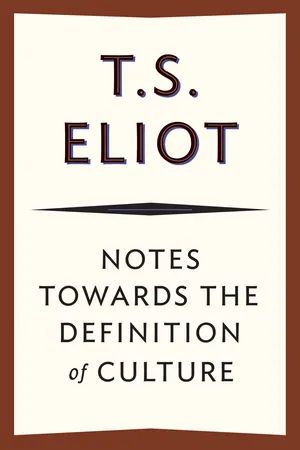
This critique of modern society argues that culture must be organic, and cannot be planned or imposed.
The word
culture has been widely and erroneously employed in political, educational, and journalistic contexts. In helping to define a word so greatly misused, T. S. Eliot contradicts many of our popular assumptions about culture, reminding us that it is not the possession of any one class but of a whole society—and yet its preservation may depend on the continuance of a class system, and that a "classless" society may be a society in which culture has ceased to exist.
Surveying the post–World War II world, Eliot finds evidence of decay in cultural standards in every department of human activity, and expects the phenomenon to continue. He suggests that culture and religion have a common root—and if one decays, the other may die too. In observing the superpowers of his day and the course of recent history, he reminds us that "the Russians have been the first modern people to practise the political direction of culture consciously, and to attack at every point the culture of any people whom they wish to dominate."
The appendix includes Eliot's broadcasts to Europe, ending with a plea to preserve the legacy of Greece, Rome, and Israel, and Europe's legacy throughout the last two thousand years.
"Behind the urbanity, the modesty, the mere good manners of Mr. Eliot's exposition, one cannot mistake the force and significance of what he has to say, or ignore that it constitutes a fundamental attack on most of our assumptions on the subject." —
The Spectator
- 128 pages
- English
- ePUB (mobile friendly)
- Available on iOS & Android
eBook - ePub
Notes Towards the Definition of Culture
About this book
Information
Subtopic
Religious Literary CriticismIndex
LiteratureTable of contents
- Title Page
- Table of Contents
- Copyright
- Dedication
- Preface
- Introduction
- The Three Senses of “Culture”
- The Class and the Elite
- Unity and Diversity: The Region
- Unity and Diversity: Sect and Cult
- A Note on Culture and Politics
- Notes on Education and Culture: and Conclusion
- Appendix
- About the Author
- Footnotes
Trusted by 375,005 students
Access to over 1.5 million titles for a fair monthly price.
Study more efficiently using our study tools.
Frequently asked questions
Yes, you can cancel anytime from the Subscription tab in your account settings on the Perlego website. Your subscription will stay active until the end of your current billing period. Learn how to cancel your subscription
No, books cannot be downloaded as external files, such as PDFs, for use outside of Perlego. However, you can download books within the Perlego app for offline reading on mobile or tablet. Learn how to download books offline
Perlego offers two plans: Essential and Complete
- Essential is ideal for learners and professionals who enjoy exploring a wide range of subjects. Access the Essential Library with 800,000+ trusted titles and best-sellers across business, personal growth, and the humanities. Includes unlimited reading time and Standard Read Aloud voice.
- Complete: Perfect for advanced learners and researchers needing full, unrestricted access. Unlock 1.5M+ books across hundreds of subjects, including academic and specialized titles. The Complete Plan also includes advanced features like Premium Read Aloud and Research Assistant.
We are an online textbook subscription service, where you can get access to an entire online library for less than the price of a single book per month. With over 1.5 million books across 990+ topics, we’ve got you covered! Learn about our mission
Look out for the read-aloud symbol on your next book to see if you can listen to it. The read-aloud tool reads text aloud for you, highlighting the text as it is being read. You can pause it, speed it up and slow it down. Learn more about Read Aloud
Yes! You can use the Perlego app on both iOS and Android devices to read anytime, anywhere — even offline. Perfect for commutes or when you’re on the go.
Please note we cannot support devices running on iOS 13 and Android 7 or earlier. Learn more about using the app
Please note we cannot support devices running on iOS 13 and Android 7 or earlier. Learn more about using the app
Yes, you can access Notes Towards the Definition of Culture by T. S. Eliot in PDF and/or ePUB format, as well as other popular books in Literature & Religious Literary Criticism. We have over 1.5 million books available in our catalogue for you to explore.