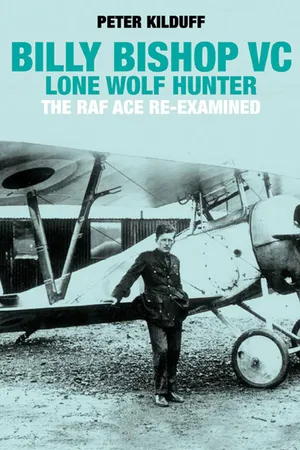
A "superb" look at one of the Great War's most storied combat pilots and his legendary solo missions, with never-before-published photos (Barrett Tillman).
William Avery Bishop is recognized as the British Empire's highest-scoring WWI ace, credited with seventy-two combat victories. Overall, he ranked behind only Manfred von Richthofen and René Fonck.
This remarkable man's story—his personal courage, daring, and superior marksmanship—has been detailed in books and articles, but here author Peter Kilduff investigates the untold story, bringing new light to missions and kills that have been previously steeped in controversy through evenhanded, thorough research and forensic evidence. As so many of Bishop's victories were achieved during solo combat, the author examines and scrutinizes German, British, and Canadian archival sources, Bishop's private correspondence, and accounts by friends and foes. Such an approach provides as complete an account as possible, in a valuable work featuring many previously unpublished photographs.
"Kilduff is not the first to conduct such an inquiry into Bishop's claim of 72 victories, but his book is by far the best researched . . . expertly laid out, with photos of the aircraft mentioned by Bishop, particularly the German types. Kilduff has done a marvelous and subtle job of showing how a real hero became larger than life." —
Aviation History
- 192 pages
- English
- ePUB (mobile friendly)
- Available on iOS & Android
eBook - ePub
About this book
Trusted by 375,005 students
Access to over 1.5 million titles for a fair monthly price.
Study more efficiently using our study tools.
Information
CHAPTER ONE
The Lone Wolf Strikes
‘Ambition was born in my breast, and … along with this new ambition there was born in me as well a distinct dislike for all two-seated German flying machines… Many people think of the two-seater as a superior fighting machine because of its greater gun-power. But to me [it] always seemed [to be] fair prey and an easy target …’
– William A. Bishop1
– William A. Bishop1
Tuesday, 28 May 1918 was a mostly sunny day2, heralding the arrival of summer. In the sky over Ypres, Belgium, a dark mottled German two-seat biplane circled the war-ravaged old city, occasionally swooping low over buildings and roads pummelled into the Flemish soil during nearly four years of artillery and troop assaults. With fierce Allied resistance to another German assault now underway, it was too dangerous for the aeroplane continually to orbit overhead, where it could be seen against the sky.
Every time the two-seater rose up, it headed north west, so the aerial observer could view British artillery units firing at German positions. Through high-powered binoculars, he looked for big red muzzle flashes. Like a high-altitude sniper armed with a wireless telegraph, once he spotted his quarry, he tapped out its location to a ground station, which directed artillery units against the British gun emplacement. The observer sent messages confirming target hits or to adjust their fire.

The Rumpler C.VII was Germany’s premier high-altitude reconnaissance aeroplane. Powered by a 240-hp super-compressed Maybach engine, the two-seater could reach altitudes approaching 24,000 feet. (Greg VanWyngarden)

Line-up of Royal Aircraft Factory S.E.5a fighters assigned to 85 Squadron, RAF. Billy Bishop flew the aeroplane in the foreground – C.1904 – in the last thirteen aerial combats in which he was credited with aerial victories. (Greg VanWyngarden)
Eyes in the Sky
The experienced observer, twenty-three-year-old Leutnant der Reserve [Second-Lieutenant, Reserves] Hanns-Gerd Rabe, knew that Allied single-seat fighters would be looking for his aeroplane. He and his pilot, Unteroffizier [Corporal] Peter Johannes, scanned the skies for tell-tale distant specks – Allied aircraft bent on shooting them down in order to save lives among their own ground forces.
Johannes drew Rabe’s attention to a small, growing spot in the distance. It turned out to be a lone British single- seat aeroplane. Rabe later recalled:
‘It was quite far off, so I was not worried about one Tommy fighterplane. Then he seemed to have disappeared, perhaps to find a more opportune target.
‘I returned to looking at the target area with my binoculars, watching for the next shell to hit. Suddenly an S.E.5a fighter aeroplane came between me and the target and filled my view. It was gaining fast and through the binoculars I could see the aeroplane as if I were next to it. The first thing I noticed was the white octagon insignia on the fuselage side and a big white letter next to it. I recognised the symbols from a report I had read recently. Mein Gott! It was Bishop, the British Richthofen!
‘We had to make a fast dive for our lines. The engine was not yet at full power, so I leaned over to my pilot and yelled: “Dive for home! Right now or we are done for!”
‘He gave full power and pushed the machine over into a streaking dive eastwards. I looked through the binoculars at Mr. Bishop, who became smaller and smaller, and I was overjoyed that we had managed to elude this master fighter pilot. If given a choice, I would always avoid combat and the possible loss of the exposed photographic plates and notes I had made earlier in the flight.’3

Fl.-Abt (A) 253 observer Ltn.d.Res Hanns-Gerd Rabe (left) and his pilot, Uffz Peter Johannes (middle), also flew low-level reconnaissance missions in Hannover Cl.IIIa 2714/18. The ‘bird’ insignia on the fuselage alludes to the name Rabe [Raven]. Aircraft mechanic Noll is at right. (Author’s Collection)
Wary of tricks, Rabe tightly gripped the stock of his machine gun. He was ready to fend off any aeroplane that attacked from behind or – even worse – from above, with the sun at its back, making it difficult to see. Likewise, Johannes readied his forward-firing machine gun in case any adversary impeded their retreat.
Rabe’s decision was vindicated that evening, when he and Johannes were back at Flieger-Abteilung (A) 253’s airfield at Pont à Marcq, France, some seventeen miles south east of Ypres. Their comrades agreed that the lone British attacker must have been the (then) forty-eight-victory fighter ace Major William A. Bishop, VC, DSO and Bar, MC, and that there was no shame in declining to fight such a formidable opponent.4

Major William A. Bishop, VC, DSO and Bar, MC, was a forty-eight-victory ace when he pursued Ltn.d.Res Rabe and Uffz Johannes on 28 May 1918. (Directorate of History and Heritage, Department of National Defence photo RE-16579-1)

The Albatros D.III enjoyed a long service life. Seen here is an aeroplane built by the company’s subsidiary OAW (East German Albatros Works) in Schneidemühl and decorated in summer 1918 national insignia. (Dr. Volker Koos)
At age twenty-four, Billy Bishop enjoyed a formidable reputation among German airmen, who whispered his name with fear.5 But later that morning, Billy – as he was called by most people – was still angry with himself for failing to shoot down the two-seater.
After lunch Bishop flew another solo hunting mission, heading eastward toward Courtemarck, where he attacked two Albatros biplane fighters. At day’s end, his usual high spirits were restored by his latest successes and he easily dismissed the opponent that got away. He wrote about it to his wife:
‘I went up to the lines this morning and only succeeded in frightening a fat two-seater to death. He ran for all he was worth, so I didn’t follow. This afternoon, however, was my lucky moment. I spied nine Albatros [fighters] under me … The two back ones were higher than the rest, so I went after them. They saw me when I was 150 yards away. I opened fire on one, twenty rounds, and passed on to the second one, who was doing a climbing turn. I [put] thirty rounds into him and then zoomed and saw the second one burst into flames. Then looking over, the first one, 600 feet lower, [was] also in flames. I then left well enough alone and cleared off, easily getting away from the remainder.’ 6
Conflicting Reports
That letter is the most detailed surviving account of Billy’s combat activities on 28 May 1918. Copies of combat reports about his morning and afternoon patrols have not been found in the UK National Archives or in any other such known resource in Britain or Canada. He was credited with scoring his forty-ninth and fiftieth aerial victories7 in that day’s entry in the Royal Air Force War Diary. They were among twenty-eight EA [enemy aeroplanes] credited as having been shot down by RAF airmen that day.8 Yet, the German weekly Nachrichtenblatt [air intelligence summary] for the period listed only eight losses – three aircraft reported missing and five shot down across the entire Western Front.9 A post-war German aviation necrology,10 however, lists twenty-three air-related deaths on 28 May 1918; of that number nineteen occurred over the Western Front.11
Determining which of those casualties Billy Bishop caused is complicated by reports from the German 4th Army air staff, over whose sector the Canadian pilot’s combats occurred. Hauptmann [Captain] Helmuth Wilberg, who was the 4th Army’s officer in charge of aviation, reported five casualties within his area that day. His listing included Gefreiter [Lance-Corporal] Peisker, a pilot with the Pfalz D.IIIa-equipped fighter unit Jagdstaffel 7, who was reported as being ‘lightly injured while making an emergency landing’.12 But Jasta 7’s commanding officer, Ltn.d.Res Josef Jacobs, had not mentioned Gefr Peisker’s incident in his war diary; rather, he recorded that another pilot, Uffz Sicho, ‘had been shot up by an S.E.5a and was wounded in the arm and upper leg’.13 Jacobs stated that Sicho’s wounds resulted from an early morning encounter with ‘five S.E.5s who were [fighting] with a formation of Albatros D.V’ aircraft.14
The preceding assemblage of casualty information does not help identify which German aircraft or unit Billy encountered, but it demonstrates the confusing array of facts to be considered in arriving at a hypothesis. Further, in his letter that evening, Billy Bishop said he saw both Albatros fighters on fire. Possibly, one or both German pilots managed to extinguish the flames or make a ‘controlled crash’ that wrecked the aircraft but did not kill the pilots.
One remarkable aspect about aerial combat during World War I is that, often, opponents were able to recognise each other. Easily the best-known example is the series of red (or mostly red) fighter aircraft flown by Germany’s top-scoring fighter ace, Rittmeister [Cavalry Captain] Manfred Freiherr von Richthofen, the pilot to whom Ltn.d.Res Rabe alluded when he recognised Bishop pursuing him on 28 May. In addition to being easily identified in the air, Richthofen’s distinctive aircraft helped create a bogey-man image, which at least put his opponents on edge. Similarly, Billy’s rapid rise to high-scoring ace status made him of high interest to his German counterparts. Shared word-of-mouth descriptions of Allied squadron markings (often revealed in prisoner of war interrogations) and the sight of a fighter aircraft, whose pilot was so bold as to operate like a lone wolf, convinced Rabe that a single S.E.5a bearing a white octagon and large white number on the fuselage must have been Billy Bishop’s. Rabe’s letter home, describing the date, time of day and location of his encounter matched the incident that Bishop described to his wife. That historical evidence led this author to conclude that Rabe and Bishop most likely had an aerial encounter over Ypres.
There are many facets to Billy Bishop’s story. Before delving into the air combat role for which he is best known, the man and events that shaped him should be considered.
Family History
Billy Bishop was descended from people with strong convictions and the courage to act on them. An example of those qualities is his Puritan ancestor John Seaman, who left England in 1630, during the tumultuous reign of King Charles I, for a more stable life in North America. Seaman sailed aboard one of eleven ships led by John Winthrop to the Massachusetts Bay Colony. From there, Seaman set out for neighbouring Connecticut and then to Long Island, where he found success.15
Well over a century later, when increasing numbers of American colonists sought independence from England, Bishop’s maternal great-great-grandfather, Caleb Seaman II, remained loyal to the British crown. Following the American Revolution and the subsequent British troop withdrawal in 1783, Seaman was continually harassed about his sentiments. Consequently, six years later, he and his wife and their two children moved to Canada, where Caleb became a blacksmith near the village of Rockville.16
Caleb’s son Nehemiah married the daughter of another loyalist-émigré family, Margaret M...
Table of contents
- Cover
- Title Page
- Copyright
- Contents
- Foreword
- Chapter One The Lone Wolf Strikes
- Chapter Two Long Journey to the Front
- Chapter Three Bad Aircraft and Bad Luck
- Chapter Four From Albion to Zeppelins
- Chapter Five First Triumphs
- Chapter Six Bloody April
- Chapter Seven Transformations
- Chapter Eight Attack in the Darkness
- Chapter Nine Growing Success
- Chapter Ten A Hero at Last
- Chapter Eleven Winged Victory
- Chapter Twelve What Price Success?
- Appendix Aerial Victory List of William A. Bishop
- Bibliography & Sources
- Endnotes
- Maps
- Index
Frequently asked questions
Yes, you can cancel anytime from the Subscription tab in your account settings on the Perlego website. Your subscription will stay active until the end of your current billing period. Learn how to cancel your subscription
No, books cannot be downloaded as external files, such as PDFs, for use outside of Perlego. However, you can download books within the Perlego app for offline reading on mobile or tablet. Learn how to download books offline
Perlego offers two plans: Essential and Complete
- Essential is ideal for learners and professionals who enjoy exploring a wide range of subjects. Access the Essential Library with 800,000+ trusted titles and best-sellers across business, personal growth, and the humanities. Includes unlimited reading time and Standard Read Aloud voice.
- Complete: Perfect for advanced learners and researchers needing full, unrestricted access. Unlock 1.5M+ books across hundreds of subjects, including academic and specialized titles. The Complete Plan also includes advanced features like Premium Read Aloud and Research Assistant.
We are an online textbook subscription service, where you can get access to an entire online library for less than the price of a single book per month. With over 1.5 million books across 990+ topics, we’ve got you covered! Learn about our mission
Look out for the read-aloud symbol on your next book to see if you can listen to it. The read-aloud tool reads text aloud for you, highlighting the text as it is being read. You can pause it, speed it up and slow it down. Learn more about Read Aloud
Yes! You can use the Perlego app on both iOS and Android devices to read anytime, anywhere — even offline. Perfect for commutes or when you’re on the go.
Please note we cannot support devices running on iOS 13 and Android 7 or earlier. Learn more about using the app
Please note we cannot support devices running on iOS 13 and Android 7 or earlier. Learn more about using the app
Yes, you can access Billy Bishop VC: Lone Wolf Hunter by Peter Kilduff in PDF and/or ePUB format, as well as other popular books in History & Military Biographies. We have over 1.5 million books available in our catalogue for you to explore.