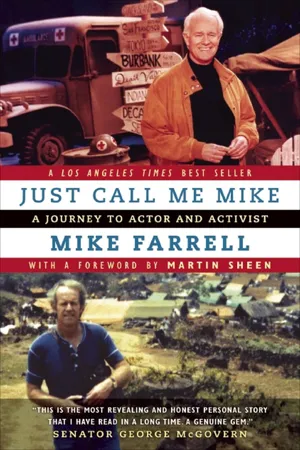
Los Angeles Times bestseller: A memoir by the
M*A*S*H actor revealing his hardscrabble childhood, his life in Hollywood, and his passion for human rights.
Best known for his eight years on
M*A*S*H and his five seasons on
Providence, Mike Farrell is also a writer, director, and producer—and a fiercely dedicated activist who has served on human rights and peace delegations to countries around the world as well as working tirelessly on the issue of the death penalty. In
Just Call Me Mike, he not only tells his story but reveals the candidness and decency that has endeared him not only to his fans but to commentators across the political divide.
"In this honest autobiography, Farrell, who played B.J. Hunnicutt in the TV series
M*A*S*H, provides intimate accounts of growing up working-class in the shadows of wealthy Hollywood, overcoming personal demons as he starts his acting career and finding happiness in the popular sitcom and what he describes as a supportive and cohesive cast and crew. Throughout the series, Farrell also began to pursue an interest in politics and human rights that took him to Cambodia, Honduras, Nicaragua and El Salvador, and his passionate descriptions of the human rights abuses in those countries show why Farrell currently is considered one of Hollywood's most prominent activists." —
Publishers Weekly
"A stand-up guy . . . His book,
Just Call Me Mike, will entertain and inform you far beyond most autobiographies. Farrell's life is fascinating and his journey is well worth your time." —Bill O'Reilly
"He describes the fantastic, sometimes painful, and ultimately redeeming journey that his conscience has led him on . . . Disarmingly honest." —Kamala Harris
"Farrell doesn't hesitate to put himself on the line, whether writing about his troubled past, the behind-the-scenes conflicts on the
M*A*S*H set, or his human rights activism." —
The Sacramento Bee
- 380 pages
- English
- ePUB (mobile friendly)
- Available on iOS & Android
eBook - ePub
About this book
Information
Print ISBN
9781933354484
Subtopic
Social Science BiographiesChapter 1
HOME
My growing up was done here in Southern California, in a small, unincorporated strip of Los Angeles County known as West Hollywood. That was before West Hollywood became a city of its own. There was no magic dividing line—at least none visible—but we were just across the tracks from Beverly Hills, where the houses were huge, the streets quiet, the cars new, and the police quick to check when anyone looked like he didn’t belong. Everything was as it should be—complete with a veneer of entitlement.
West Hollywood included the famous Sunset Strip, though that was way above us, literally and figuratively, and the entire shootin’ match was patrolled by L.A. County Sheriffs. They didn’t bother us much, probably because they paid more attention to the small Mexican community living in an unpaved area of run-down prefabricated bungalows just south of Santa Monica Boulevard by the big barn where the streetcars slept. The streetcar tracks bisected West Hollywood and ran along Santa Monica all the way from the beach right through our section and on to downtown L.A., with a branch cutting up northeast at Fairfax through people’s backyards and making a loop through Hollywood, down the storied boulevard, then connecting back to the downtown line. The streetcar was our link to the world.
We were a fairly typical working-class Irish Catholic family. My folks brought us—me, my younger brother and older sister—out from South St. Paul, Minnesota, when Jim was a baby, I was two, and Sally about seven, because Dad needed work, there was talk of war, and here, it was said, the streets were paved with gold.
Dad’s younger brother Matt was already here. A dashing, handsome man, an ice skater with Sonja Henie’s troupe, he had been an extra in movies and was now an even more arresting figure in the uniform of the Army Air Corps. He encouraged Dad to come west where jobs were plentiful and a hard-working man could do well.
Dad was a tough guy, the eldest of four kids brought up by a rigid, unpleasant mother and a father who, while a gregarious and popular fellow, traveled a lot, drank, gambled, and fought. He died in a fight, as the story goes, and Dad, still a young man, had to travel to the Dakotas or Montana or someplace to reclaim the body and bring it home. The oldest of three brothers and a sister, Dad’s was a struggle against the forces that kept a workingman down. Sometime lumber-jack, roustabout, deputy sheriff, and stockyard hand, he was a keenly intelligent man with little formal education who understood that work was the key to survival. Michael Joseph Farrell was my dad’s name, same as mine. He went by Joe, while I’ve always been Mike.
Agnes Sarah Cosgrove Farrell, our mom, was one of ten kids. Raised in the Minnesota countryside in tough circumstances—read poor—that got tougher after her father was killed when she was still a child, Ag was a homemaker who never forgot that she came from a world where getting an apple in her stocking for Christmas was a thrill. Though her family was split up, first by World War I and then the Depression, the bonds never weakened. Eventually they all gathered in South St. Paul, where work was available in the stockyards, and they ended up living within blocks of one another, most for the rest of their lives. Agnes graduated high school, where she learned shorthand, and avoided the stockyards, for a while working as a clerk at the FBI office in St. Paul, something about which we teased her in later years. She said she had once seen John Dillinger—or was it Pretty Boy Floyd? Whichever, he was a handsome, dapper man who had the office in a flutter.
Agnes and Joe met at a dance, courted, married, and settled down. Work was not easy to come by as the war approached, so after struggling for a few years, Dad responded to the siren call of the West Coast and packed up his family. Leaving her mother and siblings must have been terribly painful for Mom, who was notoriously easily moved to tears, but she was made of tough stuff and had a strong sense of loyalty. She stood by her man in the same way she stuck by her faith, with a deep and abiding commitment. If there were questions, none of us ever heard them. And once situated in California, she put all her energies into making a home. She cooked; she cleaned; she sewed; she bathed us and read to us and bandaged our wounds. She scrimped; she saved; she shopped; she cleaned; she cooked; she scrimped; she saved. She was always busy at something, and whatever she was doing, no matter how boring or tiring it might have been, she hummed as she did it.
She saved. I hated, hated, hated that she took us to the “Old Store,” the Goodwill, to buy our clothes. This was long before used clothing was a fashion trend, and it stung mightily. The smell of that store, the idea of having to wear shoes, pants or a shirt that someone had cast off, the notion that the other kids we knew got to have their own brand-new clothes, all made me hot with shame. I dreaded the fact that someone might see us going in or out of the Old Store. It doesn’t take a genius to understand why I now have more shoes than I can wear and a tough time throwing things away even when I no longer have any use for them.
We did live in a nice house in a nice neighborhood, money notwithstanding. Not ritzy, of course, this was the county strip. Mom cracked about the “lace-curtain Irish” and the “shanty Irish,” and despite the work she did to keep the house and all of us clean, it was clear which ones we were. Dad had to borrow money for the down payment from his mother, whom we knew as “Gommie.” In addition to having a room in our house that was off-limits to all of us whether she was there or not, Gommie also extracted a few pounds of flesh on an ongoing basis from both my parents for having made the house possible.
Gommie was a horror. Tough, mean, hard, bitter, bigoted, strict, doubtless miserably unhappy, she gave no quarter and, though none of us ever had the guts to check, probably asked none in return. She was a baby nurse—what we today call a live-in nanny—usually working for quite well-to-do families, sometimes for years. The thought horrifies me still. She was a neurosis-inducing machine if there ever was one, and I shudder to think of those poor kids today, trying to work things out on a psychiatrist’s couch or in a bottle somewhere. On vacation or between jobs, Gommie came to live with us, periods in which the dread quotient at home rose perceptibly. She lived to quite an advanced age and softened considerably in the later years, poor dear, but by then the damage was done.
Grannie, Mom’s mom, was Sarah “Sade” Cosgrove, who died not too long after we came to California. I remember a teary Mom getting on a train to go back for the funeral. She took Jim, who was too young to leave with us. I have few actual memories of Grannie, only that she was a sweet woman of considerable girth and an even bigger heart. Raising ten kids on her own was a monumental task in those days—in any days—and she succeeded to the degree that her memory is cherished and she was always spoken of with great affection. I’m told that when I was a tot in Minnesota, I was Grannie’s “cookie boy.”
We Farrell kids never knew either of our grandfathers, something that feels like more of a loss as I think of it today. As with Mom torn from her family and Dad thrust out on his own, we had to find our way without the guideposts some consider essential.
Sally was a very smart girl who suffered the particular difficulties associated with having been born blind in one eye, the blind one discolored. Our folks lacked the money to have the eye replaced with a false one that more nearly matched the good one, so she dealt daily with the humiliation of being “different” or, probably worse from her perspective, unattractive. Sally was an independent soul, doubtless toughened by experience. She was the only one of us who had the temerity to disobey orders from Dad, though even she would not do so openly.
Jim was cute, bright, cheerful, and enormously talented—good at everything, with an inner gyroscope that always had him landing on his feet. He was a charming kid who won friends easily and kept them. He suffered from being the little brother, of course, and I was so consumed by my need for attention and affection from Dad that I gave him short shrift, much to my later dismay. As a result, or perhaps simply because of his own adventurous spirit, he began early to blaze an independent trail.
In all, ours was what we thought of as a “happy” family. Except for the fear. Dad was a tough guy—he probably learned to fight from his father and to wield a wicked, sarcastic tongue from his mother. He was a big man, powerful and commanding, and like many men of his era, not given to tenderness or expressions of sentiment. He wasn’t comfortable with emotion, his or other people’s, and he protected himself well, clearly buying into the old cliché about the best defense. He wasn’t physically brutal in the sense that we think of as child abuse today, but if any of us stepped out of line, one way or another, we quickly regretted it. Worse, we (or maybe I should speak only for myself) lived in terror of the devastation that would result if he were ever to truly unleash his arsenal.
Drinking wasn’t just something that happened on special occasions in our house. It was pretty much a constant. Beer was the drug of choice; the hard stuff wasn’t usually brought out unless friends or family were over. And when not at work, Dad (and sometimes Mom) could often be found at the local bar less than a block away.
A great deal was demanded of us kids, most of it stuff we had to intuit. Nobody talked about anything real, but it seemed we were expected to know everything. One learns in that situation to listen well, especially for the unspoken warnings. The antennae are always up. Certain things were understood, most of them negatives. You didn’t cry. You didn’t say certain words. You didn’t do certain things. If you got into a fight, you were in trouble, but if you didn’t win, it was worse. You learned by listening well, watching the signals, and being smart enough to stay ahead of the storm. Or you learned by doing it wrong and paying the price. To this day, whenever stepping into a room, I check things out carefully. I listen well and am good at watching for signals, sensing tension, picking up nuance. Survival instinct well learned.
Our deal was you went to church and to confession and to communion. You believed in the Virgin Birth and the Holy Trinity, and you got down on your knees and said your prayers morning and night. “Lord, I am not worthy …” was the mantra. You did those things because that was the way it was done. If you didn’t, it was a sin, and you’d go to Hell. Since getting up and off to school on time was always a problem for me, I worked out what I thought was a pretty good compromise and tried saying my prayers twice at night to save time in the morning. Unsure if this was acceptable to God, I checked it through his emissary, the priest in the confessional. Not a chance, he said. So much for compromise; good intentions be damned.
It didn’t matter that you didn’t understand what was being said at Mass; you went anyway, and you knelt when they knelt and stood when they stood. And you struck your breast when the bells rang and made sure God knew you knew you weren’t worthy. Sure it was a dead language, but there was a reason for doing it exactly that way. There must have been. To question meant Hell. It didn’t matter, either, that you couldn’t understand what Father O’Reilly said after Mass, though that was supposed to be English. He talked so fast with his brogue so thick that all I understood was that I was Michael the Archangel and a soldier of the Lord. I wasn’t sure what a soldier of the Lord was supposed to do, but it became pretty clear what he wasn’t supposed to do. The list of “don’ts” kept getting longer, the load heavier, but you couldn’t ask why because that was one of the don’ts. What I “got” was that this was the way it had always been done and this was the way it was supposed to be done. There were a lot of mysteries, and there was a lot of fear: fear of God, fear of Dad, fear of pain, fear of failure, fear of not measuring up. It was hard to figure out exactly what we were supposed to measure up to, but it was probably hanging on the cross up there.
World War II was fought at home in a number of ways. Our door was always open to friends and family, some in uniform. Rose, one of Mom’s sisters, came out and went to work at a war plant, a regular Rosie the Riveter. Mom shopped even more carefully, using scrip and little ration coins, and was excited when the chance came to buy meat. We had no bubble gum because, the story went, the Army needed rubber for tires for jeeps and trucks. My one clear memory is of pulling up in Dad’s old Pontiac and getting out at the curb beside our house as the man on the radio announced, “The war is over!” That was good, I could tell.
Not too long thereafter, we got a call in the middle of the night—one of those you learn to dread. Uncle Matt, the dashing, handsome, uniformed hero, had been killed in an automobile accident. What followed was the first of what now seems a regular succession of Irish wakes at our house, with Matt’s body there in our dining room in an open coffin, looking waxen and stiff, but sort of okay. There was a sickening smell of too many flowers; lots of adults shuffling around, lots of drinking, lots of murmured stories, and lots of tears, though mostly from the women. Of course nobody explained anything to the kids; we just got to watch and listen and try to figure it all out.
A couple of years later, when I was about seven or eight, Jim and I were taken out for a long ride by friends of the family. It was weird; we knew these people, but they didn’t normally just take us for rides. I don’t know where Sally was—and Mom was gone for some reason—but I knew this was a weird ride. Nobody told us where we were going, and, in fact, nobody seemed to have a very clear idea about that. There was a lot of chitchat, some coded words exchanged, and a lot of discomfort, all of which made me increasingly ill at ease and certain that there was something terribly wrong. But of course I couldn’t say that. That’s not what we did. Finally, after an hours-long, weird, boring, and unnervingly mysterious ride, it was apparently time for us to head back home. What a relief! And when we got there, Dad was bringing Mom home, and with them was a baby: our new little sister Kathy. That’s how it works, we learned. People you don’t know very well take you for a weird ride, and when you come home, you have a new baby sister.
Kathy was a cute kid and very smart. She was pretty and fun, and we were all family. Maybe she was all that was needed and everything would now become clear. But no; she added a few new notes, but it was the same tune. We watched over her and enjoyed her, always making sure she was okay. Kathy was, as she grew up a bit, the only one of us who had Dad’s coloring. She had his dark hair and brown eyes, while Jim, Sally, and I all had blue eyes and light hair like Mom’s side of the family. Maybe it was that, or maybe it was simply that she was his little girl, but Dad was always affectionate with Kathy, picking her up and hugging her when she came running as he got home from work. I envied her so much I ached.
I kept trying to win his approval. I was the nicest, the best little boy I knew how to be, smiling and hiding the fact that I hadn’t yet figured it out. If being “good” would do it, I was going for the gold star. I’m sure I was a huge pain in the ass. I know I was a prig. But I so wanted him to let me know I was okay that everything else took a distant second. As I see it now, I was afraid that I didn’t exist without his approval. He simply terrified me. I hated living in fear all the time, but the awareness that pain awaited any misstep—not necessarily physical pain, but certainly humiliation and rejection—hung like a shroud over everything, and it took years to recognize the rage it produced. It has much to do, I know, with the degree to which I simply cannot tolerate injustice.
I certainly never gave voice to it then; I never even recognized it. He was Dad, for Christ’s sake, and I was just a kid. He was the biggest, toughest bastard on the block: great-looking, smart, charming. He was just a workingman, of course, but so popular and powerful that, to my mind, he was John Wayne—Plus. You crossed him, you were dead meat. I don’t know how many times he came down the street from Bill Ruby’s bar, the nearby saloon, burst through the front door and announced, “If the cops come, I’m not home,” then headed for the bedroom, leaving us open-mouthed, full of questions we were unable to ask, deputized to cover for him. Mom dealt with it stoically. She dealt with everything stoically. Sometimes she was with him at Ruby’s or some other joint, sometimes not. When she was, another man paying her too much attention might end up flat on his back, initiating a quick departure and our deputization.
Don’t get me wrong; it wasn’t a constant brawl, nor was our home a place of horror. There were quiet times, good times. Dad coached our Cub Scout softball team, if rarely, and, when I took up the trumpet, used to have me play “Oh, My Papa” for friends after enough drinks were shared. There were certainly laughs; it’s just that everything seemed overlain with a sense of potential explosion. Dad worked hard, worked constantly, it seemed. Mom too. And when Dad came home from work, we’d eat, he’d lie on the couch and fall asleep; and then, if we dared wake him because we couldn’t hear the TV over his snoring, he’d get up and go to bed. I understand now that working himself sick to keep food on the table and a roof over our heads was his way of showing he loved us. The quick temper, the sarcasm, the fighting, while part of his personal legacy, were also signs of personal torment, probably frustration at not being able to do more for us. I get that now, after years of struggling and thinking and working and therapizing and fuming and weeping over it. Now doesn’t help the terrified little kid I was then, except for the part of me that’s still him. Then was when it would have really helped. He just never gave it words. Nor did he show it in a way I could understand. Mom was the same, I guess, though more gentle about it. She came from the same tradition and wasn’t given to loving words or even loving pats. She showed up. But there were no hugs. We didn’t touch. It’s just the way they had learned it, I suppose. But God, it was lonely.
They arose before dawn. He ate; she heated water for him to pour into the radiator of his old car. Then he was off to work, and she got us up for school. She fed us, made our lunches, got us off, and then did her cleaning and shopping. During the war there was the rationing; after it there was still the rationing imposed by pocketbook, but she made do without complaint. From trailing along with her sometimes, we knew that she’d walk miles, from store to store, in order to save pennies on some needed item. She was a world-class shopper and a marathon walker. But she was always there when we got home from school, cleaning and cooking and humming. And dinner was on the table when Dad came home from work.
We grew up, and the dynamic didn’t change much. We figured things out the best we could and caught hell when we got it wrong. When old enough, we got work, Sal being the first to have a real job. After high school, after she had saved enough money and, I assume, Mom and Dad helped out as best they could, Sal finally had the operation to remove her bad eye and put in a replacement that more resembled the good one. It still wasn’t the same, didn’t move correctly with the other one, but it was closer.
After mowing lawns or doing odd jobs enough to save for a used bike, I got a paper route. Jim went with me until he was old enough to have his own. Mom would often help us fold the papers before we took off to deliver. The headlines were about war in Korea and the Commies here at home, but none of it had much impact on our lives from what I could see, except to begin my fascination with the Marines as the embodiment of everything manly and tough. I still wanted Dad’s approval and recognition, though try as I might, the most I could get from him was the occasional acknowledgment, more often ridicule or a cutting, embarrassing remark, too often in front of friends. Nurturing was not in the vocabulary back then.
Left alone, for the most part, to find our way in the world, we looked outside for our lessons, hoping for counsel and support, each bearing in our own way the cross of unmet hopes and dreams. For me it was the aching need for acceptance and appreciation, for love—if not from my dad from someone somewhere, but really from my dad—that would validate my existence, help me understand this life I feared and was sure I was getting wrong. And somewhere in my subconscious, I held onto the sound of my mother humming.
That’s hardly an exhaustive description of home and family, of course. It’s only a cursory glance at the early days, but it’s in these days that images, ideals, and concepts are formed, character begins to be defined, and one’s sense of life’s purpose takes shape. For me it was a daunting world in which disaster lurked. Things were not at all clear. What I knew without question was that those with power were often cruel to those without. I hated that more than anything but had no idea what I could do about it except learn to smile ingratiatingly, dance when necessary, and duck. I played by the rules as best I could make them out and tried not to be extinguished by the interplay of powerful forces around me.
Our core group of friends from school and the neighborhood was largely from the same social and economic class and was basically com...
Table of contents
- Cover Page
- Title Page
- Copyright Page
- Table of Contents
- Foreword by Martin Sheen
- Preface by Lance Lindsey
- Introduction 2008
- Chapter 1 Home
- Chapter 2 Lessons
- Chapter 3 Beginnings
- Chapter 4 The House
- Chapter 5 Birth
- Chapter 6 Quest
- Chapter 7 M*A*S*H
- Chapter 8 B.J….
- Chapter 9 … And Beyond
- Chapter 10 Revolución!
- Chapter 11 Goodbye and Hello
- Chapter 12 Salvador
- Chapter 13 Borders
- Chapter 14 Anastasio, Augusto, Dominick and Eugene
- Chapter 15 Promised Land
- Chapter 16 Father
- Chapter 17 Stalemate
- Chapter 18 “In politics …”
- Chapter 19 State Killing
- Chapter 20 Silence
- Chapter 21 Cathedrals
- Chapter 22 Sacred and Profane
- Chapter 23 Devil’s Chair
- Chapter 24 Not So Fast, Johnson!
- Chapter 25 Divine Providence
- Chapter 26 Inside
- Chapter 27 Hero
- Chapter 28 September 11, 2001
- Conclusion The Spirit of America
Trusted by 375,005 students
Access to over 1.5 million titles for a fair monthly price.
Study more efficiently using our study tools.
Frequently asked questions
Yes, you can cancel anytime from the Subscription tab in your account settings on the Perlego website. Your subscription will stay active until the end of your current billing period. Learn how to cancel your subscription
No, books cannot be downloaded as external files, such as PDFs, for use outside of Perlego. However, you can download books within the Perlego app for offline reading on mobile or tablet. Learn how to download books offline
Perlego offers two plans: Essential and Complete
- Essential is ideal for learners and professionals who enjoy exploring a wide range of subjects. Access the Essential Library with 800,000+ trusted titles and best-sellers across business, personal growth, and the humanities. Includes unlimited reading time and Standard Read Aloud voice.
- Complete: Perfect for advanced learners and researchers needing full, unrestricted access. Unlock 1.5M+ books across hundreds of subjects, including academic and specialized titles. The Complete Plan also includes advanced features like Premium Read Aloud and Research Assistant.
We are an online textbook subscription service, where you can get access to an entire online library for less than the price of a single book per month. With over 1.5 million books across 990+ topics, we’ve got you covered! Learn about our mission
Look out for the read-aloud symbol on your next book to see if you can listen to it. The read-aloud tool reads text aloud for you, highlighting the text as it is being read. You can pause it, speed it up and slow it down. Learn more about Read Aloud
Yes! You can use the Perlego app on both iOS and Android devices to read anytime, anywhere — even offline. Perfect for commutes or when you’re on the go.
Please note we cannot support devices running on iOS 13 and Android 7 or earlier. Learn more about using the app
Please note we cannot support devices running on iOS 13 and Android 7 or earlier. Learn more about using the app
Yes, you can access Just Call Me Mike by Mike Farrell in PDF and/or ePUB format. We have over 1.5 million books available in our catalogue for you to explore.