"The compelling story of the squadron of adventurous young American pilots who were among the first to engage in air combat." —
Tampa Bay Times
In
First to Fly, lauded historian Charles Bracelen Flood draws on rarely seen primary sources to tell the story of the daredevil Americans of the Lafayette Escadrille, who flew in French planes, wore French uniforms, and showed the world an American brand of heroism before the United States entered the Great War.
As citizens of a neutral nation from 1914 to early 1917, Americans were prohibited from serving in a foreign army, but many brave young souls soon made their way into European battle zones. It was partly from the ranks of the French Foreign Legion, and with the sponsorship of an expat American surgeon and a Vanderbilt, that the Lafayette Escadrille was formed in 1916 as the first and only all-American squadron in the French Air Service. Flying rudimentary planes, against one-in-three odds of being killed, these fearless young men gathered reconnaissance and shot down enemy aircraft, participated in the Battle of Verdun and faced off with the Red Baron, dueling across the war-torn skies like modern knights on horseback.
"
First to Fly shows us that there was something noble and honorable about the Escadrille, men who did not turn against their own country but put their lives up to fight for a cause, not because they had to but because it was the right thing to do." —
The Wall Street Journal
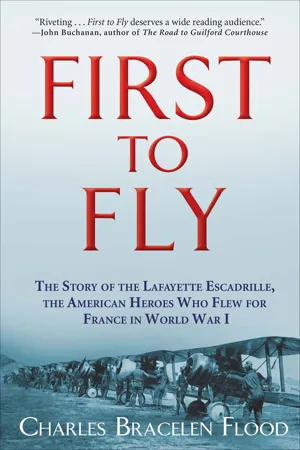
eBook - ePub
First to Fly
The Story of the Lafayette Escadrille, the American Heroes Who Flew for France in World War I
- 256 pages
- English
- ePUB (mobile friendly)
- Available on iOS & Android
eBook - ePub
First to Fly
The Story of the Lafayette Escadrille, the American Heroes Who Flew for France in World War I
About this book
Information
One
By God I Know Mighty Well What I Would Do!
In the summer of 1914 numbers of young American men were in Paris, or doing such things as hiking in the Alps. When the news came that Germany had declared war on France, on August 3rd other young Americans boarded ships in East Coast ports and headed across the Atlantic. Two days after the war began a group of those already in Paris who wanted to fight for France went to the American Embassy and requested a meeting with Ambassador Myron T. Herrick. They knew that under President Woodrow Wilson the United States had adopted an official position of neutrality, and they needed to discuss their status.
Herrick was sixty years old, a farmer’s son from Ohio who, at the age of nineteen, had taught in a one-room schoolhouse earning money to go to Oberlin College and serve as the Governor of Ohio before accepting the Ambassadorship to France. Years later he recorded what happened at that meeting.
“They filed into my office . . . They wanted to enlist in the French Army. There were no protestations, no speeches; they merely wanted to fight, and they asked me if they had a right to do so, if it was legal.
“That moment remains impressed in my memory as though it had happened yesterday; it was one of the most trying in my whole official experience. I wanted to take those boys to my heart and cry, ‘God bless you! Go!’ But I was held back from doing so by the fact that I was an ambassador. But I loved them, every one, as though they were my own.
“I got out the law on the duties of neutrals; I read it to them and explained its passages. I really tried not to do more, but it was no use. Those young eyes were searching mine, seeking, I am sure, the encouragement they had come in hope of getting.
“It was more than flesh and blood could stand, and catching fire myself from their eagerness, I brought down my fist on the table saying, ‘That is the law, boys; but if I was young and in your shoes, by God I know mighty well what I would do!’
“At this they set up a regular shout, each gripped me by the hand, and then they went rushing down the stairs . . . They all proceeded straight to the Rue de Grenelle and took service in the Foreign Legion.”
These young Americans knew that by enlisting in the Foreign Legion they might be endangering their American citizenship, but they went ahead. In his autobiography Herrick said this:
“I think the people of the United States owe a very special debt to these boys and to those who afterward created the Lafayette Escadrille. During three terrible, long years [between 1914 and 1917] when the sting of criticism [for not entering the war] cut into every American soul, they were showing the world how their countrymen could fight if only they were allowed the opportunity. To many of us they seemed the saviors of our national honor, giving the lie to current sneers upon the courage of our nation.

Fig 2. This photo in the Paris Herald (later the Paris Herald Tribune) of August 26, 1914, shows the first group of American volunteers to fight for France marching through Paris to a train station from which they will go to a French Army base in Rouen.
“Their influence upon sentiment at home was also tremendous . . . Here were Americans shedding their blood for a cause in which America’s heart was also engaged and to which later she pledged the lives . . . of her sons. I suppose that without them we would doubtless have entered the war, but the shout they sent up as they left my office was answered by millions of passionate voices urging the authorities of their government to act. Nothing is more just than that these first defenders of our country’s good name should be singled out for special love and reverence by ourselves, just as they have been by the French.”
Herrick took the position held by many Americans, but a balanced account of the views of the American public at the time would include strong isolationist sentiments. While former president Theodore Roosevelt and other prominent figures believed that the United States should enter the war, many millions of Americans saw no reason to become involved in an increasingly bloody struggle among European powers. Tremendous numbers of descendants of German immigrants did not want to fight the land of their ancestors, and equal numbers of Irish-Americans saw England as the nation that had oppressed and exploited Ireland for centuries.
Nonetheless, France was at war, and many young Americans felt moved to come to her aid. One who had lived in Paris and would fly with the Escadrille wrote, “We weren’t fooled into thinking that the World War was entirely a thing invented by the Boche [Germans], but there was no getting around the fact that the Boche had been looking for a chance to start something, and now that the chance came, we Americans who had enjoyed the hospitality of France and had learned to love the country and the people, simply had to fight. Our consciences demanded it.”
As for the men in the American expatriate colony in Paris who were above military age, many of them and their wives also felt passionately attached to the French cause. They threw themselves into activities such as volunteer work at the American Hospital in the large Paris suburb of Neuilly. The hospital, built by the same expat American surgeon who played a role in the founding of the Lafayette Escadrille, cared for many American casualties before the United States entered the war.
Two
How the New Thing Grew
When the Germans declared war on France in 1914, only eleven years had passed since the Wright brothers made their first flights near Kitty Hawk. The war brought about a major acceleration in the development of everything about aircraft—the materials used; the shape, design, and strength of the wings and tail; the controls; the engines. Nonetheless, initially they remained largely made of canvas and wood, held together by metal components such as metal pipes and baling wire. An Escadrille pilot wrote, “With only slight exaggeration, it seemed as if they were merely gathered-up odds and ends of wood, discarded matchsticks, and the like, which were wired together, catch-as-catch-can fashion . . . Then old handkerchiefs were sewed together to cover the wings and that part of the fuselage around the pilot’s seat. The remainder of the fuselage was left naked, which gave the plane a sort of half-finished appearance.” The fighter planes looked sleek and graceful, compared with the bombers. One flier said of a type of bomber called a Voisin, “They looked like flying baby carriages.” Fighter pilots called the bomber pilots “truck drivers.”
As the war progressed, more and more parts of the planes were manufactured from metal, but bullets could always cut through any steel fuselage. Each wartime year, the Germans brought out an improved plane, only to have the Allies put a better one into production a few months later. One of the best Allied fighters, the SPAD, had a flipped-off-the-tongue English-sounding name, but it was the acronym for Société Pour L’Aviation et ses Dérivés (Society for Aviation and Its Derivatives), a French corporation started not by an engineer but by Armand Deperdussin, a traveling salesman and cabaret singer who first made a fortune in the silk business. The Germans received enormous help from a young Dutchman named Anthony Fokker, who not only designed first-rate aircraft and built them, but also devised the “Interrupter Mechanism,” which synchronized machine guns mounted behind a plane’s propeller so that they fired with the bullets passing between the spinning blades, rather than hitting them. Until the Interrupter Mechanism evolved, pilots of single-seat fighters had to stand up behind the controls and awkwardly bring into play a machine gun such as a Lewis gun, mounted on a pivot that swung in a limited arc either on one side of the cockpit or above it. In a two-seater plane, the man in the backseat faced to the rear, holding a machine gun that had a much larger field of fire. (The rear-facing gunner, who could fire off to either side as well, posed such a threat that the French even introduced a plane that had a dummy holding a machine gun that was placed in the rear seat.)
In the larger sense, this evolution of the airplane continued the technical competition that warfare always stimulates. Inventions and improvements: the stirrup; the crossbow; stronger steel for breastplates, helmets, and swords. Gunpowder: the rifle, producing greater distance and accuracy than the musket; the revolver, firing faster than the flintlock pistol; the revolutionary and dreadfully lethal machine gun. And now, the possibilities of what the airplane could do.
France’s Marshal Ferdinand Foch said in 1910, seven years after Kitty Hawk, “The airplane is all very well for sport, but useless for the army.” He underestimated the speed with which aeronautical and political history were moving. In Europe, as in America, what this new “flying machine”—pilots later referred to their planes as “my machine” —could do fascinated the public. Crowds numbering tens of thousands attended air shows at which barnstorming pilots performed thrilling maneuvers and aviators competed for large cash prizes in air races.
As for the airplane being “useless for the army,” when what became known as The Great War broke out in 1914, these flimsy contraptions had advanced to the point that they were regarded as a piece of military equipment like a pair of binoculars, useful in observing and photographing enemy positions and movements. In the war’s first months, pilots of both sides would pass each other in their planes, heading out to observe the enemy on the ground like commuters going to work. Some of the opposing pilots even gave each other friendly waves.
Soon, the ability to see the enemy on the ground from the air started to produce spectacular results. A month after the war began, two large German armies were only thirty miles from Paris, advancing swiftly toward the Marne River. On September 6, French observation planes reported seeing a gap between the two enormous phalanxes. In the most dramatic action of the war, thousands of commandeered Paris taxicabs and buses rushed reinforcements to the front, just in time to prevent the two German armies from consolidating their attack. In the “Miracle of the Marne,” the Allied counterattack slammed into the gap and pushed the Germans back forty miles. That saved Par...
Table of contents
- First to Fly
- Also by Charles Bracelen Flood
- Title Page
- Copyright Page
- Epigraph
- Dramatis Personae
- Chronology
- Table of Contents
- Introduction
- Chapter One
- Chapter Two
- Chapter Three
- Chapter Four
- Chapter Five
- Chapter Six
- Chapter Seven
- Chapter Eight
- Chapter Nine
- Chapter Ten
- Chapter Eleven
- Chapter Twelve
- Chapter Thirteen
- Chapter Fourteen
- Chapter Fifteen
- Chapter Sixteen
- Chapter Seventeen
- Chapter Eighteen
- Chapter Nineteen
- Chapter Twenty
- Chapter Twenty-one
- Chapter Twenty-two
- Chapter Twenty-three
- Chapter Twenty-four
- Chapter Twenty-five
- Chapter Twenty-six
- Chapter Twenty-seven
- Chapter Twenty-eight
- Chapter Twenty-nine
- Chapter Thirty
- Acknowledgments
- Notes
- Bibliography
- Illustration Credits
- Back Cover
Trusted by 375,005 students
Access to over 1.5 million titles for a fair monthly price.
Study more efficiently using our study tools.
Frequently asked questions
Yes, you can cancel anytime from the Subscription tab in your account settings on the Perlego website. Your subscription will stay active until the end of your current billing period. Learn how to cancel your subscription
No, books cannot be downloaded as external files, such as PDFs, for use outside of Perlego. However, you can download books within the Perlego app for offline reading on mobile or tablet. Learn how to download books offline
Perlego offers two plans: Essential and Complete
- Essential is ideal for learners and professionals who enjoy exploring a wide range of subjects. Access the Essential Library with 800,000+ trusted titles and best-sellers across business, personal growth, and the humanities. Includes unlimited reading time and Standard Read Aloud voice.
- Complete: Perfect for advanced learners and researchers needing full, unrestricted access. Unlock 1.5M+ books across hundreds of subjects, including academic and specialized titles. The Complete Plan also includes advanced features like Premium Read Aloud and Research Assistant.
We are an online textbook subscription service, where you can get access to an entire online library for less than the price of a single book per month. With over 1.5 million books across 990+ topics, we’ve got you covered! Learn about our mission
Look out for the read-aloud symbol on your next book to see if you can listen to it. The read-aloud tool reads text aloud for you, highlighting the text as it is being read. You can pause it, speed it up and slow it down. Learn more about Read Aloud
Yes! You can use the Perlego app on both iOS and Android devices to read anytime, anywhere — even offline. Perfect for commutes or when you’re on the go.
Please note we cannot support devices running on iOS 13 and Android 7 or earlier. Learn more about using the app
Please note we cannot support devices running on iOS 13 and Android 7 or earlier. Learn more about using the app
Yes, you can access First to Fly by Charles Bracelen Flood in PDF and/or ePUB format, as well as other popular books in History & French History. We have over 1.5 million books available in our catalogue for you to explore.