From Jerusalem to Ghana to Katrina-ravaged New Orleans, a woman reclaims her history in a "beautifully written and thought-provoking" memoir (Dave Eggers, author of
A Hologram for the King and
Zeitoun).
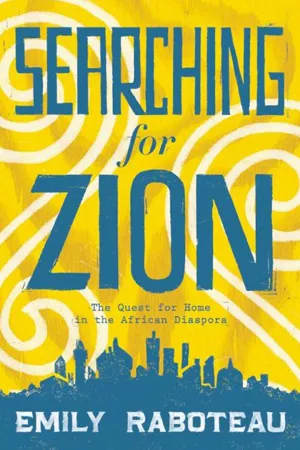
A biracial woman from a country still divided along racial lines, Emily Raboteau never felt at home in America. As the daughter of an African American religious historian, she understood the Promised Land as the spiritual realm black people yearned for. But while visiting Israel, the Jewish Zion, she was surprised to discover black Jews. More surprising was the story of how they got there. Inspired by their exodus, her question for them is the same one she keeps asking herself: have you found the home you're looking for?
In this American Book Award–winning inquiry into contemporary and historical ethnic displacement, Raboteau embarked on a ten-year journey around the globe and back in time to explore the complex and contradictory perspectives of black Zionists. She talked to Rastafarians and African Hebrew Israelites, Evangelicals and Ethiopian Jews—all in search of territory that is hard to define and harder to inhabit. Uniting memoir with cultural investigation, Raboteau overturns our ideas of place, patriotism, dispossession, citizenship, and country in "an exceptionally beautiful . . . book about a search for the kind of home for which there is no straight route, the kind of home in which the journey itself is as revelatory as the destination" (Edwidge Danticat, author of
The Farming of Bones).
- 320 pages
- English
- ePUB (mobile friendly)
- Available on iOS & Android
eBook - ePub
About this book
Information
PART I: Israel
WE’RE GOING TO JERUSALEM
1
Do You Know Where Canaan Is?
THE SECURITY PERSONNEL of El Al Airlines descended on me like a flock of vultures. There were five of them, in uniform, blockading Newark International Airport’s check-in counter. Two women, three men. They looked old enough to have finished their obligatory service in the Israel Defense Forces but not old enough to have finished college, which meant they were slightly younger than I. I was prepared for the initial question, “What are you?,” which I’ve been asked my entire life, and, though it chafed me, I knew the canned answer that would satisfy: “I look the way I do because my mother is white and my father is black.” This time the usual reply wasn’t good enough. This time the interrogation was tribal. They questioned me rapidly, taking turns.
“What do you mean, black? Where are you from?”
“New Jersey.”
“Why are you going to Israel?”
“To visit a friend.”
“What is your friend?”
“She’s a Cancer.”
“She has cancer?”
“No, no. She’s healthy.”
“She’s Jewish?”
“Yes.”
“How do you know her?”
“We grew up together.”
“Do you speak Hebrew?”
“Shalom,” I began. “Barukh atah Adonai . . .” I couldn’t remember the rest of the blessing, so I finished with a word I remembered for its perfect onomatopoetic rendering of the sound of liquid being poured from the narrow neck of a vessel: “Bakbuk.”
It means “bottle.” I must have sounded like a babbling idiot.
“That’s all I know,” I said. I felt ridiculous, but also pissed off at them for making me feel that way. I was twenty-three. I was a kid. I was an angry kid and so were they.
“Where is your father from?”
“Mississippi.”
“No.” By now they were exasperated. “Where are your people from?”
“The United States.”
“Before that. Your ancestors. Where did they come from?”
“My mother’s people are from Ireland.”
They looked doubtful. “What kind of name is this?” They pointed at my opened passport.
I felt cornered and all I had to defend myself with was my big mouth. It was so obviously not a time for joking. “A surname,” I joked.
“How do you say it?”
“Don’t ask me. It’s French.” There was a village in Haiti called Raboteau. That much I knew. Raboteau may once have been a sugar plantation, named for its French owner, one of whose slaves may have been my ancestor. It’s also possible I descended from the master himself. Or from both—master and slave.
“You’re French?” they pressed.
“No, I told you. I’m American.”
“This!” They stabbed at my middle name, Ishem. “What is the meaning of this name?”
“I don’t know,” I answered, honestly. I was named after my father’s great-aunt, Emily Ishem, who died of cancer long before I was born. I had little idea where the name came from, just a vague sense that like many slave names, it was European. My father couldn’t name anyone from our family tree before his great-grandmother, Mary Lloyd, a slave from New Orleans. Preceding her was a terrible blank. After Mary Lloyd came Edward Ishem, the son she named after his white father, a merchant marine who threatened to take the boy back with him to Europe. To save him from that fate, Mary shepherded her son to the Bay of St. Louis where it empties into the Mississippi Sound. There he grew up and married a Creole woman called, deliciously, Philomena Laneaux. They gave birth to my grandmother, Mabel Sincere, and her favorite sister, Emily Ishem, for whom I am named.
“It sounds Arabic,” one of them remarked.
“Thank you,” I said.
“Do you speak Arabic?”
“I know better than to try.”
“What do you mean?”
“No, I don’t speak Arabic.”
“What are your origins?”
I felt caught in a loop of the Abbott and Costello routine, “Who’s on first?” There was no place for me inside their rhetoric. I didn’t have the right vocabulary. I didn’t have the right pedigree. My mixed race had made me a perpetual unanswered question. The Atlantic slave trade had made me a mongrel and a threat.
“Ms. Raboteau! Do you want to get on that plane?”
I was beginning to wonder.
“Do you?”
“Yes.”
“Answer the question then! What are your origins?”
What else was I supposed to say?
“A sperm and an egg,” I snapped.
That’s when they grabbed my luggage, whisked me to the basement, stripped off my clothes, and probed every inch of my body for explosives, inside and out. When they didn’t find any, they focused on my tattoo, a Japanese character. According to the tattoo artist who inked it, the symbol meant “different, precious, unique.”
I was completely naked, and the room was cold. My nipples were hard. I tried to cover myself with my hands. I remember feeling incredibly thirsty. One of them flicked my left shoulder with a latex glove. “What does it mean?” he asked. This was the first time I’d been racially profiled, not that the experience would have been any less humiliating had it been my five hundredth. “It means ‘Fuck You,’ ” I wanted to say, not merely because they’d stripped me of my dignity, but because they’d shoved my face into my own rootlessness. I have never felt more black in my life than I did when I was mistaken for an Arab.
殊
Why was I so angry? As a consequence of growing up half white in a nation divided along racial lines, I had never felt at home in the United States. Being half black, I identified with James Baldwin’s line in The Fire Next Time about black GIs returning from war only to discover the democracy they’d risked their lives to defend abroad continued to elude them at home: “Home! The very word begins to have a despairing and diabolical ring.” Though my successful father, Princeton University’s Henry W. Putnam Professor of Religion, was an exception to the rule that black people had fewer opportunities, and though I had advantages up the wazoo, I remained so disillusioned about American equality that much of my young adulthood was spent in a blanket of low-burning rage.
I inherited my sense of displacement from my father. It had something to do with the legacy of our slave past. Our ancestors did not come to this country freely, but by force—the general Kunta Kinte rap of the uprooted. But it had even more to do with the particular circumstances of my grandfather’s death. He was murdered in the state of Mississippi in 1943. Afterward, my grandmother, Mabel, fled north with her children, in search, like so many blacks who left the South, of the Promised Land. It was as if my father, whose father had been ripped from him, had been exiled. My father’s feelings of homelessness, which I took on like a gene for being left handed, were therefore historical and personal. And truthfully, because he left my family when I was sixteen, my estrangement had also to do with the loss of him. My family was broken, and outside of its context, I didn’t belong. The El Al security staff had turned up the flame beneath these feelings. At twenty-three I hadn’t seen much of the world. I hadn’t yet traveled beyond the borders in my own head.
But now I was boarding a plane to visit my best friend from childhood, Tamar Cohen. With Tamar, I had a home. We loved each other with the fierce infatuation of preadolescent girls—a love that found its form in bike rides along the towpath, notes written in lemon juice, and pantomimed tea parties at the bottoms of swimming pools. The years we spent growing up in the privileged, picturesque, and predominantly white town of Princeton, New Jersey, where both of our fathers were professors of religious history, were marked by a sense of being different. Tamar’s otherness was cultural: her summers were spent in Israel, her Saturdays at synagogue, and, up until the seventh grade, she attended a Jewish day school. I was black. Well, I was blackish in a land where one is expected to be one thing or the other. That was enough to set me apart. I didn’t fit. I looked different from the white kids, different from the black. My otherness was cultural too. I played with black dolls, listened to black music, and, thanks to my parents if not my school, learned black history.
Being “different” allowed Tamar and me to hold everyone else in slight disdain, especially if they happened to play field hockey or football. We were a unified front against conformity. We stood next to each other in the soprano section of the Princeton High School Choir like two petite soldiers in our matching navy-blue robes, sharing a folder of sheet music with a synchronicity of spirit that could trick a listener into believing that we possessed a single voice. When I received my confirmation in Christ at the Catholic church, I borrowed Tamar’s bat mitzvah dress.
We were bookish girls, intense and watchful. We spent afternoons sprawled out on my living room rug doing algebra homework while listening to my dad’s old Bob Marley records—Soul Rebels, Catch a Fire, and our favorite, Exodus. Our Friday nights were spent eating Shabbat dinner at her house around the corner on Murray Place. I felt proud being able to recite the Hebrew blessing with her family after the sun went down and the candles were lit: “Barukh atah Adonai, Eloheinu melech ha’olam . . .” Blessed are You, Lord, our God, sovereign of the universe . . . I didn’t actually comprehend the words at the time, but I believed the solemn ritual made me part of something ancient and large.
Perhaps stemming from that belief, much to my father’s chagrin, I started to keep kosher, daintily picking the shrimp and crab legs out of his Mississippi jambalaya until all that remained on my plate was a muck of soupy rice. It was her father’s turn to be upset when we turned eighteen and got matching tattoos on our left shoulder blades. The Torah forbids tattooing (Leviticus 19:28). Ta...
Table of contents
- Cover
- SEARCHING FOR ZION
- Also by Emily Raboteau
- Title Page
- Copyright © 2013 by Emily Raboteau
- Dedication
- Epigraph
- Contents
- PART I: Israel
- Chapter 1
- Chapter 2
- Chapter 3
- Chapter 4
- PART II: Jamaica
- Chapter 5
- Chapter 6
- Chapter 7
- Chapter 8
- PART III: Ethiopia
- Chapter 9
- Chapter 10
- Chapter 11
- Chapter 12
- PART IV: Ghana
- Chapter 13
- Chapter 14
- Chapter 15
- Chapter 16
- PART V: Black Belt of the American South
- Chapter 17
- Chapter 18
- Chapter 19
- Chapter 20
- Acknowledgements
- Bibliography
Trusted by 375,005 students
Access to over 1.5 million titles for a fair monthly price.
Study more efficiently using our study tools.
Frequently asked questions
Yes, you can cancel anytime from the Subscription tab in your account settings on the Perlego website. Your subscription will stay active until the end of your current billing period. Learn how to cancel your subscription
No, books cannot be downloaded as external files, such as PDFs, for use outside of Perlego. However, you can download books within the Perlego app for offline reading on mobile or tablet. Learn how to download books offline
Perlego offers two plans: Essential and Complete
- Essential is ideal for learners and professionals who enjoy exploring a wide range of subjects. Access the Essential Library with 800,000+ trusted titles and best-sellers across business, personal growth, and the humanities. Includes unlimited reading time and Standard Read Aloud voice.
- Complete: Perfect for advanced learners and researchers needing full, unrestricted access. Unlock 1.5M+ books across hundreds of subjects, including academic and specialized titles. The Complete Plan also includes advanced features like Premium Read Aloud and Research Assistant.
We are an online textbook subscription service, where you can get access to an entire online library for less than the price of a single book per month. With over 1.5 million books across 990+ topics, we’ve got you covered! Learn about our mission
Look out for the read-aloud symbol on your next book to see if you can listen to it. The read-aloud tool reads text aloud for you, highlighting the text as it is being read. You can pause it, speed it up and slow it down. Learn more about Read Aloud
Yes! You can use the Perlego app on both iOS and Android devices to read anytime, anywhere — even offline. Perfect for commutes or when you’re on the go.
Please note we cannot support devices running on iOS 13 and Android 7 or earlier. Learn more about using the app
Please note we cannot support devices running on iOS 13 and Android 7 or earlier. Learn more about using the app
Yes, you can access Searching for Zion by Emily Raboteau in PDF and/or ePUB format, as well as other popular books in Social Sciences & African American Studies. We have over 1.5 million books available in our catalogue for you to explore.