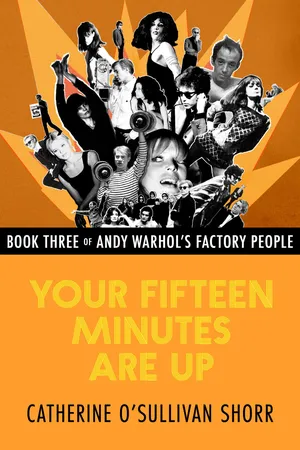
The conclusion of the uncensored oral history that sheds light on the infamous final years of Andy Warhol's Silver Factory.
The late 1960s brought seismic shifts to Andy Warhol and life at the Silver Factory. The hub of his avant-garde scene shifted from the Factory on Manhattan's 47th Street to the downtown bar Max's Kansas City; new stars like drag queens Jackie Curtis, Holly Woodlawn, and Candy Darling began to replace Warhol's old favorites; and a shocking act of violence left him paranoid and mistrusting of even his closest friends. Told by the actors, artists, writers, and hangers-on who populated and defined the Factory,
Your Fifteen Minutes Are Up is an unprecedented exposé of these tumultuous times.
By 1967, it seemed to many that the Factory had outlived its fifteen minutes of fame. Superstars like Edie Sedgwick, who had reached the height of stardom only the year before, were now running out of money and falling victim to drug addiction. Some Factory dwellers had falling-outs with Warhol, while others, like Lou Reed and John Cale of the Velvet Underground, got caught up in disputes of their own. When radical feminist Valerie Solanas shot and nearly killed Warhol, the artist had already relocated to the White Factory in Union Square, leading to further rifts within the group. Intimate interviews with scene insiders and candid photos from Billy Name portray the true stories behind the legends and mystique of the Silver Factory.
- 72 pages
- English
- ePUB (mobile friendly)
- Available on iOS & Android
eBook - ePub
Your Fifteen Minutes Are Up
About this book
Trusted by 375,005 students
Access to over 1.5 million titles for a fair monthly price.
Study more efficiently using our study tools.
Information
Topic
ArtSubtopic
Popular Culture in ArtSILVER FACTORY FINALE
Andy never said “15 Minutes of Fame.” He just adopted it. He adopted everything. And every one.
—Louis Waldon
Robert Heide: Andy was good for some people, and not others. He was maybe helpful to some, destructive to others, but maybe some of these would have self-destructed anyway. In other words he was a conduit, so he inspired admiration just as he inspired enmity and hatred, and that’s sometimes the price of fame. It’s no accident that Andy is shot. When you become so famous, someone is always lying in wait to possibly …
* * *
Bob Heide looked woebegone, and left the rest unsaid, but John Lennon was naturally uppermost in our minds. We had just visited with Jonas Mekas, down the street on 2nd Avenue at his Anthology Film Archives. Jonas had made a ‘home movie’ of Warhol with Lennon at a garden party, as they compared instant Polaroid shots and giggled together like kids in the sunshine, despite Warhol’s deep aversion to daylight and Yoko Ono. Here, he looked pale and skeletal, as if in need of a blood transfusion, while Lennon, deliriously happy, devours Japanese food and dances for the camera as Yoko clicks away. It was a private, poignant moment … Of course we used the footage. We’re filmmakers.
Jonas Mekas: (Martin) Scorsese always credits—I mean, he was there at the Film-Maker’s Cinematheque, seeing Warhol, seeing all the films. He was inspired and influenced. Influence is a very complex word. Influence can be part of the very climate, the people that you meet, and talk about the same kind of things. Just by talking or seeing what others are doing can clarify your own ideas.
Mary Woronov: Andy was a conduit. He really wasn’t interested in the things most people are interested in. The Velvet Underground—the songs were rebellious. The art was rebellious. So, you stayed there. But I believe after Warhol was shot, he was afraid, and he didn’t want to be so close to the raw kind of insanity that he wanted before. He knew it was different.
David Croland: It was the end of trust, the fear of selfishly thinking it could be me, because I was there that day … It was the end of a certain kind of innocent glamour. The glamour got harder, people got harder. They were scared after that.
Mary Woronov: It was scary, and so he stepped away. When he stepped away he lost part of his power, and he became the artist that he is. He didn’t do any more movies. Well, Paul helped him stop doing movies, because he took over.
Paul Morrissey: (from ‘Superstar in a Housedress’): So I mentioned it to Andy—I said, “I think they (Holly Woodlawn and Jackie Curtis) should play women’s libbers,” like that ridiculous Valerie Solanas, who had shot him. Andy was very brave about it. He said, “That’s a good idea.”
Nat Finkelstein: Who walked away from that scene better than when they entered? People like Paul Morrissey, maybe Danny Fields. They were used, and then when they were used up, they were gone … Now Nico was different. She was self-sufficient, she was her own person. And she wasn’t going to be swayed by those people. I knew her past then. She visited me in Amsterdam. She was still pretty badly strung out. We had a discussion about if I were to rent a larger place in Amsterdam she could stay with me and I would help her. I never was into heroin.
* * *
Nat’s close friend Nico would always be into heroin, with side trips of LSD, and his love for her would remain unrequited. No longer part of The Velvet Underground, Nico left for the West Coast and the Monterey Pop Festival—and legendary rock star/poet Jim Morrison of The Doors, with whom she would have an intense affair.
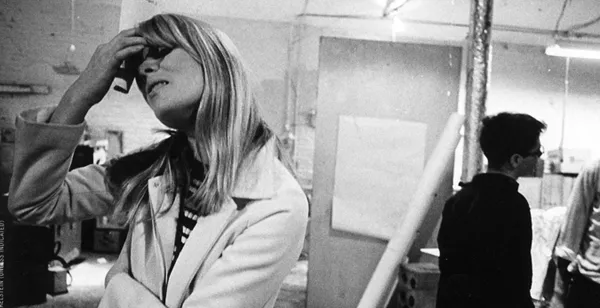
Upon her return from Cannes and the ‘Chelsea Girls’ non-screening in 1967, Nico had found herself dropped from the Velvet Underground. (Photo: Nat Finkelstein)
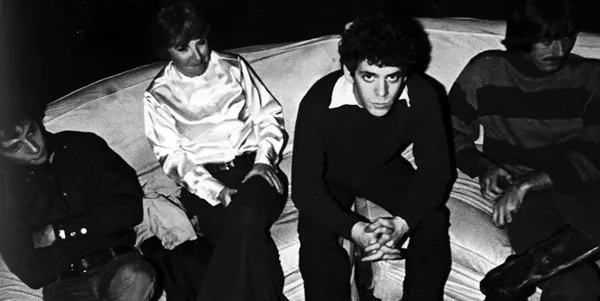
The Velvets prepare to pack it in at the Factory. (Photo: Billy Name)
Interviewer (to Nico)
Do you find that you’re swamped a lot, your days with the Velvet Underground and Lou Reed. Do you find you’re harassed by that?
Nico
I can’t say harassed. I just find it very tasteless, really. Because already that I’m still alive. I’m one amongst the few who are still alive, because I know that the audience likes clichés.
* * *
Nico’s drug use tended to distance her from Warhol, since he preferred talkers like Edie and Brigid and Viva. Nico tolerated me as a yapper, perhaps because I was also into acid, so long stretches of time could go by where no one would talk, but the brain synapses would be flying with no one the wiser. When interviewed at her concert in Manchester (an industrial town that she liked because it reminded her of Berlin), Nico was her usual circumspect self, which served the young filmmaker right, since his sound recording quality was god-awful.
* * *
Ivy Nicholson: I don’t think I communicated with any of the other actresses. Oh, Nico I really liked; she was the only one. We saw one another in Paris. She was like me, European. She was a friend, gave me advice. I was fascinated by her apartments. They were all magic, so weird—one totally black with only ashtrays. No paintings, nothing. Can you imagine? The only decor were ashtrays full of horrible cigarettes—a very elegant apartment with nothing in it. I think there might have been a mattress somewhere; I hope so. She lived there with (filmmaker) Phillipe Garell. Another was Moroccan, with different colored veils all over the walls. But again, no furniture.
Allen Midgette: In reality, much of the Silver Factory was a bit leaden more than silver. The toilet of course was also silver, but on the wall of the toilet, Ivy Nicholson had printed, “I’m in Paris once more with no money.” It’s those kinds of little things that you would want to capture, the fact that the windows are just factory windows looking out on the street, and not so clean—kind of dusty, kind of Miss Havisham from ‘Great Expectations.’ Great expectations were part of what the Factory was, what all these people had, what made you think of it as more glittering, and silvery.
Ultra Violet: You have to belong to somewhere, so that’s what held these people together, because we were all rebellious in our own way, rebelling against an establishment that is never right. Nothing is right in the world anyway, so the kids are trying to find an alternative, and that was part of the success of the Factory. T
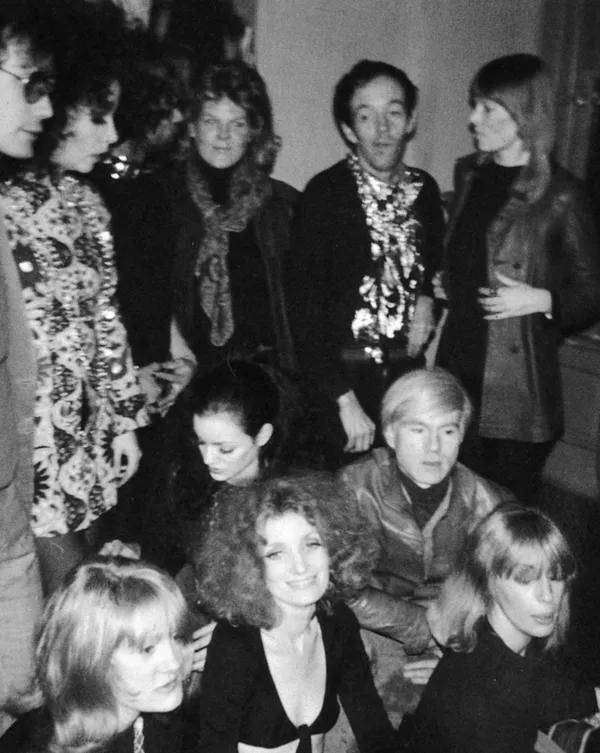
Billy records a Family get-together.
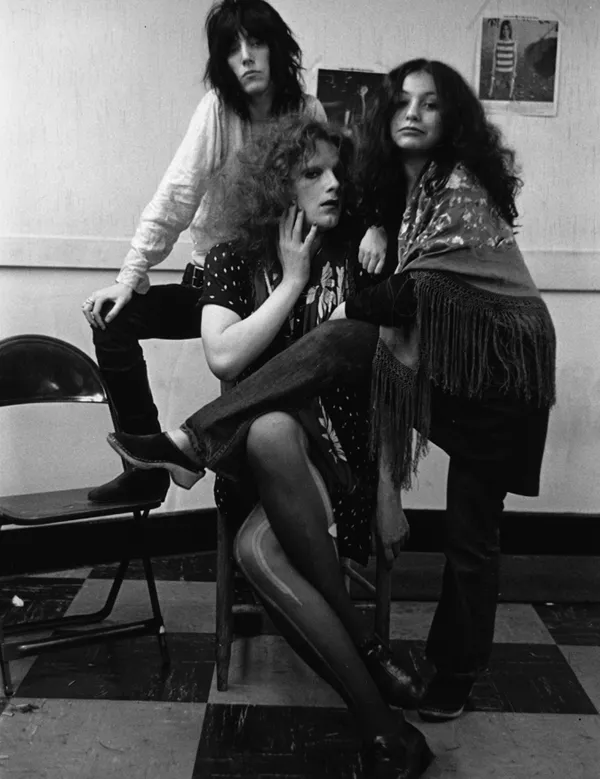
Poet-rocker Patti Smith, Superstar Jackie Curtis, and pal Penny Arcade pose for ‘Leee’ Black Childers.
Geraldine Smith: We were all younger than Viva and Ultra and Brigid. We were fifteen, sixteen. It was the most fun I ever had, I don’t regret anything. The parties! It wasn’t a party unless Andy was there. He was like one of these great puppeteers. Everyone wanted to perform for him. I really liked him; he was always nice to me. People blame him for not paying them, or for their mistakes, but they’re too negative. A lot of people think he exploited us, but others think it’s a stepping stone.
Ultra Violet: Tragedy happened, so things changed. Andy took risks, and he was pretty brave, I guess. And he only realized too late that this kind of thing had to stop if you wanted to stay alive. So, I think that belonging to the Factory … Factory is a powerful word. You manufacture things in a factory. We were being manufactured, or we self-manufactured ourselves.
Vincent Fremont: It got very dangerous when it ...
Table of contents
- Cover
- Title Page
- Dedication
- Contents
- Epigraph
- FACTORY FAMILY INTRODUCTIONS
- FACTORY LIFE … LATE SIXTIES
- OUT OF CONTROL
- OUT OF MONEY
- ON IMITATING WARHOL, BY ALLEN MIDGETTE
- ON IMITATING ANDY WARHOL’S ART
- WELCOME TO MAX’S KANSAS CITY
- QUEENS & SUPERSTARS
- ALL THE LOVELY LADIES
- I SHOT ANDY WARHOL
- SILVER FACTORY FINALE
- About the Author
- Copyright
Frequently asked questions
Yes, you can cancel anytime from the Subscription tab in your account settings on the Perlego website. Your subscription will stay active until the end of your current billing period. Learn how to cancel your subscription
No, books cannot be downloaded as external files, such as PDFs, for use outside of Perlego. However, you can download books within the Perlego app for offline reading on mobile or tablet. Learn how to download books offline
Perlego offers two plans: Essential and Complete
- Essential is ideal for learners and professionals who enjoy exploring a wide range of subjects. Access the Essential Library with 800,000+ trusted titles and best-sellers across business, personal growth, and the humanities. Includes unlimited reading time and Standard Read Aloud voice.
- Complete: Perfect for advanced learners and researchers needing full, unrestricted access. Unlock 1.5M+ books across hundreds of subjects, including academic and specialized titles. The Complete Plan also includes advanced features like Premium Read Aloud and Research Assistant.
We are an online textbook subscription service, where you can get access to an entire online library for less than the price of a single book per month. With over 1.5 million books across 990+ topics, we’ve got you covered! Learn about our mission
Look out for the read-aloud symbol on your next book to see if you can listen to it. The read-aloud tool reads text aloud for you, highlighting the text as it is being read. You can pause it, speed it up and slow it down. Learn more about Read Aloud
Yes! You can use the Perlego app on both iOS and Android devices to read anytime, anywhere — even offline. Perfect for commutes or when you’re on the go.
Please note we cannot support devices running on iOS 13 and Android 7 or earlier. Learn more about using the app
Please note we cannot support devices running on iOS 13 and Android 7 or earlier. Learn more about using the app
Yes, you can access Your Fifteen Minutes Are Up by Catherine O'Sullivan Shorr in PDF and/or ePUB format, as well as other popular books in Art & Popular Culture in Art. We have over 1.5 million books available in our catalogue for you to explore.