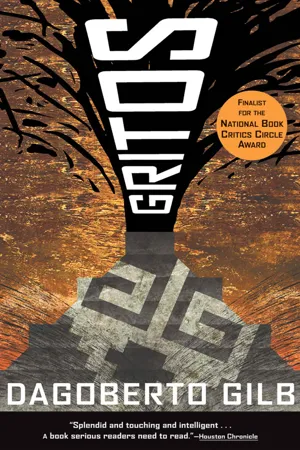
A National Book Critics Circle Award Finalist: A wide-ranging collection of essays on the Mexican American experience by the acclaimed Chicano author.
Once a struggling journeyman carpenter, Dagoberto Gilb has won widespread acclaim as a crucial and compelling voice in contemporary American letters. Known for his novels and short stories, he has also been a prolific essayist for publications such as
Harper's Magazine and the
New Yorker, as well as a popular commentator on NPR's
Fresh Air. In
Gritos, Gilb collects some of his finest works of nonfiction. Spanning twenty years of output, the entries are divided into four sections: "Culture Crossing," "Cortés and Malinche," "The Writing Life," and "Working Life and La Family."
Tackling everything from cockfighting to Cormac McCarthy,
Gritos offers a startling portrait of an artist—and a Mexican American—working to find his place in both the literary world and the world at large, to say nothing of his strange and beloved borderland of Texas. While "Dagoberto Gilb might be speaking for himself . . . he speaks so well that what he says becomes universal" (
Houston Chronicle).
"[
Gritos] is a collection about prejudice and pride, told with the flair of a storyteller known for his fiction. . . . [Gilb's] prose is easy-flowing and thoughtful. He can be unbelievably funny. . . . What he has to say and how he says it is so interesting, you can't help but pay attention." —Marta Barber,
The Miami Herald
"An arresting essayist, he is unabashedly himself, and his zest for life, passion for illuminating Mexican American culture, and seductive storytelling skills infuse his astute observations, reminiscences, and critiques with compelling energy and momentum." —
Booklist
Imagine the writing scene looking like Santa Monica Beach: near the pier, it’s another sunny southern California day, not too hot to want to hide in shade, the shore shoulder-to-shoulder bodies, pudgy to muscled, splashing, the waves as ferocious as seven-year-olds. There are many kinds of writers frolicking there, published and not yet published, of all colors, and lots of that skin darkness without sun or tanning lotions. Not so many years ago, when you’d have been half as tall and following your mommy around when she shopped, visiting here was another mouth-open trip to the other land, like Beverly Hills or even the west side of Los Angeles. What you would remember about Santa Monica Beach then was the park on a cliff above the sand, its groomed lawn and peaceful benches, and there above the sand, those people wore stylish white dresses or suits, white shoes and hats. Santa Monica wouldn’t have seemed like a beach hang to you back then. You’d go to other beaches, where you were supposed to, or maybe just did.
Let me take you on a drive to the east side of the literary West, starting at that beach. Get on the Santa Monica Freeway and drive past the Robertson and La Cienega exits, past Hoover, Vermont, Normandie, past downtown L.A., into East L.A. But no, do not exit. Just keep driving east, really east, and pretty soon—well, not so pretty soon, but eventually—you will have crossed so much desert Southwest that you’ll find yourself in El Paso, the Chicano Ellis Island. Half the people you’ve ever met in Los have lived in El Paso or Juárez. But keep driving. Like nine more hours. If you were to stay on the Santa Monica Freeway (around here called I-10), it’d take you to San Antonio and the Alamo. Which might also be a good point to start this story, but do what I suggest here anyway, and get off the interstate and take State Highway 290 to Austin, the capital of Texas.
What I want to answer is what it’s like to be a Mexican-American writer these days, when our numbers are so many we can go to any beach in Califas, when many now know what you mean when you say Califas, or Nuevo Mejico, even when you pronounce “Arizona” as if it actually has the vowel “i” in it. What I have done is lead you to the western-swing dance of political and arty and tattooed-hipster Texas, every native’s second home-town, because so much of the cultural love of the Texas Republic is centered here. If you look back in the American sixties, the most exotic music and spiciest food and mystic wisdom came from India—Ravi Shankar, chicken or vegetarian curry, and all that nirvana meditation. In here-and-now Austin, tacos are like pizza slices in New York City, there’s Flaco and Santiago Jimenez squeezing accordians wildly, and dude, if you want wisdom, you read about it in Spanish, you go to the local psychic, and if you don’t speak no español, you better be fluent in enough Spanglish to get that deep truth.
The downside, as my camarada Mando likes to say: they keep remembering the Alamo to remind us not to forget that we lost the war.
Excuse me for a second, I’m getting a little sleepies now that I’m back here. It’s hot, you know, and I theenk I might wanna leettle siesta. A leetle hard for me to concentrate a veces. It’s sometheeng I been learning aquí mero en este estado tambien.
Ay, gracias, I feel betters.
Wasn’t I telling about Texas letters (I’m not talking about ñ or rr), how it is here, how it’s all torcido aquí, like transformed for the times? Twenty years ago, even ten, maybe even five, when the university professors would teach the literature of Texas and the Southwest, even when Don Américo Paredes (“With a Pistol in His Hand”) was close enough, at least metaphorically, to be across the hall, you wouldn’t see one thing written by a Mexican-American in those courses. That’s changed. Now, sometimes, they’ll be up to two class lectures on our people’s cultural effect (or affect—not sure which word is right) on the state and region.
Especially in Austin, the Chicano people have influenced the literary establishment. Take, particularly, the magazine of the state, el mero patrón del estado, Texas Monthly. They say that any writer who wants to be taken seriously here, for a magazine of this reputation to get behind him, has to make it with the editors of this magazine. Even though, by their estimation, it is as important as any periodical in the country, it is stand-alone concerned only with the issues of Texas. Its high standards are much like the old days of South Africa, when other issues weren’t darkening that country—it knows what diamonds are, how exquisite and rare, and the focus and concern is as clear as a De Beers. Besides its own writers’ craft and income, this mag shows how it cares about us, too: over the years, there have been several stories about one of us who has died, and sometimes one of their writers does a piece on one of our musicians, or a boxer, or our cholo or graffiti trouble, and they do like our food. A feature article a couple of months ago, with color photos, was about where to get our best corn tortillas. In a laudatory recent bio in the alternative Austin weekly, the Chronicle, the newest editor in chief is even quoted as saying he has made an outstanding offer to one of our most famous writers, Sandra Cisneros, to send him a story about not loving the myth of the Alamo. An against-the-tide gutsiness that is hard not to admire.
So just imagine the honor it was for someones like me to be asked to contribute! I had another New York book coming out, I’d been given one of those Guggenheims and even had won a couple other of those eastern-award thingies, but that the editor in chief now wanted me to give them something! He’d said he read one of those articles I’d published in The New Yorker, and he liked it.
Ay!
You know how we are. I had to stop my brains from sizzling with all my schemes of getting some and had to write for higher goals, not just to impress las rucas masotas. Which, tu sabes, wasn’t so easys for me, si me entiendes. I like the girls. When I was only a chavalito, I, too, thought I would grow up to be a boxer, el mero mero chingón. I probably can’t help myself. Like they think, I guess I like to fight, you know? Fighting, hijo de su, that feels like ME, vato, you know? Especially when someone pisses me off. Pero, I also have this other drive? And, you know, I guess I decided I like the girls too much. So, sabes que, I must have, like, decided I wanted to be a good lover man instead, play my instincts that ways. You know? So, you know, I decided to be a writer. What better ways, verdad? You sit alone for long hours typing, and when you get out,
hijole!, all those killer models . . . yeah, se vale, it’s worth it. Musicians and artists, even los ricos con los bucks, they get nothing como los escritores.
But this was a special opportunity: to include something from our people in their distinctive pages. It was such a big risk for them, I understood that, and I didn’t want to mess up nothing. I even had to not goof around for a while there to get a manuscript to them. And, hard as it was for me not to think of chasing muchachas instead, I did it, just like I promised I would, on time. I was proud of it, too. I am such a macho, I even thought it was good!
The editor in chief, he called and said he liked it, but . . . You know how it is when they go “but.” He said, like a dentist after an X ray, I should come over and visit the office. All those swats I deserved over my junior and high school years in the vice principal’s office, well, as much insight as I have into my flawed character, I still get nervous being sent slips to go to the office. So I said, You couldn’t just tell me in writing? (It’s what I get away with when I publish in New York City.) He shopped the story around to find someone who could work with me. And finally, in an E-mail note, he explained to me how I should take the advice from this assistant editor he found just for me, and that I should work with him “constructively”—hey, but don’t that word sound like from boring high school teacher lady, talking slow, because she thinks you’re so much dumber than Emily Brontë? Quela, it’s probably since I got this jalapeño blood that I couldn’t slow up that fighter in me. And then his assistant (who has even been promoted to their head sports writer) had suggestions for me on how to write correctly, like his people, and how what I got puts readers to sleep, and that I gotta wake up (he said my piece “puts them into a dreamlike trance,” but since I seem to like una napita once in a while, this siesta need in my sangre, like wanting the girls too much, I see now maybe he was only trying to be culturally sensitive) (or could be they got like commercials, maybe, and that’s how I think they make money to pay for the pretty paper they print on). Well, what happened next I feel even sorrier about. I couldn’t show a good attitude. That too-picoso boxer in me felt disrespected and insulted. Like I’m thinking they’re treating me like I’m so young and inexperienced, or like I’m just a stupid, like English learning. I told you! I yelled. Didn’t you say? I yelled. I even screamed how I should be paid for doing exactly what I said I would and exactly what he said he wanted. My hot-chile temper. I dunno what I got in my jeans (or do they mean genes, or both?).
Here they were, doing me a favor, giving me a literary opportunity in this land we lost, and I’m going off like they’re . . . well, I won’t say that word. I’m sure it is how they treat everybody, and I ruined my opportunity by throwing verbal chingazos, believing I shouldn’t have to accept being told by these people how to write. I am so obviously spoiled by shoddy New York City standards. I do trick those who aren’t from here and know how we are. In the East, they think I’m smart enough already. And what I wrote that Texas Monthly couldn’t accept, I sold to la Harper’s Magazine. Those East Coast fulanos loved it just as I wrote it, and published it in June 2001 without any editing or advice whatever.
I may never learn, but you still might. What I am telling you is that we are, unlike in the past, being offered never-before opportunities, only you have to watch out and not mess up and look bad for our peoples. We play on the beaches in Santa Monica, and continue to make homes in the sands of the desert Southwest, and even though we’re told how we lost the war in Texas, we are making our history proud again, even our own unique literature, and that sooner still, if we let ourselves do our best work—without having to perform as the stereotypes they have taught us is in our blood.
What I Would Have Said About the State of Texas Literature
Yes, a publicist at Grove Press had very diligently mailed me a copy of a fax she’d received weeks earlier for the first-ever Texas Book Festival. Yes, it read clearly that I was to be on a panel, in the House Chamber, at ten-thirty A.M.., November 16, the first day of the event. The evening before, yes, I took a phone call from the moderator, Rich Oppel, editor of the Austin American-Statesman, who told me what he intended to say. I did get there on time without anybody’s help. Early, even. About half an hour before I left for the capitol, I’d made notes—word count about several fingers on one hand—on an utterly great idea, straight from the brain, I assure you. My yawning was simply an open expression of confidence.
Afterward somebody asked, Didn’t you get the idea when it said “House Chamber”? Hey, man, it sounded like a comfortable room to me. I don’t know where you grew up. Didn’t it occur to you, somebody asked, when you learned that Mrs. Laura Bush, the governor’s wife, would be there to introduce this “opening panel” at which you were featured? Yeah, well, it was morning, it was way early, I’m not from Austin, I’ve never done this gig before, I’ve been real busy, real busy, and nobody told me, they should’ve told me a lot more better. These Republicans are always trying to set us up, you know? Now that I get to think of it, I’m disappointed in the ex-librarian Mrs. Bush, who is very kind, very generous, who loves books as much as me, who was doing something inspired for Texas and its libraries and its literary arts with an extravagant, and successful, fund-raising festival, despite marrying the man who beat Ann Richards, who is cool even if she never did put me in such a position to make a fool of myself, which is also the point, you see?
I’m telling you, it wasn’t my fault that only one-syllable words, one at a time, period, next word, with pauses to help the memory, exited, distantly related, from my mouth. A couple of days before, after a public reading in San Antonio, for a good cause, too, where I had to sign several books for a couple of fans, two give or take, all of which was extremely exhausting physically and mentally for me to do two days before this other event, after which, at an excessively nice—if you’ll excuse the expression, very nice—house, there was all this food, and I hadn’t eaten dinner yet, and then I sat with Larry L. King, and got to smoking one of the host’s Cubita cigars, listening and listening, drinking and drinking, spirits, not just that French wine, laughing too much to remember the serious business that lay ahead of me. Anybody who knows Larry L. King probably would have been aware of his profligate drinking and talking. I’d never met him before. He admitted that he’s not even supposed to be smoking cigarettes, and yet he did, and a lot of them, I’ll tell you. Later, William Hauptman and Marion Winik kept me up late in that river walk hotel, digging at my psyche, I think, for material which is mine. They knew that in two days, I was supposed to say something intelligent and dignified and coherent (I know I told them repeatedly, and they simply did not care), and yet they did not relent on working me over, even though, by then, in less than two days, I had to be prepared. And then the next night, the night before, back in Austin, it was Marion Winik once again, using what she got on me against me. There was a reporter present from The New York Times, it was a bar, there was his wife. Need I say more? This is the state of Texas Literature, too, you know. And so it’s not just my fault.
I’d compare it to that scene in Journey to the East by Hermann Hesse. That’s probably not the right book, and there’ll be a head-shaking letter to the editor. Which is also the state of Texas Literature. . . . Hmm. How did that go? I’ve been out for a few nights, and been real busy, I’m not from here, and it was really a long time ago when I read Hesse. Here’s the scene I’m thinking of from wherever: a psychic literary night of dimly lit faces, masklike, in a black Catholic fog, staring at you, deciding whether you’re in or you’re out. Compared to being in the literal daylight of Texas, feeling a little hazy, at the Speaker’s podium, the state’s most famous speaker of all, the Hog, in a bigger-than-any-in-Alaska portrait over your shoulder, in that darkly aging European Renaissance hue of historical majesty but with “Remember the Alamo!” patriotism. A fifty-foot ceiling for enchanced, epic echo in the luxurious cavern of the august chamber. Distant faces staring up at you, going way way back, too, so impervious to your unadjusted sight you wish you had a pair of glasses, some prescription shades in this bright Baptist light, your jury attached to coastered executive chairs at desks with a voting mechanism, that yes/no electronic board behind the other shoulder. A red velvet and polished brass horseshoe gallery for observers. You never heard the board lighting up, but every face was very silently not smiling or winking. When all I’d expected were a couple of tables pushed together, folding chairs, an audience of twenty to thirty.
For the record, here’s a set of words I do recall around my mouth region and microphone range at the time of the incident: rich, uncles, daddies, and, the, excluded, unpublished, complainers. Lovers never see the beloved’s flaws. Américo Paredes is ignored, Port Arthur used to say Janis Joplin only screamed, the old boy Texas triumvirate didn’t think much of Mexicans who live near that river, wasn’t Dobie a little racist. Weak funding for El Paso schools. How come I’ve never read a single story by even one, say, black construction worker I’ve worked with from Houston?
What I would have said is based on what Rich Oppel did say characterized Texas Literature: in a place rooted in soil but unromantically, unsentimentally, because of the natural forces that are constant reminders. Which is empowered by history, which always reinforces or subverts myth or tall tale. That is held by honor, which forces larger-than-life issues of good and bad, right and wrong, and which is driven by a humor that distrusts pomposity and snaps with skepticism for political trends or party affiliation. And, last, which is gripped by a rugged individualism that resists generalizations, even this one.
One thing I have to admit strikes me about this depiction, on the positive side, on first impression, is how it sure does sound like me and my work. That noble implication, particularly.
A second thing, a question, from my rugged, individualistic, skeptical side, is how many books and authors would have to be eliminated if the sentimental and romanticized restrictions alone were enforced? I’d cover a few wagers they’re not the ones to get the biggest advances.
But okay, por fin (there’s another trait, missed, Spanish syllables sound like words, like, my favorite example, the street in downtown Austin, Nueces, is pronounced “new aces”), here’s the real great idea I came prepared with when I walked into the House Chamber: that this sure does sound like a description of Ross Perot. Doesn’t it? Be honest. It does, right? A mythic, romantic, sentimental Ross Perot for all Texas times, in many Texas settings. Not necessarily such a pretty picture now, is it?
I learned from years on construction jobs that there are two lists to describe workers—particularly the apprentices—who are kept at layoff time versus those let go, this being a process usually founded on a simple “intuitive” judgment. While one was thought to be growing into his feet, fiery, hardheaded, the other was clumsy, too difficult to work with, and never learned. One got a winky grin, the other a head-shaking raised eyebrow. A foreman or super chose as if pulling out one or the other explanation sheet for his decision. If you weren’t quick, you, too, might go away nodding with understanding, satisfied. Because when you shut your eyes and honestly considered the activities of the two, their behavior was, at best, exactly the same. Those in charge didn’t have to be conscious of how or why they kept who they did, and in most circumstances weren’t, but the result was the same: of a clean-cut white guy, a Chicano, a black, and a white with scraggly hair, guess which one was the best worker?
I imagine someone living in a separate Texas, remembering an equally long heritage that is almost completely ignored—go to Mexico, see the pyramids at Teotihuacán—or a state history that isn’t liked—read With His Pistol in His Hand—because it’s not so pleasant, some unnatural forces being constant reminders of disempowerment. Imagine that person who is rugged and doesn’t accept generalizations, who jumps at that traditional pomposity and arrogance, who’s proud of her saga and lineage (just as likely a him, but make it a her, which is also a more difficult fit in traditional Texas), trying to reinforce her past or to subvert the traditional myth that has called her names at the worst, romanticized and sentimentalized her exotic sex or transcendent passivity at the best. Think of her standing there listening to Ross Perot, think of what would happen if she were talking back to Ross Perot. Is she still considered a rugged, individualistic maverick? Or do you hear him harumphing about her “political correctness” and “multiculturalism”? How disrespectful she’d sound complaining, how “negative”? How her version of pride and history sounds too angry to him. How her complaining is revisionist. She’s poor. And poor is simply not as fascinating as rich. Poor does not sell magazines. Poor does not sell movies, TV shows, or books.
I’m telling you that I would have remembered to say all this, too, if those other panelists hadn’t distracted me. Bill Broyles, one of them, came with a typed-out essay. That was a very disruptive influence. I was fully prepared with my own extemporaneous exegesis, but he was so well organized and well spoken that I couldn’t stop admiring him. Especially jarring and destructive to my memory was, after he talked about Dobie and Webb and Bedicheck and McMurtry, and a whole bunch of names I’m sure are on many University of Texas literature-course lists, was when he talked about all the writers at Texas Monthly with whom he’d personally been involved. So comprehensive was he, it caused me to forget my own list of male Texas writers and camaradas neither present in life or conversation at the festival, including Cabeza de Vaca, Américo Paredes, Tomás Rivera, Rolando Hinojosa, John Rechy, Tino Villanueva, Ricardo Sánchez, raúl salinas, Arturo Islas, ...
Table of contents
Cover Page
Title Page
Copyright Page
Contents
Introduction
I. CULTURE CROSSING
II. CORTÉS AND MALINCHE
III. THE WRITING LIFE
IV. WORKING LIFE AND LA FAMILY
Trusted by 375,005 students
Access to over 1.5 million titles for a fair monthly price.
Study more efficiently using our study tools.
Frequently asked questions
Yes, you can cancel anytime from the Subscription tab in your account settings on the Perlego website. Your subscription will stay active until the end of your current billing period. Learn how to cancel your subscription
No, books cannot be downloaded as external files, such as PDFs, for use outside of Perlego. However, you can download books within the Perlego app for offline reading on mobile or tablet. Learn how to download books offline
We are an online textbook subscription service, where you can get access to an entire online library for less than the price of a single book per month. With over 1.5 million books across 990+ topics, we’ve got you covered! Learn about our mission
Look out for the read-aloud symbol on your next book to see if you can listen to it. The read-aloud tool reads text aloud for you, highlighting the text as it is being read. You can pause it, speed it up and slow it down. Learn more about Read Aloud
Yes! You can use the Perlego app on both iOS and Android devices to read anytime, anywhere — even offline. Perfect for commutes or when you’re on the go. Please note we cannot support devices running on iOS 13 and Android 7 or earlier. Learn more about using the app
Yes, you can access Gritos by Dagoberto Gilb in PDF and/or ePUB format, as well as other popular books in Literature & Literary Essays. We have over 1.5 million books available in our catalogue for you to explore.