A trio of elderly bachelors plays Cupid in this ingeniously crafted novel by one of the 19th-century's finest storytellers
A widowed lawyer named Griffith has been appointed legal guardian of Jessie, a lively young woman. In order for Jessie to claim her inheritance, her late father's will stipulates that she must spend 6 weeks with Griffith each year. Consequently, Jessie travels to a remote part of Wales to the castle where the lawyer and his 2 brothers reside. To everyone's surprise and delight, Jessie and the 3 men get along splendidly. Hoping that she will stay to meet Griffith's son, who is on his way home from the Crimean War, the brothers devise a plan à la Scheherezade: Each night they will tell Jessie a new thrilling story that will enchant her into staying.
This ebook features a new introduction from Otto Penzler and has been professionally proofread to ensure accuracy and readability on all devices.
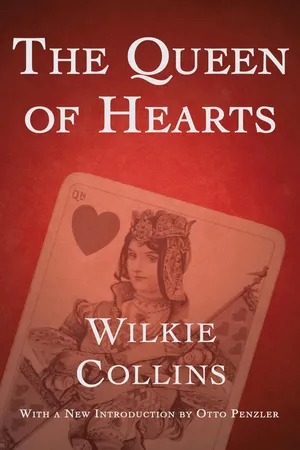
- 222 pages
- English
- ePUB (mobile friendly)
- Available on iOS & Android
eBook - ePub
The Queen of Hearts
About this book
Information
Subtopic
ClassicsIndex
LiteratureCHAPTER I
OURSELVES
We were three quiet, lonely old men, and she was a lively, handsome young woman, and we were at our wits’ end what to do with her.
A word about ourselves, first of all—a necessary word, to explain the singular situation of our fair young guest.
We are three brothers; and we live in a barbarous, dismal old house called The Glen Tower. Our place of abode stands in a hilly, lonesome district of South Wales. No such thing as a line of railway runs anywhere near us. No gentleman’s seat is within an easy drive of us. We are at an unspeakably inconvenient distance from a town, and the village to which we send for our letters is three miles off.
My eldest brother, Owen, was brought up to the Church. All the prime of his life was passed in a populous London parish. For more years than I now like to reckon up, he worked unremittingly, in defiance of failing health and adverse fortune, amid the multitudinous misery of the London poor; and he would, in all probability, have sacrificed his life to his duty long before the present time if The Glen Tower had not come into his possession through two unexpected deaths in the elder and richer branch of our family. This opening to him of a place of rest and refuge saved his life. No man ever drew breath who better deserved the gifts of fortune; for no man, I sincerely believe, more tender of others, more diffident of himself, more gentle, more generous, and more simple-hearted than Owen, ever walked this earth.
My second brother, Morgan, started in life as a doctor, and learned all that his profession could teach him at home and abroad. He realized a moderate independence by his practice, beginning in one of our large northern towns and ending as a physician in London; but, although he was well known and appreciated among his brethren, he failed to gain that sort of reputation with the public which elevates a man into the position of a great doctor. The ladies never liked him. In the first place, he was ugly (Morgan will excuse me for mentioning this); in the second place, he was an inveterate smoker, and he smelled of tobacco when he felt languid pulses in elegant bedrooms; in the third place, he was the most formidably outspoken teller of the truth as regarded himself, his profession, and his patients, that ever imperiled the social standing of the science of medicine. For these reasons, and for others which it is not necessary to mention, he never pushed his way, as a doctor, into the front ranks, and he never cared to do so. About a year after Owen came into possession of The Glen Tower, Morgan discovered that he had saved as much money for his old age as a sensible man could want; that he was tired of the active pursuit—or, as he termed it, of the dignified quackery of his profession; and that it was only common charity to give his invalid brother a companion who could physic him for nothing, and so prevent him from getting rid of his money in the worst of all possible ways, by wasting it on doctors’ bills. In a week after Morgan had arrived at these conclusions, he was settled at The Glen Tower; and from that time, opposite as their characters were, my two elder brothers lived together in their lonely retreat, thoroughly understanding, and, in their very different ways, heartily loving one another.
Many years passed before I, the youngest of the three—christened by the unmelodious name of Griffith—found my way, in my turn, to the dreary old house, and the sheltering quiet of the Welsh hills. My career in life had led me away from my brothers; and even now, when we are all united, I have still ties and interests to connect me with the outer world which neither Owen nor Morgan possess.
I was brought up to the Bar. After my first year’s study of the law, I wearied of it, and strayed aside idly into the brighter and more attractive paths of literature. My occasional occupation with my pen was varied by long traveling excursions in all parts of the Continent; year by year my circle of gay friends and acquaintances increased, and I bade fair to sink into the condition of a wandering desultory man, without a fixed purpose in life of any sort, when I was saved by what has saved many another in my situation—an attachment to a good and a sensible woman. By the time I had reached the age of thirty-five, I had done what neither of my brothers had done before me—I had married.
As a single man, my own small independence, aided by what little additions to it I could pick up with my pen, had been sufficient for my wants; but with marriage and its responsibilities came the necessity for serious exertion. I returned to my neglected studies, and grappled resolutely, this time, with the intricate difficulties of the law. I was called to the Bar. My wife’s father aided me with his interest, and I started into practice without difficulty and without delay.
For the next twenty years my married life was a scene of happiness and prosperity, on which I now look back with a grateful tenderness that no words of mine can express. The memory of my wife is busy at my heart while I think of those past times. The forgotten tears rise in my eyes again, and trouble the course of my pen while it traces these simple lines.
Let me pass rapidly over the one unspeakable misery of my life; let me try to remember now, as I tried to remember then, that she lived to see our only child—our son, who was so good to her, who is still so good to me—grow up to manhood; that her head lay on my bosom when she died; and that the last frail movement of her hand in this world was the movement that brought it closer to her boy’s lips.
I bore the blow—with God’s help I bore it, and bear it still. But it struck me away forever from my hold on social life; from the purposes and pursuits, the companions and the pleasures of twenty years, which her presence had sanctioned and made dear to me. If my son George had desired to follow my profession, I should still have struggled against myself, and have kept my place in the world until I had seen him prosperous and settled. But his choice led him to the army; and before his mother’s death he had obtained his commission, and had entered on his path in life. No other responsibility remained to claim from me the sacrifice of myself; my brothers had made my place ready for me by their fireside; my heart yearned, in its desolation, for the friends and companions of the old boyish days; my good, brave son promised that no year should pass, as long as he was in England, without his coming to cheer me; and so it happened that I, in my turn, withdrew from the world, which had once been a bright and a happy world to me, and retired to end my days, peacefully, contentedly, and gratefully, as my brothers are ending theirs, in the solitude of The Glen Tower.
How many years have passed since we have all three been united it is not necessary to relate. It will be more to the purpose if I briefly record that we have never been separated since the day which first saw us assembled together in our hillside retreat; that we have never yet wearied of the time, of the place, or of ourselves; and that the influence of solitude on our hearts and minds has not altered them for the worse, for it has not embittered us toward our fellow-creatures, and it has not dried up in us the sources from which harmless occupations and innocent pleasures may flow refreshingly to the last over the waste places of human life. Thus much for our own story, and for the circumstances which have withdrawn us from the world for the rest of our days.
And now imagine us three lonely old men, tall and lean, and white-headed; dressed, more from past habit than from present association, in customary suits of solemn black: Brother Owen, yielding, gentle, and affectionate in look, voice, and manner; brother Morgan, with a quaint, surface-sourness of address, and a tone of dry sarcasm in his talk, which single him out, on all occasions, as a character in our little circle; brother Griffith forming the link between his two elder companions, capable, at one time, of sympathizing with the quiet, thoughtful tone of Owen’s conversation, and ready, at another, to exchange brisk severities on life and manners with Morgan—in short, a pliable, double-sided old lawyer, who stands between the clergyman-brother and the physician-brother with an ear ready for each, and with a heart open to both, share and share together.
Imagine the strange old building in which we live to be really what its name implies—a tower standing in a glen; in past times the fortress of a fighting Welsh chieftain; in present times a dreary land-lighthouse, built up in many stories of two rooms each, with a little modern lean-to of cottage form tacked on quaintly to one of its sides; the great hill, on whose lowest slope it stands, rising precipitously behind it; a dark, swift-flowing stream in the valley below; hills on hills all round, and no way of approach but by one of the loneliest and wildest crossroads in all South Wales.
Imagine such a place of abode as this, and such inhabitants of it as ourselves, and them picture the descent among us—as of a goddess dropping from the clouds—of a lively, handsome, fashionable young lady—a bright, gay, butterfly creature, used to flutter away its existence in the broad sunshine of perpetual gayety—a child of the new generation, with all the modern ideas whirling together in her pretty head, and all the modern accomplishments at the tips of her delicate fingers. Imagine such a light-hearted daughter of Eve as this, the spoiled darling of society, the charming spendthrift of Nature’s choicest treasures of beauty and youth, suddenly flashing into the dim life of three weary old men—suddenly dropped into the place, of all others, which is least fit for her—suddenly shut out from the world in the lonely quiet of the loneliest home in England. Realize, if it be possible, all that is most whimsical and most anomalous in such a situation as this, and the startling confession contained in the opening sentence of these pages will no longer excite the faintest emotion of surprise. Who can wonder now, when our bright young goddess really descended on us, that I and my brothers were all three at our wits’ end what to do with her!
CHAPTER II
OUR DILEMMA
Who is the young lady? And how did she find her way into The Glen Tower?
Her name (in relation to which I shall have something more to say a little further on) is Jessie Yelverton. She is an orphan and an only child. Her mother died while she was an infant; her father was my dear and valued friend, Major Yelverton. He lived long enough to celebrate his darling’s seventh birthday. When he died he intrusted his authority over her and his responsibility toward her to his brother and to me.
When I was summoned to the reading of the major’s will, I knew perfectly well that I should hear myself appointed guardian and executor with his brother; and I had been also made acquainted with my lost friend’s wishes as to his daughter’s education, and with his intentions as to the disposal of all his property in her favor. My own idea, therefore, was, that the reading of the will would inform me of nothing which I had not known in the testator’s lifetime. When the day came for hearing it, however, I found that I had been over hasty in arriving at this conclusion. Toward the end of the document there was a clause inserted which took me entirely by surprise.
After providing for the education of Miss Yelverton under the direction of her guardians, and for her residence, under ordinary circumstances, with the major’s sister, Lady Westwick, the clause concluded by saddling the child’s future inheritance with this curious condition:
From the period of her leaving school to the period of her reaching the age of twenty-one years, Miss Yelverton was to pass not less than six consecutive weeks out of every year under the roof of one of her two guardians. During the lives of both of them, it was left to her own choice to say which of the two she would prefer to live with. In all other respects the condition was imperative. If she forfeited it, excepting, of course, the case of the deaths of both her guardians, she was only to have a life-interest in the property; if she obeyed it, the money itself was to become her own possession on the day when she completed her twenty-first year.
This clause in the will, as I have said, took me at first by surprise. I remembered how devotedly Lady Westwick had soothed her sister-in-law’s death-bed sufferings, and how tenderly she had afterward watched over the welfare of the little motherless child—I remembered the innumerable claims she had established in this way on her brother’s confidence in her affection for his orphan daughter, and I was, therefore, naturally amazed at the appearance of a condition in his will which seemed to show a positive distrust of Lady Westwick’s undivided influence over the character and conduct of her niece.
A few words from my fellow-guardian, Mr. Richard Yelverton, and a little after-consideration of some of my deceased friend’s peculiarities of disposition and feeling, to which I had not hitherto attached sufficient importance, were enough to make me understand the motives by which he had been influenced in providing for the future of his child.
Major Yelverton had raised himself to a position of affluence and eminence from a very humble origin. He was the son of a small farmer, and it was his pride never to forget this circumstance, never to be ashamed of it, and never to allow the prejudices of society to influence his own settled opinions on social questions in general.
Acting, in all that related to his intercourse with the world, on such principles as these, the major, it is hardly necessary to say, held some strangely heterodox opinions on the modern education of girls, and on the evil influence of society over the characters of women in general. Out of the strength of those opinions, and out of the certainty of his conviction that his sister did not share them, had grown that condition in his will which removed his daughter from the influence of her aunt for six consecutive weeks in every year. Lady Westwick was the most light-hearted, the most generous, the most impulsive of women; capable, when any serious occasion called it forth, of all that was devoted and self-sacrificing, but, at other and ordinary times, constitutionally restless, frivolous, and eager for perpetual gayety. Distrusting the sort of life which he knew his daughter would lead under her aunt’s roof, and at the same time gratefully remembering his sister’s affectionate devotion toward his dying wife...
Table of contents
- Cover
- Title Page
- Introduction
- LETTER OF DEDICATION TO EMILE FORGUES
- CHAPTER I: OURSELVES
- CHAPTER II: OUR DILEMMA
- CHAPTER III: OUR QUEEN OF HEARTS
- CHAPTER IV: OUR GRAND PROJECT
- BROTHER OWEN’S STORY OF THE SIEGE OF THE BLACK COTTAGE
- BROTHER GRIFFITH’S STORY OF THE FAMILY SECRET
- BROTHER MORGAN’S STORY OF THE DREAM-WOMAN
- BROTHER GRIFFITH’S STORY OF MAD MONKTON
- BROTHER MORGAN’S STORY OF THE DEAD HAND
- BROTHER GRIFFITH’S STORY OF THE BITER BIT
- BROTHER OWEN’S STORY OF THE PARSON’S SCRUPLE
- BROTHER GRIFFITH’S STORY OF A PLOT IN PRIVATE LIFE
- BROTHER MORGAN’S STORY OF FAUNTLEROY
- BROTHER OWEN’S STORY OF ANNE RODWAY
- Copyright
Trusted by 375,005 students
Access to over 1.5 million titles for a fair monthly price.
Study more efficiently using our study tools.
Frequently asked questions
Yes, you can cancel anytime from the Subscription tab in your account settings on the Perlego website. Your subscription will stay active until the end of your current billing period. Learn how to cancel your subscription
No, books cannot be downloaded as external files, such as PDFs, for use outside of Perlego. However, you can download books within the Perlego app for offline reading on mobile or tablet. Learn how to download books offline
Perlego offers two plans: Essential and Complete
- Essential is ideal for learners and professionals who enjoy exploring a wide range of subjects. Access the Essential Library with 800,000+ trusted titles and best-sellers across business, personal growth, and the humanities. Includes unlimited reading time and Standard Read Aloud voice.
- Complete: Perfect for advanced learners and researchers needing full, unrestricted access. Unlock 1.5M+ books across hundreds of subjects, including academic and specialized titles. The Complete Plan also includes advanced features like Premium Read Aloud and Research Assistant.
We are an online textbook subscription service, where you can get access to an entire online library for less than the price of a single book per month. With over 1.5 million books across 990+ topics, we’ve got you covered! Learn about our mission
Look out for the read-aloud symbol on your next book to see if you can listen to it. The read-aloud tool reads text aloud for you, highlighting the text as it is being read. You can pause it, speed it up and slow it down. Learn more about Read Aloud
Yes! You can use the Perlego app on both iOS and Android devices to read anytime, anywhere — even offline. Perfect for commutes or when you’re on the go.
Please note we cannot support devices running on iOS 13 and Android 7 or earlier. Learn more about using the app
Please note we cannot support devices running on iOS 13 and Android 7 or earlier. Learn more about using the app
Yes, you can access The Queen of Hearts by Wilkie Collins in PDF and/or ePUB format, as well as other popular books in Literature & Classics. We have over 1.5 million books available in our catalogue for you to explore.