The
Rolling Stone reporter's "fascinating . . . globe-trotting, first-person spiritual odyssey" into the Catholic Church's investigations of reported miracles (
Seattle Post-Intelligencer).
In a tiny, dilapidated trailer in northeastern Oregon, a young woman saw a vision of the Virgin Mary in an ordinary landscape painting hanging on her bedroom wall. After some skepticism from the local parish, the matter was placed "under investigation" by the Catholic diocese. Investigative journalist and
Rolling Stone contributor Randall Sullivan wanted to know how, exactly, one might conduct an official inquiry into such an incident. So began his eight year immersion into the world of "Miracle Detectives."
Sullivan set off to interview theologians, historians, and postulators from the Sacred Congregation of the Causes for Saints, men charged by the Vatican with testing the miraculous and judging the holy. Sullivan traveled from the Vatican to the village of Medjugorje, in Bosnia-Herzegovina, where six visionaries had seen apparitions of the Virgin Mary. Then, on a more personal turn, he traveled to Scottsdale, Arizona, to visit the site of America's most controversial Virgin Mary sighting.
In prose that "often reads like a spiritual whodunit,"
The Miracle Detective takes you along Sullivan's eight-year investigation into apocalyptic prophesies, claims of revelation, and the search for a genuine, direct encounter between man and god (
Publishers Weekly, starred review).
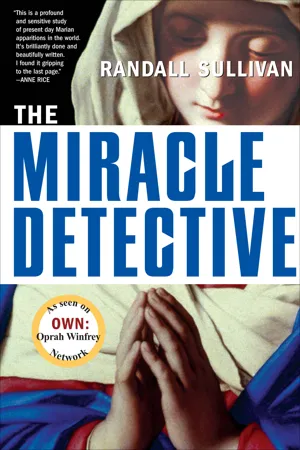
- 464 pages
- English
- ePUB (mobile friendly)
- Available on iOS & Android
eBook - ePub
The Miracle Detective
About this book
Information
Topic
Theology & ReligionSubtopic
Christian DenominationsPART I
SIGNS AND WONDERS
Two ways of thinking, the way of time and the way of eternity and timelessness, are both part of man’s effort to comprehend the world in which he lives. Neither is comprehended in the other, nor reducible to it, each supplementing the other, neither telling the whole story.
—ROBERT OPPENHEIMER
CHAPTER ONE
The first apparition had lasted twenty-four hours exactly and was witnessed by nearly one thousand people, most of them Mexican Americans, according to newspaper accounts of the event in northeastern Oregon. I read about it initially in the Portland Oregonian on Valentine’s Day, 1994.
Shortly before sunrise on the morning of February 3, in the tiny, dilapidated trailer where she lived with her parents amid irrigated fields and arid rangelands in the high desert hamlet of Boardman, a young woman named Irma Munoz had been startled, then terrified, and finally enthralled by a glowing figure. The “stylized image,” as the Oregonian article described it, had appeared in the upper right-hand corner of a landscape painting that hung in a master bedroom measuring five feet wide by six feet long.
Irma, then twenty-three and not at all religious, said she immediately recognized the glowing figure as the Virgin Mary. Irma’s mother, whose name was Lourdes, saw the Madonna also, and fell at once to her knees. Irma’s two sisters, summoned from their own trailers nearby, spread the word. Irma still stood behind her kneeling mother, staring at the radiant image, when first ten, then twenty, then thirty, then forty of her neighbors crowded into the trailer. They saw the Virgin also—or saw at least a woman wearing a veil—and most of them went to their knees with Mrs. Munoz.
There were, of course, skeptics. Two men raised the painting slightly to check its underside. Several people stood in front of the canvas, or ran their hands across it, to see if shadows would darken or disrupt the image. They even wiped the surface clean with a wet cloth. Finally, one of the men got up the nerve to lift the painting off the wall, to see if some strange play of reflected light was at work there. No matter where they moved the painting, though, or how they manipulated it, the glowing image remained. It would fluctuate in brightness, occasionally seeming to flare intensely, but this had nothing discernably to do with the painting’s angle or position.
Someone called the Spanish-language radio station in Walla Walla, Washington, with the story, which was picked up that afternoon by a local TV station. By five P.M., several hundred people had seen the image, and outside the Munoz trailer was a line three hundred feet long; men, women, and children waiting in subfreezing temperatures for a look at the wonder. Inside, people sang, wept, fainted, and prayed.
Reports of the apparition in Boardman “have stirred many of the devoutly Catholic Mexicans in Oregon’s Hispanic community,” reported the Oregonian article. “More than 3,000 people have flocked to see it, some from as far away as Utah.”
Later, when I met her, Irma Munoz said that what had hurt and angered her most was the way the media made the Madonna’s appearance “a Mexican thing.” Nearly half the people who came to her family’s trailer in Boardman were Anglos, Irma said, but one never would have known that from the newspaper coverage. The Oregonian had consulted experts to interpret this “spiritual anachronism.” Randall Balmer, the Columbia University professor who wrote a religion column for the New York Times syndicate, offered an opaque comment: “The power of faith is very real.” The local authority who weighed in was the chairman of the religious studies department at a liberal arts college outside Portland, a man who had lived for eighteen years in Bolivia. Such sightings of the Virgin were examples of “syncretism,” the professor explained: a marriage of Christian and pre-Christian beliefs in which the Madonna’s apparitions either were linked to sacred sites of the Incas, Aztecs, or Maya, or in which the mother of Jesus had assumed the identity of some Native American fertility goddess. In other words, a Mexican thing.
The Oregonian article also managed to incorporate a brief history of Marian apparitions. Three such events during modern times had inspired worldwide interest among Roman Catholics. First among these, of course, were the visions reported during 1858 by the peasant girl Bernadette Soubirous in the grotto at Lourdes, France. The second had involved the alleged appearances and purported prophecies of the Virgin at Fátima, Portugal, in 1917. The third event still was in progress at a small village in Bosnia-Hercegovina called Medjugorje, where a group of children had been claiming daily discourses with the Madonna since the early 1980s.
It was the first time I remember seeing or hearing the word Medjugorje (Medge-you-gor-yi-a). My ignorance would amaze many of those I met in the months that followed, but none of the well-educated, well-read, well-informed people I knew back in 1994 had heard of the place either. This schism between the secular and the religious would become the consuming context of my life during the next several years, yet at the time I was far too temporal to see it as significant.
Any number of claims were made for the Boardman event. Most arresting was the claim that the apparition in eastern Oregon was the first appearance by the Madonna ever captured on videotape. I watched the video when it was broadcast by a television station in Portland. At first all I saw was a spectacularly ugly oil painting of a sunset in a Sonoran desert: segauro cactuses, crumbling rocks, and cirrus clouds, all rendered in shades of reddish orange and black. Desert Aglow, the artist had titled it. Then I noticed that there was, indeed, an oval of light in the upper right-hand section of the painting. Suddenly the light flared, and for a moment I could see . . . well, something. Maybe I saw a woman in a veil standing with her hands pressed together only because that’s what I was looking for.
The television news reader reported that unnamed “experts” had speculated that the image might have been created by a holographic projector. Irma Munoz was still shaking her head over this one when I met her. “If we could afford a holographic projector,” she asked, “do you think we would have been living in a place like that?”
The place Irma referred to was a trailer about two-thirds the size of my living room, which her parents had purchased for four hundred dollars five months earlier. Reporters who described the family’s abode as “a small mobile home” were being polite to the point of misrepresentation. The trailer’s painted aluminum skin was covered with scabs of rust and hung loose at the seams. It sat on bald tires among the broken branches of half-dead fruit trees upon which laundry was hung even during winter. Inside, the quarter-inch plywood that covered the walls didn’t reach all the way to the ceiling, so that the wind (and in Boardman, less than a mile from the Columbia River, there is always wind) entered from both above and below. The roof leaked and the floorboards were so loose that one could see through to the ground in places. A propane heater was all that kept the temperature in the trailer above freezing during winter months. The bedroom where the apparitions had taken place was barely large enough to contain a double bed, meaning that those who inspected the landscape painting on that first morning had climbed across the mattress to get to it.
“My mom just let them,” Irma recalled. “She didn’t want to deny anyone the opportunity.”
My meeting with Irma had come as a relief. To make contact with her, I went through an Anglo lady from nearby Hermiston who had assumed the role of mentor to the young visionary. This was Marge Rolen. Although Marge was entirely sincere, deeply reverent, and quite generous, she also was what most of the people I knew would have called a religious nut. Born and raised in rural Kansas, Marge had been homeschooling her children to keep them away from the sort of bad influences a town the size of Hermiston (population almost ten thousand) can breed. In her spare time, she had helped set up the community’s pro-life Pregnancy Crisis Center, and for months had been engaged in “spiritual warfare” with her parish priest.
She was downriver in The Dalles with Dr. Rolen (an optometrist) when word of the apparition in Boardman reached her, Marge recalled: “My husband said, ‘You may not go!’ He knows I get carried away. I was thinking, ‘I know I have to obey my husband, but how can I not see this?’” She consulted with a priest in Pendleton who suggested Marge offer the Munoz family some blessed salt and holy water to sprinkle at the apparition site, in order to expose any demonic presence that might be involved. Her husband, outranked, consented to a trip to Boardman.
Early the next morning, Marge was sitting with the Munoz family in their trailer, watching the video they had made on the afternoon of the first apparition. She saw not only the Blessed Mother, Marge reported, but also the face of Jesus, and the silhouette of St. Bernadette. Furthermore, her rosary had turned to gold. Marge showed me a string of beads that looked as if the tarnished silver finish had worn away to expose a metallic alloy containing, perhaps, a bit of brass.
Irma was an earthier sort, attractive despite being at least forty pounds overweight, with enormous eyes and a musical laugh—a young woman whose greatest difficulty was understanding why the Mother of God would choose a person such as herself. “I mean, I’m not exactly holy,” she explained. Irma had been to church just once since her baptism, when her father was sick and her grandmother insisted the whole family must kneel at the altar and pray for him. “To me, religion was something old people talked about,” Irma said. “It had nothing to do with me. Going through high school, I was taught about evolution, that we were monkeys, and there was really no God. That’s what I believed.”
Growing up in the Rio Grande Valley on the Texas side of the border, she refused to learn even the Our Father or the Hail Mary. Like her parents, though, she would resort to prayer occasionally, when the family was strapped for cash. Irma prayed also after her tragedy, when she went to the hospital in her ninth month of pregnancy and was told that her baby had died in the womb. “My parents took me to this shrine of Our Lady of Guadaloupe, down in the valley, and I had never seen anything like it,” Irma recalled. “All these candles burning, all these people praying. It scared me. I remember there was this couple kneeling next to a little crib where their baby was hooked up to all these tubes and tanks.”
She and her husband, an Anglo from Georgia, divorced soon after, and in 1991 Irma came north for the summer with her parents. The family went back and forth for three years, then bought the trailer in Boardman to be close to Irma’s older sister. The painting of the desert landscape they had purchased for five dollars at a garage sale. “I hated the thing,” Irma said. “I was always telling my mom, ‘It’s so ugly and big. Get rid of it.’”
The morning the apparitions began, she woke up at four-thirty, which was a miracle all by itself, Irma said. Her father, who worked for a local rancher, left the trailer at five, and Irma was on the sofa watching TV when her mother called from the bedroom to ask if she would fix a cup of coffee. Irma said no at first, but then did as she was asked. “I was walking into her room, toward her, where she was lying down, facing me, and I was holding the cup of coffee, and then I looked up at the picture and saw the light. I said, ‘Mom! Mom! There’s something behind you!’ She goes, ‘What?’ I said, ‘The thing, the Lady, what you call—the Virgin.’ That’s all I knew to call her. I didn’t even know her name was Mary. But I knew who it was the moment I saw her. My mom sort of shook her head, but I kept insisting, ‘Mom, turn around.’ I was still holding the coffee, and it was shaking in my hand; I think that got her attention. I said, ‘Mom, I swear to you on my son’s grave. Please just turn around.’ I wondered if I was going nuts. So she turned around, and the next thing I know she’s jumping out of bed, and she’s on her knees, doing the sign of the cross, praying. And I said, ‘You see it too?’ And she said, ‘I see it.’”
Everyone that day saw it: “The minute they walked in, they were on their knees. I thought, ‘Well, at least I know I’m not goin’ nuts.’”
Irma worked as a nurse’s aide, and hadn’t missed a day on the job yet, but called in sick that morning. “I didn’t want to be away from Her. I never did kneel and pray like the others, though. I was just standing there watching, amazed by the love and devotion of these people, some of them getting on their knees way before they got to the door. Wow! And they just kept coming and coming.
“I was thinking, ‘Why us?’ People told me, ‘Well, if She’s here, so is the Devil.’ That scared me really bad. I started crying, thinking, ‘What did we do?’”
The image of the Madonna remained fixed for hours, changing only in brightness, fading and glowing. “Then She turned her head,” Irma recalled. “It was almost evening, and She just sort of slowly turned Her head to the other side. Somebody said it was Her telling us to pray, to get closer to God. And that was when I realized how bad we were. We never went to church, never said a prayer.”
By dusk, the line of people stretched from the front door of the trailer to the street nearly three hundred feet away. A team of sheriff’s deputies arrived for crowd control; Irma’s sister was furious when she heard one deputy say to another, “Hey, let’s call Immigration—they could get ’em all in one swoop.”
People kept coming all through the night, and Irma stayed up until the next morning, when the image disappeared at exactly the time she first had seen it the day before.
For the next forty-eight hours, the trailer remained full of those who wanted to see the painting or touch it. “They said they could still feel Her presence. It upset me. We couldn’t take a bath or have any privacy. My mom, though, she left the front door open and let in anyone who wanted to see. People were jumping over my dad while he lay in bed to touch the spot where Our Lady had been, or to check if we had anything hidden behind the painting, or if anything was shining on it.”
At least a half-dozen people who visited the trailer on the first day brought video cameras. Irma’s parents decided they should rent a camcorder themselves, thinking of their relatives back in Texas. The Munoz video (the one that played on the local news in Portland) showed the illuminated figure in the corner of the desert landscape quite distinctly. All of the other people who aimed their cameras at the apparition, however, reported that the image of the Virgin they saw with their naked eyes had not been recorded. “Which was weird,” Irma remembered. “Because it was very clear on our tape. We kept checking to see if it was still there, and it was.”
The family made a second video when the image of the Virgin reappeared six days after the first sighting, at the same hour of day, and in the same place on the painting. Irma and her family kept quiet this time, wanting to have the Virgin to themselves. While they sat watching and waiting, someone knocked at the trailer’s door. Irma told the man outside to come back another time, that her mother was ill and needed rest. When she returned to the bedroom, the image of the Madonna had disappeared. It was a lesson in unselfishness, Irma decided: The Blessed Mother’s presence was to be shared with all who believed.
After this, the Munoz family accommodated visitors whatever time of day or night they arrived. The bed in the little room was removed, replaced by an altar loaded with candles and flowers. The video of the apparition played nonstop on the television in the living room.
For Irma, the overwhelming question had become “Why me? I knew there must be some reason She appeared to me, but I had no idea what it could be.” Visitors to the trailer kept bringing her books and pamphlets, mostly about Lourdes, Fátima, and Medjugorje (she’d never heard of Medjugorje either). “People knew I was the first one who saw Her, and a lot of them, like, wanted to touch me.” They asked if She told me anything. And I said, ‘No, or if She did I didn’t hear it.’ I said I was sorry, but I didn’t have any message. I kept apologizing.”
By March 1994, Irma had partners in her search for meaning. Three women joined her to form a prayer group. The first of these was her coworker Kim Hickey. The daughter of a retired army officer well known in Hermiston, Kim was the first Anglo in whom Irma had confided, phoning her at home on February 2. “I wanted her to tell me if I was nuts.” Kim had left the Catholic Church fourteen years earlier, but that afternoon found herself consumed by curiosity, and drove directly to the trailer court. There was a long line out the door, but she pushed her way to the front, telling those ahead of her, “I’m Irma’s friend, let me in.”
She squeezed into the bedroom, looked at the painting, and saw the Virgin immediately, Kim recalled. She stared at the “image of light” for a few moments, then approached the painting and touched its surface. “It was like my hand went through a cloud. You knew who it was because you could feel it. In fact, as soon as you saw, you knew, because there was this feeling that you had, not like any other feeling, a feeling of knowing, and of awe. And everybody who saw Her had it. “
Irma and Kim soon brought in another adult care worker, Irene Virgen. They tried not to make too much of Irene’s last name, but still. . . . The three said the Rosary on their fingertips until Marge Rolen arrived with her strings of plastic beads and made them four. “We knew there was a purpose to what had happened,” Marge recalled, “and so we prayed to discover what it was.”
They weren’t getting much help from their parish priest, Father Paco Vallejo. The Munoz family called him for counsel the morning of the first apparition, but the priest already had been notified by at least a dozen other parishioners. His office received more than 150 calls during the next twenty-four hours, Father Paco said; the telephone lines seemed to be ringing constantly. Yet the priest made no effort to visit the Munoz trailer, and from the start expressed not only skepticism but outright antipathy. “It happens all the time,” he told the high desert’s largest newspaper, the East Oregonian. “It’s natural things that are thought to be supernatural. But God is always present—He’s here right now.” Father Paco was troubled by people more interested in a romantic relationship with God than in “the hard-core, day-to-day relationship” that a true believer maintained by regular attendance at Mass. His bishop had advised him to remind the people in his homily the following Sunday that even authentic apparitions were merely private revelations and amounted to little beside the revealed truth of Scripture.
Jesus Himself had said you could know a tree only by its fruit, Father Paco observed. “Call me Monday morning,” he advised the newspaper of the Portland diocese, the Sentinel, “and see how many people come to church this weekend.” Church attendance actually was higher than normal that Sunday, and Father Paco dutifully visited the Munoz trailer on Tuesday morning. “I went and saw nothing,” the priest would tell me later, before adding archly, “but they said it wasn’t happening that day.” Patience and prudence were the best policies to follow in dealing with such matters, he reminded his congregation on the Sunday after that.
The priest had asked Mr. and Mrs. Munoz if he might take custody of the painting. “But all the people told my mom and dad, ‘No, this is where She came,’” Irma recalled. “‘This is where She wants to be. Keep it.’ So we refused to give it to him. And after that, Father Paco didn’t seem to want to have anything to do with us.” Their parish priest was one of those people who believe such events should happen in church, and then only to someone very holy, Kim told Irma. “He thinks he knows the Blessed Mother,” Irma’s friend said. “But he doesn’t understand Her at all.”
While on the one hand she felt truly blessed, Irma said, the weeks that followed were among the most agonizing of her life. She was frightened by those who spoke of the Devil. Worst were the ones who said the apparition was itself the work of Satan, and that she was possessed. Her own brother, a Jehovah’s Witness, told Irma she was a tool of evil. Strangers phoned in the middle of the night and threatened to burn the trailer with Irma inside. “Witch!” she heard shouted after her when she went into Hermiston. Even those who meant well upset her, warning that Satan hated above all others those who had seen the Virgin Mary, and that she and her family would be “under attack.”
She started to think it might be true when a call came from Texas on February 11, informing them that Irma’s grandmother had been found on the floor in her home, unconscious and bleeding from the head, apparently the victim of an assault. Mr. and Mrs. Munoz flew south the next morning, but by the time they arrived the old woman was in a coma. She died on Valentine’s Day.
“People told me this was the Devil’s work,” Irma said, “and I was afraid it might be true. At the same time, though, I could feel that seeing the Blessed Mother had helped me, and my parents, too, deal with my grandmother’s death better than we ever could have before. For the first time, I really believed there was a God and a Heaven. Her visit had changed me, changed us all.”
Irma’s parents stayed on in Texas through that winter. They called one evening to say they had visited a guarandero in Brownsville who said: “Your daugh...
Table of contents
- Cover Page
- Title Page
- Copyright Page
- Dedication
- Contents
- Part I Signs And Wonders
- Part II Between The Mountains
- Part III Testing The Spirit
- Sources
- Acknowledgments
Trusted by 375,005 students
Access to over 1.5 million titles for a fair monthly price.
Study more efficiently using our study tools.
Frequently asked questions
Yes, you can cancel anytime from the Subscription tab in your account settings on the Perlego website. Your subscription will stay active until the end of your current billing period. Learn how to cancel your subscription
No, books cannot be downloaded as external files, such as PDFs, for use outside of Perlego. However, you can download books within the Perlego app for offline reading on mobile or tablet. Learn how to download books offline
Perlego offers two plans: Essential and Complete
- Essential is ideal for learners and professionals who enjoy exploring a wide range of subjects. Access the Essential Library with 800,000+ trusted titles and best-sellers across business, personal growth, and the humanities. Includes unlimited reading time and Standard Read Aloud voice.
- Complete: Perfect for advanced learners and researchers needing full, unrestricted access. Unlock 1.5M+ books across hundreds of subjects, including academic and specialized titles. The Complete Plan also includes advanced features like Premium Read Aloud and Research Assistant.
We are an online textbook subscription service, where you can get access to an entire online library for less than the price of a single book per month. With over 1.5 million books across 990+ topics, we’ve got you covered! Learn about our mission
Look out for the read-aloud symbol on your next book to see if you can listen to it. The read-aloud tool reads text aloud for you, highlighting the text as it is being read. You can pause it, speed it up and slow it down. Learn more about Read Aloud
Yes! You can use the Perlego app on both iOS and Android devices to read anytime, anywhere — even offline. Perfect for commutes or when you’re on the go.
Please note we cannot support devices running on iOS 13 and Android 7 or earlier. Learn more about using the app
Please note we cannot support devices running on iOS 13 and Android 7 or earlier. Learn more about using the app
Yes, you can access The Miracle Detective by Randall Sullivan in PDF and/or ePUB format, as well as other popular books in Theology & Religion & Christian Denominations. We have over 1.5 million books available in our catalogue for you to explore.