Fifty-two essays exploring identity, literature, immigration, and politics by the American Book Award winner, one of the godfathers of Chicano literature.
Best known for his novel
Bless Me, Ultima, which established him as one of the founders of Chicano literature, Rudolfo Anaya displays his gift for storytelling and deep connection to the land and its history in
The Essays. These intimate and contemplative essays explore censorship, immigration, urban development, the Southwest as a region, and personal identity.
In "Aztlan: A Homeland Without Boundaries," he discusses the reimagining of the modern Chicano community through ancient myth and legend; in "The Spirit of Place," he explores the historical connection between literature and the earth. Some essays are autobiographical, some argumentative; all are passionate—and a must-read for Anaya fans and readers who crave a view of contemporary America through fresh eyes.
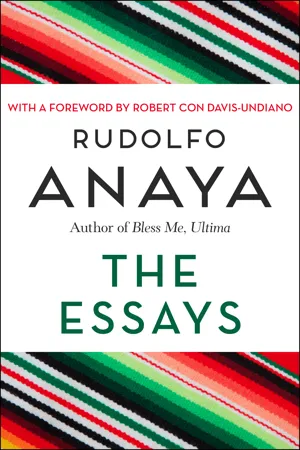
- 344 pages
- English
- ePUB (mobile friendly)
- Available on iOS & Android
eBook - ePub
The Essays
About this book
Information
Topic
LittératureSubtopic
Biographies de sciences socialesPART ONE
Living Chicano
I’m the King
The Macho Image
The word “macho” has one of the shortest definitions in the Spanish language dictionary, and yet the cult of macho behavior (machismo) is as ambiguous and misunderstood as any aspect of Hispanic/Latino culture. To be macho is to be male, that’s simple, but when the term is applied to Hispanic male behavior, then the particulars of the role are defined according to the particular culture. From Spain to Latin America, from Mexico to the USA Chicano communities, one gets a slightly different definition of the macho image at every turn.
Being macho is essentially a learned behavior; as such it is a conditioned behavior. We males learn to act manly from other males around us; the macho behavior that preceded us was learned from the cultures from which it evolved. Many forces impinge on the Hispanic/Latino cultures, so throughout history, machismo—or the conditioning of male behavior—has attracted all sorts of positive and negative elements.
Many cultural forces (from literature and religion to the latest musical fad, movies, MTV, or car styles) play a role in promoting the behavior of the macho, and these influences are the issue here. Still, beneath the conditioned behavior, the essence of what maleness means remains largely unchanged across time. We can describe conditioning and its effects; it is more difficult to describe the essence of maleness, especially today, when males seem to be retreating from describing, or laying claim to, a positive macho image.
Drunkenness, abusing women, raising hell (all elements of la vida loca) are some mistaken conceptions of what macho means. And yet the uninformed often point to such behavior and call it machismo. In fact, much of this negative behavior is often aped by a new generation, because as young men they are not aware that they are being conditioned. Young men acting contrary to the good of their community have not yet learned the real essence of maleness.
Sex
Our generation passes on to the next its ideals and rituals, and also behavior patterns that have to do with our sexuality. People have always composed games around sexuality. In this respect, the macho image has a history. The cock-of-the-walk behavior is game playing. Games and sex go hand in hand.
The game can be spontaneous and fun, reflecting the courtship and mating we see in the natural world. Part of the purpose of gender games is to reflect nature’s dance of life, evolution playing itself out in each new encounter. Animals, insects—high and low organisms—engage in this dance of life. We are caught up in “nature’s game,” this vast and beautiful dance that is part of the awe of life. We feel love in the harmonious flow of nature, the movement of birth and death, and we take meaning from our sexual natures.
But the game has taken on a manipulative aspect. The assertion of one person over another is part of our conditioning. The game has turned ugly in many ways, and we are numbed by the outcome of the conditioning factors. But we can still be in charge of the game and change the negative aspects of the game. We can choose not to play a power game that hurts and demeans women.
Macho behavior, in large part, revolves around the acting out of sex roles. The games the macho plays may be part of nature’s dance, with the goal of procreation imprinted on the cells long ago, but the power to subjugate is also inherent in out relationships. When the male gets caught up in superficial power plays that have to do with sex, he is acting against his community. It’s time to analyze the social forces that condition negative behavior and toss out the ones that destroy family, friendship, and community.
For the Chicano, the roots of the idea of maleness extend not only into the Mediterranean world but also into the Native American world. We still act out patterns of male behavior emerging from those historic streams. To fully understand our behavior requires a knowledge of those literary and cultural histories. The Don Juan image and how it sets the tone for a pattern of behavior from the Mediterranean Spain of the past to the present day is only one aspect of a behavioral legacy. We need to know the role of the Native American warrior and how he cares for the community. The Chicano is a synthesis of these, and many more, streams of influence.
“I Can Piss the Farthest”
Little boys like to brag about the length of their penises, or they have contests to see who can piss the farthest. Acting out “I’m bigger, I’m better,” the game begins to have its built-in power aspect. Later, boys will brag about having scored with a girl, and in the boast is contained a hint of the power they have exercised. Those who haven’t yet scored have less power. They’re virgins in the game. Those who don’t see girls as the goal to be conquered have even less power. A hierarchy of needs and behavior begins to define the male role and the power inherent in it. The truer essence of male and female doesn’t need this hierarchy, for hierarchy implies the use of power over others. And why should that which is most natural to our nature, our sexuality, require us to deal with others as objects?
Macho needs partners, not objects.
Until my father’s generation, the men of the Mexican culture of the southwest United States could continue to speak Spanish and interact within the parameters of their history. That is, they set the code of behavior, one that was communal and focused on survival in an often harsh land. As Anglo-Americans moved into the territory, a wrenching of male relationships took place. The language of domination shifted from Spanish to English. Anglo-American law came to New Mexico in the mid-nineteenth century, but the rule of law in daily life and most communal enterprises remained Spanish. It was not until after World War II that the ways of my ancestors were overwhelmed. And therein lies an epic tragedy.
My father’s generation had to adjust to the new language, the new man in town, the new laws. To be a man under Anglo domination was difficult if you didn’t have the tools. I saw men broken by the new time, the new space. If they didn’t adjust to the new language, they were demeaned. I now better understand my father’s behavior, why he gave up. He didn’t have the language, the tool with which to protect his own dignity, his own concept of macho. An excellent example of this meeting of cultures is shown in the movie The Ballad of Gregorio Cortez, a film that takes its story from a real corrido.
In some areas the males did absorb one another’s concept of maleness. For example, the New Mexican land owners, lawyers, and politicians (those generally known as los ricos or los patrones) quickly learned to work with their Anglo counterparts. The Mexican vaqueros taught the Anglo cowboys the trade, so there existed some camaraderie on a macho level in those endeavors. But overall, the power of law and language was too vast and overwhelming. The Anglos could dictate roles; they could piss farthest, so to speak.
“I’m the King”
“Sigo siendo el Rey.” “I’m the King” are the lyrics from a popular Chicano rap song I hear on the radio. The words and rhythm are catchy. I listen to the song and find myself repeating the lines.
Macho behavior is instilled in us as children. Both father and mother want their boys to grow up to be manly. Usually, the more traditional the rules of behavior are for the macho, the stricter the behavior the child learns. When he becomes a man the child sings, “I’m the king. I rule the family, like my father before me, and what I say goes.” The child is the father to the man. But fathers at home are more and more rare. The child turns to the gang in the streets. A new style of being king is learned.
My parents knew a wonderful couple, old friends who came to visit. My mother and her comadre would cook up big meals, my father and his compadre would buy the wine. It was fiesta time. The old man would have a few glasses of wine and start acting like the king. “Yo mando,” he would tell his wife, and the teasing about who ruled, the man or the woman, would go on. Visiting across the kitchen table and drinking wine, they were caught up in discussing the roles of man and woman.
It has always been so. In that space of the family fiesta in the small kitchen, they could define and redefine their roles. The mask of gaiety put on for the fiesta allowed them to speak freely. But beneath the surface a real dialogue was going on, defining and refining the roles of the men and the women. Do we have that dialogue about machismo going on in our community today, or have we accepted old roles conditioned by forces beyond our control? Are we too programmed to see the light?
The male child observes and learns to be the king, how to act as número uno, how to act around men and women. In a community that is poor and often oppressed there is much suffering, so he is taught aguantar: to grin and bear it. “Aguántate,” the men around him say. A macho doesn’t cry in front of men. A macho doesn’t show weakness. Grit your teeth, take the pain, bear it alone. Be tough. You feel like letting it out? Well, then let’s get drunk with our compadres, and with the grito that comes from within, we can express our emotions. Lots of essays could be written on aguantar. The women also learn aguantar: Bearing it crosses the gender boundary. How women express the flood-waters of the aguanto is now being documented by Chicana writers.
The macho learns many games while learning to be número uno. Drinking buddies who have a contest to see who can consume the most beer, or the most shots of tequila, are trying to prove their maleness. From the pissing contest to drinking, the wish to prove his manliness becomes antisocial, dangerous. The drunk macho driving home from the contest he won can become a murderer.
The car in our society has become an extension of his manhood for the macho. The young male hungers for the most customized, flashiest car. It replicates him. It is power. The car is used in the mating ritual. As in our small villages generations ago the young vaqueros came into town to show off their horses and their horsemanship, the young now parade the boulevard showing off their cars. The dance is the same; the prize is the same.
To other males, the vato with the best car is saying, “I’m bigger, I’m better, I’m the king.” Exactly the lyrics to the rap song. “Sigo siendo el Rey,” he sings, “I continue being the king.” The song describes one goal of the macho, to be king, to be número uno, to answer to no one. The message is aimed not only at other males, it is also for the female of the species.
Outside Influences
But guns have entered the game. Perhaps they’ve always been there, because certainly the Mexican charro and the cowboy of the movies both carried pistols, both fought it out with the bad guys, and the fastest draw won. In the rural areas hunting is most often male behavior. The gun extends the power and the sexuality of the young men. Now you can strike farther and deadlier.
It is time to call that behavior that is good, good. And that which is negative to the self and the community, not good. To be unkind and violent is not macho. The vato in the song who wants to be the king needs to find positive ways of acting for his community.
In my generation the “attitude” of James Dean influenced young male behavior, as did that of black musicians and black talk. Today, parents worry about the violent influence of the movies. The characters portrayed by Arnold Schwarzenegger (and other such exaggerated macho images) and the Power Rangers have become the symbols of violence in our society. Machos seem to solve problems only through violence, and quickly. Discourse and problem solving, which take time, are not honored in such movies. Parents worry about the influence such media are having on the young. Macho has really gotten out of hand; in fact, it’s been perverted by those who use a false ideal of manliness to achieve their goals. We need to stand up and say loudly and clearly, that violence and oppression are not macho.
As more Chicano families become single-parent families, the traditional role of the father and of males in the extended family will not be as influential in shaping the behavior of boys. The boys are being conditioned instead by the behavior they see on TV, in movies and music videos. Boys loose in the hood are being shaped by the gang instead of the father.
La ganga shapes behavior, provides initiation, belonging. (Life in the gang—whether it’s a neighborhood group of boys; an athletic fraternity, “the jocks”; or a gang that is into la vida loca, cruising, drinking, drugs, and guns—is a subject that requires a book to itself.) In the traditional culture, we didn’t practice drive-by shooting as initiation into maleness. Young Chicanos moving into the maleness of the gang now practice a more violent form of initiation.
Young Chicano males learn from the past generations (drinking is often learned from brothers or close relatives), and such behavior is greatly influenced by the mainstream society. The influence of the Anglo-American culture on the Chicano culture cannot be overlooked. We can no longer speak of a continuum of learned behavior that is solely Mexican macho, because young males are greatly influenced by the totality of the culture around them. MTV, music, movies, television, and the behavior of other cultural groups all influence the behavior of the young Chicano male. To truly understand himself, and his maleness, the young male must ask himself: “Who is affecting me?” “What do they want of me?” “How can I take charge of my own life?”
There is a lesson to be learned here. Let us not repeat the loss of the prior generation, a loss we see today in the streets. Let us not be “powerless” as men. Let us not act out negative behaviors. We have within us the power to change. We have the future of our community at stake, so macho behavior has to be used positively for the community.
Los Chucos
Each generation becomes a new link in the group’s tradition, but also transforms behavior. My adolescent years saw the advent of the pachuco, a radical departure in the male behavior of the small New Mexican town I knew. Who were esos vatos locos imitating in the forties when they invented the pachuco argot, the dress, sexual liberation in attitude and action, use of drugs, use of cars, and so on? Was there a continuous line of macho behavior in which the chucos were a link? Or was the behavior so spontaneous and new that the pachucos initiated a new definition of what it meant to be macho? After all, being macho does mean to defend the territory, and the chucos did defend their barrios against mainstream encroachment. Were the pachucos a reaction to the growing oppression by Anglo America? Partly, but once the warriors defined themselves, they spent as much time fighting each other as they did fighting the enemy, el gabacho.
The pachuco became a new model of behavior, breaking with the past, and yet in his role vis-à-vis la chuca, the male-female dance contained the same old elements embedded in the Mexicano culture. The power play was definitely at work. La chuca, as liberated as she was from her contemporary “square” sister who remained a “nice” girl, was still subservient. The pachuco loved to show off his baby doll.
This makes us question if breaks with the past are really radical, or does only the surface dress of the macho change? Beneath the zoot suit of the pachuco, old cultural forces and conditioned behavior continued to define the relationship between the macho and his woman. “Esta es mi ruca,” he said proudly, introducing the woman as property in which he was pleased.
The pachuco practicing la vida loca continued to influence the definition of macho behavior in the nineties. They were the early lowriders. They spawned the baby chooks and those Chicano males who today are acting out roles, sometimes unknowingly, with roots in the pachuco lifestyle. (The Chicano rapper borrows from the Black rapper, but in his barrio and in his strut and talk, he is borrowing as much from the old veteranos.) This role of an “unconscious energy” in the community is something we can’t measure, but it’s there. History is passed on not only in stories and books, but by osmosis.
It makes us ask: Is behavior only learned? Or is there real maleness, a golden rule not only in the blood but in the myths? I look at the young machos parading down the street, acting out their roles, and I wonder how much of their behavior comes from that unconscious influence, something inherent in maleness itself. There is something in that dignity of maleness we don’t want to give up. But what is it? We know those negative forces that condition us have to be repudiated. But we also yearn to be noble men, and to act in a noble fashion for our families.
La Familia
The pachuco macho behavior, while very visible in the barrio (and introduced to a larger audience by the U.S. Navy anti-pac...
Table of contents
- Cover Page
- Praise of the Writing of Rudolfo Anaya
- Title Page
- Dedication
- Contents
- Foreword
- Part I. Living Chicano
- Part II. Censorship
- Part III. The Southwest: Landscape and Sense of Place
- Part IV. Culture and Art of the Southwest
- Part V. Literature of the Southwest
- Part VI. Modern Ethnic Literature and Culture
- A Biography of Rudolfo Anaya
- Copyright Page
Trusted by 375,005 students
Access to over 1.5 million titles for a fair monthly price.
Study more efficiently using our study tools.
Frequently asked questions
Yes, you can cancel anytime from the Subscription tab in your account settings on the Perlego website. Your subscription will stay active until the end of your current billing period. Learn how to cancel your subscription
No, books cannot be downloaded as external files, such as PDFs, for use outside of Perlego. However, you can download books within the Perlego app for offline reading on mobile or tablet. Learn how to download books offline
Perlego offers two plans: Essential and Complete
- Essential is ideal for learners and professionals who enjoy exploring a wide range of subjects. Access the Essential Library with 800,000+ trusted titles and best-sellers across business, personal growth, and the humanities. Includes unlimited reading time and Standard Read Aloud voice.
- Complete: Perfect for advanced learners and researchers needing full, unrestricted access. Unlock 1.5M+ books across hundreds of subjects, including academic and specialized titles. The Complete Plan also includes advanced features like Premium Read Aloud and Research Assistant.
We are an online textbook subscription service, where you can get access to an entire online library for less than the price of a single book per month. With over 1.5 million books across 990+ topics, we’ve got you covered! Learn about our mission
Look out for the read-aloud symbol on your next book to see if you can listen to it. The read-aloud tool reads text aloud for you, highlighting the text as it is being read. You can pause it, speed it up and slow it down. Learn more about Read Aloud
Yes! You can use the Perlego app on both iOS and Android devices to read anytime, anywhere — even offline. Perfect for commutes or when you’re on the go.
Please note we cannot support devices running on iOS 13 and Android 7 or earlier. Learn more about using the app
Please note we cannot support devices running on iOS 13 and Android 7 or earlier. Learn more about using the app
Yes, you can access The Essays by Rudolfo Anaya in PDF and/or ePUB format, as well as other popular books in Littérature & Biographies de sciences sociales. We have over 1.5 million books available in our catalogue for you to explore.