From an award-winning historian: "A new and convincing likeness of medieval England's most iconic king" (
The Sunday Times).
This biography by the bestselling author of
The Time Traveler's Guide to Medieval England takes an insightful look at the life of Henry V, casting new light on a period in history often held up as legend.
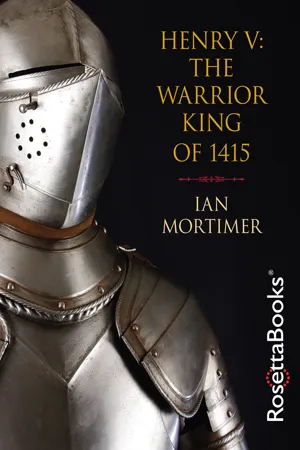
A great English hero, Henry V was lionized by Shakespeare and revered by his countrymen for his religious commitment, his sense of justice, and his military victories. Here, noted historian and biographer Ian Mortimer takes a look at the man behind the legend and offers a clear, historically accurate, and realistic representation of a ruler who was all too human—and digs up fascinating details about Henry V's reign that have been lost to history, including the brutal strategies he adopted at the Battle of Agincourt.
"The most illuminating exploration of the reality of 15th-century life that I have ever read." —
The Independent
"Compelling, exuberant . . . vivid." —Simon Sebag Montefiore,
New York Times–bestselling author of
The Romanovs: 1613–1918
- 618 pages
- English
- ePUB (mobile friendly)
- Available on iOS & Android
eBook - ePub
Henry V: The Warrior King of 1415
About this book
Information
Subtopic
Historical BiographiesIndex
HistoryNotes
Prologue
1. McFarlane, Lancastrian Kings, p. 133. It is worth noting that McFarlane did not specify what he meant by ‘greatness’ or ‘the greatest man’.
2. McFarlane wrote ‘the historian cannot honestly write biographical history: his province is rather the growth of social organisations, of civilisation, of ideas’ (quoted in Harriss, Cardinal Beaufort, v).
Introduction
1. Vaughan, John the Fearless, pp. 44–8.
2. Vaughan, John the Fearless, pp. 71–2.
3. Vaughan, John the Fearless, p. 85. The guidebook to La tour Jean sans Peur, Paris, suggests that it was not actually the duke’s bedchamber. The reasons it gives are that the tower is small, and not of the expected ducal grandeur. The chamber beneath the duke’s is described today as the equerry’s chamber. However, Vaughan’s statement, based on the building accounts, is explicit: the principal room was indeed designed for John’s personal safety at night. The fifteenth-century chronicler Monstrelet also states specifically that he built this tower to sleep in at night. The two chambers are supported on huge stone pillars, rising twenty-five feet or so above the first-floor guard chamber, and reached only by an extremely elaborately carved stone staircase, which incorporates several of the duke’s heraldic badges. The wonderful staircase ceiling suggests strongly that, although this was a small chamber, it was intended to be seen by the duke. The whole edifice amounted to a lordly stone box supported sixty feet above the walls of Paris. And as the tower was constructed in 1408–9, after the murder of Orléans and John’s return to the city, I suspect that the extraordinary design, incorporating so much empty space, was a means of preventing the duke being attacked in his bedchamber by the use of fire. The tower is illustrated in the second plate section of this book.
4. Allmand, Henry V, p. 48. There had been earlier embassies appointed to negotiate with Burgundian ambassadors—e.g. those of 3 July 1406 and 29 November 1410 (Hardy, Syllabus, pp. 556, 566) but these seem to have been for the defence of Calais and the local truce. See Nicolas (ed.), Privy Council, ii, pp. 5–6 for the instructions to the ambassadors appointed on 29 November 1410.
5. Fears, esp. p. 322.
6. Fears, p. 337; Allmand, Henry V, p. 48.
7. Monstrelet, i, pp. 18–19. Although the then duke of Burgundy (Philip the Bold) was excepted by Louis in this agreement, this was only with regard to Louis’ part of the bargain. In other words, Henry would have still been liable to help Louis against John the Fearless’s father even though Louis was not bound to help Henry against the duke of Burgundy.
8. Fears, pp. 114, 134–5, 155.
9. Hardy, Syllabus, ii, pp. 567–8. An extension of the truce in Flanders was sealed on 27 May 1411.
10. In support of this it should be noted that on the same day that Henry appointed the ambassadors to treat with the Burgundians at Calais he granted safe conduct for ambassadors of the king of France to come to England. See Syllabus, ii, p. 566. See also p. 567, where redress of injuries with ambassadors from Burgundy and France are simultaneously authorised on 27 March 1411.
11. Curry, Agincourt, p. 26.
12. Fears, p. 339; Nicolas (ed.), Privy Council, ii, pp. 19–24.
13. Given-Wilson (ed.), PROME, 1411 November (Introduction) states the fleet sailed in September. Curry, Agincourt, p. 27, states that the force was sent to meet the duke of Burgundy at Arras on 3 October.
14. Allmand, Henry V, pp. 48–9. It is perhaps significant that the name of the duke of Berry was removed from the 1 September instructions to the ambassadors to treat with John the Fearless, removing any requirement for the English to fight Berry on John’s behalf. See Nicolas (ed.), Privy Council, ii, pp. 21–4.
15. Fears, p. 338. The consensus view on intervention in France in 1411 is specified in Allmand, Henry V, p. 48; Curry, Agincourt, p. 27.
16. In Fears, p. 341, I stated two thousand English archers and eight hundred men-at-arms were at St-Cloud. However, recent research suggests that the expedition consisted...
Table of contents
- Cover
- Title Page
- Copyright
- Contents
- Author’s Note
- Map of Northern France
- List of Illustrations
- Acknowledgements
- Prologue
- Introduction
- Christmas Day 1414
- January
- February
- March
- April
- May
- June
- July
- August
- September
- October
- November
- December
- Epilogue
- Conclusion
- Appendices
- Notes
- Select Bibliography and List of Abbreviations
- Genealogical Tables
Trusted by 375,005 students
Access to over 1.5 million titles for a fair monthly price.
Study more efficiently using our study tools.
Frequently asked questions
Yes, you can cancel anytime from the Subscription tab in your account settings on the Perlego website. Your subscription will stay active until the end of your current billing period. Learn how to cancel your subscription
No, books cannot be downloaded as external files, such as PDFs, for use outside of Perlego. However, you can download books within the Perlego app for offline reading on mobile or tablet. Learn how to download books offline
We are an online textbook subscription service, where you can get access to an entire online library for less than the price of a single book per month. With over 1.5 million books across 990+ topics, we’ve got you covered! Learn about our mission
Look out for the read-aloud symbol on your next book to see if you can listen to it. The read-aloud tool reads text aloud for you, highlighting the text as it is being read. You can pause it, speed it up and slow it down. Learn more about Read Aloud
Yes! You can use the Perlego app on both iOS and Android devices to read anytime, anywhere — even offline. Perfect for commutes or when you’re on the go.
Please note we cannot support devices running on iOS 13 and Android 7 or earlier. Learn more about using the app
Please note we cannot support devices running on iOS 13 and Android 7 or earlier. Learn more about using the app
Yes, you can access Henry V: The Warrior King of 1415 by Ian Mortimer in PDF and/or ePUB format, as well as other popular books in History & Historical Biographies. We have over 1.5 million books available in our catalogue for you to explore.