From the author of
The Automatic Diet: "A useful yet fun book that could provide the push you all need to achieve lasting change" (
Shape).
Ever get the sense that you're reliving the same events, arguments, and frustrations again and again? Does your relationship, job, or diet always begin full of hope, but, somehow, fail to work out in the end?
In
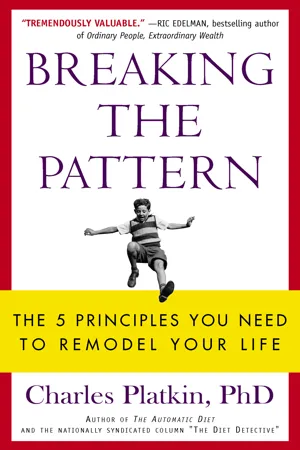
Breaking the Pattern, nutrition and public health advocate Dr. Charles Platkin synthesizes years of research in psychology, motivation, success, and achievement into the "The 5 Principles You Need to Remodel Your Life," helping readers take action in those areas where they feel stuck or doomed to repeat negative experiences. Through a series of self-reflective exercises, Platkin encourages readers to examine their successes and failures, identifying, analyzing, and finally breaking the very patterns that have kept them from realizing their dreams. By incorporating inspirational quotes and stories throughout the book, Platkin creates a positive, healing environment in which even the most self-doubting reader can gain the support and motivation necessary to begin to change his or her life for the better.
"[Platkin] breaks down five principles necessary to transform your life . . . And he's not just spouting theory." —
The Dallas Morning News
"
Breaking the Pattern blends cozy inspiration with a dose of military rigidity." —
The Denver Post
"A road map for anyone who's failed at New Year's resolution, or any goal for personal change." —
San Jose Mercury News
- 272 pages
- English
- ePUB (mobile friendly)
- Available on iOS & Android
eBook - ePub
About this book
Information
Topic
Personal DevelopmentSubtopic
Self ImprovementGoals
CHAPTER FIVE
What Makes a Goal a Goal?
In the long run, men hit only what they aim at. —Henry Thoreau
If you set high goals for yourself, and every day continue to reflect on them, step by step, you will be more focused and make yourself a better human being. —Konosuke Matsushita, CEO of Matsushita Electric
Society seems to have been designed to dull your dreams and sensibilities. In childhood, you could dream abundantly and fancifully about what might or might not happen. Your imagination seemed limitless—you were even encouraged to fantasize, create, and spin dreams. But as an adult, your efforts to make dreams come true are often met with resistance, doubt, or criticism. Or, others attempt to impose limitations on you. You may have internalized those doubts and negativity and, out of fear of humiliation and failure, learned to keep your dreams under wraps, concealed sometimes even from yourself. Or, you stop yourself from taking chances. To break the pattern and unleash your true potential, recapture some of that lost ability to dream! Unearth the visionary inside you.
The fifth-century philosopher Confucius declared that wisdom is “when you know a thing, to recognize that you know it, and when you do not know a thing, to recognize that you do not know it.” So, while defining your dream, you should try to maintain the ability to see yourself and your circumstances practically and clearly. Dreams can be wonderful and energizing, but it takes discipline to make them real. Let’s meet that head-on.
As an adult, you need to dream realistically and wisely. This wisdom is a combination of tapping into your youthful ingenuity and your innate ability to come up with innovative solutions, tempered by your ability to modify those ideas with the experiences, insights, and principles you’ve picked up along the way. In adulthood, dreaming is a good start, but it is only the beginning. That beginning leads us to goals or passions and more important, to goal planning.
What Is Goal Planning?
I always achieve my goals because I don’t quit, and have a plan. —Sam LeFrak, billionaire real-estate developer
“When I was growing up, a guy across the street had a Volkswagen Bug. He really wanted to make it into a Porsche. He spent all of his spare money and time accessorizing this VW, making it look and sound loud. By the time he was done, he did not have a Porsche. He had a loud, ugly VW. You’ve got to be careful choosing what you’re going to do. Once you pick something you really care about, and it’s a worthwhile thing to do, then you can kind of forget about it and just work at it. The dedication just comes naturally,” says Steve Jobs, CEO of Apple Computers. Still, many people choose the path of least resistance. Rather than pursue a goal, they take whatever is at hand or whatever comes up, then try to fit themselves into whatever opportunity presents itself.
You can do this in terms of career. You can also do it in your relationships and with your health. It’s not the job you want, but you take it because it’s better than nothing. You’re not really happy with the person you’ve committed to, but he or she has always been there.
Goal planning can be tricky business. You don’t want to err too far on the side of being unrealistic, like the fool Steve Jobs described who wanted to remake his VW into a Porsche. On the other hand, you don’t want to err by setting your sights too low, spending a lifetime underachieving, only to end up wondering what if you really had applied yourself.
I’m going to propose that life is not such a game of wait-and-see. Your goals, thankfully, are in your hands and are not a matter of chance. I propose that rather than “making do” with whatever presents itself, you instead dare to take a proactive role in creating the world that lives in your dreams. It will not be handed to you. It will not coincidentally materialize if you think about it long enough and hard enough. It begins with knowing what you want. Then you have to really want it enough to plan for it, and yes, work for it, sometimes over a long period of time. You also have to be careful, literally, full of care about what you want. You have to ponder it, then be clear that you want it badly enough to put a committed effort into making it happen—to sacrifice other more fleeting pleasures. And you will make sacrifices because anything worth having usually involves some struggle. Then, after all of this dreaming, soul-searching, deciding, and steeling of your resolve, you must remember that this is only the beginning—you need a plan.
Why You Need Goal Planning
The focus of the fourth Principle is Goal Planning rather than the more familiar phrase “goal setting.” Goal setting is something almost everyone engages in to some extent. You can imagine a goal and how to make it happen. Or, if you’re really ambitious, you can write an annual list of goals at New Year’s or on your birthday, stick the list in a drawer, and forget about what’s on it. For people who choose this method, goal setting is a one-time proposition.
But don’t misunderstand me—writing down your goals and putting the list in a drawer is still better than not having any goals at all. You set the goal, but didn’t necessarily plot the course to reach it. The thing is, sometimes, what you think of as goal setting amounts to little more than a wish list.
Goal planning, on the other hand, is a much more comprehensive, more intensive, and less fleeting affair. You not only write down a goal, but also outline the steps you’ll take to reach it. You devise a thorough plan of attack, complete with contingencies of every sort, and then track your progress, consistently and thoughtfully. Goal planning includes self-monitoring and follow through.
As you’ll see below, there’s hard evidence that active goal setting and planning for both the short- and long-term lead to higher achievement. High achievement is not something that happens to anyone by accident. It is planned for, visualized, and pursued relentlessly. If you don’t set a goal that tells you where you want to go, you could easily end up someplace else. By understanding this Principle, you will embark on the path of defining, visualizing, planning for, and eventually attaining goals and breaking your patterns.
Goals and Risk
I’m not going to sugarcoat the message: It’s both brave and risky to have a goal. To have a goal is to admit to wanting something; and to yearn for something implies vulnerability, which is not necessarily a bad thing. It opens you up to the possibility of dis-appointment, failure, and rejection, which you might be inclined to fear. But having a goal is also a tremendous step in being responsible to yourself. When you actually tell people about your goals, you make the goals that much more real by giving yourself something to live up to, but you also become that much more vulnerable.
Suzanne Yalof, author of Getting Over John Doe, said, “The biggest chance I ever took was when I said to my fiancé on our fourth date, ‘I want to get married and have children eventually and if you don’t, then let’s move on.’ I can’t believe he went out with me again—he still teases me.”
While she certainly risked rejection by her future husband when she laid her cards on the table so early in their relationship, she also took responsibility for her relationship and its direction.
But, the alternative is worse. To be mired in less-than-ideal circumstances for your one and only life (as far as we know), is to suffer a loss of dreams, which is a crippling condition.
Let me assure you: A goal doesn’t have to be something extraordinary or marvelous. It can simply be wanting to make a family, or getting a new car every two years, or getting a promotion at work. Also, don’t be intimidated into thinking you must have a goal that is perceived by others as dynamic or extraordinary. You might decide to retire from a busy life and relax more, do a little volunteer work, go back to school, or spend more time with relatives—or even become a couch potato for a little while. You might not want to make any decision right now. That’s also okay. Just be clear that this is what you want.
Reaching your goals is not about gambling, that is, unless your goal is to win $1 million in the slot machines in Las Vegas. Getting to your goals is not a matter of random chance no matter how hard you blow on the dice and pray. Getting to your goals requires techniques that greatly improve your chances of achieving. This chapter takes you through the steps, starting with the first stages of goal planning.
What Makes a Good Goal?
An easy way to remember how to ensure your goal will be effective is to make it S.M.A.R.T.:
- Specific and clearly defined
- Motivating and stimulating
- Achievable (especially in terms of time frame) and honest
- Rewarding
- Tactical (have tactics, strategy, and discipline)
Let’s take these one by one.
Specific and Clearly Defined
Goals should be specific, so there can be no doubt about your intentions. If you set a goal to “make more money so I can retire early,” or “be warmer to my family,” you have not given yourself a clear enough target at which to aim. Your efforts will lack focus and an effective means of measuring their success. A better defined and clearer goal is: “I’m going to make X amount of money so that I can retire at 45.”
Most studies show that clear and specific goals with a well-defined target (such as to retire at 45 years old) are more effective than general “do your best” or “do better” goals. Other studies show that people perform better on tests in which they are asked to find specific objects in a cluttered picture, that is, meeting the goal of finding something specific by filtering out irrelevant information. Specific goals also enable people to use and deal with negative and positive feedback intelligently. When your goal is clear and specific, you can answer questions about your objectives or deal with criticism about your goal from yourself and others.
Let’s take the example above on retirement and continue to analyze it. Having the relatively unclear goal of “making more money to retire early” doesn’t put you on track or tell you how far down that track you are right now. “More” money must be defined with other specifics, such as when, how much, and through what means? Having “more” money is difficult to achieve without creating a definite plan. By clearly defining both the long-term goal (to retire by 45) and the interim target (saving/investing/earning “X” dollars per year) and by what means you will earn this money, you’re able to evaluate your progress and know whether you are falling short along the way.
Goals vs. Tasks
Goals should not be confused with tasks. Tasks are those little things you do to reach your sub-goals. A task is a piece of work to be accomplished and checked off the list. For example, if you wanted a better job, a related task would be to se...
Table of contents
- Breaking the Pattern
- Copyright
- Acknowledgments
- Table of Contents
- Introduction to the New Edition
- Introduction: What One Can Imagine, One Can Achieve
- Patterns
- Failure
- Responsibility
- Goals
- Achievement
- More from Charles Platkin, PhD
- Connect with Diversion Books
Trusted by 375,005 students
Access to over 1.5 million titles for a fair monthly price.
Study more efficiently using our study tools.
Frequently asked questions
Yes, you can cancel anytime from the Subscription tab in your account settings on the Perlego website. Your subscription will stay active until the end of your current billing period. Learn how to cancel your subscription
No, books cannot be downloaded as external files, such as PDFs, for use outside of Perlego. However, you can download books within the Perlego app for offline reading on mobile or tablet. Learn how to download books offline
Perlego offers two plans: Essential and Complete
- Essential is ideal for learners and professionals who enjoy exploring a wide range of subjects. Access the Essential Library with 800,000+ trusted titles and best-sellers across business, personal growth, and the humanities. Includes unlimited reading time and Standard Read Aloud voice.
- Complete: Perfect for advanced learners and researchers needing full, unrestricted access. Unlock 1.5M+ books across hundreds of subjects, including academic and specialized titles. The Complete Plan also includes advanced features like Premium Read Aloud and Research Assistant.
We are an online textbook subscription service, where you can get access to an entire online library for less than the price of a single book per month. With over 1.5 million books across 990+ topics, we’ve got you covered! Learn about our mission
Look out for the read-aloud symbol on your next book to see if you can listen to it. The read-aloud tool reads text aloud for you, highlighting the text as it is being read. You can pause it, speed it up and slow it down. Learn more about Read Aloud
Yes! You can use the Perlego app on both iOS and Android devices to read anytime, anywhere — even offline. Perfect for commutes or when you’re on the go.
Please note we cannot support devices running on iOS 13 and Android 7 or earlier. Learn more about using the app
Please note we cannot support devices running on iOS 13 and Android 7 or earlier. Learn more about using the app
Yes, you can access Breaking the Pattern by Charles Platkin in PDF and/or ePUB format, as well as other popular books in Personal Development & Self Improvement. We have over 1.5 million books available in our catalogue for you to explore.