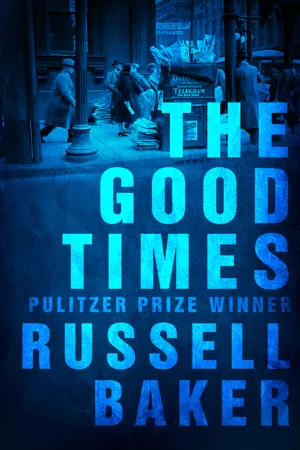
A "superb [and] often hilarious" memoir of a life in journalism, from the Pulitzer Prize–winning author of
Growing Up (
The New York Times Book Review).
"Baker here recalls his years at the
Baltimore Sun, where, on 'starvation wages,' he worked on the police beat, as a rewrite man, feature writer and White House correspondent. Sent to London in 1953 to report on the coronation, he spent the happiest year of his life there as an innocent abroad. Moving to the
New York Times and becoming a 'two-fisted drinker,' he covered the Senate and the national political campaigns of 1956 and 1960, and, just as he was becoming bored with routine reporting and the obligation to keep judgments out of his stories, was offered the opportunity to write his own op-ed page column, 'The Observer.' With its lively stories about journalists, Washington politicians and topical scandals, the book will delight Baker's devotees—and significantly expand their already vast number." —
Publishers Weekly
"Aspiring writers will chuckle over Baker's first, horrible day on police beat, his panicked interview with Evelyn Waugh, and his arrival at Queen Elizabeth's coronation in top hat, tails, and brown-bag lunch." —
Library Journal
"A wonderful book." —
Kirkus Reviews
- 416 pages
- English
- ePUB (mobile friendly)
- Available on iOS & Android
eBook - ePub
The Good Times
About this book
Information
Subtopic
Journalist Biographies25
Player
After Eisenhower’s reelection, I spent a year covering the State Department, so lost sight of the politicians for a long time. Then I inherited the Senate beat from Bill White and became too busy learning the tricks of lawmaking to spend much time watching the political sharks cruise.
Obviously Lyndon Johnson wanted to be president. I could tell that by the vigorous way he denied it, but he could never make it: too deep in Texas oil and too thick with the southern segregationists who ran the Senate committees.
I knew Hubert Humphrey wanted to be president, too. Humphrey had been born wanting to be president.
All humanity knew that Richard Nixon wanted to be president, but as 1958 faded into 1959 I was surprised to pick up rumors that Stuart Symington also wanted to be president. In Symington’s favor, he was a Hollywood casting director’s dream of what a president ought to look like.
I was especially surprised to learn that Jack Kennedy wanted to be president because he looked less like a president than anybody else in the pack. In fact, he looked like a kid, which was how I thought of him. He wasn’t much older than I was. In the Senate he had a desk in the very back row, which was reserved for greenhorns, and I rarely thought of him because he was there so little. He was such a small figure in heavy Senate business that I almost never had occasion to deal with him.
In our first encounter, he ran an errand for me. Covering Senate action on a bill one day, I needed to see a document on the presiding officer’s desk, but couldn’t get at it because reporters were barred from the floor while the Senate was in session. Phil Potter of the Sun, an old hand on the beat, was sitting beside me in the gallery.
Was there any way to get the text of that document off the floor?
Looking down over the Senate, Phil said, “There’s Jack. He’ll get it for you.”
Jack?
Jack Kennedy, said Phil. Didn’t I know Jack?
Well, sure, I knew who he was. I’d been there that crazy day in Chicago when he almost beat Kefauver out of the vice-presidential nomination. But I’d never met him.
Come on, said Phil, heading for the elevator that went down to the Senate floor level.
“Jack’s a nice guy, and he likes reporters. He’ll get it for you.”
Phil sent in a message that the Sun and the Times would like to see Senator Kennedy if he was free for a moment, and he came out. Potter introduced us and said I had a problem and maybe he, Jack, could help out.
Kennedy said he’d be glad to help any way he could.
I said there was this document on the desk. Could he bring it out long enough for me to copy some of the more salient lines?
He’d be delighted to do that, he said, and did, and waited while I copied what I needed, and smiled so warmly when I thanked him that I was never again able to think of him seriously as the genuine senatorial article.
When I began hearing that he wanted to be president, it seemed comical because he had once served as my copy boy.
I was really surprised to discover that Gene McCarthy also wanted to be president. A canny veteran of the House of Representatives, McCarthy was elected to the Senate in 1958. I took to him right away. A Catholic intellectual and that rarest of creatures in American politics, a genuine wit, he was a delight to consult on the problem of the day. Talking presidential politics one day in the Senate dining room, he said, “If the Democrats are going to run a Catholic liberal, they ought to nominate me; I’m twice as liberal as Humphrey and twice as Catholic as Kennedy.”
I thought, Hey, he’s not kidding.
Like Adlai Stevenson, Kennedy was blessed with a personality beguiling to reporters. On the other hand, Nixon, poor Nixon, was cursed with a personality reporters loved to loathe. Even Nixon partisans on the press bus conceded that liking him took a lot of exertion. There were darknesses in his soul that seemed to leave his life bereft of joy. He was a private, lonely man who never seemed comfortable with anyone, including himself, a man of monumental insecurities, for whom public life, I thought, must be a constant ordeal.
The stock presidential candidate is expected to be an exuberant, self-confident extrovert whose face lights up with joy when he is out among the people because he is the friend of all mankind. Nixon fitted none of the personality specifications, so had to fake it. All right, a lot of good people in politics had to fake it; Nixon’s problem was that you could see him faking it. “Tricky Dick,” the nickname that afflicted him, was false and misleading. He had no talent whatever for fakery. His attempts at it were so transparent, so wooden, so reminiscent of the lead in the eighth-grade class play, that they invited laughter and contempt.
My first close experience with Nixon came in 1958 on a ten-day campaign trip from West Virginia to California, and I was fascinated. Not with the campaign. That was small-bore political stuff. Nixon was campaigning for Republican congressional candidates. What struck me was how different he was from the man I expected.
Familiar with his reputation for championship Red-baiting and bare-knuckles campaigning, I expected to see a first-class demagogue exulting in his power to raise the rabble. What I saw instead was a painfully lonesome man undergoing an ordeal. As a campaigner, he had no natural talent for the stirring stump performance, for mingling joyfully with the people, or for strutting triumphantly when the crowd roared. He seemed to do everything by the numbers, without feeling the rhythm, the pleasure, the sensual delight it could provide when you felt it in the bones and really loved it.
You could watch him telling himself, now it’s time to put on the big smile, now jab the air for rhetorical effect, now throw the arms high in the air, now turn to wife Pat and smile the faithful, loving husband smile. I was moved by the awfulness of his performances. I felt sympathy for his discomfort with the obligatory routines of his chosen profession and felt bemused admiration for the mechanical determination with which he forced himself to go through with them anyhow. It touched something a little painful in myself.
Growing up, I had missed learning to dance, and felt shamefully defective about it, so got a book and tried to teach myself by marking arrows on the floor and counting as I walked through the patterns.
“One, two, feet together, sidestep three, feet together four. One back, two, feet together…”
The trouble was, I never made any connection between the steps and the music, so the idea that dancing was supposed to be a graceful, sensuous response to lovely sounds never registered with me. On the dance floor I moved woodenly through patterns memorized from books while silently counting, “One, two, sidestep three, feet together four. One back…”
It was so graceless, so awkward, so terrible that I became painfully self-conscious of doing it poorly, which made my movements even more comically mechanical. I finally gave it up, avoided situations where I might be challenged to dance, and in the end even learned the courage, if dancing was suggested, to say, “Sorry, I don’t dance.”
Nixon’s public political performances were like my dancing. He was doing everything by the numbers. I could give up on dancing because my mother never decreed that dancing was vital for boys who wanted to amount to something. Nixon was not so lucky. In the line of work he’d chosen, public performing was essential. He could never give it up. No matter how artificial he looked at it, he had to keep it up, had to keep counting. One, two, sidestep three, feet together four…
No wonder he couldn’t stand the reporters. They were an audience that would never stop watching him do something he didn’t do well. They were witnesses to the profound joylessness with which he pursued his terrible ambition. I never liked being watched while doing things I didn’t do well, so I guessed Nixon didn’t either. It must have deepened the natural melancholy of his spirit to have that awful audience always there, watching, so many of them with the supercilious smiles of critics who would sneer at his performance.
Some of the price he paid is told in an incident Pete Lisagor of The Chicago Daily News noticed on a campaign trip when we were sharing the same chartered plane with Nixon. It was all propeller flying, very slow by modern standards, and we were droning away somewhere over the great desert, most of us dozing in exhaustion. Nixon and his wife had the front seats, and Lisagor could see Nixon, chin sunk on his chest, apparently sleeping soundly.
As Lisagor watched, Alfred Eisenstaedt, a photographer for Life magazine, glided up the aisle, then dropped to his knees, and, camera at the ready, edged toward the sleeping Nixon. Lisagor watched Eisenstaedt raise the camera, pause a long moment, then lower his camera without shooting, turn, rise, and head back toward his seat. As Eisenstaedt went past, Lisagor stopped him and asked what went wrong.
“This man is amazing,” said Eisenstaedt. “Even when he’s asleep he knows he is being photographed.”
My assignment on the 1958 campaign swing was to get an accurate record of what Nixon was saying in his campaign speeches. There were horror stories about well-poisoning speeches he supposedly made in 1956, accusing several Democratic candidates of treasonous tendencies. There was no record that he had ever said anything of the sort, but the suspicion thrived, partly because many people judged him capable of saying it if he thought nobody could prove he’d said it.
To get a reliable record of the 1958 tour, the Times equipped me with a small German-made wire recorder. There was no such thing yet as a lightweight, portable tape recorder. Even my wire recorder was a curiosity on the press plane.
Its main defect, aside from the wire’s maddening habit of getting itself tangled in knots, was its limited range. Unless you got it within six or eight feet of the speaker, it was useless. This meant I had to be constantly pressing close to Nixon while holding this small green machine toward his face.
He had probably never before had to worry that absolutely everything he said was being recorded and might come back to haunt him. The low state of recording technology up to then had given politicians great freedom to deny their most outrageous statements after they had registered their effect. I noticed Nixon looking at the green machine with annoyance now and then, and by the time we got to Wyoming he was set to explode. I lit the fuse at the end of a grueling day by asking a tough political question during a small news conference for the local papers, then thrusting the green box up toward his face.
“That’s the kind of question I’d expect from The New York Times,” he began, his face black with rage at me or the Times or, more likely, the wire recorder with its constant hint that he was not a man who could be trusted without mechanical devices to keep him honest.
This was the first time I had ever been the target of intense fury from a grown man more important than a high-school teacher. Under the shock of it, my reporting reflexes failed so completely that I flipped the wrong button on the wire recorder and lost every word of the great eruption. All I knew was that he was so outraged with me that for a few seconds he lost control of himself. He must have realized almost immediately, though, that he couldn’t afford a public temper tantrum because he calmed down in time to frame a reasonable answer to my question before moving to the next one.
An hour later he was already in his front seat of the chartered plane when the rest of us boarded to leave Cheyenne for Denver. As I came past, he touched my arm to stop me and said he was sorry about the way he’d behaved in the news conference. He was getting the flu and felt terrible, he said; I probably knew from experience how flu affects you sometimes.
I didn’t know what the etiquette was for handling personal apologies from men who want to be president, but forgiveness and absolution were what I granted him.
It was nothing, don’t worry about it, I knew exactly how he felt, I felt as if I might be getting the flu myself, this had been a brutal trip, take good care of yourself, you’ve had a hard week. All this I mumbled, too stricken with embarrassment to say something witty and memorable, something that might have prevented him from telling himself all the way to Denver, “Now there’s another one who hates Nixon.”
Bill Lawrence took a year off from the Times to enjoy being president of the Press Club and came back in 1960 to cover the presidential campaign. He sized up the huge field of candidates, then started spending a lot of time with Kennedy. Like too many reporters that year, he fell harder for Kennedy than he should have.
In his memoir, Six Presidents, Too Many Wars, he wrote proudly about the “really close” relationship he formed with Kennedy early that year and described how it thickened until, after the convention, he and Kennedy became regular golfing companions at Hyannisport.
Lawrence was playing a dangerous game, but one that a lot of other political reporters played routinely. After a while you knew which reporters were betting on Nixon, which on Johnson, or Humphrey, or Kennedy, or Stevenson. Publishers and editors knew it could lead to journalistic malpractice, but seldom objected when it paid off in big scoops for their papers or invitations to state dinners at the White House.
To politicians, newspapers still mattered more than television in 1960. Friendly coverage in one of the big papers was something winning c...
Table of contents
- The Good Times
- The Good Times
- Copyright
- Cousin Edwin
- Deems
- Marydell Road
- Hemingway
- Mr. Dorsey
- Uncle Gene
- Murder
- Paying the Dues
- Inside
- Mimi
- Ed Young
- Money
- Day Off
- Fog
- Innocent Abroad
- Buck
- Anglia Days
- The Crown
- Paradise
- Fathers
- Hagerty
- Jumper
- Johnson
- Lawrence
- Player
- Zeus
- Morrisonville
- Gallery
- More from Russell Baker
- Connect with Diversion Books
Trusted by 375,005 students
Access to over 1.5 million titles for a fair monthly price.
Study more efficiently using our study tools.
Frequently asked questions
Yes, you can cancel anytime from the Subscription tab in your account settings on the Perlego website. Your subscription will stay active until the end of your current billing period. Learn how to cancel your subscription
No, books cannot be downloaded as external files, such as PDFs, for use outside of Perlego. However, you can download books within the Perlego app for offline reading on mobile or tablet. Learn how to download books offline
Perlego offers two plans: Essential and Complete
- Essential is ideal for learners and professionals who enjoy exploring a wide range of subjects. Access the Essential Library with 800,000+ trusted titles and best-sellers across business, personal growth, and the humanities. Includes unlimited reading time and Standard Read Aloud voice.
- Complete: Perfect for advanced learners and researchers needing full, unrestricted access. Unlock 1.5M+ books across hundreds of subjects, including academic and specialized titles. The Complete Plan also includes advanced features like Premium Read Aloud and Research Assistant.
We are an online textbook subscription service, where you can get access to an entire online library for less than the price of a single book per month. With over 1.5 million books across 990+ topics, we’ve got you covered! Learn about our mission
Look out for the read-aloud symbol on your next book to see if you can listen to it. The read-aloud tool reads text aloud for you, highlighting the text as it is being read. You can pause it, speed it up and slow it down. Learn more about Read Aloud
Yes! You can use the Perlego app on both iOS and Android devices to read anytime, anywhere — even offline. Perfect for commutes or when you’re on the go.
Please note we cannot support devices running on iOS 13 and Android 7 or earlier. Learn more about using the app
Please note we cannot support devices running on iOS 13 and Android 7 or earlier. Learn more about using the app
Yes, you can access The Good Times by Russell Baker in PDF and/or ePUB format, as well as other popular books in Media & Performing Arts & Journalist Biographies. We have over 1.5 million books available in our catalogue for you to explore.