A fascinating, one-of-a-kind memoir that takes readers on a journey to the dawn of the jet age—and reveals how technology will shape the world to come.
Drawing on engineering breakthroughs achieved during World War II, aviation in the 1950s was an exciting and uplifting sequel to the most destructive conflict in history. It gave birth to the jet age and fostered remarkable social changes.
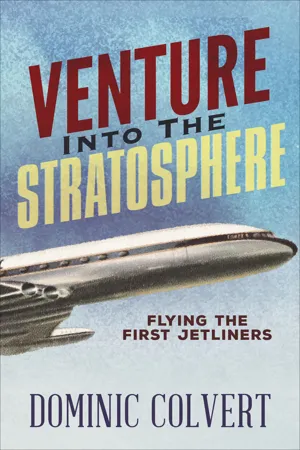
Venture into the Stratosphere is a memoir about the exhilaration and challenges of flying the first jetliners—the de Havilland Comets. Former Irish Air Corpsman and aviation engineer Dominic Colvert explains technical matters in layman's terms, tells a fascinating love story, examines the post-war ethos, and reveals intimate details of the flight deck in both routine and emergency situations.
By opening a window onto cultural developments after the turn of the century, Colvert offers key insights into how new technologies shape behavior and values. Passenger jets have become a routine part of life for most people, but have you ever wondered—how did we get here? Read
Venture into the Stratosphere to find out!
- 286 pages
- English
- ePUB (mobile friendly)
- Available on iOS & Android
eBook - ePub
About this book
Information
CHAPTER ONE

THE ELIXIR OF FREEDOM
My earliest interest in flying machines was in 1939. I never saw those behemoths—the airships—that preceded the flying boats in ferrying passengers across the Atlantic. But in 1939, when silver machines were spotted in the sky in our airspace in County Tipperary, everyone was excited and stopped to gaze heavenward. The adults’ excitement was contagious; and we, little kids, ran around with our arms extended, yelling “Yankee Clipper! Yankee Clipper!” For that was what our mentors had identified the object in the sky to be. You might think “cute, but not a powerful story.” However, remember that scarcely a generation earlier, the idea of a silver machine flying through the air could only have occurred in Greek mythology.
In a short time, make-believe Yankee Clipper gave way to exploring our rural surroundings. I remember my brother Brendon organized an expedition to An Cnoc. This was a hill from which we were promised to see parts of seven counties “on a clear day.” It was an all-day trek, so we started early. Armed with stout sticks and with our commander reconnoitering the route we, budding Roald Amundsens, strode through fields, walked carefully around fairy forts, hurried past paddocks that might have dangerous bulls, gave wide berth to farmers’ houses with their inevitable watchdogs, and paused to pick blackberries and whorts (whortleberries) as the opportunities arose.1 By midday, we were ascending the final steep climb to the summit. Triumphant and seated in that commanding position, we, with some misgivings, hungrily downed our lunch rations purloined from the kitchen. The misgivings arose because it had been thought in the morning that adequate rations for the trip included some of Auntie Maie’s raisins. It must be remembered that this was war time and any imported goods, such as raisins, were an extreme rarity. I will never know how Auntie Maie got them, but I know she planned a scrumptious and rare cake.
At the summit, my knowledge of geography and terrestrial science did not permit me to identify for sure the terra firma of seven counties. Nevertheless, it was a satisfying experience. The return journey was tough and we were tired when we reached home. I expected dire consequences from Auntie Maie. She brought up the subject and Brendon shouldered full responsibility for the irreplaceable raisins. He pleaded necessity. She was a gentle lady and, to my continued amazement, she accepted my brother’s plea, without admitting to his military necessity part. We were experiencing how the distaff side of the house primed boys to be men!
On the long days of summer vacation, my brother, Terry, and I worked as a team, savoring the pleasure of fishing in streams too tiny to have a name. We would bring home our catch of trout that was six inches or bigger. Our prize catch was a marvelous eighteen-inch specimen, taken from the head springs of the river closest to us. After the heads were cut off and they were gutted, Mama pan fried them. Those fish had a deliciousness never again, in my experience, to be equaled. Although we did fish with rod and line—using worms for bait, and a hook crudely fashioned from Mama’s sewing supplies—it was the elemental nature of hand fishing that made it our much-loved challenge. The contemplative experience of sitting on the river bank waiting for a fish to bite faded in comparison to removing boots and socks, wading into the stream, and attempting to outwit the wily fish.
The crowning experience for “The Young Lads of the River” was the legendary trout of Kyle that got away.2 Kyle was a place about a mile beyond the village and there, hidden in a sheltered ravine, was a small year-round unnamed river. We discovered the enormous trout that inhabited an impregnable pool in that river. We thought of him in the singular, though he was undoubtedly just one of many. Here was a challenge we could not refuse! On a hot day, we entered the overgrown ravine and headed upstream through the dappled sunlight. In less than a half mile we arrived at the pool; it was at the base of a waterfall. The glinting waters at the top of the falls plummeting ten or twelve feet had sculpted out a very deep pool at the base. The aerated water at the base flowed out into a progressively shallower, dark, limpid pool for about thirty or forty feet before the river returned to an ankle-depth, burbling stream among the rocks.
So we devised our plan of attack. We knew the secret of hand fishing—the hands must be placed motionless in the water until the fish approaches close enough that it cannot escape. The slightest movement alerts the fish to danger and he darts away; in this case upstream into the inaccessible deep. So, we rolled up our shorts and waded in above knee height into the shockingly cold water. The shaded pool water was close to ground temperature, definitely less than fifty degrees. Facing toward the shallows, we hold our hands steady in the water, and wait for him to appear. We did not last very long, and gave up as hands and legs became painfully numb, and a deep blue color from the icy cold water. However, we did not surrender easily. We returned a number of times to the contest, but the quarry always managed to elude us and flee to his mysterious sanctuary.
In competitive games, I liked handball and practiced my skills endlessly against any convenient gable wall. Running held great interest for all of us and we secretly envisioned, if it were humanly possible, our being the first to run the four-minute mile. Remember, it was to be 1954 before this worldwide interest in the sub-four-minute mile was resolved by Roger Bannister. We were also inspired by the performance of John Joe Barry (The Ballincurry Hare) of Kyle, who actually—not to our surprise—went on to hold many world-class records for running.
We committed ourselves to investigating beyond the horizon, beyond the visible more distant features of the landscape—Slievenamon and the Devils Bit. We were not going to set any limits to our horizons. The silver machine in the sky was the sign of another even more exciting dimension of the world awaiting exploration. We would venture into the stratosphere. Indeed our youthful spirits were fired up with the excitement, not just for geographic discovery, but also for the potential for a holistic knowledge of the cosmos.
We tasted the ultimate in freedom. Of course, if you had asked us the meaning of freedom we could not have answered. Nor did we analyze the aphorisms we imbibed from our widowed mother that emphasized that we should fearlessly seek the objective truth. It would require more maturity to see objectivity as the elixir of freedom. Referring to the Jeffersonian compendium of the good life, it could be said that we were grateful for the gift of life and freedom that produced happiness. But this exercise of freedom was not in any passing pleasure; for Mama’s rules were strict, and we could see, for example, that those “given to drink” were enslaved. Instead, we thought to pursue the good as a kind of inchoate natural law. For me, the sense of freedom and wellbeing was often acute at the end of a busy day when the shades of sleep would envelop my tired body. As the demands of the external world faded, without conceptualization, the pure experience of Being produced a euphoria before sleep enveloped the mind.
I was, however, a veteran of the jet age before I had an opportunity to explore the aircraft that was the summit of flying boat technology—the Yankee Clipper, or more exactly, the Boeing B-314. Construction of an airport for seaplanes at Foynes on the Shannon River began in 1935. The airport, being on neutral territory in World War Two, became one of the world’s largest civilian airports in the 1940s. It served worldwide destinations and the huge flying boats took off from there on the initial trans-Atlantic routes. After the flying boat era came to an end and the land-based planes moved to Rineanna (now Shannon) airport, a marvelous exhibit was built at the Foynes museum: floating in its own lagoon, is a B-314 built from Boeing’s original blue prints.
Exploring the interior of this “Yankee Clipper,” was indeed a wondrous venture. You can wander about the Boeing’s B-314’s spacious cabin interior; you can envisage poring over the maps in mid-Atlantic at the navigator station, or hauling back on the control column to nudge the boat from the Shannon River into the air.
For me, the childhood thrill of aviation never really wore off. In our school library, I delighted in books on adventure and travel to mysterious places. I read about and identified with heroes like Charles Lindbergh and Amelia Earhart. I harbored dreams of travel to far-off mysterious places and to see and understand the whole breadth of human existence.
By the time I reached manhood, coming from a strong family, I had a positive self image. So, the Western ideas in my upbringing would be the position from which I would examine the civics and cultures of those mysterious places I would visit. I would naturally scrutinize things for their conformance to the concept of freedom, which was a palpable part of our existence. This sentiment, as distinct from the practice, related immediately to the French Revolution but ultimately came through turbulent history from more ancient times.3 As epitomized in the American Revolution, Western nations hearkened to the cry for freedom, and the eighteenth and nineteenth centuries saw the borders and civic dynamics of Europe change. England and other countries, of course, would remain colonial powers for some time, but their internal politics were democratic. Even in England, where the Head of State and the Head of State Church are ceremonially one and the same person, and bishops sat in the House of Lords, there was freedom of conscience.
Ireland, in the 1950’s, had recently passed through a tumultuous period. Only a generation had passed since its terrifying civil war. Prior to that, in common with other European nations, the country also had a history of civil, cultural, and religious struggles that lived vividly in the people’s memory. The mark of those historical exertions was to leave our minds cherishing these symbols: separation of spiritual and civic powers, democracy, and freedom. The separation of powers was essentially a part of the Irish Christian heritage that guaranteed the treasured freedom of conscience.4
However, by the 1950s, these higher things belonged to a vaguely held or unspoken philosophy. My concerns were naturally directed toward economic possibilities, and to choosing a successful career in line with my youthful aspirations.
CHAPTER TWO
MASTERY OF THE AIR
To understand the thrill aviation held for society in general in those early days, it is necessary to transpose oneself in spirit to that bygone era. This is no easy task, given that we now routinely fly to a destination to accomplish something there. Furthermore, the experience of getting there may be for us no more than a distraction from our computer or the entertainment system movie channel. Imagine, though, the wonderful experience when for the airplane passenger getting there was still a first class adventure!
From prehistory, people were mindful of heavier-than-air flight. The powerful and graceful flights of many species of birds always excited envy and dreams of human aviation: as in the Biblical expression where Isaiah says, “they will soar as with eagles’ wings.” The human spirit was uplifted even by a mental image of a bird’s eye view that was so often captured by the creativity of an artist, and, after October 1783, by those privileged to make an ascent in a hot air balloon. For such earth-bound people, actual aviation was a savoring of the magic of bi-location.
Those ancient dreams are celebrated in the Greek myth of Icarus, who escaped Crete on wings constructed by his father with wax and feathers. Glorying in his freedom and driven by hubris, Icarus flies too high. Being too close to the sun the wax melts and he crashes and drowns in the Icarian Sea. In true mythical fashion, the story is more than mere fantasy, and these twin themes—happiness and hubris—were still marks of heavier-than-air flight in the 1930s and 1950s.
Nothing better demonstrates the widespread—may we say, universal—appreciation of the human venture into the air than the frenzied emotional adulation poured out worldwide on Charles Lindbergh’s daring, but foolhardy, flight from New York to Paris in 1927. On May 21st, when he made landfall at Dingle Bay in Ireland, and while traversing southern England and Normandy, people rushed from their houses to wave to him. At Paris, he was greeted by a mob of admirers a hundred thousand strong. But these demonstrations were only a beginning; the outpouring of approval for the man and his achievement was truly international. Effusive demonstrations were made in Belgium, England, Mexico, Japan, and China.5 While Lindbergh, the man, was later to suffer rejection, his achievement in that first New York to Paris flight never lost its appeal. It was estimated that an astonishing 25 percent of the American population turned out to greet him and laud his success.
Probably the first routine manned heavier-than-air flights were achieved in California by a University of Santa Clara professor, John J. Montgomery, in glider flights from 1883 to 1911. Following the earth-shattering 1906 San Francisco earthquake, Montgomery’s experiments were held up. On resumption of his experiments, he was killed in October 1911 when his glider stalled and crashed. At Kitty Hawk in December 1903, the Wright brothers achieved their renowned takeoff, and first sustained manned heavier-than-air flight using an internal combustion power plant.
These wonderful achievements in the technology and art of flying unleashed, as we have noted, a natural human interest and delight in aviation. But what was to be the commercial aspects of these innovations? There was money to be made in air shows and demonstrations of death-defying feats. Charles Lindbergh recounts that on his first parachute jump he decided it would be a “double jump.” When he exited the airplane his canopy blossomed, then he collapsed it. As he was falling free, the crowd gasped at witnessing a man falling to his death. Then he opened a second parachute. But such circuses were by nature not going to be truly large businesses unless they involved the general public in a useful way, and as more than just spectators.
It so happened, that nineteenth-century institution, the Post Office, was the key to commercialization. There was a market for the value received from air mail—a high-value lightweight payload. Commerce is, of course, stimulated by prompt communications. But more importantly, in human terms, as a social reality, the harshness of being separated from those we love is softened by speedy exchanges. In America, the Post Office proved to be a vital component of the westward migration. Without its delivery of letters and newspapers an American national politics was hardly conceivable.
The early aircraft flights in the mail business competed with horse-drawn, automotive, and steam train postal services on land, and with telegraph messaging. In this environment, the revenues from air mail were able to attract entrepreneurial capital. Mail contracts have been a vital part of aviation economics from the earliest days to the jet age. Where it was difficult to attract brave passengers, a Post Office air mail subsidy could turn a profit.
Remarkably, the ...
Table of contents
- Cover
- Title
- Copyright
- Table of Contents
- Preface
- Chapter 1: The Elixir Of Freedom
- Chapter 2: Mastery Of The Air
- Chapter 3: The Ethos Of Post-War Aviation
- Chapter 4: A Military Career
- Chapter 5: Irish Army Air Corps
- Chapter 6: Innovation
- Chapter 7: The Jetliner
- Chapter 8: An Evolving Civil Aviation
- Chapter 9: Flight Engineering
- Chapter 10: Ground School And Flight Training
- Chapter 11: North Atlantic Operations
- Chapter 12: Adventures Close To Home
- Chapter 13: Arabian Days
- Chapter 14: The Paris Of The Middle East
- Chapter 15: A Shia Capitol
- Chapter 16: A City On The Nile
- Chapter 17: African Journeys
- Chapter 18: Five Minutes
- Chapter 19: The Kingdom Of Ceylon
- Chapter 20: India
- Chapter 21: British China
- Chapter 22: The Land Of The Rising Sun
- Chapter 23: A Successful Colony
- Chapter 24: Venturing Down Under
- Chapter 25: South America
- Chapter 26: Afterword
- Meet the Author
- Acronyms
- Notes
Trusted by 375,005 students
Access to over 1.5 million titles for a fair monthly price.
Study more efficiently using our study tools.
Frequently asked questions
Yes, you can cancel anytime from the Subscription tab in your account settings on the Perlego website. Your subscription will stay active until the end of your current billing period. Learn how to cancel your subscription
No, books cannot be downloaded as external files, such as PDFs, for use outside of Perlego. However, you can download books within the Perlego app for offline reading on mobile or tablet. Learn how to download books offline
Perlego offers two plans: Essential and Complete
- Essential is ideal for learners and professionals who enjoy exploring a wide range of subjects. Access the Essential Library with 800,000+ trusted titles and best-sellers across business, personal growth, and the humanities. Includes unlimited reading time and Standard Read Aloud voice.
- Complete: Perfect for advanced learners and researchers needing full, unrestricted access. Unlock 1.5M+ books across hundreds of subjects, including academic and specialized titles. The Complete Plan also includes advanced features like Premium Read Aloud and Research Assistant.
We are an online textbook subscription service, where you can get access to an entire online library for less than the price of a single book per month. With over 1.5 million books across 990+ topics, we’ve got you covered! Learn about our mission
Look out for the read-aloud symbol on your next book to see if you can listen to it. The read-aloud tool reads text aloud for you, highlighting the text as it is being read. You can pause it, speed it up and slow it down. Learn more about Read Aloud
Yes! You can use the Perlego app on both iOS and Android devices to read anytime, anywhere — even offline. Perfect for commutes or when you’re on the go.
Please note we cannot support devices running on iOS 13 and Android 7 or earlier. Learn more about using the app
Please note we cannot support devices running on iOS 13 and Android 7 or earlier. Learn more about using the app
Yes, you can access Venture into the Stratosphere by Dominic Colvert in PDF and/or ePUB format, as well as other popular books in Social Sciences & Historical Biographies. We have over 1.5 million books available in our catalogue for you to explore.