A revealing account of Polish cooperation with Nazis in WWII—a "grim, compelling [and] significant scholarly study" (
Kirkus Reviews).
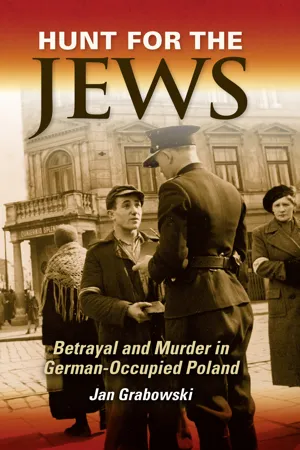
Between 1942 and 1943, thousands of Jews escaped the fate of German death camps in Poland. As they sought refuge in the Polish countryside, the Nazi death machine organized what they called Judenjagd, meaning hunt for the Jews. As a result of the Judenjagd, few of those who escaped the death camps would survive to see liberation. As Jan Grabowski's penetrating microhistory reveals, the majority of the Jews in hiding perished as a consequence of betrayal by their Polish neighbors.
Hunt for the Jews tells the story of the Judenjagd in Dabrowa, Tarnowska, a rural county in southeastern Poland. Drawing on materials from Polish, Jewish, and German sources created during and after the war, Grabowski documents the involvement of the local Polish population in the process of detecting and killing the Jews who sought their aid. Through detailed reconstruction of events, "Grabowski offers incredible insight into how Poles in rural Poland reacted to and, not infrequently, were complicit with, the German practice of genocide. Grabowski also, implicitly, challenges us to confront our own myths and to rethink how we narrate British (and American) history of responding to the Holocaust" (
European History Quarterly).
- 320 pages
- English
- ePUB (mobile friendly)
- Available on iOS & Android
eBook - ePub
About this book
Information
1
DĄBROWA TARNOWSKA
Writing about the extermination of Jews in the small Galician town of Buczacz, Omer Bartov raised an important question: “Genocide would have been much harder to accomplish, and its success much less complete, had the Germans not found so many collaborators willing, even eager, to do the killing, the hunting down, the brutalizing, and the plundering. Conversely, hardly any of the handful of Jews who lived to tell the tale would have survived had it not been for those Ukrainians and Poles who gave them food or shelter, even if at times they charged them for the service and not infrequently drove them out or denounced them once the Jews’ resources ran out.”1 In order to understand the genocide, Bartov argued, we need to reconstruct the events from bottom up, from the local level, from the level of single murders, all the way to the planners of the Endlösung. An analysis of the situation in one chosen area, such as a single county in occupied Poland can, it is hoped, bring us closer to this goal.2
This book looks at the fate of those Jews who, following the liquidation of local ghettos in 1942, went into hiding on the territory of Dąbrowa Tarnowska County. The choice of the area is dictated, on the one hand, by a substantial volume of preserved and available archival evidence and, on the other hand, by its overwhelmingly rural and farming character. Some scholars have suggested that the widespread outbreaks of anti-Jewish violence and pogroms that occurred behind the advancing German lines in the summer and fall of 1941 were somehow related to the previous political sympathies of the Jews. According to these scholars, the arrival of the Germans unleashed a fury of retribution against the Jews, who were perceived as active collaborators with the Bolsheviks who had occupied much of eastern Poland during the period of 1939–1941. Although much of this argument was later debunked by historians, the notion of “Jew-communist” still persists in the literature, not only in popular accounts, or in the media, but in academic circles as well. Writing about Poles who saved Jews on the eastern borderlands (Kresy), one award-winning historian wrote of “us” (Poles) pitted against “the enemy” (Jews):
We see the Polish suffering under the Soviet occupation, suffering caused by the Jews. Therefore, the Righteous, if they were Catholics (Christians), they came close to holiness, and [today] should be considered candidates for beatification. Saving the life of an enemy, an enemy who betrayed us [sic], denounced us [sic], who made mockery of our suffering and who caused this suffering [in the first place], and who could still revert to the same practice in the future, was an act of boundless compassion.3
In the face of arguments such as these, it needs to be stressed that Dąbrowa Tarnowska County—situated well to the west of the Soviet–German demarcation line—never found itself under Soviet occupation. From the very beginning of war, the area was occupied by the Germans, who remained firmly in control of it until January 1945. To explain the murders and betrayals of Dąbrowa Jews at the hands of their neighbors, we need, quite obviously, to look for other explanations than the convenient excuse of an earlier “Jewish collaboration with the Soviets.”
One has to begin with the physical and human geography of the region. The county, situated some fifty miles east of Kraków and ten miles north of Tarnów, before the war was a typical farming area. In the north, its border runs along the Vistula River, while the Dunajec River marks its western frontier. In 1939, arable land made up 74 percent of Dąbrowa Tarnowska County; the rest was made up of forests and meadows. The county was divided into two administrative areas (Żabno and Dąbrowa), which covered 101 villages. According to the detailed index of 1925,4 the population numbered 63,717 people, including 4,815 Jews. The “urban” population (two small towns) numbered 3,888 inhabitants (including 2,460 Jews), and the villages had a population of, respectively, 59,829 and 2,355 people. According to the last prewar census, taken in 1931, the county was home to 66,678 people, including 4,807 Jews. The next decade witnessed a steady transfer of people from the villages to Dąbrowa Tarnowska, the only sizeable town in the county.5 The local “urban” population thus grew to 8,484 inhabitants, including 3,012 Jews, while the rural population declined slightly, to 58,194 (including 1,795 Jews). Dąbrowa and Żabno both enjoyed municipal rights, although the latter was, for all practical purposes, a large village rather than a city. Szczucin, a sizeable community located close to the Vistula River, north of Dąbrowa, in 1934 lost its municipal status due to its declining population. Dąbrowa Tarnowska County embraced seven large villages (large meaning more than 1,000 inhabitants), including the most populous one, Radgoszcz, which had a population of 3,400. More numerous and more typical for the area, however, were small villages and hamlets with fewer than 500 inhabitants. The county was subdivided into eight communes (gmina): Dąbrowa Tarnowska, Bolesław, Gręboszów, Mędrzechów, Olesno, Radgoszcz, Wietrzychowice, and Szczucin. The list is important, since the county as such had been dissolved by the Germans in 1939, but the structure and borders of the communes of which it was previously composed remained unchanged. Finally, it should be mentioned that until 1918, before the rebirth of the Polish state, Dąbrowa County was a “frontier” area. While Dąbrowa was still within Austria-Hungary, the lands north of the Vistula River already belonged to the Russian Empire.6 This, in turn, was to have a significant impact on the development of Jewish–Polish relations in the area.
A historian wishing to learn more about the wartime fate of the Jews of Dąbrowa can take advantage of fairly well-preserved archival documentation. This allows us to study not only the early years of occupation, but also the post-1942 period, which in this case will be of particular interest to us. In order to shed as much light as possible on the Jewish tragedy, we shall have recourse to a method that can be called triangulation of memory. Three types of sources allow us to see this wartime reality from three very different points of view. First are the testimonies of Jews who survived the war in hiding. These accounts, filed shortly after the war with the local offices of the Central Committee of Polish Jews (Centralny Komitet Żydów Polskich; CKŻP), were later transferred under the custody of the Jewish Historical Institute in Warsaw (ŻIH) and are today known as collections 301 and 302. Altogether, more than seven thousand of these testimonies are preserved in ŻIH holdings. Their historical value is linked, in part, to the early date of their creation (the ŻIH testimonies were collected, for the most part, between 1945 and 1948 period). More importantly, these testimonies were created without ulterior motives, and their only goal was to preserve the historical evidence and to bear witness to the tragedy of the Shoah. People emerging from the Holocaust, painfully aware that they were the only survivors of the murdered nation of Polish Jews, knew that their duty was to leave an exact, credible, and accurate historical record. Another group of survivors’ testimonies was collected, twenty years later, in Israel. They can be found today at Yad Vashem in Jerusalem, in archival series 0.33, M.1.E and 0.3. Finally, since 1995, the Visual History Foundation (VHF) has registered more than fifty thousand filmed interviews with survivors. Taken together, the ŻIH, Yad Vashem, and VHF collections provide us with twenty-four accounts of Jews who survived the war hidden in Dąbrowa Tarnowska and in nearby villages.7
Jewish testimonies need to be set against and compared with the records of Polish courts created shortly after the war, mostly during the late 1940s. The trials (known as the “August Trials”) were conducted on the basis of the August 31, 1944 decree “concerning the punishment of Fascist-Nazi criminals, guilty of murders and mistreatment of civilians and prisoners of war and traitors of the Polish Nation.” We shall pay particular attention to these “traitors of the Polish Nation” because it is among them that we find individuals who denounced, mistreated, or simply murdered their Jewish fellow citizens. According to the contemporary interpretation of the law, all actions undertaken by Poles that helped the Germans to exterminate Jews constituted a form of collaboration with the enemy. Between 1945 and 1946, the “August Trials” were heard by Special Criminal Courts (Specjalny Sąd Karny), but by the end of 1946 regular courts had taken over. The cases followed a normal judicial process, starting with the local district courts, through the courts of appeal, and sometimes were appealed all the way to the Supreme Court. More importantly, there is no evidence that the “Jewish” trials were tampered with by the ruling communists. Quite the contrary, in the aftermath of the Kielce pogrom,8 the authorities seem to have been reluctant to pursue these cases (possibly for fear of international backlash), resulting in short sentences and quick release of suspects from prisons. The reluctance of communist authorities to prosecute these cases extended even to “ideologically tempting” targets, such as local commanders of the staunchly anticommunist Home Army (AK) who were implicated in murders and denunciations of Jews.9
The court evidence presented in this book has been taken, in the majority of cases, from the files of the Kraków Appellate Court (Krakowski Sąd Apelacyjny; SAKr) and, to a lesser extent, from the records of the Kraków District Court (Krakowski Sąd Okręgowy; SOKr).10 The records of the Kraków courts contain forty-five trials of people prosecuted for denunciation and murder of Jews who went into hiding in the area of Dąbrowa Tarnowska. Fifty-six other investigations concern similar cases from neighboring counties. Altogether, the pertinent court files deal with two hundred accused and more than one thousand witnesses. A typical file of the Kraków Appellate Court numbers two hundred–five hundred pages and includes the records of investigation (depositions of witnesses, interrogations of suspects, denunciations, etc.), transcripts of court hearings, sentences, appeals to the Supreme Court, requests for pardon, and collectively signed petitions in favor of the accused or convicts.
In practically all cases, the investigations were triggered by “confidential information,” or another form of denunciation, that arrived at the local offices of the People’s Militia, or were delivered directly to the organs of the State Security (UBP). There were only four cases in which investigations were initiated by Jewish survivors who decided to denounce people responsible for the deaths of their close ones. Most of these trials were held during the 1947–1950 period, after the Kielce pogrom, when the vast majority of survivors from the Holocaust had already fled Poland. Those who stayed behind made a conscious decision to adapt to the new reality and, quite naturally, were highly unlikely to accuse their non-Jewish neighbors of wartime crimes against the Jews. Under these circumstances, the extenuating accounts of rare Jewish survivors still able and willing to testify in Polish courts became appreciated and highly valued by the magistrates and—above all—by the accused. This mechanism was first described in the case of early investigations into the 1941 Jedwabne massacre. The few Jewish survivors still present in the area, paralyzed with fear, hastened to provide their Polish neighbors, murderers of the Jews, with an alibi. This was the case of Marianna Ramotowska (originally Rachela Finkelsztejn) from Radziłów, who not only kept quiet about the Jedwabne massacre, to which she was a witness, but who also spoke out in favor of her “Aryan” neighbors, the killers. The situation in the Dąbrowa area was no different—there were at least two Jews who survived the war in the area and were willing, on several occasions, to provide alibis to the Poles who faced the court.
The third group of sources was created by the German authorities or, more precisely, by the West German system of justice. In the 1960s, German authorities initiated a series of investigations into the crimes committed during the war by gendarmes and other policemen stationed in Dąbrowa Tarnowska. These valuable records shed more light on the fate of Dąbrowa Jews, and are today kept at the central archive in Ludwigsburg. The remaining German records used in this book came from the files of the Polish Main Commission to Investigate Crimes Against the Polish Nation (GKBZpNP), which can today be found in the Warsaw archive of the Institute of National Remembrance (IPN). In the case of the German records, we are dealing mainly with investigations conducted during the 1960s and 1970s by the Public Prosecutors’ Offices in Bochum, Cologne, and Dortmund, and concerning the extermination of the Jewish population of Tarnów and Dąbrowa. Unlike Jewish testimonies, the German court records pose several methodological problems, related to the way in which they were created. The investigations were initiated a quarter century after the events, and the suspects (quite often high-ranking West German officials, judges, or policemen) knew the law well and knew even better how to minimize their own responsibility. The proceedings were conducted with little enthusiasm by the prosecutors, who were visibly confused by the strange-sounding names and terms from the distant Kreishauptmannschaft Tarnów.11 The German materials are not without value, but one needs to sift through a large volume of such evidence before reaching any conclusions.12 On the other hand, these “Ludwigsburg” investigations featured a large number of Jewish and Polish witnesses who testified in Israel, Poland, and, occasionally, Germany. The Jews (most of whom had left Poland in 1946–1948) retold the accounts given just after the war in front of the Jewish Historical Commissions, in Poland. Despite the passage of time, their testimonies from the 1940s and the depositions given in Germany twenty years later bear a striking resemblance to each other. Meanwhile, the accounts and depositions of Polish witnesses from the 1960s are altogether a different matter. A comparison of accounts made during the 1945–1950 period with the 1960–1975 testimonies reveals a significant change of tone and an important “correction of narrative.” The testimonies were gathered (on behalf of the German Prosecutor’s office) by local authorities, in the presence of Polish prosecutors. We can take for granted that any information potentially implicating Polish citizens, or hinting at Polish complicity, in wartime murders of Jews would be the last thing to be shared by Polish officials with their German counterparts. After all, the Germans were investigating other Germans—in this case German gendarmes and Gestapo officers—and the possible involvement of the local “Aryan” population was deemed of no consequence. In order to seize the logic of this “correction of narrative,” we can look at the murder of Mendel Kogel, a wealthy miller from Bolesław, a large village located north of Dąbrowa, close to the Vistula River. There is no doubt that Kogel had been murdered by a German gendarme in the spring of 1943. In 1945, shortly after the war, Kogel’s two sons (who survived the concentration camps) returned to Bolesław, where they started digging and asking questions about the circumstances surrounding the death of their father. Soon, they alerted the authorities in Dąbrowa and in Tarnów to the results of their private investigation.13 In the course of the next few months, the prosecutors learned that Mendel Kogel had been caught by the local peasants and later delivered (or, to use the local euphemism, “rendered”) to the Germans, for execution.14 The head of the local administration told the authorities that “Dudek could not find this Jew, so he started looking for him. During the search, he located the Jew in a barn and brought him to the police station in Bolesław . . . the same day this Jew was shot by the gendarmes.”15 The peasants selected by the Germans to the burial detail first knocked out Kogel’s gold teeth with a shovel, and later buried his body in nearby woods.16 So much for the testimonies from 1949. Twenty years later, the Main Commission heard from a farmer from Bolesław. The witness testified that one day an exhausted Mendel Kogel showed up in the village and told the peasants that he was no longer willing to continue hiding and that he had lost his will to live. The Poles kept telling him—insisted the witness—to seek shelter, but Kogel refused, and was soon shot by one Neureiter, a German gendarme. This was the version that was eventually communicated to the German prosecutors in Bochum. Indeed, as far as the final moments of miller Mendel Kogel are concerned, the discrepancies between two versions are minor—in both cases the victim was shot by a German policeman. But here the similarities end, raising difficult questions about the extent of complicity, motivation, and the degree of personal initiative exercised by the local “Aryan” population in tracking down and “rendering” the Jews to the Germans. These are some of the questions with which we shall struggle throughout this book.
In addition to the three types of historical sources described above, the historical evidence gathered for this book includes local press and selected archival documentation dealing with the prewar period. All in all, the Jewish, Polish, and German documents allow us to follow the destinies of 337 Jews who, after the liquidation of the ghettos, tried to survive in Dąbrowa Tarnowska County. Of this number, 51 succeeded, and survived ...
Table of contents
- Cover
- Title
- Copyright
- Contents
- Acknowledgments
- List of Abbreviations
- Introduction
- 1 Dąbrowa Tarnowska
- 2 Jews and Poles in Dąbrowa Tarnowska before 1939
- 3 First Years of Occupation
- 4 The Destruction of Dąbrowa Tarnowska
- 5 Judenjagd—Hunt for the Jews
- 6 Rural Society and the Jews in Hiding
- 7 In the Dulcza Forest
- 8 The German Police
- 9 The Polish “Blue” Police
- 10 The Baudienst
- 11 The Last Months of War
- 12 Different Kinds of Help
- 13 The Righteous
- Conclusion
- Appendix: Documents and Tables
- Notes
- Bibliography
- Index
Trusted by 375,005 students
Access to over 1.5 million titles for a fair monthly price.
Study more efficiently using our study tools.
Frequently asked questions
Yes, you can cancel anytime from the Subscription tab in your account settings on the Perlego website. Your subscription will stay active until the end of your current billing period. Learn how to cancel your subscription
No, books cannot be downloaded as external files, such as PDFs, for use outside of Perlego. However, you can download books within the Perlego app for offline reading on mobile or tablet. Learn how to download books offline
Perlego offers two plans: Essential and Complete
- Essential is ideal for learners and professionals who enjoy exploring a wide range of subjects. Access the Essential Library with 800,000+ trusted titles and best-sellers across business, personal growth, and the humanities. Includes unlimited reading time and Standard Read Aloud voice.
- Complete: Perfect for advanced learners and researchers needing full, unrestricted access. Unlock 1.5M+ books across hundreds of subjects, including academic and specialized titles. The Complete Plan also includes advanced features like Premium Read Aloud and Research Assistant.
We are an online textbook subscription service, where you can get access to an entire online library for less than the price of a single book per month. With over 1.5 million books across 990+ topics, we’ve got you covered! Learn about our mission
Look out for the read-aloud symbol on your next book to see if you can listen to it. The read-aloud tool reads text aloud for you, highlighting the text as it is being read. You can pause it, speed it up and slow it down. Learn more about Read Aloud
Yes! You can use the Perlego app on both iOS and Android devices to read anytime, anywhere — even offline. Perfect for commutes or when you’re on the go.
Please note we cannot support devices running on iOS 13 and Android 7 or earlier. Learn more about using the app
Please note we cannot support devices running on iOS 13 and Android 7 or earlier. Learn more about using the app
Yes, you can access Hunt for the Jews by Jan Grabowski in PDF and/or ePUB format, as well as other popular books in History & Holocaust History. We have over 1.5 million books available in our catalogue for you to explore.