"A treasure trove of insightful, real-time commentaries from a consummate legislator highly respected by members of both parties." —US Senator Olympia Snowe
When Lee H. Hamilton joined Congress in 1965 as a US Representative from southern Indiana, he began writing commentaries for his constituents describing his experiences, impressions, and developing views of what was right and wrong in American politics. He continued to write regularly throughout his 34 years in office and up to the present.
Lively and full of his distinctive insights, Hamilton's essays provide vivid accounts of national milestones over the past fifty years: from the protests of the Sixties, the Vietnam War, and the Great Society reforms, through the Watergate and Iran-Contra affairs, to the post-9/11 years as the vice chairman of the 9/11 commission. Hamilton offers frank and sometimes surprising reflections on Congress, the presidency, and presidential character from Lyndon Johnson to Barack Obama. He argues that there are valuable lessons to be learned from past years, when Congress worked better than it does now. Offering history, politics, and personal reflections all at once, this book will appeal to everyone interested in understanding the America of the 20th and 21st Centuries.
"Hamilton provides a solid look at the thinking, actions, and failures from the Lyndon Johnson years to the present." —
Kirkus Reviews
"This superb collection of Lee Hamilton's commentaries about Washington reminds us why he was a great bipartisan leader for half a century: he understood politics, and he always put his country first." —David Ignatius, columnist,
The Washington Post
eBook - ePub
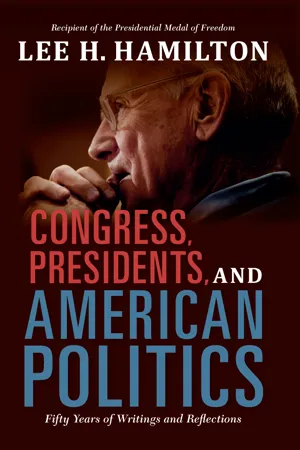
Congress, Presidents, and American Politics
Fifty Years of Writings and Reflections
- 382 pages
- English
- ePUB (mobile friendly)
- Available on iOS & Android
eBook - ePub
About this book
Information
Subtopic
North American HistoryIndex
HistoryONE
THE JOHNSON YEARS
(1965–68)
A Remarkable Time to Begin in Congress
THE NOVEMBER 1964 ELECTION THAT BROUGHT ME TO CONGRESS was also the Lyndon Johnson landslide over Barry Goldwater. The four years that I would serve in Congress during the Johnson years—in the 89th and 90th Congresses—were a memorable, tumultuous time.
Legislation came at us very quickly. I was sworn into office on January 4, 1965, and by April we had passed the Elementary and Secondary Education Act, the first of sixty major bills we passed that Congress. President Johnson felt he had a clear mandate from the election, and he was poised to strike. Much of the legislation had been developed by President Kennedy, so Johnson had an agenda handed to him. And many of the major bills were fully aired and, to Johnson’s mind, fully settled during the campaign. So it was full speed ahead.
The 89th was a Congress in which the president clearly took the lead, and Johnson was relentless in pursuing his agenda and in his follow-up with Congress. He had great energy and focus, and a thorough knowledge of the institution and its members. He enjoyed the legislative process and had been involved in it for much of his life. He was constantly on the phone to members of Congress, making dozens of calls every day. Like other members I was cornered by Johnson on several occasions, his index finger poking against my chest as he told me why a bill needed to be passed. The question on his mind was always, How do I get your vote? Johnson was a dealmaker and he used the full powers of his office—which were considerable—to close the deal, whether it was promising a federal building or bridge for your district, offering you a trip overseas, or appointing someone you knew to an office. Anything he needed to do, he’d do.
He was proud of the accomplishments of the 89th Congress, and at the end of the two years hosted a reception at the White House for what he called “the fabulous 89th,” saying its record exceeded that of any previous Congress. Impressive as the accomplishments were, I did have some reservations. At midsession I wrote the president, saying that it might be a “time to pause” in the legislative flurry. We were passing a lot of major legislation—aid to education, Medicare, War on Poverty—all of broad magnitude, and I was concerned about implementation. I took numerous trips back home, almost every weekend, to hold public meetings with constituents to discuss what we were doing, and there was clear skepticism about the rush of legislation. It took the 1966 elections, when the Democrats lost several seats in the House, to slow us down.
I had a good personal relationship with President Johnson. He took a special interest in me as a new member of Congress, for reasons I never fully understood—perhaps he overestimated the significance of my being president of the incoming House class. He was always accessible and open to my requests, and once he even came out to my district for a campaign appearance, which was an unusual thing for a president to do for a member of the House. Later in his term I offered one of the first amendments in the House to reduce funding for the Vietnam War. Our effort wasn’t successful, but it received more votes than expected. It so happened that I went to the White House that evening for a reception. President Johnson came directly over as soon as he saw me. I still remember the disappointed look in his eyes when he said, “Lee, how could you do that to me?” But to his great credit, we stayed on good terms. As a master politician he knew that down the road he would need my vote or support on something else.
I actually had a less direct relationship with the House leadership early on. In the 1960s the general advice from the congressional leadership to new members was to keep your mouth shut your first few terms in Congress, and we were told—not altogether in jest—that the senior members didn’t even learn your name until your third or fourth term. In my second term in office, in January 1967, I did receive a phone call from Speaker John McCormack—a surprising “Lee, how are you?” call, since I don’t think he would have recognized me if I walked unannounced into his room. He said a vote for Speaker was coming up in the caucus and he hoped I’d be with him. I told him I’d be voting for Mo Udall, and then I heard the phone slam down. McCormack was reelected Speaker, but he never held my vote against me. And from then on he did know who I was. He was never vindictive, always nice, and ready to be helpful. Both he and Johnson showed me that to be a successful politician you don’t hold grudges, and you think about the battles ahead, not those in the past.
The Democratic and Republican leaders in the House—Speaker McCormack, Majority Leader Carl Albert, and Minority Leader Gerald Ford—were all political professionals who got along well. They had regular meetings, and there was a sense of civility and accommodation. Make no mistake: there was partisanship. The leaders were strong and articulate advocates for their party caucuses. But the overall sense of working together for the good of the nation was quite unlike the way it is in Congress today.
I was impressed not only with the leadership but also with the quality of the members of the House—their integrity, their competence, their many abilities. I remember thinking to myself that these people were good, and that I was both honored and challenged to be among them.
At one point early on, when I was still learning my way around Congress, I was managing a minor bill on the House floor for the Democrats and made a small parliamentary mistake that would have doomed its fate. At the direction of the Republican leadership, Bill Bray, a prominent Republican also from Indiana, came over to me, put his arm on my shoulder, and gently pointed out how I could fix my blunder—and this was on a bill they opposed. They didn’t want even a new Democratic member of Congress to look foolish. It is simply unimaginable that something like that could happen in Congress today.
The 89th Congress was a remarkable time to start a career in Congress. It was a two-year period of accomplishments unlike anything seen since. It was also a time when the public had a high regard for Congress. I don’t think I appreciated it enough initially, thinking that maybe that was the way it always worked in Congress. But as the Congress progressed, I came to recognize the uniqueness of what we had done.
The 89th Congress: Key Facts
·January 4, 1965, through October 22, 1966, during the first two years of the second Johnson administration
·House of Representatives controlled by the Democrats, 295 to 140
·Senate controlled by the Democrats, 68 to 32
·810 bills enacted
·Major accomplishments included passing the Older Americans Act, Medicare and Medicaid, the Voting Rights Act of 1965, the Elementary and Secondary Education Act, the Higher Education Act, the Water Quality Act, a minimum wage increase, the Freedom of Information Act, the Highway Safety Act, and the Financial Institutions Supervisory Act; and setting up the Department of Housing and Urban Development and the Department of Transportation
·Support for President Johnson’s position in the House: Democrats 82 percent, Republicans 46 percent; in the Senate: Democrats 73 percent, Republicans 54 percent
The 90th Congress: Key Facts
·January 10, 1967, through October 14, 1968, during the last two years of the second Johnson administration
·House of Representatives controlled by the Democrats, 246 to 187 (2 other)
·Senate controlled by the Democrats, 64 to 36
·640 bills enacted
·Major accomplishments included passing the Investment Tax Credit Act, the Public Broadcasting Act, the Air Quality Control Act, the Wholesome Meat Act, the Age Discrimination in Employment Act, an increase in Social Security benefits, the Civil Rights Act of 1968 (housing), the Truth in Lending Act, the Omnibus Crime Control and Safe Streets Act, the Juvenile Delinquency Prevention and Control Act, the Housing and Urban Development Act, the National Trails System Act, and the Gun Control Act; and Senate ratification of the first US-USSR bilateral treaty
·Support for President Johnson’s position in the House: Democrats 79 percent, Republicans 55 percent; in the Senate: Democrats 69 percent, Republicans 60 percent
THE FACTS ABOUT THE MEDICARE BILL
In the 1964 campaign, my first campaign for Congress, I had several debates in southern Indiana on Medicare, as well as on federal aid to education—those were the two big domestic issues. So I was reasonably familiar with the main questions and controversies about Medicare when I came to Congress. Often my debates were with doctors rather than with other politicians. The American Medical Association was the main group opposed to Medicare—calling it socialized medicine—and they found doctors to debate me in various forums.
I was only in Congress for six months before Medicare came up for consideration and for a vote, and it was a good learning experience for me. Two lessons stand out:
I was impressed by the way Chairman Wilbur Mills and ranking member John Byrnes handled the bill on the House floor. They had complete command of the details, and the debate consisted basically of Mills answering questions about every aspect of the bill, with Byrnes’s help. It was a good lesson about the importance of mastering the details of a bill—if you are bringing a bill to the floor, you need to know more about it than anyone else.
I also learned a lot from Wilbur Mills about consensus building and respect for minority views. The Democrats at that time had an overwhelming majority in the House—more than two to one—and many of us felt that we should just pass the Medicare bill we wanted. But Mills argued persuasively that it would be unwise not to give some significant concessions to the Republicans. He recognized that what matters is not just passing a bill but also its implementation, and that there would be a much better chance of successful implementation if something passed with bipartisan support. The bill received many Republican votes on final passage, making it a significant bipartisan accomplishment.
Mills was constantly talking to members of both parties about legislation he was developing, and if he spotted a potential problem he would go back to his committee to try to find a way to fix it—which meant that the bills he brought to the floor almost always passed by wide margins and with strong bipartisan support. He was the most impressive legislator I saw during my years in Congress, and to my mind the greatest legislator of the twentieth century, responsible for shaping a broad range of our nation’s basic legislation, from Social Security and the tax code to trade agreements and welfare.
April 28, 1965: “The Facts about the Medicare Bill”
Report from Washington
Vol. I, No. 7
On April 8, 1965, the House of Representatives by an overwhelming majority of 313 to 115 passed an historic bill providing for medical care for persons sixty-five years or older.
The bill actually provides
1. basic hospital insurance under Social Security;
2. voluntary supplementary health benefits through private insurance in part paid by government; and
3. an expanded medical assistance program for the needy.
In addition, the bill provides for improvements in the Social Security program itself, including a general increase in benefits of 7 percent.
I voted wholeheartedly in favor of this bill because it is of monumental significance to all residents of the Ninth District.
Because the subject of medical care for the aged has been under discussion for so long, I think you are entitled to a thorough review of the issues involved.
The Problem
There was unanimous agreement in the Congress that a real problem exists. Persons over sixty-five years of age are a growing segment of our society. Nearly one out of every ten Americans is in this age group and their numbers are increasing every year. Medical care is a serious matter of concern to all citizens, but this group faces special problems:
Less Income: Of the eighteen million persons over sixty-five, more than half have incomes of less than $1000 a year. The average for two-person families is just $2530. This level of income will buy very little hospital care today.
Fewer Assets: One-third of the persons over sixty-five, numbering six million Americans, have no assets at all. Half of all persons over sixty-five have assets amounting to less than $1,000. Yet, when a husband or wife is hospitalized, half the aged couples today have total medical bills exceeding $800 a year.
Ill Longer: Persons over sixty-five use three times as much hospital care as younger people. When they go to the hospital they stay twice as long for each illness on the average.
Costs Hurt: Since their productive years e...
Table of contents
- Cover
- Half title
- Title
- Copyright
- Dedication
- Contents
- Acknowledgments
- Introduction
- 1. The Johnson Years (1965–68): A Remarkable Time to Begin in Congress
- 2. The Nixon Years (1969–74): Accomplishments amid Turmoil
- 3. The Ford Years (1974–76): A Needed Respite
- 4. The Carter Years (1977–80): Intraparty Discord
- 5. The Reagan Years (1981–88): Letting the Democratic Process Work
- 6. The George H. W. Bush Years (1989–92): A New World Order
- 7. The Clinton Years (1993–2000): Opportunities Missed
- 8. The George W. Bush Years (2001–2008): A Timid Congress
- 9. The Obama Years (2009–14): Continuing Struggles
- Some Concluding Thoughts
- Index
Trusted by 375,005 students
Access to over 1.5 million titles for a fair monthly price.
Study more efficiently using our study tools.
Frequently asked questions
Yes, you can cancel anytime from the Subscription tab in your account settings on the Perlego website. Your subscription will stay active until the end of your current billing period. Learn how to cancel your subscription
No, books cannot be downloaded as external files, such as PDFs, for use outside of Perlego. However, you can download books within the Perlego app for offline reading on mobile or tablet. Learn how to download books offline
Perlego offers two plans: Essential and Complete
- Essential is ideal for learners and professionals who enjoy exploring a wide range of subjects. Access the Essential Library with 800,000+ trusted titles and best-sellers across business, personal growth, and the humanities. Includes unlimited reading time and Standard Read Aloud voice.
- Complete: Perfect for advanced learners and researchers needing full, unrestricted access. Unlock 1.5M+ books across hundreds of subjects, including academic and specialized titles. The Complete Plan also includes advanced features like Premium Read Aloud and Research Assistant.
We are an online textbook subscription service, where you can get access to an entire online library for less than the price of a single book per month. With over 1.5 million books across 990+ topics, we’ve got you covered! Learn about our mission
Look out for the read-aloud symbol on your next book to see if you can listen to it. The read-aloud tool reads text aloud for you, highlighting the text as it is being read. You can pause it, speed it up and slow it down. Learn more about Read Aloud
Yes! You can use the Perlego app on both iOS and Android devices to read anytime, anywhere — even offline. Perfect for commutes or when you’re on the go.
Please note we cannot support devices running on iOS 13 and Android 7 or earlier. Learn more about using the app
Please note we cannot support devices running on iOS 13 and Android 7 or earlier. Learn more about using the app
Yes, you can access Congress, Presidents, and American Politics by Lee H. Hamilton in PDF and/or ePUB format, as well as other popular books in History & North American History. We have over 1.5 million books available in our catalogue for you to explore.