- 147 pages
- English
- ePUB (mobile friendly)
- Available on iOS & Android
eBook - ePub
Haunted Boston Harbor
About this book
Meet the spirits who lurk in the waters near this historic seaport and its secluded islands—photos included!
Boston Harbor brims with the restless spirits of pirates, prisoners, and victims of disease and injustice. Uncover the truth behind the Lady in Black on Georges Island. Learn about the former asylums on Long Island that inspired the movie Shutter Island, and dig up the skeletal secrets left behind by the Woman in Scarlet Robes.
From items flying off the shelves at a North End cigar shop to the postmortem cries of tragedy at the centuries-old Boston Light on Little Brewster, author Sam Baltrusis breathes new life into the horrors that occurred in the historic waters surrounding Boston.
Boston Harbor brims with the restless spirits of pirates, prisoners, and victims of disease and injustice. Uncover the truth behind the Lady in Black on Georges Island. Learn about the former asylums on Long Island that inspired the movie Shutter Island, and dig up the skeletal secrets left behind by the Woman in Scarlet Robes.
From items flying off the shelves at a North End cigar shop to the postmortem cries of tragedy at the centuries-old Boston Light on Little Brewster, author Sam Baltrusis breathes new life into the horrors that occurred in the historic waters surrounding Boston.
Trusted by 375,005 students
Access to over 1 million titles for a fair monthly price.
Study more efficiently using our study tools.
Information
Chapter 1
ASYLUM HAUNTS
Boston Harbor was a literal dumping ground for the city’s undesirables and those traditionally marginalized by the status quo. Asylums, or institutions built for the poor, orphaned, sick and mentally ill were commonplace on a handful of the islands throughout the harbor.
“For centuries, Bostonians used the harbor islands to sequester and provide for those suffering from physical and social ills,” reported the Boston Phoenix. “Locals have grown up believing that many of these sites are haunted. They are: if not by ghosts, then by the twisted and shameful legacy of what happened in these places.”
Based on the intense residual energy at many of the former asylums scattered throughout Boston Harbor, it would make sense that many of the people who lived in these buildings left behind a psychic imprint of sorts, especially if neglect or trauma was involved.
One hypothesis, developed in the 1970s and known as the Stone Tape theory, speculates that an environment can absorb energy from a high-tension event, such as an untimely death or a suicide. The theory is a possible explanation for the alleged paranormal activity reported on the islands of Boston Harbor, including lights flickering and inexplicable screams. A residual haunting is like a videotaped event that plays over and over. Residual spirits are not intelligent entities and can’t interact with the living. However, it’s possible that a few lost souls still linger on the islands where they were formerly sequestered.
Rachel Hoffman, investigator with the all-female team called Paranormal Xpeditions, said it’s possible that an aura of disaster has psychically imprinted itself on the islands, especially those that formerly housed tuberculosis clinics, poorhouses or mental institutions. “We believe that asylums are higher in paranormal activity due to the amount of personal anguish suffered by the ill and also the nurses who were understaffed,” explained Hoffman. “We oftentimes hear them going about their daily activities as if they don’t know they are dead.”
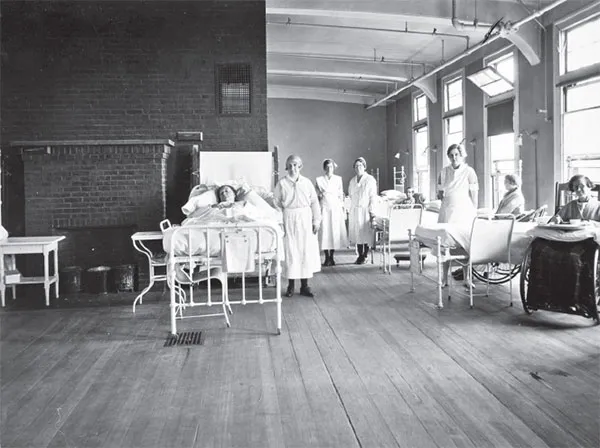
Long Island’s Chronic Disease Hospital and almshouse was home to 1,400 patients and inmates in the 1940s and was staffed by hundreds of nurses, doctors and employees. Courtesy of the Boston Public Library, Print Department.
Hoffman appeared on Zak Bagan’s Paranormal Challenge, during which her team investigated the extremely haunted Rolling Hills Asylum in East Bethany, New York. On the Travel Channel show, Paranormal Xpeditions captured a “class A” EVP of a female voice saying, “Don’t touch me again” followed by the sound of a straightjacket slapping down after a blood-curdling shriek.
“We believe it was a confrontation between a nurse and a patient,” said Hoffman. “I believe it was residual activity and probably repeats itself consistently because the patient is unaware that she has died.”
The veteran paranormal investigator believes that the ghosts haunting old asylums are both intelligent and residual. “We have come across spirits that are nasty in nature and tend to carry on being aggressive even after death,” Hoffman said. “We also run into child spirits, which are the ones to us that tend to be intelligent and receptive. We generally bring candy or toys as trigger objects to evoke a response. Kids love candy and shiny toys and usually approach us easily, as we have a mothering nature to our crew of all females.”
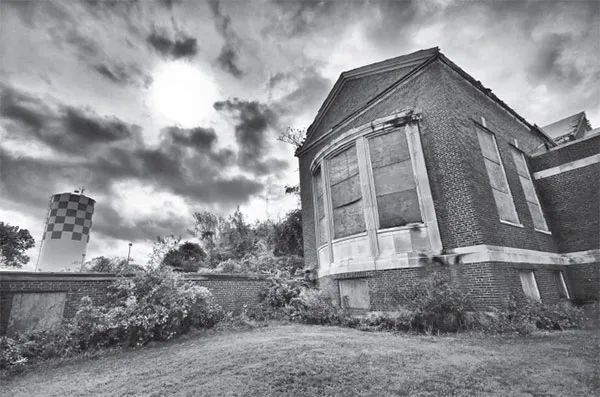
Long Island, marked by a red-and-white water tank, inspired the fictional Ashecliffe Hospital for the Criminally Insane in author Dennis Lehane’s book Shutter Island. Photo by Jason Baker.
The asylums in Boston Harbor deviate a bit from the so-called insane asylums we’ve seen portrayed in pop culture, specifically on TV shows like American Horror Story: Asylum and movies like Martin Scorsese’s Shutter Island. However, they did exist in other areas like Danvers, Medfield and Taunton.
Cambridge’s “Jolly” Jane Toppan is an extreme example of a human monster who formerly worked and eventually died in one of those inhumane institutions. Born in 1854, Toppan began training to be a nurse at Cambridge Hospital in 1885. There she would overdose her patients with morphine and change their medical charts to hide evidence of their intake. She was known as “Jolly” Jane because of her sugary-sweet demeanor. However, Toppan got her jollies by killing her victims and jumping into bed with them after she poisoned them. She would wrap her limbs around her dying patients and get sexual gratification from feeling the life leaving their frail bodies. She left a trail of bodies at Cambridge Hospital and was moved to Boston’s Mass General in 1890.
After years of murdering innocent patients, she was implicated in 1902 and was sent to the Taunton Insane Hospital, where she died in 1938. There she refused to eat because she was afraid staffers at the insane asylum had poisoned her food. From a paranormal perspective, it would make sense that the female serial killer’s spirit lingers at the spot where she died.
When it comes to asylums in Massachusetts, including the handful of institutions in Boston Harbor, fact is definitely stranger than fiction.
“It’s tough to invent anything more messed up than what actually happened at Massachusetts’s network of public mental hospitals,” wrote Scott Kearnan in the Boston Phoenix. “Our state’s institutional memories are riddled with sordid tales of deplorable physical conditions, sexual misconduct and cruelly unusual torture masquerading as treatment.”
DEER ISLAND
Don’t let the dinosaur egg–shaped sludge digesters from the sewage treatment facility fool you. Deer Island is marred by tragedy and stained with the blood of hundreds of innocents who were confined in one of the most horrific untold genocides in American history.
For the Native Americans quarantined on the 185-acre dumping ground, Deer Island was known as Devil’s Island.
A group of native people were converted to Christianity by the Reverend John Eliot. Known as the “praying Indians,” they were captured one night in October 1675 and were quarantined on the barren island, their captors fueled by fear of the impending King Philip’s War. Eliot, a British minister who had fled to Boston in 1631, had painstakingly translated the Bible into their native tribal language. Many of the innocent men, women and children were holding their Bibles when they were forced to fend for themselves on what was then a desolate island in Boston Harbor.
“Deer Island became a place of internment in the winter of 1675–76 for approximately 500 Native Americans, whom Europeans had removed from their homes and villages,” reported the National Park Service’s website. “Many of the imprisoned Native Americans died that winter without access to adequate food or shelter.”

Millions of gallons of sewage are pumped through the dinosaur egg–shaped tanks known as sludge digestors. The Deer Island Sewage Treatment facility was ordered by a federal judge after the citizens of Boston filed a lawsuit to clean up the harbor. Photo by Frank C. Grace.
Contrary to the NPS report, there were up to 1,100 “praying Indians” kept on Deer Island, and historians believe that more could have lived there who went unrecorded. The Native Americans, demonized by the colonists, were dropping at an alarming rate. Many of them were on the shoreline praying for God to help. No one came.
The Reverend Eliot made several attempts to deliver food, but the angry townspeople stopped him by trying to capsize his vessel. A group of men planned to massacre the natives—or, as Malden’s Abram Hill worded it, they intended to “destroy ye Indians.” The rogue slayers never made it out to Deer Island. However, hundreds of natives died anyway from the elements and lack of food.
During the spring of 1676, a rescue vessel was sent to retrieve the few “praying Indians” who were still alive. The handful who did survive were rumored to have been sold as slaves.
Paranormal investigators believe this tragedy left an aura of disaster on Deer Island. People have reported inexplicable cries and a residual haunting of tribal drums on the island over the years. However, the screams of the Native Americans were just a precursor to the horrors yet to unfold on this cursed land.
When millions fled Ireland to seek refuge from the Great Famine in the mid-1800s, Deer Island became a quarantine facility for thousands of Irish immigrants. “In June 1847, the City of Boston established a hospital on Deer Island,” confirmed the NPS website. “Approximately 4,800 men, women and children were admitted for treatment in the years from 1847 to 1849. Many recovered, but more than 800 died.”
There’s one notorious haunting in Boston tied to hundreds of Irish children whose lives ended abruptly on Deer Island. According to lore, a teen spirit with a soiled dress has been a regular visitor at the Central Burying Ground. She’s believed to be one of the many children buried in a mass grave in the pauper cemetery on the corner of Tremont and Boylston Streets.
According to the late, great ghost expert Jim McCabe, the young female spirit is a teen girl “with long red hair, sunken cheekbones and a mud-splattered gray dress on.” On a rainy afternoon in the 1970s, she paid a visit to a dentist named Dr. Matt Rutger, who reportedly experienced “a total deviation from reality as most of us know it.” According to Holly Nadler’s Ghosts of Boston Town, Rutger was checking out the gravestone carvings. He felt a tap on his shoulder and then a violent yank on his collar. No one was there.
As Rutger was bolting from the cemetery, he noticed something out of the corner of his eye. “I saw a young girl standing motionless in the rear corner of the cemetery, staring at me intently,” he said. The mischievous spirit then reappeared near the graveyard’s gate, almost fifty yards from the initial encounter. Then the unthinkable happened. “He somehow made it by her to Boylston Street, and even though he couldn’t see her, he felt her hand slip inside his coat pocket, take out his keys and dangle them in midair before dropping them,” McCabe recounted.
Others have spotted the teen spirit over the years. I’ve seen photos of a full-bodied apparition of what appears to be a girl wearing a bonnet. According to legend, Dr. Rutger was doing an etching at a mass grave for children who died from tuberculosis on Deer Island. Indeed, a cemetery on the island called Rest Haven is believed to be the final resting spot for the people who died there in the 1800s. However, ghost lore enthusiasts claim the ghost girl regularly encountered in Central Burying Ground is one of the thousands of Irish immigrants who fled to Boston to seek refuge.
In 1850, an almshouse, or asylum for the poor, was built on Deer Island to house the city’s paupers. The structure became a short-term prison in 1896. The facility was a house of correction until 1991. According to A Short History of Nearly Everything, experiments were done on the prisoners. The facility generally held short-term offenders whose crimes ranged from public drunkenness to disorderly conduct.
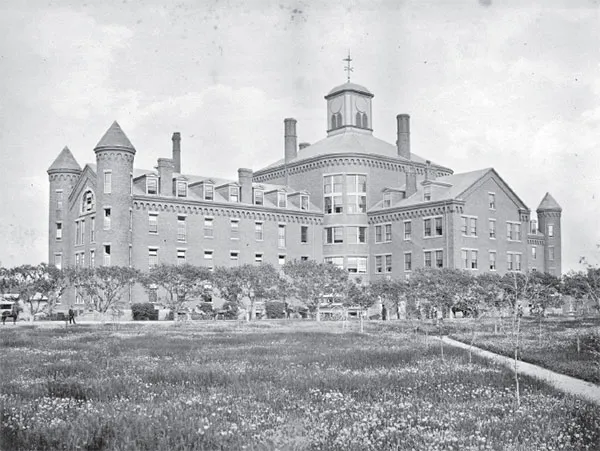
A quarantine hospital was built on Deer Island in 1847. Thousands of Irish immigrants were admitted to the asylum during the smallpox epidemic. Hundreds died and are buried in a mass grave on the island’s northern hill. In 1850, an almshouse was built and became a prison in 1896. The facility was a house of correction until 1991. Courtesy of the Boston Public Library, Print Department.
According to people who spent time in the Deer Island House of Industry, cruel and unusual punishment was the norm. In fact, one woman reached out to me to help solve what is believed to be the unsolved murder of her great-great-grandfather. “His name was John Barry. He was murdered in April 1894 on Deer Island where he had been on and off for about fifteen years,” wrote Julie H. via e-mail. “The Boston Globe articles I unearthed helped me confirm he is my ancestor. However, not long after the murder the ‘case’ went cold, and I assume the suspect was never captured. There is nothing about the murder other than the suspect’s name on the date of the murder and the word escaped.”
Escaped? No reports of a prison escape in 1894 have been found. Besides, based on the structure’s design, an escape would have been nearly impossible. Based purely on intuition, it sounds like an inside job or coverup of sorts. The waterway, known as the Shirley Gut channel, that separates Deer Island from Winthrop was filled in after the 1938 New England nor’easter. So it’s highly unlikely a prisoner could have escaped the facility and then swum in the harbor without getting caught.
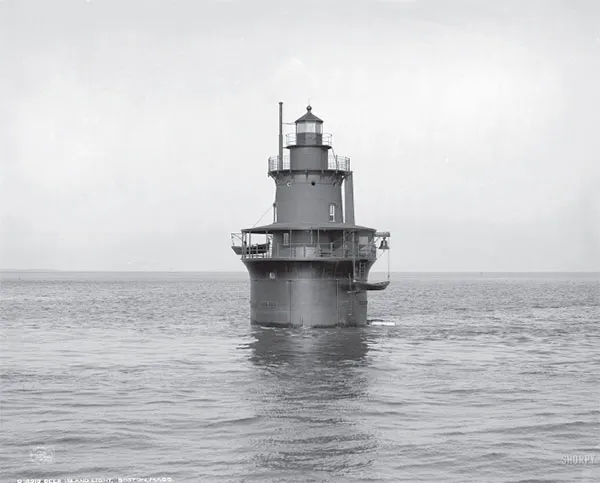
Deer Island Lighthouse, built in 1890, was the scene of tragedy in 1916, when assistant light keeper Joseph McCabe slipped on a rock and drowned in Boston Harbor. Courtesy of the Boston Public Library, Print Department.
In fact, there was an attempted escape in 1933, and all four men were apprehended.
As far as ghosts are concerned, there’s a legend involving the Deer Island Lighthouse, which was built in 1890. “After the Coast Guard took over the light, officer-in-charge John Baxter played a trick on a new crewmember,” reported LighthouseFriends.com. “Knowing the surf was rising and soon the light would be shaking, he said, ‘I want to warn you. We have ghosts out here.’ Soon the coffee cup on the table began to dance as if in proof.”
Jeremy D’Entremont, historian for the American Lighthouse Foundation, confirmed the ghostly pranks at the Deer Island Lighthouse. “One of the early keepers at Deer Island Light drowned near the lighthouse,” he said. “Later, Coast Guard keepers would tell new arrivals that the place was haunted. One told me that he made a coffee cup slide across a table and convinced a new arrival that the ghost did it. Of course, the fact that the whole place was on a slight slant is what made the coffee cup slide.”
As D’Entremont mentioned, one tragedy at the Deer Island Lighthouse could have resulted in an actual haunting. Joseph McCabe accepted the post as assistant light keeper in 1908. He found the isolation unbearable and had a piano delivered to the lighthouse to “break the monotony of the lonely life in the isolated tower,” reported the Boston Globe in 1913. He met a woman, Gertrude Walter, in East Boston and left his post on February 16, 1916, to help his soon-to-be-wife address wedding invitations. On the trek back, he hopped on a rock and tragically slipped. McCabe fell into the turbulent Boston Harbor waters, and the ...
Table of contents
- Front Cover
- Half Title
- Title Page
- Copyright
- Contents
- Acknowledgements
- Introduction
- 1. Asylum Haunts
- 2. Charlestown Haunts
- 3. Fort Haunts
- 4. Lighthouse Haunts
- 5. Literary Haunts
- 6. Nightlife Haunts
- 7. North End Haunts
- 8. Pirate Haunts
- Bibliography
- About the Author
Frequently asked questions
Yes, you can cancel anytime from the Subscription tab in your account settings on the Perlego website. Your subscription will stay active until the end of your current billing period. Learn how to cancel your subscription
No, books cannot be downloaded as external files, such as PDFs, for use outside of Perlego. However, you can download books within the Perlego app for offline reading on mobile or tablet. Learn how to download books offline
Perlego offers two plans: Essential and Complete
- Essential is ideal for learners and professionals who enjoy exploring a wide range of subjects. Access the Essential Library with 800,000+ trusted titles and best-sellers across business, personal growth, and the humanities. Includes unlimited reading time and Standard Read Aloud voice.
- Complete: Perfect for advanced learners and researchers needing full, unrestricted access. Unlock 1.4M+ books across hundreds of subjects, including academic and specialized titles. The Complete Plan also includes advanced features like Premium Read Aloud and Research Assistant.
We are an online textbook subscription service, where you can get access to an entire online library for less than the price of a single book per month. With over 1 million books across 990+ topics, we’ve got you covered! Learn about our mission
Look out for the read-aloud symbol on your next book to see if you can listen to it. The read-aloud tool reads text aloud for you, highlighting the text as it is being read. You can pause it, speed it up and slow it down. Learn more about Read Aloud
Yes! You can use the Perlego app on both iOS and Android devices to read anytime, anywhere — even offline. Perfect for commutes or when you’re on the go.
Please note we cannot support devices running on iOS 13 and Android 7 or earlier. Learn more about using the app
Please note we cannot support devices running on iOS 13 and Android 7 or earlier. Learn more about using the app
Yes, you can access Haunted Boston Harbor by Sam Baltrusis in PDF and/or ePUB format, as well as other popular books in History & North American History. We have over one million books available in our catalogue for you to explore.