"Spine-tingling ghost stories . . . Thrilling tales of the Bluff City's past" (
Memphis Reads).
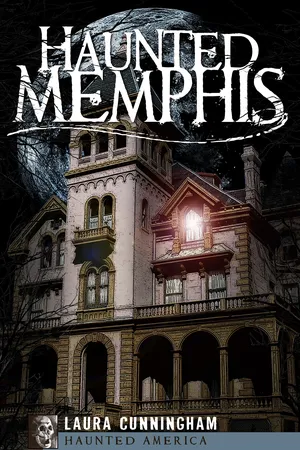
Much like its muddy riverbanks, the mid-South is flooded with tales of shadowy spirits lurking among us. Beyond the rhythm of the blues and tapping of blue suede shoes is a history steeped in horror. From the restless souls of Elmwood Cemetery to the voodoo vices of Beale Street, phantom hymns of the Orpheum Theatre and Civil War soldiers still looking for a fight, peer beyond the shadows of the city's most historic sites. Author and lifelong resident Laura Cunningham expertly blends fright with history and presents the ghostly legends from Beale to Bartlett, Germantown to Collierville, in this one-of-a-kind volume no resident or visitor should be without.
Includes photos!
"There are plenty of places in Memphis to go where the spirits aren't in costume or getting paid to make you scream. Laura Cunningham reveals all the terrifying details in [
Haunted Memphis]." —WREG.com
- 131 pages
- English
- ePUB (mobile friendly)
- Available on iOS & Android
eBook - ePub
Haunted Memphis
About this book
Information
HOME SWEET HOME
WOODRUFF-FONTAINE HOUSE
The Woodruff-Fontaine House, located at 680 Adams Avenue, was built in 1870 for a carriage maker from New Jersey, Amos Woodruff. Woodruff hired architects Mathias Harvey Baldwin and Edward Culliat Jones to design his ornate, French Second Empire mansion. For nearly ten years, beginning in 1869, nearly all of the finest homes and grandest buildings were designed by Jones and Baldwin.
The mansion was built with handmade bricks. The home’s hardwood floors are Southern cypress, with the first floor interlaced with bands of mahogany. The home’s floor plan follows a traditional pattern of a long center hallway with rooms on each side. The ceilings in the home are sixteen feet high on the first level, fourteen feet on the second and thirteen feet on the third. The ceiling of the three-story central staircase is made of tin and decorated with garlands and cherubs. Outside, the home is styled with a steep mansard roof and a central tower that extends two additional levels above the three-story home.
A carriage maker by trade, Amos Woodruff expanded his business interests once in Memphis. He would eventually become president of two banks and hold interests in hotel, railroad, cotton, insurance and lumber companies. He lived in his home on Adams until 1884 with his wife Phoebe and their four children.
Amos’s nineteen-year-old daughter, Mollie, became the first bride at the house, marrying Egbert Wooldridge on December 18, 1871. The new couple made the mansion their home, living in a suite of rooms on the second floor. Unfortunately, the young couple would only have a few short years of happiness together. On February 13, 1875, Mollie gave birth in the home to a stillborn daughter. Three months later, Mollie’s husband Egbert contracted pneumonia after a boating accident and died just three days later in the same room as his daughter.
The widowed Mollie continued to live with her parents until she married James Hennings on June 14, 1883. On January 13, 1885, Mollie gave birth for a second time; tragically, this child was stillborn as well. Mollie never had any children. In 1917, Mollie died of heart disease at her sister’s home on Poplar Avenue. She was just fifty-six years old.
In 1883, Noland Fontaine purchased the home from the Woodruffs. The Fontaine family lived in the home for the next forty-six years. Fontaine was a prominent Memphian and third-wealthiest cotton factor in the country. Raising eight children ensured that the Fontaine’s home was the scene of many elaborate parties with prominent guests arriving from all around the country. In 1892, on the occasion of the opening of the first Mississippi River bridge between St. Louis and New Orleans, the Fontaines entertained over two thousand people, including the governors of five states. Later in 1892, Grover Cleveland visited the home during the presidential election campaign. John Philip Sousa and former vice president Adlai Stevenson were once also guests at the home. Noland Fontaine died of kidney failure at the home in 1913 at age seventy-two. His wife Virginia also died at the home at age eighty-two.
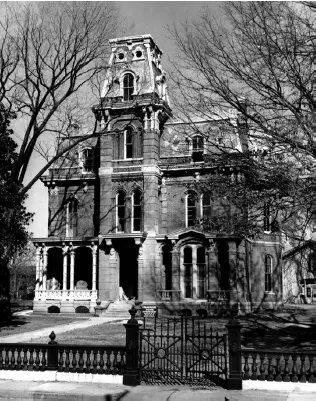
The Woodruff-Fontaine House, 1960. The home, once set to be demolished, was preserved by the efforts of the Memphis Chapter of the Association for the Preservation of Tennessee Antiquities.
Rosa Lee purchased the house for the James Lee Art Academy, named in honor of her father. In 1959, the Memphis Academy of Arts, successor to the James Lee Art Academy, moved to its present location in Overton Park. The buildings, willed to the city, stood vacant and vandalized and were scheduled for demolition. At that time, the Memphis Chapter of the APTA stepped in and saved the properties for preservation. The Memphis chapter, founded in 1953, raised $50,000 from a public fund drive and received permission for the restoration from Mayor Henry Loeb. The restoration efforts for the house, directed by Luke Eldridge Wright, began in 1961. The house opened as a museum in September 1964. When the museum first opened, it was unfurnished. Eventually, the museum was furnished and accessorized with period pieces, none of which belonged to the Woodruff or Fontaine families.
Although Mollie may have died in 1917, many believe she is still at home at her former house on Adams. Mrs. Elizabeth Dow Edwards, great-granddaughter of Mollie’s sister, Sarah, was one of those believers. The only personal experience Mrs. Edwards has had with Mollie involved a slamming door. However, her friends have heard footsteps following down the stairs and a voice calling out “My dear.” On one occasion, while Mrs. Edwards was conducting a tour, a woman walked into Mollie’s old bedroom and grew quite pale and started to tremble. She told Mrs. Edwards that she was a psychic medium who could give messages from the dead. She informed Mrs. Edwards that Mollie’s room was arranged incorrectly and that the bed was near the wrong wall. The large half-tester bed stands against the south wall, but the medium felt it belonged on the east wall, closest to the central staircase.
When the mansion housed Miss Rosa Lee’s Art Academy, students who lived and studied in the home often sensed Mollie’s presence, hearing sighs and whispers originating from Mollie’s old bedroom. Workers in the home during the restoration period reported feeling Mollie’s presence—an unseen person walking behind them on the stairs.
The second-floor bedroom, known as the “Rose room,” is the center of Mollie’s activity, although she occasionally wanders throughout the rest of the house. This is the room, now currently decorated with pale cabbage rose wallpaper, in which Mollie’s baby daughter and husband both died. The room often becomes extremely cold with no apparent cause. Occasionally, the room will fill with a musty odor. One tourist walked into Mollie’s bedroom and immediately began having a hard time breathing. She turned to her guide and asked, “Who died in this room?”
While visitors to the home have experienced paranormal activity year round, there is a noticeable, heightened sense of disturbance from February to May every year, corresponding to the time between the deaths of Mollie’s daughter and husband.
Visitors to the home have claimed to hear a baby crying and a woman’s voice lightly whispering. On the day before the anniversary of Egbert’s death, employees heard the sounds of a woman’s muffled crying. When they climbed the stairs to investigate the source of the noise, the crying stopped by the time they reached the first landing. They walked around Mollie’s room, but everything was normal. After they got downstairs, the crying started up again.
The bed in Mollie’s room has also been disturbed by an unseen entity. Several witnesses saw wrinkled bedsheets smoothen out before their eyes, as if someone had run her hand down the bed. People have also seen a human impression on the bed, as if someone was sitting on it. People have also witnessed shutters flapping violently, chandeliers swinging and doors slamming when no one was nearby. Mollie is also blamed for turning on lights in the house overnight.
While most of the interactions with Mollie’s ghost are felt or heard, she has actually appeared to a few people. A woman, described as wearing an old-fashioned green dress, has been seen pacing back and forth in Mollie’s room. Once, a seven-year-old boy on a field trip turned to his teacher and the tour guide and asked, “What happened to the lady who was just sitting in that chair?”
At least three psychics who visited the house reported the presence of a woman in the Rose bedroom. Each described Mollie in complete detail and was also able to point her out in old photographs. On one occasion, a psychic provided such a detailed account that an archivist recognized that the ghost from the description was wearing Mollie’s “going away” dress from one of her weddings.
While Mollie Woodruff is known as the ghost at the Woodruff-Fontaine House, the home has a second ghost, who makes his presence known on the third floor. On this floor, visitors and employees have reported smelling cigar smoke. Although he has never been seen, people have sensed his presence and can clearly tell that the ghost is male. Along with simply not wanting visitors on his floor, he has shown violent tendencies and given many people quite a fright at the house. The ghost is decidedly more hostile toward women than men. Female visitors and employees have felt threatened on the third floor. One former director of the museum was pushed down the stairs. One woman reported being pushed along by something on the third floor and also being shoved into one of the bedrooms. However, when a male visitor came to the house, he sensed a ghost who seemed pleased to have him there and eager for him to stay. The ghost made him feel incredibly comfortable and at ease. Many believe that the third-floor ghost is Elliot Fontaine, who died in the influenza outbreak in 1918 at age thirty-four. Elliot was rumored to be a gay socialite and a bit snooty.
MOLLIE FONTAINE-TAYLOR HOUSE
Across the street from the Woodruff-Fontaine House sits the Mollie Fontaine-Taylor House. Located at 679 Adams Avenue, Noland Fontaine had this Queen Anne Victorian mansion built as a wedding present for his daughter in 1886. During the years the home was under construction, Mollie and her husband, Dr. William W. Taylor, lived in her father’s home across the street. After Dr. Taylor died in 1925, Mollie Taylor remained in the home until her death in 1939. The property changed hands numerous times, even being divided into apartments.
In 1965, the Memphis Housing Authority purchased the home as part of an urban renewal project. The home was selected as part of the project because it had restorative value and fit in well with the surrounding buildings on Adams Avenue, which were in various stages of being restored. Although the Mollie Fontaine-Taylor House is not as large as the other mansions on the street, it makes up for its smaller size with elaborate gingerbread ornamentation. The home is considered the best representative of 1880s architecture in the city of Memphis.
In the 1970s, the homeowner was a notorious ladies’ man. He turned the home into a big party house. The home is also rumored to be the location for the first photo spread in Penthouse magazine.
In 1985, Karen and Bob Carrier purchased the home. The house was used as a home for the family and a location for Karen’s catering business, Another Roadside Attraction. A few years later, she renovated the home’s old carriage house and moved her catering business there. Already the owner of three other Memphis restaurants—Automatic Slim’s, the Beauty Shop and D O Sushi—Karen converted the main house into the Cielo restaurant in 1996. In 2007, Cielo was modernized into the Molly Fontaine Lounge, named in honor of the home’s previous occupant.
The ghost of Mollie is still rumored to be lingering around her former home. She’s been blamed for items going missing and an occasional cake flipping over. On one hot summer night, the power went out at Cielo. The manager lifted his glass and exclaimed “Cheers to Mollie!” and the lights immediately came back on. People have been proclaiming “Cheers” to Mollie’s ghost ever since.
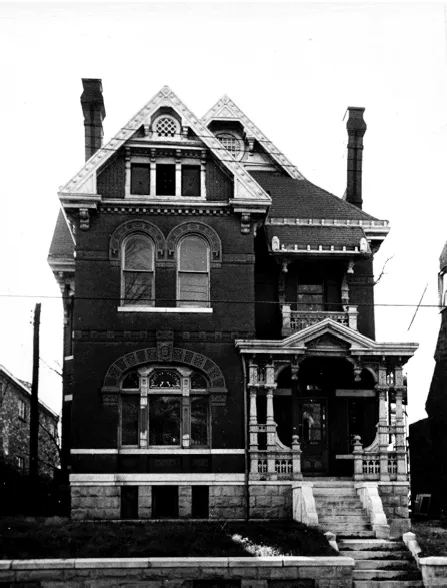
The Mollie Fontaine-Taylor House, 1962. Noland Fontaine built this house, located across the street from his own, as a wedding present for his daughter.
JAMES LEE HOUSE
Located next door to the Woodruff-Fontaine House, at 690 Adams Avenue, the James Lee House stands empty, waiting to be restored to its former glory. Looking through the window, you may still see an art easel or paintbrush strewn about, left over from its days as an art school.
In 1848, lumberman William Harsson built a small, two-story brick home in the middle of farmland, which would later become the intersection of Orleans Street and Adams Avenue. In 1849, Harsson’s daughter, Laura, married Charles W. Goyer, who had arrived in Memphis in 1841 by flatboat when he was just seventeen years old. By 1852, Goyer had prospered in his career as a merchant, and he saved enough money to purchase the home from his father-in-law. In 1865, a second addition to the south side of the home was added. By 1871, he expanded his home to its present day front and three-story tower. One story alleges that Goyer, a sugar and molasses importer, grew so rich that he formed the Union Planters Bank in order to have a place to keep his money. In the late 1860s, Laura Goyer died in the home from yellow fever. After her death, Charles Goyer married Laura’s sister, Charlotte.
In 1890, Captain James Lee, son of the founder of the Lee Line steamboat company, purchased the home from the Goyer family, moving from his previous home down the street at 239 Adams. James Lee, a Princeton graduate, moved to Memphis in 1860 to practice law. In 1877, he retired from his law practice to join his father’s company, the Lee Line of river packets and steamers based in Memphis. Lee’s daughter, Rosa, was the last family member to live in the home.
In 1961, the Memphis Chapter of the APTA saved the buildings from demolition by leasing them from the City of Memphis for restoration and public viewing. While the James Lee House has benefited from repairs over the years, any efforts thus far to restore the James Lee House for public viewing have failed.
For decades, the ghost of a woman wearing a red dress has been seen throughout the old house. Psychics and parapsychologists who have visited the mansion have felt the presence of an agitated female spirit. Workers making small renovations to the house have also sensed movement in different rooms. Students who attended the art academy often saw a woman wearing a flowing red dress seemingly glide down the front staircase and vanish before their eyes. The woman is thought to be Laura Goyer, the daughter of the first homeowner.
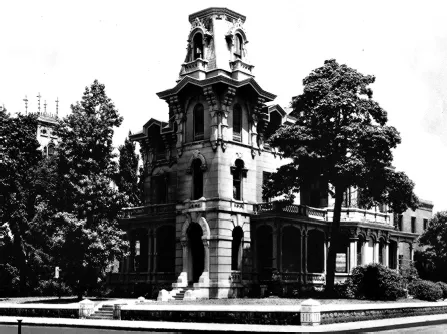
In 1925, Rosa Lee established the James Lee Memorial Academy of Art in her former home, named in honor of her father.
Some say that she returned after death to check on the welfare of her children. Others allege that Laura returned furious and unable to rest because she felt betrayed by her husband and sister. The oldest section of the home contains an apartment, whose tenants serve as caretakers for the house. A former caretaker once reported a rocking chair that rocked by itself and a woman in a red dress standing in the corner of the apartment. Many people claim that they can feel an intense, angry energy emitting from the house. The anger is so strong that it can be felt by those in cars driving by on the street.
THE MALLORY-NEELY HOUSE
The Mallory-Neely House Museum, located at 652 Adams Avenue, was once considered the most accurate example of upper-class life in late nineteenth-century Memphis, possibly in the entire country. The museum’s authenticity is directly linked to the preservation efforts of “Miss Daisy” Mallory. Born Frances Daisy Neely, Miss Daisy moved into the house in 1883 when she was twelve years old. She continued living in the home until she died in 1969, at age ninety-eight.
In 1852, Isaac B. Kirtland, a banker from New York, began construction on a large, two-and-a-half-story home on Adams Avenue, designed to resemble an Italian villa. He purchased the three-acre lot for $5,500. In 1864, Kirtland sold the home and one acre of land to Benjamin Babb for $40,000. Babb came to Memphis in 1844 and began working in the cotton industry. By 1881, he had become so successful that he and his brother-in-law established their own firm, Benjamin Babb & Company.
In 1883, James Columbus Neely purchased the residence with his wife, Frances, and their five children for $45,000. J.C. Neely had moved to Memphis in 1854 and became a cotton broker and wholesale grocer. The Neely family made extensive renovations to the house throughout the next decade. They expanded the house to three full floors with a four-story tower. The final result was a sixteen-thousand-square-foot, twenty-five-room mansion with a fireplace located in almost every room.
The family decorated the house in an elaborate, high Victorian style. Parquet flooring, ornamental plasterwork and elaborate stenciling on the ceilings were all added to the home at this time and still remain in the home today. Mr. Neely purchased two ornate stained-glass windows at the 1892 Columbian Exposition in Chicago. One window was installed in the home...
Table of contents
- Front Cover
- Half Title
- Title Page
- Copyright
- Dedication
- Contents
- Acknowledgements
- Introduction
- Pink Lizzie, the Ghost of Brinkley Female College
- The Educated Ghosts
- Southern Folklore
- On Sacred Ground
- Home Sweet Home
- Going, Going, Gone
- The Orpheum
- Restaurants, Bars, Taverns
- At Death’s Door
- Phantasms in the Parks
- St. Paul’s Spiritual Temple
- Elvis Has Left the Building
- The Suburban Ghosts
- Bibliography
Trusted by 375,005 students
Access to over 1.5 million titles for a fair monthly price.
Study more efficiently using our study tools.
Frequently asked questions
Yes, you can cancel anytime from the Subscription tab in your account settings on the Perlego website. Your subscription will stay active until the end of your current billing period. Learn how to cancel your subscription
No, books cannot be downloaded as external files, such as PDFs, for use outside of Perlego. However, you can download books within the Perlego app for offline reading on mobile or tablet. Learn how to download books offline
Perlego offers two plans: Essential and Complete
- Essential is ideal for learners and professionals who enjoy exploring a wide range of subjects. Access the Essential Library with 800,000+ trusted titles and best-sellers across business, personal growth, and the humanities. Includes unlimited reading time and Standard Read Aloud voice.
- Complete: Perfect for advanced learners and researchers needing full, unrestricted access. Unlock 1.5M+ books across hundreds of subjects, including academic and specialized titles. The Complete Plan also includes advanced features like Premium Read Aloud and Research Assistant.
We are an online textbook subscription service, where you can get access to an entire online library for less than the price of a single book per month. With over 1.5 million books across 990+ topics, we’ve got you covered! Learn about our mission
Look out for the read-aloud symbol on your next book to see if you can listen to it. The read-aloud tool reads text aloud for you, highlighting the text as it is being read. You can pause it, speed it up and slow it down. Learn more about Read Aloud
Yes! You can use the Perlego app on both iOS and Android devices to read anytime, anywhere — even offline. Perfect for commutes or when you’re on the go.
Please note we cannot support devices running on iOS 13 and Android 7 or earlier. Learn more about using the app
Please note we cannot support devices running on iOS 13 and Android 7 or earlier. Learn more about using the app
Yes, you can access Haunted Memphis by Laura Cunningham in PDF and/or ePUB format, as well as other popular books in History & North American History. We have over 1.5 million books available in our catalogue for you to explore.