The author of the Tattooed Girl series and the author of
The Corpsewood Manor Murders of North Georgia team up to delve into Chattanooga's spirited past.
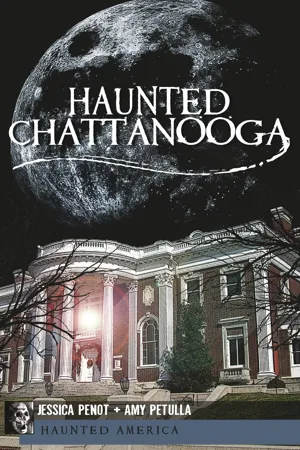
It is the home of one of the most famous railways in American history, the site of a historically vital trade route along the Tennessee River, and the gateway to the Deep South. Chattanooga has a storied past, a past that still lives through the spirits that haunt the city. Whether it is the ghost of the Delta Queen still lingering from the days of the river trade, the porter who forever roams the grounds of the historic Terminal Station, or the restless souls that haunt from beneath the city in its elaborate underground tunnel system, the specter of Chattanooga's past is everywhere. Join authors Jessica Penot and Amy Petulla as they survey the most historically haunted places in and around the Scenic City.
Includes photos!
"Until quite recently, Chattanooga was a city whose ghosts were ill documented. Jessica Penot and Amy Petulla's recent book,
Haunted Chattanooga, has helped to fix that." —
Southern Spirit Guide
- 115 pages
- English
- ePUB (mobile friendly)
- Available on iOS & Android
eBook - ePub
Haunted Chattanooga
About this book
Information
CHILLING CHATTANOOGA HIGH
AMY PETULLA
Schools have always been favorite haunts for ghosts. Perhaps the attraction of many happy memories calls them to linger in those locations. Whatever the reason, Chattanooga’s oldest and most historic high school continues this proud tradition at both of its last two locations.
A HAUNTING ON THIRD STREET
Chattanooga School for the Arts and Sciences (CSAS), at first glance, appears similar to many schools built in the first quarter of the century; built in the Colonial Revival style, the imposing brick structure serenely surveys its surroundings. In an effort to get a different perspective, I decided to photograph the school from across the street and was immediately struck by the marked difference in atmosphere brought about by the short passage over the pavement.
On the opposite side of Third Street lie no fewer than three adjacent graveyards: the Confederate Cemetery, which is home to many Confederates and at least two Union soldiers who lost their lives in America’s Civil War and which opened its gates to its last denizen in the year 2000, when the body of a long-dead soldier was discovered during a swimming pool excavation on Missionary Ridge; the Citizens Cemetery, which houses the graves of many early residents; and the Jewish Cemetery, the only one of the three that is still accepting new occupants. A stroll through the central section of the burial grounds simply brings a sense of peace and history; some gravestones leave you wondering at the story that must be behind them, like the one in the Jewish cemetery inscribed, “A Priestess by Birth and Deeds,” and some that strike a note of recollection, like the Citizens Cemetery marker of Chattanooga’s first postmaster John P. Long, who is credited with naming the city.
The outskirts of the burial grounds, however, are a different story. I was struck with a feeling of overwhelming sadness as I proceeded toward the plot’s edge. While the grounds there are neat and clean, many markers are knocked over, worn flat or sunk so deep into the ground that they can no longer be read. The graves are more spread out and less organized. Tombstones have crumbled, a crypt was broken into and a massive oak was uprooted, leaving a body-sized hole right next to a tombstone, as if the resident had given the roots a mighty shove in order to crawl out. Many graves are unmarked. The old potter’s field remains undesignated, and many soldiers are memorialized merely by unit. Some sources say that as many as 2,500 soldiers are buried there, far more than the number of monuments. During the Civil War, many soldiers were buried in a low, swampy lot near the river; the river rose and fell over them, and markers were lost or marred beyond legibility. In 1867, veterans purchased the Third Street plot for $750 and had the remains dug up, moved and reinterred, but the identities of many were never recovered.
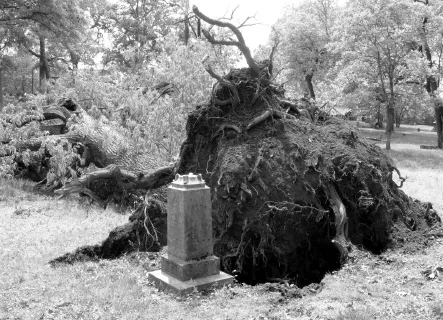
A disturbed grave at Citizens Cemetery.
The memorial park is quiet, too quiet for an area lying between two large schools (for it is backed by UTC). While at one time, students played ball there, using the tombstones for bases long ago, no such frolicking of the living goes on at that location now. However, at least one member of the East Tennessee Paranormal Society reports that the shade of a soldier interred in that hallowed ground still patrols the Confederate Cemetery portion of this graveyard. He contents himself with the confines of his eternal home and has not been known to expand his domain to the school but rather, at least according to this member, makes his presence known: “You will leave there with a different view of the paranormal.” Perhaps it is simply a question of territory, as CSAS has its own eternal overseers already. A history of the school is helpful in identifying who lurks within its confines and why.
A SCHOOL SYSTEM IS BORN
The first school in Chattanooga was located in a log cabin near the corner of Lookout and Fifth Streets in 1835. The structure also served as the community center, and in 1838, the area’s leaders gathered there and selected “Chattanooga” (which, depending on who you ask, means, “rock coming to a point,” “the Big Catch,” “draw fish out of water,” “Choctaw town,” “Eagle’s [or Hawk’s] Nest” or “difficulty”) as the community’s name. Later, after that building was gone, the jail that housed the famous Andrews’ Raiders was constructed at the same intersection.
A graded public school system was not established until July 18, 1872, when an ordinance was passed to create this more formal educational structure. Henry D. Wyatt was elected as the first superintendent, a position he kept for twenty years. The first public grade school opened its doors to white students on January 1, 1873. Because there was no high school, Professor Wyatt initially taught a few of the older boys who wanted to continue their education in his office. He sought to rectify this omission when he planned the entire city school system. The system included five schools: the first and third district schools, a small primary school, Howard School for black children and the second district school, which included a high school.
CHATTANOOGA HIGH SCHOOL
The first space for Chattanooga High School was purchased in December 1873 from the Masonic fraternity, and it was opened to thirty-five students on December 11, 1874. Over the next forty-eight years, the location was moved five times, until finding its home in 1922 at its sixth location, between Third Street and Riverside Drive—the building that currently houses the Chattanooga School for the Arts and Sciences. The land for that location was purchased in 1917. The building itself was designed by famous architect Reuben Harrison Hunt, who designed virtually all of Chattanooga’s most memorable buildings, including the old Hamilton County Courthouse, the Federal Building, the Tivoli Theater, Memorial Auditorium and the James Building, which at twelve stories was the city’s first “skyscraper.” Hunt went on to design so many public buildings throughout the South that he earned the moniker, “the outstanding architect of the South.”
Chattanooga High School remained in the current CSAS building for forty-one years, all but five of those years under the leadership of revered principal Colonel Creed Bates. Colonel Bates was an incredible leader, unconditionally dedicated to his school and students. The colonel often recited, “You may forget you’re a student of Chattanooga High School, but the public will never forget.” Colonel Bates loved roaming the school to be among his students. He particularly loved the third-floor library, where he could oversee his pupils hard at work, as well as the auditorium that was later named for him. He remained principal of CHS until 1964.
RIVERSIDE HIGH
In 1963, Chattanooga High School was moved across the river to the site where it remains to this day, a school that is also currently known as the Center for Creative Arts. At that time, Howard High School, Chattanooga’s black high school in that era of segregation, was bursting at the seams, so the city converted the old Third Street building to Riverside High in order to house the excess population from Howard. The school was immediately full—when Riverside first opened, it had about two thousand students, almost twice as many as today.
Riverside High was known for having a great basketball team and a great band. The school won the state basketball championship in its division three times. Some exceptional athletes came out of the school, and other students also went on to fame and fortune, including Riverside’s most well-known graduate, actor Samuel L. Jackson. The school remained segregated until about 1973, and while it differed in racial makeup from Chattanooga High School, it was similar in the strong attachment the students felt toward the school.
Assistant Principal Roy O. Vaughn, called “R.O.” by the kids, epitomized the heart and soul of Riverside. He reminisced about the kids: “Some needed love, some needed understanding, some money for lunch, some a good paddling.” Mr. Vaughn loved the young scholars so much that he turned down a request for him to become principal so that he could continue to work closely with the teens. He said that his worst experience was having a student leave the school without permission, only to be killed in a car wreck shortly after sneaking out.
CHATTANOOGA SCHOOL FOR THE ARTS AND SCIENCES
Riverside was closed in 1983 due to a drop in enrollment after desegregation, down to one-tenth of what it had originally been. The old CHS and Riverside High building was used from 1983 until 1985 as Erlanger School of Nursing and Continuing Education and then remained empty until 1986, when it was reopened in its present incarnation, as the Chattanooga School for the Arts and Sciences.
CSAS was the first, and until recently the only, K-12 Paideia school in the country. It was established on the Paideia principles that all children could learn and that children learned in a lot of different ways. Steve Prigohzy was hired as the school’s principal. He and his staff had little time, less money and a building they variously described as “nauseating,” “depressing” and “dog-ugly,” but they had enough motivation and drive to more than make up for those shortages. Mr. P, as he came to be known, brought in an interior designer willing to brainstorm ways to work with money shortages, the need to comply with the fire code and the necessity of preserving history. Money-saving measures included sending the auditorium chairs to Nashville so prisoners could refinish them, as well as rescuing lights that were otherwise on their way to the dump for use in the school. The school’s name was going to be Paideia, but no one could pronounce it. Someone said, “You’re going to do a lot of arts and sciences. Why not call it that?” And the name stuck.
As a magnet school, CSAS draws students from all over the Chattanooga and the Hamilton County area. Diversity was among its founding principles, and the school strived for years to maintain an equal ratio of students in the areas of gender, race and economic factors, until maintaining that balance was declared “unconstitutional.” However, there are always more applicants than spots, as students at Chattanooga School for the Arts and Sciences boast some of the highest standardized grades and post-graduation college attendance rates in the area. The school was added to the National Register of Historic Places in 1986.
THESE HAUNTED HALLS
During the day, filled with light and the laughter and buzz of a thousand students, it is hard to imagine that CSAS is haunted. At night, however, with shadows creeping around corners and only the sound of your footsteps echoing through the halls, the school takes on a much darker aspect. With a glance out the window at the moonlit expanse of graves across the street and the haunted UTC buildings beyond, the disembodied sighs of those long dead become almost audible and the paranormal possibilities seem much more real.
One of the ghosts at CSAS is purported to be Colonel Bates. According to legend, his spirit likes to hang out in the library on the third floor and sometimes manifests itself as a cold chill. I was able to speak to one person who had experienced this himself. A former custodian in the building says that he would always go to the library at night to turn off the lights. Although the temperature had been normal in the library earlier in the evening, late at night he frequently felt a presence there and would feel a cold chill in a particular spot on many occasions. Sometimes this would occur after he had already turned the light off once, only to return and find it on again, with a chill presence permeating the air.
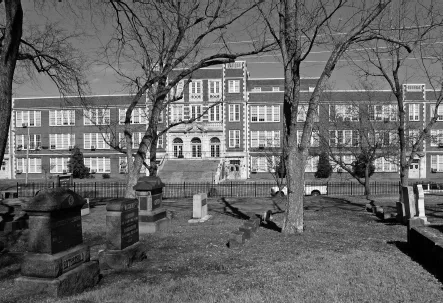
CSAS, as seen from the cemeteries across the street.
The same custodian reported that, during the time the building sat empty, before it became CSAS, he was walking down the main hall on the second floor when he heard the sound of children’s laughter coming from a classroom just around the corner. The sound continued as he approached, and he decided to investigate, knowing that no children were supposed to be in the school at the time. He approached the classroom that was the source of the disturbance, put his hand on the knob and slowly opened the door, only to find…nothing! There were no children or adults in the room, no audio device playing and no windows—nothing to cause the sound. He looked all around to see if someone might be hiding or if there was a way that they could have snuck out, but there was simply nothing there.
Legend also has it that a ghost has been seen in the hallway near the Creed Bates Auditorium on the second floor of the school. While it is possible, of course, that an errant spirit might be venturing from the cemetery across the street, a more plausible explanation is that the specter of a former student, or perhaps Colonel Bates himself, lonely for the memories and emotions that constitute life, had returned to the social center of the school to try to recapture some of the joie de vivre of former days. After all, the most joyful events at the school occurred almost exclusively in and around the auditorium. It has hosted many spectacular events. Bob Hope performed at the school early in his career. Everyone’s favorite CHS teacher, Ms. Pryor, put on fifty-three plays, twenty-five stunt nights and at least one circus, for which a live baby elephant and several ponies were brought in. Teens would tell their friends to join them “under the clock” outside the auditorium, which served as the central meet-and-greet, where music was often played. All in all, many strong and pleasant memories have imprinted themselves in and around the Creed Bates Auditorium, and while the clock may be a distant memory, the aura abides still—as do apparitions, apparently.
The final ghost reported at CSAS is associated with the gymnasium. As the story goes, a popular and gifted basketball star who was at the school at the time it was Riverside died, and he continues to haunt the John B. Steele Gymnasium there. It’s said that you can still hear him dribbling if you are in the gym late at night. If a basketball star died during the time he was a student there, the name has since been lost, but there is at least one well-known NBA basketball player, Anthony Jerome Roberts of the Denver Nuggets and Washington Bullets, who went to Riverside and died young—as did the Riverside student whom R.O. Vaughn mourned, who died tragically before she had a chance to really live. Perhaps one of them has returned to the place they were happiest in life.
CENTER FOR CREATIVE ARTS
Chattanooga High School was relocated from Third Street to north Chattanooga in 1963. While the school initially thrived at the new location, it gradually lost attendance as the population in the area aged and the number of teenagers dropped. In an effort to revive the school, it was converted to the Phoenix School, with the theme of rising from the ashes back to its former prominence. Later, administrators decided to add a performing arts “school within a school,” which incorporated dance, music and musical theater for the students within the school’s zone. This coincided with the decision to build Chattanooga’s Tennessee Aquarium, the central factor in the rebirth of downtown Chattanooga. After the aquarium opened on May 1, 1992, the North Shore boomed, but the population was mostly young professionals, so there continued to be a shortage of teenagers. As the performing arts curriculum at the school had proven popular, and as Chattanooga was increasingly embracing its arts community, the school system decided to take a bolder step by eliminating Chattanooga High School’s zone and making it a true magnet school, where admission was determined by audition and interview. The result was the Center for Creative Arts—Chattanooga’s arts magnet school, which draws the most gifted students from all of Hamilton County.
The arts offerings at CCA were expanded beyond just performing arts to also include fine art and writing. The school has won many state and national awards, most recently garnering national recognition when it received the Outstanding Arts School Award and the outstanding Community Partnership Award with the Chattanooga Symphony and Opera from Arts School Network in 2011.
A FRIENDLY GHOST
Even before it became a dedicated arts magnet school, Chattanooga High School had an auditorium with a full orchestra pit. However, a steep drop off the edge of a stage into such a hole has its risks. While no student was reported to suffer a major injury from a tumble off the brink, one staff member was not so lucky. The school is reported to have had a custodian known as “Old Joe.” Old Joe was jovial enough, though sometimes with some artificial help. It is said that during his lifetime, this man was...
Table of contents
- Front Cover
- Half Title
- Title Page
- Copyright
- Contents
- Acknowledgements
- Introduction
- Haunted Hales Bar
- The Legendary Ghost of the Delta Queen
- Chilling Chattanooga High
- The Ghosts of Chickamauga
- The Black Aggie and Bogeyman of Memorial Cemetery
- The Angry Ghost of the Read House
- The Ghosts Beneath the City
- The Quarry Ghost
- The Tennessee River Serpent
- The Haunted Halls of Higher Education
- The Haunting of the Hunter Museum
- Never Checking Out of the Chattanooga Choo Choo
- South Pittsburgh Hospital
- The Ghosts of Lookout Mountain
- Hanging with Heroes and Hooligans
- Raccoon Mountain’s Guardian of the Cavern
- Eternal Denizens of the Valley
- About the Authors
Trusted by 375,005 students
Access to over 1.5 million titles for a fair monthly price.
Study more efficiently using our study tools.
Frequently asked questions
Yes, you can cancel anytime from the Subscription tab in your account settings on the Perlego website. Your subscription will stay active until the end of your current billing period. Learn how to cancel your subscription
No, books cannot be downloaded as external files, such as PDFs, for use outside of Perlego. However, you can download books within the Perlego app for offline reading on mobile or tablet. Learn how to download books offline
Perlego offers two plans: Essential and Complete
- Essential is ideal for learners and professionals who enjoy exploring a wide range of subjects. Access the Essential Library with 800,000+ trusted titles and best-sellers across business, personal growth, and the humanities. Includes unlimited reading time and Standard Read Aloud voice.
- Complete: Perfect for advanced learners and researchers needing full, unrestricted access. Unlock 1.5M+ books across hundreds of subjects, including academic and specialized titles. The Complete Plan also includes advanced features like Premium Read Aloud and Research Assistant.
We are an online textbook subscription service, where you can get access to an entire online library for less than the price of a single book per month. With over 1.5 million books across 990+ topics, we’ve got you covered! Learn about our mission
Look out for the read-aloud symbol on your next book to see if you can listen to it. The read-aloud tool reads text aloud for you, highlighting the text as it is being read. You can pause it, speed it up and slow it down. Learn more about Read Aloud
Yes! You can use the Perlego app on both iOS and Android devices to read anytime, anywhere — even offline. Perfect for commutes or when you’re on the go.
Please note we cannot support devices running on iOS 13 and Android 7 or earlier. Learn more about using the app
Please note we cannot support devices running on iOS 13 and Android 7 or earlier. Learn more about using the app
Yes, you can access Haunted Chattanooga by Jessica Penot,Amy Petulla in PDF and/or ePUB format, as well as other popular books in History & North American History. We have over 1.5 million books available in our catalogue for you to explore.