Discover the ghosts that wander this historic stretch of the South . . . photos included.
There is a place in Alabama, a region that stretches across its lower middle from Georgia to Mississippi. It is a place steeped in history—a place where a people were enslaved, a nation was broken, and a new dream of freedom was born. It is a place where the past is always near at hand. And sometimes, that past takes a moment to whisper in your ear.
They call this place the Black Belt. From the Cato-Thorn House in Barbour County to the Snow Hill Institute in Wilcox County, Alabama's Black Belt has a great number of restless spirits that still haunt it. Join paranormal researcher David Higdon and Bram Stoker Award nominee Brett Talley as they uncover the ghosts and hauntings of one of Alabama's most historic areas.
- 129 pages
- English
- ePUB (mobile friendly)
- Available on iOS & Android
eBook - ePub
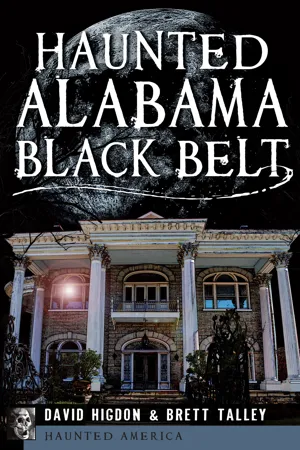
Haunted Alabama Black Belt
About this book
Information
PART I
EASTERN BLACK BELT
BARBOUR COUNTY
With a population of just over twenty-seven thousand, one might not expect much from tiny Barbour County, nestled in the southeast corner of Alabama. And yet no fewer than eight of Alabama’s governors—including the infamous George Wallace—called the county home. If one drives through Barbour County and looks at the great homes of towns like Eufaula, such a fact is probably less surprising. The migrants who came to settle the former Creek Indian territories found rich soil, ripe for the planting of cotton. The county soon became home to the state’s elite. Great mansions were built, the pride of the men and women who lived there. If some stories are to be believed, the owners of those homes never left them, even in death.
The Cato-Thorn House
In Barbour County, the cream of southern aristocracy is on display, and one will find the kind of Greek Revival antebellum mansions that some might expect to exist only within the confines of a Hollywood film. Built just before the start of the Civil War, the Cato-Thorn House was the brainchild of Lewis Llewellyn Cato. Its most striking feature is the cupola rising from the center of the roof. Look closely, and it becomes apparent that the cupola is an almost exact replica, in miniature, of the house itself.
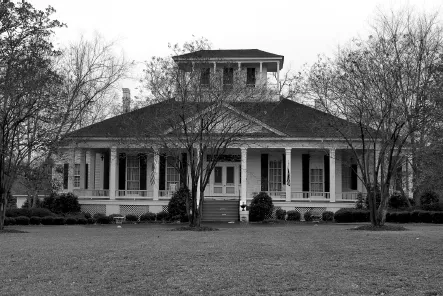
Front view of the Cato-Thorne House. Courtesy Amanda Baird/BlackDoll Photography.
When Alabama voted to secede, a huge party was held at the home. William Lowndes Yancey, one of the leading secessionists in the state, is said to have given a rousing speech in support of independence. When the house was renovated in the 1970s, a trunk containing letters from Confederate president Jefferson Davis and other significant figures of the Civil War was found in the attic.
The Confederacy is strong in the Cato-Thorn House, and perhaps it’s no surprise that its spirits come from that era as well. Some speculate that it was the restoration that stirred them up. Several of the painters who worked on the house reported the uneasy feeling that they were being watched. It was only when one of them looked up to the landing above and saw a man standing there, clothed in the full dress uniform of a Confederate officer, that these suspicions were confirmed. The painter left that day and never returned.
And it’s not just the men of the era who have come back to visit the house. A previous owner named Victoria is said to also remain on the premises. She has been seen dressed in the full regalia of a woman of the antebellum age. Victoria herself had a ghost story she liked to tell visitors. She had a dog that lived with her in the house. It seemed that something she could not see was scaring the dog, and it would often run through the house until it was exhausted. Finally, Victoria went to the second floor of the house, where the activity seemed to be centered, and told the ghost that it was welcome to stay but that it had to quit chasing the dog. The chasing stopped, the dog quit running and all of them lived together without incident. To this day, the people who own the Cato-Thorn House have been known to say that the first floor belongs to them, while the second floor belongs to the ghost. An equitable arrangement, indeed.
Kendall Manor
Another of Eufaula’s odes to days long gone by—to days of king cotton and steamships and of an age when southern Alabama was the wealthiest region in the nation—is the Kendall Manor. This is a gorgeous two-story mansion in the Italianate style. Sitting on a hill and crowned by a cupola that overseers could use to monitor both slaves working in the cotton fields and steamboat traffic coming up and down the Chattahoochee River, the owners of Kendall Manor must have felt like the entire town of Eufaula was their own kingdom to survey.
The town of Eufaula gets its name from one of the Indian tribes that used to call the area home. Meaning “high bluff” in the Muscogee language, the embankments overlooking the river and the fertile cropland fed by regular floods quickly drew white settlers to the area. Houses like Kendall Manor were built as monuments to the wealth and prosperity that followed. Soon the town had become a major shipping and trading mecca, with traders and merchants from all over Georgia and Alabama drawn to the bustling city.
But it wasn’t just the fertile land that made Eufaula wealthy. Someone had to work that land, and it was that need for labor that brought thousands of African slaves to the area. When the question of secession to protect that way of life became a pressing one after the election of Abraham Lincoln, the wealthy and powerful of the area, called the Eufaula Regency, were adamant supporters of separation. When the Civil War began, the people of Eufaula answered the call for soldiers, and many from the area would fight in some of the biggest battles of the war.
What the people of the town could not know is that they had signed the death warrant for the glory days of the Black Belt. The war, which started with many promising victories for Confederate forces, soon turned against the South. When Montgomery fell in early 1865, there was nothing to stand between federal troops and the town of Eufaula. Given that many of the towns that fell to the Union were burned to the ground, the people of Eufaula prepared for the worst. When a messenger arrived with word that four thousand Union cavalrymen were moving in their direction, it seemed that all hope was lost.
But luck was on their side. With Union troops across the river and in sight of the city, news came of the surrender of Robert E. Lee at Appomattox Court House, as well as Joe Johnston’s capitulation to William Tecumseh Sherman in Raleigh, North Carolina. Under a flag of truce, Union troops crossed the river and marched into the city, peacefully and without incident. Unlike so many of the great cities of the South, Eufaula survived the war without death and destruction.
But things would never be like they were before the war. Even as new rail lines and cotton mills brought a measure of prosperity back to the town, places like Kendall Manor watched as the world passed them by. But while Eufaula isn’t as wealthy as it once was, it is one of the most historic cities in the country. And Kendall Manor is one of more than seven hundred buildings in Eufaula listed on the National Register of Historic Places.
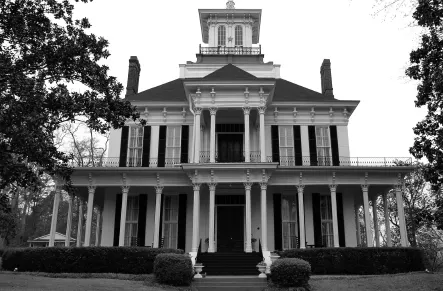
Front view of the Kendall Manor. Courtesy Amanda Baird/BlackDoll Photography.
A little bit of that history remains at Kendall Manor. It often seems like every house in Eufaula is haunted, and Kendall is no different. The manor’s particular ghost is called Annie. She was, a very long time ago, a nursemaid who cared for generations of children who passed through the halls of Kendall. It is said that she was very protective of the children and rather strict in their upbringing. Annie has long since passed from the scene, but her spirit remains, and it is said to appear whenever there are children in her area who are acting up and need discipline. And if anything would keep kids in line, seeing a ghost is probably it.
We know less about the other story attached to Kendall Manor. It involves a spirit that is said to ride a white horse. When danger is about, or when something tragic and horrible is about to happen, the man on the white horse appears at Kendall Manor, a harbinger of doom. Let’s hope that’s a spirit you never encounter.
The Shorter Mansion
The Shorter Mansion is a testament to the nostalgia for days gone by, but perhaps not the one you expect. While Shorter appears to the world to be a classic antebellum home, it was actually built after the war, in 1884 to be exact. Eli Sims Shorter II and his wife, Wileyna Lamar Shorter, constructed the house to be a modest townhome for their family. But renovations commenced in 1901—forty years after the Civil War began—to transform it into a magnificent Greek Revival mansion. So convincing was the effort that the mansion was even included in the film Sweet Home Alabama.
The family lived in the house until 1965, when the great-granddaughter decided to move to Atlanta. The people of Eufaula loved the house so much that they pooled their money and bought the house for the city heritage association. With it, they may have also purchased a ghost.
Those who claim to know say that the Shorter Mansion is haunted by the ghost of a man, although who he is no one knows. They call him the “man in the top hat,” and apparently he has a habit of appearing in wedding photos. A top hat is on display in the mansion, one that belonged to Governor Sparks of Alabama. Is he the spirit that haunts the home? It’s hard to say. In any event, the crew members at the Shorter Mansion make sure that they always show examples of these photos to anyone who decides to book the mansion for a wedding, just so they know they can expect an extra guest.
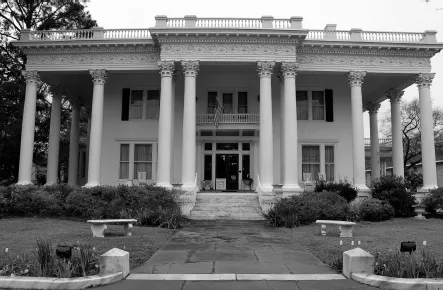
Front view of the Shorter Mansion. Courtesy Amanda Baird/BlackDoll Photography.
Then there is the lady in pink. While she is also in the habit of appearing in wedding pictures, she has surfaced in real life as well. While a tour was going on in the Shorter Mansion, one of the staff was talking with a woman in the parlor. At least, she was talking. The other woman never said a word, merely nodding her head at appropriate times. The staff member turned away for but a moment, and when she looked back, the woman had simply vanished.
Shorter Mansion is definitely an ode to the past, both living and dead.
Fendall Hall
When Edward and Anna Young arrived in Eufaula in 1837, they came to a town that was in the midst of the cotton boom that swept through the South in the prewar era. They were the owners of slaves, and they drew their wealth from the efforts of those in chains. In fact, Fendall Hall was not named such until the middle of the twentieth century. Until that time, it was known simply as the “house on the hill.” Perhaps, then, it is appropriate that the family completed the gorgeous Italianate mansion in 1860, on the eve of the Civil War. It would play its part in that war, used as a temporary hospital for men wounded in the fighting that led to the burning of Atlanta.
But despite the losses and depravations caused by the war, the Young family managed to hang on to the home all the way until the 1970s, when it was finally purchased by the Alabama Historical Commission. Today, the house serves the people of Eufaula, giving back to the descendants of many of the people who built it. And depending on whom you believe, it also serves as a home for the deceased.
It is said by some that Fendall Hall never feels empty. Doors open and close, cold spots are frequently felt and apparitions appear and disappear at random. Some have seen a young woman running toward the house, only to vanish when she reaches the door. Others report a young boy who watches guests in the foyer from the upstairs banister. And while most of the visitors to Fendall are not bothered by the presence at the house, others feel quite differently about it. There are some who report a sense of being unwanted, as if whoever remains behind is displeased with the disturbance.
The caretakers of Fendall Hall have attempted to research the history of the home in the hopes of better understanding the source of these spirits. So far, their efforts have failed. Whatever goes on at Fendall Hall truly is a mystery.
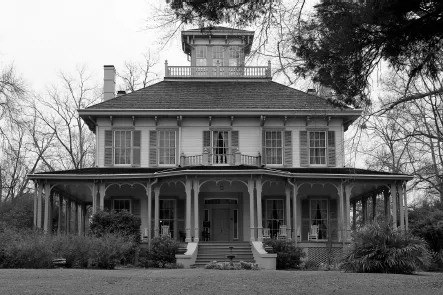
Front view of Fendall Hall. Courtesy Amanda Baird/BlackDoll Photography.
BULLOCK COUNTY
Bullock County is named for Colonel Edward C. Bullock—the primogenitor of actress Sandra Bullock—who left Barbour County to settle the land to its northwest. Union Springs, the sort of idyllic place one expects to find in the small-town South, serves as its county seat. It boasts one of the oldest jails in the state and a 150-year old hotel, the Josephine. A passer-through no doubt leaves Union Springs enchanted, with no notion of the dark mysteries bubbling just below the surface.
Bullock County Courthouse
The Bullock County Courthouse simply looks like it should be haunted. Its two towers of red brick loom over a colonnaded central structure that seems to brood over visitors, daring them to stay awhile. Within hangs the faded photo of a Civil War soldier, his eyes watching you every step you take. That photo alone has unnerved generations of those who work within the courthouse doors, to the point that one former sheriff had the old portrait covered up. The elevators go up and down with no cause or explanation, and more than once, the footsteps or whispered words of disembodied voices have floated down the halls to greet the ears of someone supposedly alone.
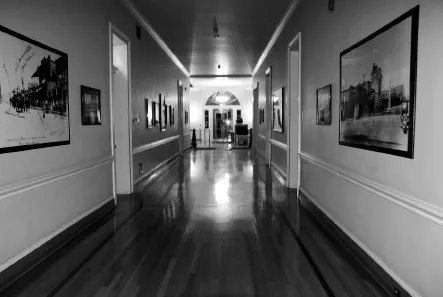
Hallway of Bullock County Courthouse. Courtesy Faith Serafin.
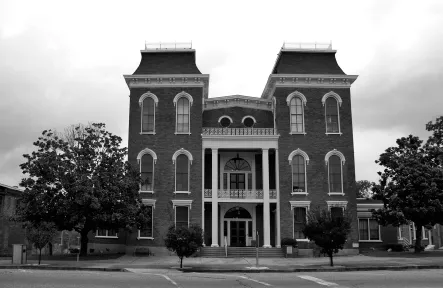
Front view of Bullock County Courthouse. Courtesy Faith Serafin.
The courthouse was built in 1871, its designers placing it in an idyllic setting, surrounded by a park and gazebo. It is patterned after an executive office in Washington, D.C., although no one can ever agree on which one. But whatever the case, cameras rarely work in the Bullock County Courthouse, and when they do, the pictures are often oddly blurred and indistinct. Batteries drain within the confines of the building, and an uneasy feeling seems to hang over the courtroom itself.
What happened here to cause these bizarre occurrences? Did someone die here? Did a trial end in an unjust conviction? Like so many questions that remain about the haunted places of the earth, we simply do not know.
Pauly Jail
While the Bullock County Courthouse was designed to be a beautiful and imposing building, the Pauly Jail was constructed with more practical considerations in mind. Finished in 1897, the jail is one of the oldest in the state, if not the oldest. The jail is of an interesting design. It is a three-story, red brick structure that—with its spikes and turrets—reminds one more of a castle than a place of incarceration. Today, the jail serves as a museum of sorts to the facility’s primary goal in the days of its operation: combating the persistent and pervasive moonshine industry in the forests around the city.
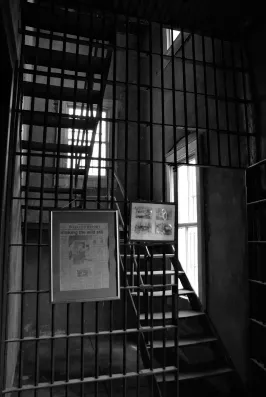
Pauly Jail ground floor. Courtesy Faith Serafin.
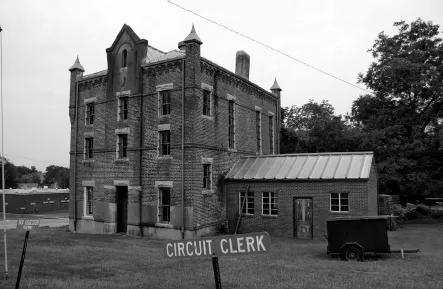
Front view of Pauly Jail. Courtesy Faith Serafin.
The second floor of the jail features a trapdoor. One might wonder why, until you realize that it was in this place where the men...
Table of contents
- Front Cover
- Title Page
- Copyright
- Dedication
- Contents
- Acknowledgements
- Introduction
- Prologue: Kathryn Tucker Windham House
- Part I. Eastern Black Belt
- Part II. Central Black Belt
- Part III. Western Black Belt
- Sources and Interviews
- About the Authors
Trusted by 375,005 students
Access to over 1.5 million titles for a fair monthly price.
Study more efficiently using our study tools.
Frequently asked questions
Yes, you can cancel anytime from the Subscription tab in your account settings on the Perlego website. Your subscription will stay active until the end of your current billing period. Learn how to cancel your subscription
No, books cannot be downloaded as external files, such as PDFs, for use outside of Perlego. However, you can download books within the Perlego app for offline reading on mobile or tablet. Learn how to download books offline
Perlego offers two plans: Essential and Complete
- Essential is ideal for learners and professionals who enjoy exploring a wide range of subjects. Access the Essential Library with 800,000+ trusted titles and best-sellers across business, personal growth, and the humanities. Includes unlimited reading time and Standard Read Aloud voice.
- Complete: Perfect for advanced learners and researchers needing full, unrestricted access. Unlock 1.5M+ books across hundreds of subjects, including academic and specialized titles. The Complete Plan also includes advanced features like Premium Read Aloud and Research Assistant.
We are an online textbook subscription service, where you can get access to an entire online library for less than the price of a single book per month. With over 1.5 million books across 990+ topics, we’ve got you covered! Learn about our mission
Look out for the read-aloud symbol on your next book to see if you can listen to it. The read-aloud tool reads text aloud for you, highlighting the text as it is being read. You can pause it, speed it up and slow it down. Learn more about Read Aloud
Yes! You can use the Perlego app on both iOS and Android devices to read anytime, anywhere — even offline. Perfect for commutes or when you’re on the go.
Please note we cannot support devices running on iOS 13 and Android 7 or earlier. Learn more about using the app
Please note we cannot support devices running on iOS 13 and Android 7 or earlier. Learn more about using the app
Yes, you can access Haunted Alabama Black Belt by David Higdon,Brett Talley in PDF and/or ePUB format, as well as other popular books in History & North American History. We have over 1.5 million books available in our catalogue for you to explore.