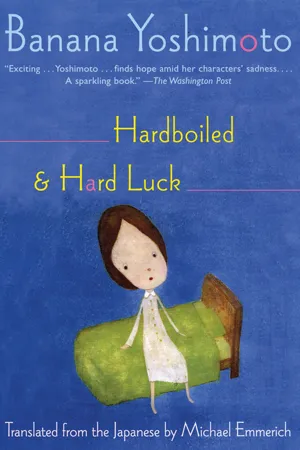
A pair of thematically linked novellas from the acclaimed author of
Lizard,
Amrita, and
Goodbye Tsugumi.
In cherished novels such as
Kitchen and
Goodbye Tsugumi, Banana Yoshimoto's warm, witty, and heartfelt depictions of the lives of young Japanese have earned her international acclaim and bestseller status. Her insightful, spare vision returns in two novellas possessed by the ghosts of love found and lost. In
Hardboiled, the unnamed narrator is hiking in the mountains on an anniversary she has forgotten about, the anniversary of her ex-lover's death. As she nears her hotel—stopping on the way at a hillside shrine and a strange soba shop—a sense of haunting falls over her. Perhaps these eerie events will help her make peace with her loss.
Hard Luck is about another young woman, whose sister is dying and lies in a coma. Kuni's fiancé left her after the accident, but his brother Sakai continues to visit, and the two of them gradually grow closer as they make peace with the impending loss of their loved one. Yoshimoto's voice is clear, assured, and deeply moving, displaying again why she is one of Japan's, and the world's, most beloved writers.
"A sparkling book." —
The Washington Post
- 149 pages
- English
- ePUB (mobile friendly)
- Available on iOS & Android
eBook - ePub
Hardboiled & Hard Luck
About this book
Information
Topic
LetteraturaSubtopic
Letteratura generale1
November
For the first time in ages, my mom wasn’t at the hospital when I arrived.
Sakai was there all alone; he sat at my sister’s bedside, reading a book.
Kuni had all sorts of tubes hooked up to her body, just as she did every day. The awful sound of the respirator filled the quiet space.
I was used to this scene by now, though from time to time I would still see it in my dreams, and somehow the shock I felt on waking was much worse than what I experienced when she was actually lying there before me.
I always felt much deeper emotions when I visited her sickroom in my dreams. In real life, in the train on the way there, I could sense that I was readying myself, little by little. The emotions I would have when I saw her lying there, when I felt her skin, were slowly being pieced together. It was different in dreams. In my dreams, Kuni still talked and walked just like she used to. And yet even in those dreams, I knew it wasn’t true. The image of her room in the hospital was always there, somewhere, waiting for me. That scene was always in the back of my mind, always; and so over time the distinction between wakefulness and sleep had faded. No matter where I was, I always felt that something inside me was stretched to the limit, and there was no relief. From the outside, though, I must have seemed very calm. Because as autumn deepened, my face grew less and less expressive, and the tears I cried fell on their own, automatically.
Already a month had passed since my sister had suffered a cerebral hemorrhage. It happened after she stayed up several nights in a row preparing a manual for the person who was going to take over her job when she quit to get married. One cerebral hemisphere was seriously damaged, and the resulting edema put pressure on her brain stem, so that it slowly ceased to function. In the beginning she could still breathe on her own, if only faintly, but eventually her respiratory functions gave out. For the first time, I realized that living on as a vegetable isn’t the worst thing that can happen to the comatose. Slowly but surely, my sister’s brain was dying.
Recently my whole family had started studying up on these things, and we had learned that my sister could no longer even be called a vegetable—not even that slim ray of hope was left. Just one week ago, we had been informed that her brain stem was functioning at such a low level that her body was only being kept alive by the respirator. My mother had been planning to keep her alive for years, if necessary, as long as she was a vegetable, but now that wouldn’t be possible. All we could do was wait for the doctors to declare her officially brain-dead and take her off the respirator.
Slowly everyone in my family came to understand that no miracle would occur, and after that life became somewhat easier. In the beginning, because we had no knowledge to fall back on, we were hounded, again and again, by all sorts of ideas. We lived for a time in a kind of concentrated hell from which there was hardly any escape, torn between everything from superstition and science to our own heartfelt prayers to the gods; we even tried to make out the things Kuni said in our dreams. Then, once we had emerged, sort of, from that agonizing period in which we were constantly assaulted on all sides by conflicting hopes, we calmed down a little and made up our minds to do everything we could to keep my sister comfortable, and not to think or do anything she wouldn’t like. By then, we knew that Kuni wouldn’t be coming back—and it wasn’t just a matter of logic anymore, we could see with our own eyes that it was true. Though when we felt the warmth of her hands or saw that her nails were still growing, or when we heard her forced breathing or the beating of her heart, we couldn’t help imagining that something wonderful might happen.
That strange period we all lived through before my sister finally departed from this world forced us all to do a lot of thinking.
That very morning, the day I went to the hospital and found my mother absent, I’d started filling out paperwork again to go and study in Italy—a trip I had been forced to postpone and had been thinking of abandoning all together, depending on how things went with Kuni. We were starting to go on with our lives. Even if every sight that met our eyes was still alive with secret shadows of my sister.
The only one who didn’t seem particularly troubled was Sakai, the older brother of Kuni’s fiancé. My sister’s fiancé had been so traumatized by the terrible thing that had happened to her that he had gone to stay with his mother. As a student in dental school, he knew very well that there was no longer any hope of a recovery now that Kuni’s brain stem had stopped functioning. My parents had made a formal request that the engagement be broken off, and the day before he had agreed.
Sakai came to the hospital pretty often, even though none of this had much to do with him—he happened to live in Tokyo, so he said he would like to come if that was OK with us. My family was pretty harsh with him in the beginning because we assumed he was only coming because he was ashamed of the way his useless younger brother was acting. This didn’t seem to be the case, though: he came regularly and sometimes tried to hit on the nurses. It didn’t seem to have taken very long for him to get used to this devastating state of affairs. I couldn’t figure him out.
His life was shrouded in mystery, though my sister had told me at some point that he and his brother had had a hard life. Their father died of some terminal illness, leaving their mother to raise them by herself, working all the while as head nurse in a local hospital. That, as far as I can recall, was the story my sister told me.
Whenever I remembered the time when my sister could still talk, I felt as if there were some sort of membrane around me. My sister had a thin, high-pitched voice, and she talked a lot. When we were kids, we were always dragging our futons into each other’s rooms, then talking together until dawn. We swore in the most adorable way that when we grew up, one of us would have to install a skylight in her house so that we could gaze up at the stars while we talked. In our minds, the glass skylight gleamed, shiny and black, and the stars glittered like diamonds, and the air was clear. In that future room, there would be no end to the topics we wanted to discuss, and morning would never come.
My sister was always so cute—there was something about her that reminded you of a fairy tale—but when love was involved she became one very fierce woman, just the opposite of me. When she was a teenager, she was so into her boyfriend that she kept saying she was going to have his initial tattooed on her arm.
“I think it’s a bad idea,” I told her. “It’ll narrow your range of options, right? You won’t be able to date anyone later on unless they have the same initial.”
“What are you talking about?”
“I mean, say you get a tattoo of the letter N for Nakazawa. It won’t make any sense if you date someone with no N in his name. What happens then? Sure, it’ll be just fine if you happen to end up with another N, but what if you fall in love with someone without any Ns? You won’t be able to explain it.”
“I don’t see why you’re thinking about these things. None of that is relevant! I’ll never go out with anyone else! I mean, isn’t it romantic to marry the first guy you ever date? I’m pretty sure it’s going to work out, you know.”
“It’s never going to happen. Forget the tattoo.”
We enjoyed these silly, late-night conversations, and we had them all the time. Back then our imaginations were so vibrant that, even in the absence of a skylight, we could sense how full of stars the sky was.
At first, the membrane I felt around me when I thought of Kuni would dissolve when I cried, washed away by the hot stream of my tears. But now I had stopped crying. That’s how hard I was struggling, body and soul, to accept the situation. I remained enclosed in that membrane—the sense of my sister’s absent presence—all the time.
“Where’s my mom?” I asked Sakai.
I had left home to live on my own, and now I was in graduate school studying Italian literature. During the past several weeks I had suddenly started doing a lot of part time work, because it occurred to me, after my sister was hospitalized and the possibility arose that she might end up as a vegetable, that I might not be able to rely on my parents for money anymore. I also needed a way to distract myself. My days passed in a cycle of trips to the hospital, time spent with my sister, all-night jobs at bars, going to school, taking naps . . . and I was hardly eating at all. As a result, I learned that all you have to do is change your daily routine, and you start to accumulate an amazing amount of money. It began to seem as if I might even save up enough to cover the cost of my studies in Italy.
With all that going on, I hardly ever went back to my parents’ house anymore, though I did keep going to the hospital. I talked to my mother on the phone every day, in addition to seeing her at the hospital. But even so, I couldn’t even imagine the depth of her pain. She looked as if she might have some kind of attack herself. Whenever I went to the hospital, she was always there in my sister’s room, reading a magazine, washing my sister’s thin body, moving her around to prevent bedsores, or talking earnestly with a nurse. Externally she seemed very calm, but you just had to be standing nearby to sense the storm that was raging inside her.
“She said she had a cold or something,” Sakai replied.
I found it easy to talk to Sakai, and I generally used informal speech with him, as if he were a close friend my own age, though in fact he was already past forty.
And he had an unusual job. He was a master in a particular school of tai chi with a center of his own where he taught its philosophy and practice. He was the only person I knew who had such a weird occupation. But he had written a book, and he did have students, and I had even heard of people coming from abroad to study with him. Until recently, I hadn’t even realized that people could make something like that into a successful business.
I liked Sakai. I had liked him ever since I first set eyes on him. His unusually long hair, the strange sparkle in his eyes, the difficulty of what he taught, and the unexpected ways he reacted to things—his whole air branded him as an eccentric.
I’ve always had a soft spot for wackos and oddballs—in fact, my very first love was TŌru, “the boy who swallowed a tadpole in front of everyone”—and Sakai was certainly peculiar enough to intrigue me. Maybe that was why my sister had tried so hard to keep us apart. She was a sharp woman who knew my character well, so she found a way to prevent anything from developing between us. She must have worried a lot, because it really was very hard to know what to make of him. We met for the first time only after my sister was hospitalized.
I was so thoroughly exhausted the first time he came to visit that I was feeling a bit high, and the moment I saw him I thought, Wow, this guy is awesome! But since I was so preoccupied with my sister’s sickness, I suppressed the feeling. I have always found it relatively easy to keep my emotions in check. I stop being able to savor, even in the secret recesses of my own mind, the ache I feel, and my heart stops dancing when we talk—I convince myself that I never felt anything at all. Kuni always used to say that if I was able to do that, I couldn’t really be very deeply in love. When you’re in love, she once said, it really hurts, it aches, and you can’t suppress it, you want to see it through to the end even if it means that someone has to die, and so you end up causing a whole lot of trouble for everyone. Judging from the tenor of her comments, I would guess that she was having an affair with someone, probably a married man, at the time.
I used to look at Kuni, envious of the fun she was having. Would she still urge me to fall in love, I thought, even if she was the one who was dying? I always told her that she didn’t know what she was talking about, she just fell in love too easily, that was all. Who knows, I said, maybe I’m actually more passionat...
Table of contents
- Cover
- Half Title
- Also by Banana Yoshimoto
- Title
- Copyright
- Contents
- Hardboiled
- Hard Luck
- 1. November
- 2. Stars
- 3. Music
Trusted by 375,005 students
Access to over 1.5 million titles for a fair monthly price.
Study more efficiently using our study tools.
Frequently asked questions
Yes, you can cancel anytime from the Subscription tab in your account settings on the Perlego website. Your subscription will stay active until the end of your current billing period. Learn how to cancel your subscription
No, books cannot be downloaded as external files, such as PDFs, for use outside of Perlego. However, you can download books within the Perlego app for offline reading on mobile or tablet. Learn how to download books offline
Perlego offers two plans: Essential and Complete
- Essential is ideal for learners and professionals who enjoy exploring a wide range of subjects. Access the Essential Library with 800,000+ trusted titles and best-sellers across business, personal growth, and the humanities. Includes unlimited reading time and Standard Read Aloud voice.
- Complete: Perfect for advanced learners and researchers needing full, unrestricted access. Unlock 1.5M+ books across hundreds of subjects, including academic and specialized titles. The Complete Plan also includes advanced features like Premium Read Aloud and Research Assistant.
We are an online textbook subscription service, where you can get access to an entire online library for less than the price of a single book per month. With over 1.5 million books across 990+ topics, we’ve got you covered! Learn about our mission
Look out for the read-aloud symbol on your next book to see if you can listen to it. The read-aloud tool reads text aloud for you, highlighting the text as it is being read. You can pause it, speed it up and slow it down. Learn more about Read Aloud
Yes! You can use the Perlego app on both iOS and Android devices to read anytime, anywhere — even offline. Perfect for commutes or when you’re on the go.
Please note we cannot support devices running on iOS 13 and Android 7 or earlier. Learn more about using the app
Please note we cannot support devices running on iOS 13 and Android 7 or earlier. Learn more about using the app
Yes, you can access Hardboiled & Hard Luck by Banana Yoshimoto, Michael Emmerich in PDF and/or ePUB format, as well as other popular books in Letteratura & Letteratura generale. We have over 1.5 million books available in our catalogue for you to explore.