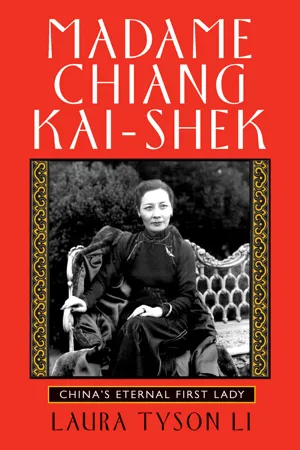
The first biography of one of the most controversial and fascinating women of the twentieth century.
Beautiful, brilliant, and captivating, Madame Chiang Kai-shek seized unprecedented power during China's long and violent civil war. She passionately argued against Chinese Communism in the international arena and influenced decades of Sino-American relations and modern Chinese history. Raised in one of China's most powerful families and educated at Wellesley College, Soong Mayling went on to become wife, chief adviser, interpreter, and propagandist to Nationalist leader Generalissimo Chiang Kai-shek. She sparred with international leaders like Churchill and Roosevelt, and impressed Westerners and Chinese alike with her acumen, charm, and glamour. But she was also decried as a manipulative Dragon Lady," and despised for living in American-style splendor while Chinese citizens suffered under her husband's brutal oppression. The result of years of extensive research in the United States and abroad, and written with access to previously classified CIA and diplomatic files,
Madame Chiang Kai-shek objectively evaluates one of the most powerful and fascinating women of the twentieth century.
"Li brilliantly analyzes a fearless and profoundly conflicted woman of extraordinary force." —
Booklist
- 557 pages
- English
- ePUB (mobile friendly)
- Available on iOS & Android
eBook - ePub
About this book
Information
Chapter One
Little Lantern
John Stuart Mill once wrote that no one could properly say what is natural to woman till she has been long enough emancipated to show her true instinct and character. . . . The same may be quite as truthfully predicated of the Chinaman.
—James Harrison Wilson, 1901
Mayling Soong was born in about 1898, at the cusp of the twentieth century, the fourth of six children and the youngest of three daughters in a family destined to play an extraordinary and unheralded role in the history of modern China. Her sister Eling was the eldest, followed by another sister, Ching Ling. Next came brother T. V., then Mayling. Brother T. L. would follow a year or so later, and youngest brother T. A. several years after that.
The milieu was Shanghai, that fabled “sink of iniquity” of the “Orient,” where the “natives” lived in medieval ghettos in a colony built and run by foreigners in the image of the cities they came from. Nestled near the confluence of the Huangpu River and the East China Sea, Shanghai had been a foreign colony for nearly half a century. France controlled its French Concession and the International Settlement was administered by a council made up of nationals from several countries including England, Germany, and the United States. Vibrant, prosperous, and cosmopolitan, Shanghai’s foreign enclaves were a world apart from the rest of China, which was virtually sealed off. The wealth and comfort of the Shanghai elite contrasted sharply with the abject poverty and suffering of hundreds of millions of ordinary Chinese across China and even in Shanghai, who lived as they had for millennia. Vast numbers of Chinese of all classes were addicted to opium. The weak and corrupt Qing dynasty imperial government in Beijing was powerless to stop the opium trade, which was orchestrated by British merchants with the profitable collusion of Qing officials. While Shanghai’s foreign enclaves had all the luxuries of a “higher and a better civilization,” in the words of one contemporary Western observer, its ancient walled Chinese city, with its “sordid multitudes,” was “inconceivably squalid … and fills the foreign soul with a sentiment of unutterable disgust.”
The Soong family did not live in the Chinese ghetto. Its sights and smells were as unfamiliar and deplorable to them as they were to Shanghai’s well-heeled foreign residents. Neither did the Soongs live in the International Settlement or the French Concession, as did many Chinese of both low and high estate—the latter, by virtue of their wealth and social connections, being considered something akin to honorary foreigners. By 1896 Charles Soong had built a house for his growing family in the suburb of Hongkew, once known as the American Settlement. It was located on the north bank of the Soochow Creek, across from the International Settlement, the commercial heart of the city.
At the time Hongkew was far out in the country, and family friends thought Soong eccentric for choosing to live there. Eventually the area was overtaken by urban sprawl, but when Mayling was a girl the house was surrounded by green fields stretching for miles. Date palms grew in the garden and a stream ran beyond the wall that enclosed the front yard. The Soong children quickly learned to scale the wall and gadded about climbing trees and otherwise disturbing nearby farmers, whom the children’s indulgent father mollified with coins rather than restrict his playful children to the garden.
Charles Soong had spent many years of his youth in America, where he studied theology at Vanderbilt University before returning to China as a missionary for the Methodist Church. When he built his own house it was a hybrid of traditional Chinese and American antebellum architectural styles. Amid the Chinese flourishes were occidental comforts to which he had grown accustomed during his sojourn in America, including running water, gas heating, and kerosene light. Behind the house was a large vegetable garden that Soong tended himself, shocking status-conscious acquaintances as further evidence of his American eccentricities.
In temperament, Charles Soong was extremely frank, outspoken, and impatient. He insisted on punctuality and did not hesitate to chastise those who possessed “Oriental” notions of time. His directness often offended people. Once he made a decision, he did not waver. His wife, Ni Guizhen, whom Charles called “Mamie,” had similarly strong determination and convictions, but she possessed the virtue of patience and spoke only after careful consideration. The Soongs’ aim was to make their children cultured, self-reliant, and useful. They were not sentimental parents and from an early age the Soong children were trained not to show emotion. Mayling grew up ashamed to admit fear and rarely wept.
Charles had a fine singing voice and taught his children hymns and other songs he had learned in the American South, including spirituals, Stephen Foster ballads, and, of course, that anthem of the South, “Dixie.” His wife loved music too and was one of the first Chinese women to learn to play the piano. Eling, her father’s favorite, showed the most talent, but the other siblings enjoyed singing too.
Despite a preference for things American, Soong wanted his children to have a semblance of a classical Chinese education. He engaged for them the same tutor who had coached him in the mysteries of the unfamiliar Shanghainese dialect, who also helped him to catch up on some of the Chinese schooling he had missed in his peripatetic boyhood. Like Soong, Dzau Tsz-zeh was a preacher returned from America, and was best known by his Anglicized name, C. K. “Charlie” Marshall. After fourteen years in America, Marshall had acquired a pronounced Deep South accent.
When Soong studied with Marshall, they resorted to English for explanations, as it was their common language. Soong hailed from the South China island of Hainan, where the dialect was unintelligible to the Shanghainese. Marshall’s colorful trench English was a far cry from Soong’s gentlemanly version, and irritated Soong so much that what were supposed to be Chinese lessons often became debating matches over the finer points of the English language. Once, Marshall lost his temper: “You, you upstart, you!” he cried. “Why you come pesterin’ me wid dat Yankee talk. I bin talking English ’fo you was ever born. Now go ’way and leave me ’lone.” Under Marshall’s tutelage the Soong children learned the rudiments of Chinese characters and a smattering of the classics, but were spared the years of rigorous drills and rote learning to which students of traditional Chinese schools were typically subjected.
The children’s spiritual education was of course not neglected. Mother Soong was the guiding moral influence in the home and she became more devout with each passing year. One of Mayling’s earliest memories is of her mother going to a special room on the third floor of the house to pray. She would spend hours in prayer, often beginning before dawn. Whenever Mayling or her siblings asked for advice about anything, she would say, “I must ask God first.” She could not be rushed into an answer. For Mother Soong, this was not a perfunctory affair; it meant “waiting upon God until she felt his leading.” As a young woman Mayling thought her mother excessively pious.
The Soongs kept a Christian home in the best Southern Methodist tradition, veering toward puritanical. In addition to attending church services and Sunday school each Sabbath, they held daily family devotions. Mayling hated having to sit through long and tedious sermons while her friends played, and subtly rebelled during Bible readings. “It must often have grieved my beloved mother that I found family prayers tiresome and frequently found myself conveniently thirsty … so that I had to slip out of the room,” Mayling later wrote. The family’s habits were also a model of Christian propriety. There was no alcohol in the Soong household, and card games and dancing were forbidden. On Sundays, no games whatsoever were allowed.
Despite her early distaste for prayers and sermons, the religious environment in which Mayling was raised had a profound influence on her life and her values. Similarly, her education set her apart from her peers. In an era when Chinese parents bound the feet of their daughters, kept them cloistered at home, and, if the family was poor, sold them as slaves or even abandoned them at birth, the Soongs were an anomaly. They were unusual even among the Chinese elite of Shanghai in that they treated their daughters and sons the same, and made certain that the girls received the best education available to women at the time. In this respect the family was advanced even by the standards of the West, where “female education,” apart from the domestic arts and perhaps a smattering of French, drawing, and piano, was still a controversial notion.
In any event, traditional Chinese schools—which were at that time private, as there was no public school system—did not accept girls. The first government-run girls’ primary schools were not established until 1907. It was the nineteenth-century foreign missionaries who had led the crusade for education of girls in China. Chinese generally held that anything more than a rudimentary education for girls was unnecessary and even unwise. But the foreign missionaries were convinced that educating native missionaries, women as well as men, was imperative not only for spreading the gospel, but for transforming the Chinese family and ultimately the nation. China’s very salvation, they believed, hinged upon the elevation of women. “The degrading systems of the East are based mainly on the condition of women,” argued Young John Allen, an American missionary known as the “great Mandarin of the Methodists” in nineteenth-century China.
As was true for the missionaries themselves, the very presence of mission schools for girls was subversive, even dangerous, for they threatened the patriarchal order upon which Chinese society and government were predicated. They posed a direct challenge to Confucianism, the all-encompassing moral, political, and family code of Chinese society and the justification for not only the scholar aristocracy but the imperial dynasty itself. The perpetuation of the Confucian hierarchy depended on the subservience of women, which in turn required that women remain ignorant. Paradoxically, although the mission schools reached just a tiny portion of the Chinese people, and converts to Christianity were still fewer, it would be difficult to overestimate their impact on the history of modern China. Although they failed miserably in achieving their goal—winning souls for Christ—they were in great measure responsible for many of the changes that China underwent in the late nineteenth and early twentieth centuries. The missionaries and their schools nurtured generations of Chinese patriots and reformers, fueling the rise of nationalism and ultimately helping to bring about the “great revolution.”
Mayling’s mother was among the first Chinese girls to receive an education, studying at a mission school until she married at the age of eighteen. There she cultivated a passion for learning as well as prayer. She excelled at mathematics, especially trigonometry. Such was her devotion to intellectual matters that she continued to study religion, mathematics, and language until the end of her life. She enjoyed puzzles and studied English, Chinese, and Japanese. Until the age of sixty she paid a scholar to hold stimulating discussions with her.
By the early twentieth century, Chinese reformers were arguing that the education of Chinese women was vital for building a strong and independent China. The Soong girls were sent to Methodist-run McTyeire, the most fashionable girls’ school in all Shanghai. Young John Allen founded McTyeire in 1892 to impart what was called the “gospel of gentility” to the fee-paying daughters of the Chinese elite. The school offered nontraditional female role models in its unmarried, well-educated, and strong-willed missionary teachers, who nonetheless were grooming their charges to be the “idealized vision of the good Christian wife, mother and helper” and a model for Chinese women. Mayling went when she was five, attending kindergarten and staying with Ching Ling in the dormitory. She was devoted to her big sister and often prepared tea for Ching Ling and her friends. Mayling appeared fearless, but after a time one of the teachers discovered that she was waking up at night in fits of trembling. She was experiencing nightmares and having trouble sleeping, and was sent back home to be tutored.
Mother Soong often dressed Mayling in her older brother T. V.’s cast-off clothes. The little girl was so round that they nicknamed her “Little Lantern.” During their childhood years Mayling developed deep affection for her eldest sister, Eling, who often defended and protected her against bullies. The feeling Mayling held for Eling bordered on hero worship and would endure throughout their lives. The two sisters were always the closest among all the Soong siblings. The older children in the neighborhood liked to tease and play tricks on Mayling. She begged them to let her join their games. One day they made her “it” in a game of hide-and-seek. She covered her eyes and attempted to count to a hundred. When she uncovered her eyes, not a child was to be found. When she realized they had abandoned her, she began to cry. Eling came to her rescue, comforting her and wiping her eyes. And so it would be always.
Chapter Two
Revelation to Revolution
They have borne the light of Western civilization into every nook and corner of the empire … The awakening of China may be traced in no small measure to the work of the missionaries.
—His Excellency Tuan Fang,
an emissary sent by the Empress Dowager Tzu Hsi
to study American institutions, 1906
an emissary sent by the Empress Dowager Tzu Hsi
to study American institutions, 1906
The story of Charles Jones Soong begins much like those of millions of other Chinese who over the last several centuries left China to seek their fortune, fanning out across the globe. But for a quirk of fate, he would have been just one among the multitude toiling away a lifetime unsung and largely unseen in the Chinese diaspora. Part Cinderella, part American dream, the story of the founder of China’s fabled “Soong dynasty” inspired generations of churchgoing Americans and the dedicated China missionaries they supported with their nickels and dimes when the collection plate was passed around every Sunday in churches across America. It made them believe, passionately and absolutely, in the notion that China could and would become a Christian country, and that it was their spiritual and moral duty to lead a crusade for the souls of the Chinese people.
Charles Soong was born on Hainan, an island off the southern coast of China, in 1861. He was the second son of three and had one sister. His family lived in a tiny village called Guluyuan in Wenchang county. The family name was Han, not Soong, which he adopted later, together with the English name Charles. The Han family was of Hakka ancestry. In a country in which one’s provincial background is paramount, the Hakka are the only Chinese without a geographical home base. The word “Hakka” literally means “guest families,” and throughout Chinese history Hakka have migrated across China or overseas, forced to the margins of society and onto poorer lands. Speaking a distinct dialect, and by repute clannish, stubborn, and shrewd, they have been loosely compared with the gypsies and the Jews of Europe.
Chinese of Hakka blood have become leaders—among them Lee Kuan Yew, the founder of modern Singapore; China’s late leader Deng Xiaoping; and Taiwan’s former president Lee Teng-hui. The Hakka have historically been regarded with suspicion by authorities in China, as many revolts were fomented by disgruntled Hakka. The most notorious was the bloody Taiping Rebellion, launched in 1851 by Hong Xiuquan, a Christian convert who...
Table of contents
- Cover Page
- Preface
- Title Page
- Copyright Page
- Dedication
- Contents
- Acknowledgments
- Notes on Chinese Romanization
- Prologue
- Part I
- Part II
- Part III
- Part IV
- Epilogue
- Notes
- Bibliography
- Index
Trusted by 375,005 students
Access to over 1.5 million titles for a fair monthly price.
Study more efficiently using our study tools.
Frequently asked questions
Yes, you can cancel anytime from the Subscription tab in your account settings on the Perlego website. Your subscription will stay active until the end of your current billing period. Learn how to cancel your subscription
No, books cannot be downloaded as external files, such as PDFs, for use outside of Perlego. However, you can download books within the Perlego app for offline reading on mobile or tablet. Learn how to download books offline
Perlego offers two plans: Essential and Complete
- Essential is ideal for learners and professionals who enjoy exploring a wide range of subjects. Access the Essential Library with 800,000+ trusted titles and best-sellers across business, personal growth, and the humanities. Includes unlimited reading time and Standard Read Aloud voice.
- Complete: Perfect for advanced learners and researchers needing full, unrestricted access. Unlock 1.5M+ books across hundreds of subjects, including academic and specialized titles. The Complete Plan also includes advanced features like Premium Read Aloud and Research Assistant.
We are an online textbook subscription service, where you can get access to an entire online library for less than the price of a single book per month. With over 1.5 million books across 990+ topics, we’ve got you covered! Learn about our mission
Look out for the read-aloud symbol on your next book to see if you can listen to it. The read-aloud tool reads text aloud for you, highlighting the text as it is being read. You can pause it, speed it up and slow it down. Learn more about Read Aloud
Yes! You can use the Perlego app on both iOS and Android devices to read anytime, anywhere — even offline. Perfect for commutes or when you’re on the go.
Please note we cannot support devices running on iOS 13 and Android 7 or earlier. Learn more about using the app
Please note we cannot support devices running on iOS 13 and Android 7 or earlier. Learn more about using the app
Yes, you can access Madame Chiang Kai-shek by Laura Tyson Li in PDF and/or ePUB format, as well as other popular books in Politics & International Relations & Political Biographies. We have over 1.5 million books available in our catalogue for you to explore.