"The longtime chronicler of Michigan's Upper Peninsula . . . gives eloquent expression to death and the grieving process." —
Booklist
Hailed by
The New York Times Book Review as "a master . . . who makes the ordinary extraordinary, the unnamable unforgettable," beloved author Jim Harrison returns with a masterpiece—a tender, profound, and magnificent novel about life, death, and finding redemption in unlikely places. Donald is a middle-aged Chippewa-Finnish man slowly dying of Lou Gehrig's Disease. His condition deteriorating, he realizes no one will be able to pass on to his children their family history once he is gone. He begins dictating to his wife, Cynthia, stories he has never shared with anyone as around him, his family struggles to lay him to rest with the same dignity with which he has lived. Over the course of the year following Donald's death, his daughter begins studying Chippewa ideas of death for clues about her father's religion, while Cynthia, bereft of the family she created to escape the malevolent influence of her own father, finds that redeeming the past is not a lost cause.
Returning to Earth is a deeply moving book about origins and endings, making sense of loss, and living with honor for the dead. It is among the finest novels of Harrison's long, storied career, and confirms his standing as one of the most important American writers.
"A deeply felt meditation on life and death, nature and God, this is one of Harrison's finest works." —
Library Journal
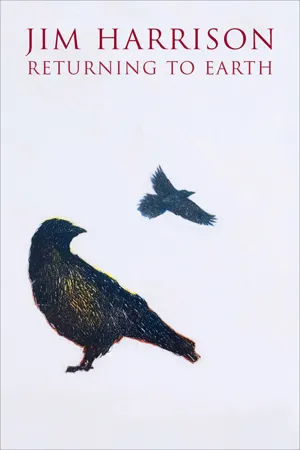
- 282 pages
- English
- ePUB (mobile friendly)
- Available on iOS & Android
eBook - ePub
Returning to Earth
About this book
Information
Part I
Donald
1995
I’m laying here talking to Cynthia because that’s about all I can do with my infirmity. We’re living in Cynthia’s old house in Marquette in order to be close to the doctors. Her brother David usually lives here but he’s off taking a look at different parts of the world but mostly Mexico. Cynthia and I ran away in our teens and got married and now she’s back where she started. My dad, Clarence, did the yard work for her family for about thirty years. My bed is in her father’s den because it’s too hard for me to get upstairs. One wall of the den is full of books with a moving ladder to get to the top shelves. Cynthia says her brother lives inside these books and never really got out. I’m forty-five and it seems I’m to leave the earth early but these things happen to people.
I don’t have the right language to keep up with my thinking or my memory or all of my emotions over being sick so I’m speaking this to Cynthia [I’m interfering as little as possible. Cynthia] because she wants our two children to know something about the history of their father’s family.
Starting a long time ago there have been three Clarences but when they got to me my father thought there hadn’t been all that much luck in the name so they called me Donald in honor of a young friend of his who died in a mining accident over near Ishpeming. The first Clarence, named after a Jesuit priest who was a missionary to Indians out in Minnesota, waited until he was fifty to father children because he wasn’t too sure about the world. He had tried to come east in 1871 because his mother had told him about the great forests of the Upper Peninsula. Some of her family had moved west to Minnesota from the U.P. because the white men were moving in for the copper up in the Keweenaw Peninsula. Her people were Chippewa (Anishinabe) but she slept with an immigrant who had come over to the Pipestone area of southwest Minnesota. This man was from the country of Iceland and a bunch of them had come over to farm that real good soil down that way. It was hard on Indians then because the Sioux had killed a bunch of farmers near New Ulm and the settlers were leery of any kind of Indian. So the first Clarence’s mother died when he was about twelve and he had never met his father in person. He was real big for his age and he ran off and worked for a farmer near Morris for a year but they made him sleep in the root cellar beneath their pump shed. He was a good worker and they didn’t want him to get away. They kept him locked down there a whole winter week for stealing a pie. Who is to say how angry a young man would get trapped in a root cellar for a week? By and by he got loose and walked down to Taunton near Minneota and found his father, whose name he had memorized, a farmer named Lagerquist. It was a Saturday morning when farmers come to town but the man was with a wife and two kids so that young Clarence wasn’t sure what to do. The story goes that the man came up to him and said, “What do you want, son?” Clarence was real glad the man recognized him. So Clarence said, “I’d like a horse to ride to Michigan if you can spare one?” The man got him a horse but it was a draft horse so it was slow going. That’s how the first Clarence started out for Michigan. It’s hard to think of a thirteen-year-old doing such a thing nowadays.
Here I am on the sofa at age forty-five and I have Lou Gehrig’s disease. [Donald has had amyotrophic lateral sclerosis for nearly a year now. His case is especially aggressive and it appears he will fall short of the three years of the disease that fifty percent of patients last. Cynthia.] I never knew much about Lou Gehrig though my dad, Clarence, used to talk about him. Gehrig played baseball, which I never had any time for because the coaches at Marquette decided they needed me for track where I could be counted on to win the 100, 220, and the shot put, though my true love was for football where I was the quarterback, and a linebacker on defense.
The children are both in California where Herald is taking advanced degrees at Caltech and Clare is an apprentice for wardrobe in the movie business. We talk on the phone to them for about an hour every Sunday.
You wonder how a girl from the Upper Peninsula could end up working on movies but that’s the way the world goes these days. Clare got this interest from her stepcousin Kenneth, who doesn’t like his name and just goes by the letter “K.” He’s Polly’s son and is a crazy bastard but I like him. Years ago K would ride his bicycle all the way two hundred miles from Marquette to Sault Ste. Marie for a visit. Herald is more like his uncle David. Mathematics is enough for Herald though he’s also interested in botany. He’s a big strong young man but finds people confusing. Herald and Clare have an apartment together in Los Angeles and look after each other like a brother and sister should. Why I say Herald takes after David is because when I read David’s rundown of what his family did in the Upper Peninsula for a hundred years I was puzzled. It was published in the Sault Ste. Marie newspaper among others and I was proud that a relative knew so much but there weren’t any real people in it. I like the stories with people myself. I mean he told the story of the bad details of the logging and mining his ancestors were involved in but not the actual story of the people who owned the logging companies and mines and the working people. I’m not being critical; I just prefer stories.
Of course I’ve got a foot in both worlds. My dad figured I’m over half Chippewa. In fact I’m due benefits from the tribe for my sickness but Cynthia has some money salted away and we figure tribal money should go to the folks who really need it.
Let’s go back to the first Clarence. I remember when I first heard the story from my dad when I was a kid and I worried about the hardship. Here was this boy only thirteen being kept in a root cellar who after he escapes sees his real father only half an hour and then he’s gone to the northeast riding a big draft horse toward a future. The story goes that he only had seven dollars and a letter that said the horse was his because he looked pretty Indian and people were liable to take the horse from him claiming it was stolen. I said all these worries to my dad and he said, “Life is real hard for some folks,” but then he added that riding off on that horse was likely a good feeling for his grandfather compared to losing his mother and being trapped in a root cellar. So maybe it wasn’t too bad to be him on a draft horse riding east. For instance I’m real sick right now but I’ve been able to live with it except for a few times when it got out of hand. Back in high school when I ran track or played football you were likely to get a cramp. With this disease at times you are a cramp, your whole body seizes up so that even your mind seems inside a cramp. You’re all cramp, pure and simple. That’s why K goes with me when I feel good enough to take a walk. I’m too big for anyone to carry but K can go for help.
When I was a kid of eight or nine years and first listened carefully to the story of the first Clarence I was upset when Dad said that he rode his horse through fields so wide out on the prairie that you couldn’t see across them. This fact upset me for a few weeks because I couldn’t imagine such a landscape. In most places in the Upper Peninsula you can’t see very far because of the thickness of the forest and that’s why it’s a relief to be in the hills along the coast of Lake Superior, where you can see a long ways. When I finally questioned my dad about these fields with no end to them he said they were something like Lake Superior, which you can’t see across to the other side in Canada. This all became clear to me when Cynthia and I took the kids on a camping trip out west years ago. Cynthia explained that in 1871 when Clarence began his trip there weren’t many trees in western Minnesota and the eastern Dakotas except for cotton-woods along the creeks and rivers. At that time the trees the settlers had planted hadn’t grown up much to speak of.
The upshot was that it took the original Clarence thirty-five years to reach the Marquette area, in 1906. His first try heading east frightened him because by late September in 1871 and early October every morning the sun rose red and the world was full of smoke. It had been a real dry season in the northern Midwest and there were fires everywhere, mostly the tops of trees and limbs left behind by logging. This was the year of the great Peshtigo fire in northeast Wisconsin that killed over a thousand people. Clarence heard from travelers that rivers boiled, and birds high in the air caught fire, and the wind everywhere was a hundred miles an hour, more than the worst November gales on Lake Superior.
So he turned around near Bad River and never saw the great uncut forests his mother had told him about. He had some bad luck and then some good luck. He was camped on the Red River north of Grand Forks and two outlaws tried to steal his horse. He threw them in the river and one drowned. He moved his camp north and one day a rich farmer up that way saw him riding the horse, which was a sorrel mare by the name of Sally. The farmer wanted to buy the horse and Clarence explained that the horse was all he had of his father and needed to keep it. The farmer hired Clarence to take care of his twelve teams of draft horses and work on his farm. Clarence got to live in a small log cabin, which was good after many months of camping and besides it was November and getting pretty cold that far north. The farm was so big that there was a cook to make food for the many hired hands so he got to eat regular. Snared rabbits, muskrat, and beaver can be pretty tasty but anyone hankers for some beef, cabbage, and potatoes.
The horses were how Clarence got to see his father again. The farmer was impressed by Sally and wrote off to Clarence’s father to see if he might have any other horses of Sally’s breeding. By and by his father showed up by railroad in Grand Forks with two fine teams, which the farmer bought. Clarence was right there in Grand Forks with the farmer and they had a steak dinner together so it was a real good experience to be acknowledged by your dad. Cynthia tells me that the Icelandic on their remote island don’t grow up with much in the way of prejudice. I’ve always had an urge to go to this island but I’ve had this problem of not wanting to get on a plane. I’ve never been on one and now it’s not likely I will. I’ve always loved winter and ice and snow. I’ve been on a helicopter twice a year ago when K took me up to western Canada to see a glacier. After I got diagnosed with this disease Cynthia said to me that if I had any special wishes for travel I better jump on them. I had always wanted to see a glacier and K figured out the whole trip with his computer. K told me that a helicopter was more like a huge metal hummingbird than a plane. I’ll tell about this trip at some point because it got me over wanting to murder a man.
It’s hard to understand your fears. For instance I don’t fear death. As far as I know every living creature dies but as a boy after they took my mother off to the asylum in Newberry I had to stay with my dad’s cousin back in the woods over near Au Train. I cried about a month over my mother. [She was diagnosed with schizophrenia I learned from the records. Cynthia.] I also cried because I was scared of my dad’s cousin. I couldn’t stop crying so they sent me home from the third grade. The principal tried to tease me out of it by saying here I was a foot taller than any other boy in the class and crying like a baby. The principal was a nice man from down in Ann Arbor and took me for a walk way out to Presque Isle but that didn’t stop me from crying. Anyway I lived for about two months with my dad’s cousin that early summer when I wanted to be back in Marquette playing football with other kids. Such is the nature of athletes that I was already being watched when I was ten. It was the accident of me being big and fast, which is what coaches look for.
My dad’s cousin was named Flower, her white name anyway, but she was a pure-blood and traditional. For all practical purposes my dad and I weren’t the least bit Indian but were just among the ordinary tens of thousands of mixed bloods in the Upper Peninsula. Of course we had a bunch of relatives, especially on my mother’s side, who were more like real Indians but we thought of ourselves as city people with Marquette being the biggest city in the Upper Peninsula with a population of 20,000 in the mid-1950s. All our relatives were such a mixture of Finn, some Cornish, a few Italian, and Chippewa. A lot of these nationalities turned up to get work as miners and loggers. Take my Great-Uncle Bertie for instance. He worked on the ore boats out of Duluth and could be gone for years at a time. Both Bertie and his wife were half Chippewa and had three of their own children but three more came along fathered by a Finn miner when Bertie was gone so much. Once when he was in the merchant marines sailing out of Los Angeles and he was gone for seven years, he wrote a card that said, “I am in the country of Chile. Say hello to the kids.” The upshot of this is that of my dad’s six cousins in Bertie’s family three look like Chippewa and three look more like Finns.
So I didn’t know anything to speak of about Indian life when I went to live with Flower for those two months, but then what can a ten-year-old know? Quite a lot, says Cynthia, though they don’t have the language to express what they know. That’s like me. Anyway, Flower shook my brain like one of her many rattles hanging from the rafters of her tarpaper shack. To make a living she cleaned cabins and did laundry for cottagers, sold her wild berry pies, collected herbs with some like wild ginseng bringing good money. In winter she trapped and was pretty good at it my dad said. She wouldn’t take any money from the state, county, or federal government because she wouldn’t sign papers. Her grandpa had lost a lot of land by signing timber leases for white lumbermen. Her grandpa couldn’t read and they slipped land-sale papers past him and then had him kicked off his land down toward Trenary. These things happened in those days with evil men for whom everything is money.
So I tagged along with Flower in the woods while she was finding herbs, or picking berries for pies, or cleaning cottages when I would sit out in the car though twice I got invited to go swimming with the kids of the cottage owners. I mostly swam with Flower in the Au Train River or in Lake Superior when it was warm enough. Flower had an old rickety ’47 Plymouth that wouldn’t go very fast and this is how I started getting scared. We drove over to Grand Marais to see a friend of hers and to catch some pike in early June. We were out in the rowboat on Au Sable Lake and this old woman friend of Flower’s pointed toward the huge sand dunes to the north along Lake Superior and said that long ago there was a bad tribe that lived up in the dunes. They could become beasts and fly down in the night and cannibalize the peace-loving Indians that lived near the Grand Marais harbor though there was no town back in those days. Up to the point of this story I was happy because I had caught two nice pike, which pleased Flower because pike were her favorite dish. Well, after the story I could imagine these bad Indians becoming bears with huge wings and flying down to the harbor in the moonlight and eating Indian children like myself. I almost peed my pants right there in the boat.
During our two months together Flower told me dozens of old stories, most of which scared me especially the ones about the Windigo, but then the story of lona, the Night Flying Woman, calmed me down. Cynthia said that I was already frightened because my mother had to be hospitalized forever. That’s what my dad told me anyway. I think at ten I already sensed this because we were always looking for her whether in our old house on the edge of town where the city was going to tear down the house to build a road. It had been a farmhouse before the city moved outward and was cold as a barn in winter. We pretty much lived in the kitchen during the coldest parts of winter. That’s when my dad worried the most because Mother would wander off into the coldest part of the house, or worse yet into the frozen swamp behind the house. Her cousin from Negaunee would babysit her but she liked our phone too much because she didn’t have a phone in Negaunee. The last straw was during a cold snap in March and mother lost the tips of two toes when she walked out barefoot in the swamp. Our best help during this hard time was a Mexican I called Uncle Jesse who also worked for my dad’s boss, Mr. Burkett, who was Cynthia’s father. Mr. Burkett often didn’t have both oars in the water as they say, which means he wasn’t a stable man. Some of the drugs my mother had to take tended to eat up the paycheck but Jesse was there to help. Sometimes he would come over with one of his many girlfriends and a six-pack and my dad would fry up some fish or venison, which Jesse loved to eat. Jesse would tease me because at ten I was already as big as he was and every time he would come over he would give me four quarters because on the side he owned a Laundromat.
So the city took our house and by the time Dad found one and got it ready I had been two months at cousin Flower’s. Strange to say, at first I missed Flower’s place when I got back to Marquette but then it faded away except at night when her stories would come back to my imagination in full Technicolor, especially the flying beasts which I took to mean bears with huge wings. When that happened I might come down from my room and sleep on the front porch where there were always street noises nearby our bungalow, which was fairly close to the college. A car passing would send the flying bears away and then I could think of the good things about living with Flower like looking for a buck for the deer season months away. Flower guided this rich man from Grand Rapids who came up alone every November. Dad said this man liked bringing home a huge buck every year though it was Flower who had the deer completely scouted. Dad told me later that he thought the two of them were “sweet” on each other. Once when a drunk hit her when she was walking a two-track this hunter paid her doctor and hospital expenses in Munising.
I feel like I’m running on at the mouth but Cynthia says no. I should get back to the beginning of the story but I’m still in an odd mood from waking up at first light on this warm morning and smelling the lilacs in bloom. It seemed like when I woke up I couldn’t understand anything and my heart ached. I looked down and took the sheet off and my muscles are nearly gone. Cynthia says not but I know otherwise. Even a pencil or a glass of water weighs something now. For twenty-five years I made a fair living laying blocks, pouring and finishing cement, and sometimes roughing in houses. Now I have too much spit and I don’t want to eat. On Sugar Island I used to carry the rowboat down to the river for the kids and it weighed three hundred pounds. I would hold an arm out and my little daughter would swing on it like a monkey. I could hold a ninety-pound corner block out straight and now I can scarcely hold my arm out. These things happen to people but some days it can be hard to handle. So this morning my reality broke down and I wasn’t sure of anything. Just before I got sick I finally made a three-day fast, which I’d failed at four times before I succeeded. What you do is go up into Ontario to a certain mountainside and spend three days without food, shelter, or water. I’m not going to talk about my religion because it’s too private. Maybe a little. There’s another hillside from which you can see Lake Superior where I’m going to be buried. You can’t think of a thing that lives that’s not going to die. I had hoped in these three days to find out how I was going to get rid of my fears and how to grow older with grace. I found out in a hurry! Here I am on my way. [Donald is now laughing. It takes courage to laugh until you cry at death. Cynthia.] Anyway, while I was up there after about a day and a half reality fell apart, which I’ll explain to you later without any religious conclusions.
My last long walk alone was only a few months after I got sick last year. My doctors told me I had been sick for a while but I didn’t want to let on. Cynthia noticed because it’s an old joke in our marriage that when I really want to make love I charge upstairs in the evening while she reads in bed. Cynthia has always just read and not watched television where like to watch sports. Only suddenly one day I couldn’t charge upstairs. That was that. She waited a long time to question me but it scared me too much to talk about it until we finally went to the doctors.
Well, on my last long walk K drove me over to Grand Marais so we could fish for early pike just like I had done thirty-five years before with Flower. The fishing was so good that K drove into town to get some ice so we could keep the fish in good shape. I told K I was going to take a stroll up into the dunes and he wondered if this was a good idea because Cynthia had told him not to let me out of his sight. I said I was feeling fine, which wasn’t quite true. It was hot and sunny and I knew if I got up into the dunes I could get away from the deerflies. I’m not so fast at swatting them away anymore. What I was hoping to find was this beautiful, cool grove of birches that my brother-in-law David had shown me years ago. My kids used to refer to their uncle David as “the loon.” He heard about his secret nickname and just laughed. David has spent so many years around here at this cabin that he knows some fine places that seem to carry a weight of their own. Flower knew such places. Actually there’s a tinge of resemblance between them. If you spend that many years in the woods it’s bound to be a share of your body and soul.
So I half crawled up the dunes because I already wasn’t very strong but I made it up and over a ridge and descended into a bowl of sand about a mile wide. Out in the middle of the bowl was the grove of birches and poplars. It occurred to me that this place was the same as it was back in the time of the first Clarence. Maybe I’m him, I thought, which is an odd thought. I had a handkerchief and wiped the sweat out of my eyes feeling lucky because there weren’t any deerflies up in the dunes. Way off to the northwest I could see a single bear grazing on beach pea and wild strawberries on a grassy hillside. I wasn’t worried though he was close to the birch grove because there were no cubs. It’s the female who is ornery when she has cubs. Well, it took me about a half hour to reach the grove because my muscles were seizing up and sometimes I crawled because it was easier, also faster. I made my way into the grove and crawled up on this huge low-slung birch limb where David showed me how you could lay back on it and the slightest breeze off Lake Superior would rock you gently. That’s what I wanted. It was a miracle of sorts but there was no breeze until I laid out on the limb and my body calmed down. Within minutes there was no inside or outside to the world if you get what I mean. My sick body disappeared plain and simple, at least for a while, and then it slept. There was a spirit in the place that gave my body some peace. Maybe it was only because the wind came up and the huge branch rocked me as my mother once had in the rocking chair. My eyes were closed but I started to see things just as I had up in Canada in my three days on the hill. My mind brought up the vision of the bears with big wings the old woman told me about when I was in the boat with Flower. One had a face that looked a little like my own. I wondered how you could see things with your eyes closed? [Donald wants an immediate an...
Table of contents
- Cover Page
- Title Page
- Copyright Page
- Preface
- Part I Donald
- Part II K
- Part III David
- Part IV Cynthia
- Acknowledgments
Trusted by 375,005 students
Access to over 1.5 million titles for a fair monthly price.
Study more efficiently using our study tools.
Frequently asked questions
Yes, you can cancel anytime from the Subscription tab in your account settings on the Perlego website. Your subscription will stay active until the end of your current billing period. Learn how to cancel your subscription
No, books cannot be downloaded as external files, such as PDFs, for use outside of Perlego. However, you can download books within the Perlego app for offline reading on mobile or tablet. Learn how to download books offline
Perlego offers two plans: Essential and Complete
- Essential is ideal for learners and professionals who enjoy exploring a wide range of subjects. Access the Essential Library with 800,000+ trusted titles and best-sellers across business, personal growth, and the humanities. Includes unlimited reading time and Standard Read Aloud voice.
- Complete: Perfect for advanced learners and researchers needing full, unrestricted access. Unlock 1.5M+ books across hundreds of subjects, including academic and specialized titles. The Complete Plan also includes advanced features like Premium Read Aloud and Research Assistant.
We are an online textbook subscription service, where you can get access to an entire online library for less than the price of a single book per month. With over 1.5 million books across 990+ topics, we’ve got you covered! Learn about our mission
Look out for the read-aloud symbol on your next book to see if you can listen to it. The read-aloud tool reads text aloud for you, highlighting the text as it is being read. You can pause it, speed it up and slow it down. Learn more about Read Aloud
Yes! You can use the Perlego app on both iOS and Android devices to read anytime, anywhere — even offline. Perfect for commutes or when you’re on the go.
Please note we cannot support devices running on iOS 13 and Android 7 or earlier. Learn more about using the app
Please note we cannot support devices running on iOS 13 and Android 7 or earlier. Learn more about using the app
Yes, you can access Returning to Earth by Jim Harrison in PDF and/or ePUB format, as well as other popular books in Literature & Literature General. We have over 1.5 million books available in our catalogue for you to explore.