The "wrenching but inspiring" true story of a tragic medical mistake that turned a grieving mother into a national advocate (
The Wall Street Journal).
Sorrel King was a young mother of four when her eighteen-month-old daughter was badly burned by a faulty water heater in the family's new home. Taken to the world-renowned Johns Hopkins Hospital, Josie made a remarkable recovery. But as she was preparing to leave, the hospital's system of communication broke down and Josie was given a fatal shot of methadone, sending her into cardiac arrest. Within forty-eight hours, the King family went from planning a homecoming to planning a funeral.
Dizzy with grief, falling into deep depression, and close to ending her marriage, Sorrel slowly pulled herself and her life back together. Accepting Hopkins' settlement, she and her husband established the Josie King Foundation. They began to implement basic programs in hospitals emphasizing communication between patients, family, and medical staff—programs like Family-Activated Rapid Response Teams, which are now in place in hospitals around the country. Today Sorrel and the work of the foundation have had a tremendous impact on health-care providers, making medical care safer for all of us, and earning Sorrel a well-deserved reputation as one of the leading voices in patient safety.
"I cried . . . I cheered" at this account of one woman's unlikely path from full-time mom to nationally renowned patient advocate (Ann Hood). "Part indictment, part celebration, part catharsis"
Josie's Story is the startling, moving, and inspirational chronicle of how a mother—and her unforgettable daughter—are transforming the face of American medicine (
Richmond Times-Dispatch).
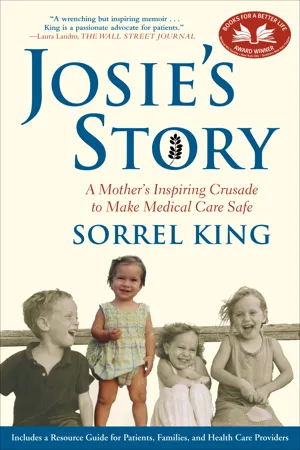
- 272 pages
- English
- ePUB (mobile friendly)
- Available on iOS & Android
eBook - ePub
About this book
Information
Topic
MedicineSubtopic
Medicine Biographies1
I was draining the spaghetti at our home in Richmond, Virginia, Josie sat in her swing playing with her little blue bear.
The phone rang and I could hear the excitement in Tony’s voice when I picked up. A few weeks earlier he had been asked to run his bank’s sales trading desk. It was a great opportunity for a thirty-two-year-old, but meant moving to Baltimore, where the company was headquartered. He was there now, in search of the perfect home. He had called to tell me he had found it.
“The house is old and definitely needs some work, but the land around it is beautiful,” he said.
“So, is it a total dump or what?” I asked, pouring the spaghetti sauce onto the noodles.
“Well, yeah sort of,” he admitted. He told me it had been a barn in the 1800s and then, in 1920, it had been converted into a house. “It’s got green shingles and huge windows with that old, wavy glass that you like. If we want it, we need to sign the contract today.”
“But what about the inside?” I asked.
“We can check it out during the inspection. If we wait until then, we’ll lose it. It’s the land. There’s something about it that’s kind of magical. It reminds me of Bruce Farm.”
“Bruce Farm? It reminds you of Bruce Farm?”
“Yeah, it does. It really does,” he said. “You’re going to fall in love with this place.”
In 1939, my mother’s parents, in search of a summer escape from the city life of Washington, DC, found it when they stepped foot onto an old farm that sat at the top of the Blue Ridge Mountains in Loudoun County, Virginia. The huge stone house with flagstone terraces, called the Big House, was surrounded by sprawling open lawns of Kentucky bluegrass. Fieldstone walls separated the manicured lawns from the pastures that were grazed by Black Angus cattle and horses. But the thing that took my grandparents’ breath away when they stood on the farm for the first time was the view. From the front porch, I came to see and love what they saw that day: a pale green lawn gently sloping down to a stone wall, above which a panoramic view of multiple shades of blue burst as far as the eye could see, making you feel as if you were looking over the ocean. With a slight squint, you could see dairy farms, little towns, and country roads. With a telescope you could see the Washington Monument in the solid, earthy valley. This was God’s country, and its name was Bruce Farm.
Bruce Farm was where my mother and her sister spent their summers and weekends, and as children my siblings and I did, too. It was a place where we were taught, like my mother had been, the meaning of hard work. Our mornings were spent weeding the vegetable garden, mucking out stalls, creosoting fences, and blazing trails. When the work was done we’d pull on our bathing suits, lace up our work boots, and run as fast as we could, with towels flying like superhero capes, across the lawn, over the stone wall, and down the dirt road to jump into the cool pond. Bruce Farm held a special place in all of our hearts.
Tony had been to Bruce Farm, and it got to him the same way it got to me. So, I could tell, as he described what he saw walking around the property in Baltimore, that he had fallen for the place for the same reasons that he knew I would, and that no matter how dilapidated the house was it would become our new home.
“Josie, it looks like we’re going to live in an old green barn. What do you think about that?” I said, plopping a zwieback biscuit on the tray of her swing. She liked the Swiss cardboard-like crackers and sucked on them until they became mushy enough to squeeze in her fists. When she wanted a fresh one, she’d throw the wad of mush at Trapper, the smelly, thirteen-year-old Lab that no one in the family paid attention to anymore except Josie, who adored him. He’d catch the mush that came flying his way and she’d laugh from her swing, kick out her feet, and dangle her chubby zwieback-encrusted fingers in front of him. He’d lick them clean.
Josie was the youngest of four, our caboose. When I was a little girl, I always wanted to have four children. Maybe because I was one of four it was the perfect, even number, not too big, not too small. I loved being part of a big family. Everyone always had someone to play with; no one was ever left out. A life like The Brady Bunch or Eight Is Enough was right up my alley: the more confusion, the more chaos, the better.
With the birth of each of our children, driving home from the hospital was like Christmas morning. Everything was magical. But with Josie, there was more. It was July 3, a typical sweltering, humid, Virginia summer day. My mother insisted on driving, so the three of us—Tony, two-day-old Josie, and I—sat in the back seat as she slowly—ten miles below the speed limit, holding her breath, gritting her teeth, gripping the steering wheel—made her way down the highway.
I looked at Josie’s tiny cheeks as she lay swaddled in the pink blanket that the hospital had given us. She had brown eyes and lots of brown hair with a cowlick that threw part of her hair straight up. Somehow, we had wedged her into the car seat without waking her. I was making mental notes, thinking that I had better tuck this away in the memory bank because this was it. No more babies. Josie completed us. I looked at Tony, who was smiling as he gazed down at Josie, probably having the same thought. Jack, Relly, and Eva were at home waiting for their new little sister. Soon we would all be together, at home for the first time. Four children. Perfect.
Richmond was home for me, where I had grown up and where my parents still lived, along with my brother, Mac, and sister Mary Earle. My younger sister Margaret was right up the road in Washington, DC. Tony and I had spent the previous year building a house in the country just outside of town, on a pretty slice of land next to my parents. From our house the children could walk down a little hill and then up a little hill and be at their grandparents, Big Rel and Pop’s doorstep.
We had loved our home with its dark gray shingles and front porch that faced the western sky; nothing but horse pastures and hay fields framed our view as the sun set every evening. I had planted a bed of perennials and a tiny Carolina jasmine vine with hopes that the vine would climb up the front pillar of the house and shade the porch with fragrant yellow flowers. We had lived there for a little over a year when Tony was offered the promotion in Baltimore.
Our life in the countryside of Virginia was perfect, but Tony and I both agreed that we were too young to say to ourselves: this is where we’ll be forever. The children were not yet entrenched in school and so we decided to take a chance. It would be an adventure, we told ourselves. “We can rent the house in Virginia out and if we don’t like Baltimore we can come home,” Tony promised me. And so we decided to leave our family and friends and the home that we had worked so hard to build, and start a new life in Baltimore.
A few weeks after Tony had signed the contract, we drove to Baltimore to look at our new house—a house I had never seen. My parents took care of Jack, Relly, and Eva, and we took Josie so that I could continue nursing her. Tony and I had been to Baltimore together once before and had spent no more than a few hours with the realtor, driving around the neighborhoods, trying to get a feel for the place. Here we were, buying a house, knowing practically nothing about the city.
It was early October when we turned onto Kayhill Lane, in Baltimore. Through the changing leaves I saw a rolling lawn topped by a pretty, green-shingled farmhouse, shaped like a saltbox, with a gambrel roof and an awkward haybale-pitching window in the center.
In the mailbox we found a note from the current owner.
Dear Tony and Sorrel,
I hope this old house provides you with many happy memories. In the early 1900s, it was a barn and was called Ashline.
Sincerely,
Elizabeth Cunningham
A house with a name. This was going to be good. I strapped Josie into her front carrier and we headed in with the realtor.
It was inspection day and lots of people scurried about carrying clipboards. The living room was amazing: high ceilings, an old mantelpiece, and a bay window flanked by huge windows, each with twelve panes of beautiful, old, wavy glass, just like Tony had said. It helped that Mrs. Cunningham, who hadn’t moved out yet, had good taste, and this room was a showcase of her antiques and artwork. The dining room was equally as elegant, with two large French doors that opened out onto a redbrick terrace. This was definitely a grown-up house, and I was not quite sure what we were doing in it. I was beginning to wonder why no one else had bought the place.
The realtor saved the worst for last—the worst being the rest of the house. The kitchen was tiny, split into three little sections. There was no place for a kitchen table and hardly any room to cook. Most appalling of all, there was green carpet everywhere. As we moved upstairs the situation did not improve. The bathrooms had various wires sticking out, the bedrooms were small, and the hallways were slanted, giving the doorways a cockeyed look. The basement had signs of water damage. Ashline was not looking so hot anymore.
“Do you think there’s any way we can get out of this?” I whispered into Tony’s ear.
“It’s not so bad. We can live with it and then fix it up,” he said as Josie reached for him. He took her from me and led me outside. “You’re going to love this part.”
Hearing Tony, the realtor took his cue. “Don’t you love it?” he asked a little too enthusiastically, leaning close to me with bright, excited eyes. “I’ve got the name of a great contractor who can fix some of this stuff,” he added, holding the front door open for me.
The land was spectacular and as I walked around looking at the old boxwoods, the pretty dogwoods, the tulip poplars, the ash tree that longed to have swings hanging from its branches, and the rolling lawns I could see why Tony had fallen for the place. Along with the house came a little barn that backed on to Lake Roland, an old city reservoir that had lots of walking paths around it. The view out of every window made you feel as if you were in the country, yet the schools were five minutes away and there was a Starbucks practically within walking distance.
“Should we go for it?” Tony asked, handing Josie back to me.
As we stood on the redbrick terrace looking over the lawn, I could feel a hint of Bruce Farm about the old place. I told him I was in if he was.
“What do you think of your new house, little monkey?” Tony said, squeezing Josie’s yellow-socked feet as he leaned down to give her a kiss on the cheek. He put his arm around me and we stood there, the three of us. “I think we’re gonna like it here,” he said.
As we headed to the car the inspectors informed us that we better take a good look at the Terminix contract because there was definitely some termite damage in the front portion of the house.
“Don’t worry,” the realtor said. “My contractor does termites, too.”
2
We settled into our new life in Baltimore. Jack, Relly, and Eva were happy at their new school, Tony was enjoying his job, and I stayed busy at home with Josie, trying to fix up the old house. Although I was liking Baltimore, I missed Richmond terribly. It was a happy surprise when, one day in late January of 2001, we pulled into the driveway to find a green Explorer with Virginia plates parked in front of the farmhouse. “Hey guys, what’s that license plate say?” I asked.
Five-year-old Relly leaned up front to get a closer look. “Bbb-iiii-gggg,” she said, sounding out each letter as her kindergarten teachers had taught her. “Rrrr … eeeee …”
Jack, her brother, who was a year older, quickly unrolled his window and craned his neck to get a closer look. He was not about to let her beat him to it.
“Jack, let Relly figure it out. She’s almost got it,” I said, as I pulled the dark blue Suburban up next to the Explorer.
“Big Rel! It says Big Rel. That’s Big Rel’s car. Big Rel is here!” he blurted out.
“Big Rel, that’s right!” Relly added excitedly as she struggled to climb out of the car. She and Jack raced to the house as three-year-old Eva trailed behind, trying her best to keep her blue fleece blanket up off the ground with one hand while sucking a finger on her other. I unbuckled seventeen-month-old Josie from her car seat and followed them into the house, carrying all of the backpacks, coats, and snack wrappers that they had left behind. My mother—or Big Rel as the children had nicknamed her—had surprised us with a visit.
My mother was, and still is, a beautiful woman. In her younger years people said she looked like Jackie O. Some said she was prettier. “I know I should have called,” she said, bending over to hug the children, then standing up to take Josie from me, “but Pop was out of town so I thought I’d drive up and see what you guys were up to.” The children sat on the sofa with their grandmother and began telling her about their new school, their new bedrooms, and how I had let them paint the old kitchen cabinets before the workmen took them out and put them in the Dumpster.
“We don’t have a kitchen anymore,” Jack said.
“We get to go out to dinner all the time,” Relly added as Eva, still sucking her finger and holding her blanket, wedged herself onto Big Rel’s lap next to Josie, who tried unsuccessfully to push her away.
She hadn’t been to see us since we had started renovations on the old green-shingled farmhouse, which was still a work in progress. I gave her a tour, pointing out where new walls would be going, where doors and windows would be placed, and where the new kitchen would be. She carried Josie, stepping over two-by-fours and piles of plywood with Jack, Relly, and Eva following behind.
“This looks like more work than building a house from scratch,” she said. “How on earth are you going to live like this?”
“Let’s just finish the tour,” I said, leading her through the framing of the family room, mudroom, and bathroom.
We showed her the old, still-intact dining room, which was now serving as kitchen, family room, dining room, and play room.
“Isn’t this nice and cozy,” I asked as I began laying kindling and logs in the fireplace. “It’s like living in a cabin.” I struck a match and lit the fire.
“How long will this take?” she asked.
“I don’t know, six months or so.”
She looked suspiciously at the makeshift stove and the milk crates filled with flour, sugar, and cereal boxes. I recognized this look, her head cocked, brows furrowed, and mouth twisted; it was the same one she had used when I was a teenager and wore feather earrings and ripped jeans.
The children sat down to color and start their homework as Josie pushed the “ON” button to her little music cube and began her knee-buckle dance. She had gotten the toy for Christmas and loved dancing to the “I love you, you love me” Barney song. After ten minutes of it being played over and over it began to drive us all crazy. We had searched for the volume control but there was none.
Jack marched over, grabbed the toy from Josie, and turned it off. Josie shrieked, grabbed a handful of his hair, and burst into tears. Screaming, Jack tried to dislodge himself, but Josie pulled harder. I pried back her little fingers and released Jack from her iron grip. She cried until I picked her up and let her push the button back on.
“You’re spoiling her. You should put her in time-out,” Jack said.
“You’re right, but she’s so little, and look how cute she is. You used to do the same thing when you were her age, and you turned out okay.”
Big Rel announced she was going to take a bubble bath and that whoever showed her where there was a tub that actually worked would get to pour the bubbles in. They all raced upstairs, leaving me alone with the Barney song pulsing in my ears.
The children loved sitting on the floor and talking to Big Rel as she lay back in the bath in her skirted bathing suit, covered up to her neck in bubbles. Eva and Relly brought in their Barbies—the ones that had not yet had all their hair cut off—for shampooing. Big Rel let them pour more bubbles in and told funny stories. This time it was even more of a treat because she was using a bathroom that had never been used before. It was across the hall from Josie’s room and had been closed for renovations. There wasn’t much in it that worked other than the old tub. Josie brought in all of her bath toys including her favorite, a little blue airplane.
At about six, Tony arrived with take-out Thai food and was opening up a bottle of wine when my mother reappeared with the children all in their pajamas. “Big Rel, it’s good to see you,” he said, handing her a glass of wine. “What do you think of the house?”
“I think you all have your work cut out for you,” she said, taking a sip of the wine as they stood together in front of the fir...
Table of contents
- Cover Page
- Title Page
- Copyright Page
- Dedication
- The Picture
- 1
- 2
- 3
- 4
- 5
- 6
- 7
- 8
- 9
- 10
- 11
- 12
- 13
- 14
- 15
- 16
- 17
- 18
- 19
- 20
- 21
- Powder Days
- Acknowledgments
- Resource Guide
- Appendix—Excerpts from the Nursing Journal
- Bm01
- Bm02
- Bm03
- Bm04
Trusted by 375,005 students
Access to over 1.5 million titles for a fair monthly price.
Study more efficiently using our study tools.
Frequently asked questions
Yes, you can cancel anytime from the Subscription tab in your account settings on the Perlego website. Your subscription will stay active until the end of your current billing period. Learn how to cancel your subscription
No, books cannot be downloaded as external files, such as PDFs, for use outside of Perlego. However, you can download books within the Perlego app for offline reading on mobile or tablet. Learn how to download books offline
Perlego offers two plans: Essential and Complete
- Essential is ideal for learners and professionals who enjoy exploring a wide range of subjects. Access the Essential Library with 800,000+ trusted titles and best-sellers across business, personal growth, and the humanities. Includes unlimited reading time and Standard Read Aloud voice.
- Complete: Perfect for advanced learners and researchers needing full, unrestricted access. Unlock 1.5M+ books across hundreds of subjects, including academic and specialized titles. The Complete Plan also includes advanced features like Premium Read Aloud and Research Assistant.
We are an online textbook subscription service, where you can get access to an entire online library for less than the price of a single book per month. With over 1.5 million books across 990+ topics, we’ve got you covered! Learn about our mission
Look out for the read-aloud symbol on your next book to see if you can listen to it. The read-aloud tool reads text aloud for you, highlighting the text as it is being read. You can pause it, speed it up and slow it down. Learn more about Read Aloud
Yes! You can use the Perlego app on both iOS and Android devices to read anytime, anywhere — even offline. Perfect for commutes or when you’re on the go.
Please note we cannot support devices running on iOS 13 and Android 7 or earlier. Learn more about using the app
Please note we cannot support devices running on iOS 13 and Android 7 or earlier. Learn more about using the app
Yes, you can access Josie's Story by Sorrel King in PDF and/or ePUB format, as well as other popular books in Medicine & Medicine Biographies. We have over 1.5 million books available in our catalogue for you to explore.