A manifesto for the workplace feminist that moved Oscar winner Jane Fonda to exclaim "Please, please, please. All working women must read this book!"
Enough about "breaking the glass ceiling." Here are blueprints for a redesign of the entire building, ground up, to benefit women
and men—as well as the bottom line.
In
Taking on the Big Boys, longtime labor activist Ellen Bravo explores workplace environments in both business and government. She recounts women's testimonies from offices, assembly lines, hospitals, and schools, unmasking the patronizing, trivializing, and minimizing tactics employed by "the big boys" and their surrogates, such as portraying feminism as women against men, and dismissing demands for pay equity, family leave, and flex time as outrageous.
Also included are practical tips on everything from dealing with a sexual harasser to getting family members to share chores—and build equal relationships.
In this "smart, kind, funny, and very effective" Gold Medal Winner of
ForeWord Magazine's Book of the Year Award for Women's Issues, Bravo argues for feminism as a system of beliefs, laws, and practices that value women and work associated with women, while detailing activist strategies to achieve a society where everybody—women and men—reach their potential (Gloria Steinem, feminist icon).
eBook - ePub
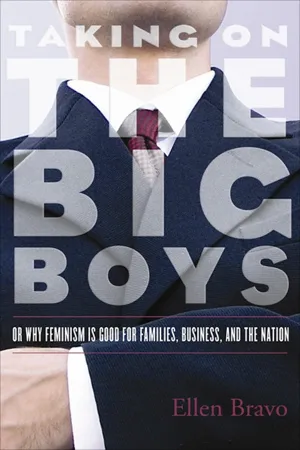
Taking On the Big Boys
Or Why Feminism Is Good for Families, Business, and the Nation
- 294 pages
- English
- ePUB (mobile friendly)
- Available on iOS & Android
eBook - ePub
About this book
Information
1. OVERVIEW
Soon after the publication of my book The Job/Family Challenge (1995), I appeared on a popular Sunday night interview show in Milwaukee. The next day my husband went to buy a new bicycle. The guy behind the counter pointed to my name on the check.
“Do you live with her?” he asked.
“She’s my wife,” Larry replied.
The bike shop owner leaned over the counter as if about to divulge a secret: “I saw her on that show last night. And the amazing thing is, she didn’t say one thing I disagreed with. She even made me laugh.”
“What’d you expect?” Larry started to ask. But he didn’t—because he already knew (plus he really wanted to get home and ride that bike). When the shop owner clicked on my interview, he was waiting for me to say, “All men are pigs,” “All women are saints,” “Women who stay home with kids are wasting their lives.” Instead he heard how little this society values families, and how much men as well as women suffer when workplaces function as if everyone had a wife at home full time. He was surprised to learn that the changes feminists want are not favors to women, but a better way to do business, raise families, build society. And yes, most men have a lot of changing to do—but here I was, arguing they have much more to gain than to give up.
And what do you know, I had a sense of humor.
I wanted to tell you this story so you’d see what a nice, reasonable, and amusing person I am. But the more I thought about it, the more I became, you should pardon the expression, PISSED OFF. Think about it—the majority of women in the United States earn less than $25,000 a year. The average woman loses nearly a half million dollars over her lifetime because of pay inequities. Cameroon, Brazil, and India offer better maternity leave than we do. The percentage of female executives is down and the percentage of kids in poverty has gone back up. And feminists like me are the ones with a bad reputation?
It’s hard not to be outraged. But I’m not mad at most people, not even most men. Who I’m really mad at are the Big Boys.
Who Are the Big Boys?
The Big Boys are what I call the relatively small number of men who have a real stake in maintaining gender discrimination. They’re the ones who control wealth and power in this country. You may think of them as the “powers-that-be” or the ruling class or the owning class or “the Man.” They profit from our labor, set the conditions under which we work, and create or greatly influence public policy. They may be executives, elected officials, lobbyists, pundits. I include their spokespeople, whether appointed or self-appointed, since these people help the Big Boys maintain power. Some may wear high heels and lipstick, but regardless of gender, they’re part of this group.
It’s not enough to run the show—the Big Boys also control its description. By their reckoning, the status quo isn’t a particular system that serves their interest. It’s inevitable and beneficial to all. Whatever perks they happen to have, they deserve. Because they’re in charge, they get to tell the story of what’s happening in the world—what’s working, what the problems are, what solutions are needed. Anyone can put forward opposing views. But the Big Boys’ version is the one we hear most often. The tales they tell, repeated over and over by the media they control, take on the appearance of objective truth. Yet as we’ll see, these narratives are often myths designed to misdirect and confuse while they perpetuate the existing distribution of power.
The Big Boys don’t function like a club or fraternity. They don’t have secret handshakes or smoke-filled meetings where they conspire to keep women down. And they don’t all agree on every point. But they do operate from the same general interests and often work together to preserve their authority.
Some men earn the title of “Big Boys” even though they have no wealth and little actual power, based on the role they play at the workplace to keep women out or down. These folks may see themselves as part of “the people,” but their behavior toward women in fact helps cement the Big Boys’ domination.
By saying the Big Boys are relatively few in number, I certainly don’t mean to let men as a whole off the hook. Most men exhibit male supremacy—the notion that males are superior to females—in the way they view and treat women, and the majority don’t think that’s a problem. Guys who get kicked around in the rest of their lives grow up believing they can at least be “the boss” at home. They’re not eager to let that go. But as this book will point out in many different places, most men actually have much to gain from feminism. Only the Big Boys have a lot to lose (and even some of them can be transformed).
To understand how feminists—and women as a whole—got such a bad rap, we have to understand the role of the Big Boys and learn how to take them on.
Back to Basics: How Did This Happen?
The Big Boys didn’t always exist, and neither did gender inequality. Some would argue that men have always been masters, or brutes. I don’t buy it. Anthropologists have documented a very different story—tribes where gender played a role in how men and women spent their day, but not in how that work was valued.1
Picture the earliest humans. The problem wasn’t that cavewomen were too emotional to go after a woolly mammoth, or men too macho to tidy up the cave. The men trooped out to hunt because the tribe needed food and they were mobile; women hung out near the cave and gathered edible food and other nearby supplies because they were usually pregnant or lactating. There’s every reason to think both forms of work were valuable and valued. When a child was born, the group always knew who the mother was, but the dad connection was much less clear. That reality often added to women’s status. In many human societies, mothers were revered and given significant power.2
Why did this change in many parts of the world? Here’s the most logical explanation I’ve heard: Most humans at first used up everything they got their hands on. They considered themselves lucky not to freeze or starve. As tribes were able to move beyond day-to-day survival and develop agriculture, land and tools were not scarce, but labor was. Therefore, tribes with greater numbers of women and children were more successful. Tribes could and did steal women, but they needed ways to avoid constant warfare with each other. And at some point early humans learned the lesson that too much intertribal marriage weakened their offspring. Anthropologists have documented how these developments led to an “exchange of women” among tribes.3 Women—and in particular, women’s sexual capacity—became the first private property. In a world without paternity tests, there was only one surefire way to ensure that the woman a man received belonged only to him—preventing her from being sexual with any other man. As some men began to accumulate surplus land and goods, they also had to make certain the property got passed on to rightful heirs (as Samuel Johnson once put it, “The chastity of women is of all importance, as all property depends on it”).4 Controlling women’s sexuality went hand in hand with restricting their rights in all spheres. Those who began to accumulate property went on to restrict the rights of the majority of men as well.
Think of these men as the original Big Boys. Once in charge, they found ways to justify their actions. They created an ideology, declaring women to be weaker, inferior, of lesser value (just as it justified that men with wealth were in fact more “worthy” and destined to rule over others).5 As society developed, these beliefs about women weren’t just opinions—they were transformed into laws. Not good enough to own property, women could in fact be treated as the property of their husbands. (I stopped using the expression “rule of thumb” as soon as I learned its origins in British law: The stick with which a husband could beat his wife was to be no thicker than the size of his thumb.) In most cultures, women’s “natural” role as mothers didn’t translate into any rights to their children. Instead, as societies industrialized, women’s ability to bear children became an excuse to keep them out of all kinds of jobs. And the jobs they did perform were considered less valuable.
Flash forward to the twentieth century. Technology brought many changes that helped women, but perhaps none more significant than the development of birth control. Throughout the ages, some women had applied their knowledge of herbs and nature to prevent unwanted pregnancy. But for the majority of women, biology really was destiny. Access to modern contraception (for those not prohibited by pulpit or pocketbook) represented a monumental advance. Having some control over when and whether to have children laid the basis for changes in how women might spend their time—changes many women in this country had begun to demand but hadn’t had the power to effect.
Rise of Feminism
Social movements don’t spring up out of nowhere. Usually before numbers of people act together in groups, some individuals have begun to make a case for change; isolated acts of rebellion have taken place. This was certainly the case with feminism in the United States.6 When people use the phrase “first-wave feminism,” they generally mean the first time women in this country took action on their own behalf on a significant scale.
The movement started in the mid-nineteenth century when women abolitionists began to question why they were denied so many of the rights they were seeking for slaves. Since women at the time had fewer rights than men who’d been declared insane, it’s not surprising that the original list of demands was pretty extensive. The Declaration of Sentiments drafted at Seneca Falls in 1848 called for, among other things, “securing to women an equal participation with men in the various trades, professions and commerce.”7 In the next decades, women in some states scored a few victories, including the right to divorce, to own and inherit property, and to keep their own names. Pioneers like Margaret Sanger fought for women to have access to birth control. But women needed political power to gain reforms. The general list of goals was soon whittled down to the vote—a win white women didn’t see until 1920; Puerto Ricans had to wait until 1928, and many African Americans decades more. In addition to massive opposition from the Big Boys, racist views held by many leaders in the women’s suffrage movement helped narrow and weaken its outcomes.8
The movement appeared to hibernate after the suffrage victory. In fact, groups of women, including African Americans, immigrants, and other low-wage workers, continued to make demands and take action, often boldly, to improve their lot (see Chapter 6). But for the next burst of feminism we had to wait until the 1960s. Young women inspired by the civil rights and antiwar struggles demanded equality in the movement, in the bedroom, and in society at large. At the same time, women privileged to stay home with children began to feel stuck in suburbia and wanted more options. Both groups began to imagine—and then demand—entrance to occupations and status that had been off-limits. Women who’d been told they couldn’t, or shouldn’t, or wouldn’t want to dig underground or fly in outer space or many other things in between found that they certainly could, and more and more of them did.
Today virtually all occupations have at least some females; gender discrimination has been outlawed for more than forty years in the United States. But whenever a group has legally been declared inferior for centuries, there’s bound to be a powerful legacy of inequality and a slew of structural barriers that remain. Imagine if all the best jobs were in buildings designed for short people.9 One day tall people are told, “Okay, you can work here, too, as long as you walk on your knees or stoop over so you don’t bump your head.” How many tall people would we expect to find in those jobs? It shouldn’t be surprising that women still earn considerably less than men—even in the same professions—are in charge less often, and are treated badly more often. Nor is it surprising that today’s Big Boys still try to justify women’s lower status. In fact, their arguments have become more sophisticated. Feminism, they say, is not just the wrong solution for women, but the very cause of women’s problems.
What Is Feminism Anyway?
According to the dictionary, feminism is the movement for social, political, and economic equality of men and women. The problem isn’t that most people disagree with feminism—it’s that they don’t know what it is. When people are asked directly about this definition, they overwhelmingly support it, even if they avoid the label.
My own definition goes further than the dictionary version. Feminism is a system of beliefs, laws, and practices that fully values women and work associated with women in order to help all people reach their potential. It means an end to views of women and “women’s work” as being less valuable. Doing away with discrimination against women opens the way to full participation and choices both for women and men.
What about the “men are from Mars, women from Venus” theory? Once gender stereotypes—assumptions and generalities about females and males—are eliminated, perhaps we’ll still find more women than men in caregiving occupations and more men than women who are good with tools. Who knows? But clearly many in each group go against stereotype right now, and many more would if they weren’t punished for doing so. Simply being female or male will one day tell us very little about someone’s talents, interests, and dreams.
Like all social movements, the women’s movement is not monolithic. The brand of feminism I’m advocating is what’s known as “social justice feminism.” It takes into account women’s different experiences depending on class, race, and sexual orientation. We know there can’t be full freedom for women if there’s not freedom for all women. And we can’t end domination by the Big Boys in one area if we allow it to continue in another. That means the fight for gender equality has to be linked with systemic change that opposes all forms of injustice and domination.
In other words, our goal is not equal numbers of females among the Big Boys. What we want isn’t just more women in power, but more power to women as a whole and others who have been disenfranchised. To achieve that, we have to do more than smash the glass ceiling—we have to redesign the building.
Why Big Boys Beat Up on Feminism
Ask yourself, Who gains when women get less? The extra money, power, prestige, opportunities do not land in the laps of most men. If I make a dollar an hour less than the guy working next to me, that dollar goes not into his pocket but into the profits of the business owner. Paying women less and treating them as if they deserved less has been very profitable for the Big Boys. That’s not all. Workers who are divided among themselves because of the color of their skin or the country they were born in or which box they check under “gender” are less likely to band together to challenge the Big Boys’ power. That means feminism or any other beliefs that do challenge that power inevitably run into resistance.
The Big Boys’ arguments against feminism are often infuriating, sometimes stupefying, and usually predictable. One thing you learn early on is that they don’t all take extremist positions. Instead, many exploit the misunderstanding and prejudice spread by those who do.
For example, some opponents of women’s suffrage warned that victory would cause women physiological damage—larger, heavier brains and loss of unique feminine mannerisms.10 Female labor would bring even worse devastation, destroying not just women’s nature but the home: “[I]t is the knife of the assassin aimed at the family circle.”11 Most Big Boys were less heavy...
Table of contents
- Cover
- Title Page
- Copyright
- Dedication
- Contents
- Acknowledgments
- 1. Overview
- 2. Why Social Workers Earn Less than Accountants: Pay Equity
- 3. Can You Have a Job and a Life?
- 4. Can a Woman Do a Man’s Job?
- 5. You Want to See My What? Sexual Harassment
- 6. Nine to Five: Not Just a Movie—The Right to Organize
- 7. Working Other than Nine to Five: Part-Time and Temporary Jobs
- 8. What this Nation Really Thinks of Motherhood: Welfare Reform
- 9. Revaluing Women’s Work Outside of Work
- 10. How You Can Help Get There
- Notes
- Appendix A. Organizations Working for Women
- Appendix B. Alternative Sources of Information
- Index
Trusted by 375,005 students
Access to over 1.5 million titles for a fair monthly price.
Study more efficiently using our study tools.
Frequently asked questions
Yes, you can cancel anytime from the Subscription tab in your account settings on the Perlego website. Your subscription will stay active until the end of your current billing period. Learn how to cancel your subscription
No, books cannot be downloaded as external files, such as PDFs, for use outside of Perlego. However, you can download books within the Perlego app for offline reading on mobile or tablet. Learn how to download books offline
Perlego offers two plans: Essential and Complete
- Essential is ideal for learners and professionals who enjoy exploring a wide range of subjects. Access the Essential Library with 800,000+ trusted titles and best-sellers across business, personal growth, and the humanities. Includes unlimited reading time and Standard Read Aloud voice.
- Complete: Perfect for advanced learners and researchers needing full, unrestricted access. Unlock 1.5M+ books across hundreds of subjects, including academic and specialized titles. The Complete Plan also includes advanced features like Premium Read Aloud and Research Assistant.
We are an online textbook subscription service, where you can get access to an entire online library for less than the price of a single book per month. With over 1.5 million books across 990+ topics, we’ve got you covered! Learn about our mission
Look out for the read-aloud symbol on your next book to see if you can listen to it. The read-aloud tool reads text aloud for you, highlighting the text as it is being read. You can pause it, speed it up and slow it down. Learn more about Read Aloud
Yes! You can use the Perlego app on both iOS and Android devices to read anytime, anywhere — even offline. Perfect for commutes or when you’re on the go.
Please note we cannot support devices running on iOS 13 and Android 7 or earlier. Learn more about using the app
Please note we cannot support devices running on iOS 13 and Android 7 or earlier. Learn more about using the app
Yes, you can access Taking On the Big Boys by Ellen Bravo in PDF and/or ePUB format, as well as other popular books in Social Sciences & Women in Business. We have over 1.5 million books available in our catalogue for you to explore.