"Well-written . . . analysis and insight into what role the crisp, clean Black Hills air may have had in the culmination of a successful political career" (The Washington Times).
On August 2, 1927, President Calvin Coolidge shocked the nation by announcing he would not seek reelection. The declaration came from the Black Hills of South Dakota, where Coolidge was vacationing to escape the oppressive Washington summer and to win over politically rebellious farmers. He passed his time at rodeos, fishing, meeting Native American dignitaries and kick-starting the stagnant carving of Mount Rushmore. But scandal was never far away as Coolidge dismissed a Secret Service man in a fit of anger. Was it this internal conflict that led Coolidge to make his famous announcement or the magic of the Black Hills? Veteran South Dakota journalist Seth Tupper chronicles Coolidge's Black Hills adventure and explores the lasting legacy of the presidential summer on the region.
Includes photos
"The book sets out to examine such questions as why the president chose to travel west and why he used the trip to make the announcement that he would not run for president again in 1928 . . . well documented and filled with fascinating details." —
The Washington Free Beacon

- 160 pages
- English
- ePUB (mobile friendly)
- Available on iOS & Android
eBook - ePub
Calvin Coolidge in the Black Hills
About this book
Information
Topic
HistoriaSubtopic
Biografías políticasPART I
ANTICIPATION
1
FAILURE AND A FARM PROBLEM
When President Coolidge put his signature on the veto message of the McNary Haugen Farm Relief bill, he touched off as heavily charged a current of political electricity as has been let loose in national politics for years.
—L.C. Speers, New York Times9
—L.C. Speers, New York Times9
Before succeeding in 1927, South Dakota made a failed attempt to host a presidential vacation in 1926.
Possibly the earliest evidence of that attempt is a letter dated March 10, 1926, from Albert M. Jackley, of Pierre, to William Williamson, who represented western South Dakota in the U.S. House of Representatives. The language of the letter indicates the two men had discussed inviting President Coolidge to the Black Hills. “There is no possible way in which our President or the Government could so forcefully show its appreciation of conditions in the west than by establishing the Summer White House in the Black Hills,” Jackley wrote. “The inconveniences would undoubtedly be forborne cheerfully, and universally approved. You have a good case and I feel sure it will be well presented by you.”10
Jackley’s use of the phrase “conditions in the west” was probably a reference to the depressed crop prices afflicting farmers in the northern and western Great Plains. The “farm situation,” as it was called, would eventually play a pivotal role in bringing Coolidge to South Dakota in 1927.
Jackley apparently had little to no further involvement in the presidential recruitment effort but went on to a modest measure of fame in later years as the state’s official rattlesnake eradicator. Coolidge, who reportedly had an intense fear of snakes, probably would have liked him.11
Another South Dakota man, Francis Case, claimed to have hatched the idea to invite Coolidge to South Dakota and also received popular credit for it, even though the only evidence to support Case’s claim is a telegram he sent to Williamson twenty days after the Jackley letter. Case eventually served in Congress, but in 1926, he was the publisher of the Hot Springs Star newspaper in the southeastern Black Hills.
In Case’s telegram to Williamson on March 30, 1926, Case noted press reports that said the chronically chest-congested Coolidge wanted a higherelevation retreat with drier air for his 1926 vacation. Coolidge had spent his previous summer vacation in Swampscott, Massachusetts, following the long tradition of keeping the Summer White House relatively near the nation’s capital.
“Press dispatches say President Coolidge will not return to Swampscott this summer, desiring mountains,” Case wrote to Williamson. “Please present superior climate, temperate altitude, accessibility and communication facilities of the Black Hills, particularly the state park, and learn exact requirements. Confident associated commercial clubs and park board will provide whatever necessary to establish summer White House in Black Hills. Western summer home means much for entire country.”12
By “state park,” Case meant Custer State Park, roughly thirty miles north of Hot Springs in a beautifully rugged portion of the Black Hills.
Williamson honored Case’s request and wrote a letter on April 1, 1926, inviting the president to South Dakota for the summer. Williamson enclosed two pamphlets about the Black Hills and a picture of the State Game Lodge.
In the letter, Williamson proudly described the mild climate, impressive scenery and abundant wildlife in the Black Hills and tried to spin a potential weakness—the relatively moderate elevation of mountains in the Black Hills, at least in comparison to the Rockies—into a strength.
“It is not so massive as to be overawing and oppressive,” Williamson wrote, “but is sufficiently rugged to possess all the charms of the best mountain landscape.”13
The president’s executive secretary, Everett Sanders, whose duties were comparable to those of a modern chief of staff, replied with a brief note acknowledging receipt of the invite and saying only that it would be “given consideration.”14
There were other places competing for the president’s attention, and a national competition ensued. Some prominent South Dakotans, including other members of the congressional delegation, called on the president personally to make their case.
“It soon became apparent, however,” Williamson wrote, “that the President thought the Hills were too far from Washington for present consideration.”15
Coolidge chose a spot in the Adirondack Mountains of New York and vacationed there during the summer of 1926.
South Dakotans, refusing to accept the finality of their defeat, turned their attention to 1927.
OPPORTUNITY IN A VETO
As the new year dawned, a group of midwestern and western lawmakers known as the Farm Bloc pressed hard for congressional legislation to ease the economic suffering of their agricultural constituents.
American farmers had increased their productivity during World War I to replace waning European production. After the war, as European productivity recovered, American farmers continued to overproduce. They suffered plummeting prices as their supply outpaced demand.
The Farm Bloc’s efforts to address the problem took the form of the McNary-Haugen bill, named for Republican sponsors Charles McNary, an Oregon senator, and Gilbert Haugen, an Iowa representative. The bill sought government intervention to raise American farm prices, in part by removing surplus crops from the U.S. market and dumping them on the international market.
The bill’s momentum in Congress put the Farm Bloc on a collision course with the strictly conservative President Coolidge, who opposed aggressive government intrusion in the marketplace.
South Dakotans were well aware of the looming showdown and the opportunity it presented. Political commentators believed that if the McNary-Haugen bill passed and Coolidge vetoed it, an angry backlash among Farm Bloc lawmakers and their constituents would create a political problem for Coolidge in 1928, when it was assumed he was considering a run for reelection. If that scenario played out, Coolidge would need to do something to bolster his standing in farm country.
South Dakota legislators had that on their minds when they adopted a resolution on January 8, 1927, inviting Coolidge to the Black Hills for the summer. The resolution extolled the beauty of the Black Hills and included a reminder, in anticipation of a McNary-Haugen veto and Coolidge’s probable need to placate farmers, that “agriculture is prosecuted in the foothills and adjacent plains.”16
The McNary-Haugen bill won final approval from Congress on February 17, 1927. Eight days later, on February 25, Coolidge vetoed the bill and excoriated it with a veto message so long that it ran to nearly eleven thousand words and spanned almost two pages in the newspapers that published it. The president called the bill, among other things, “an economic folly from which the country has every right to be spared.”
As expected, the Farm Bloc fumed. Some Republican members spoke openly about supporting candidates other than Coolidge for the party’s 1928 presidential nomination. The inner-party rift spelled trouble not only for Coolidge’s reelection but also for the protection of the Republican majority in Congress.
The resentment Coolidge engendered among farm state Republicans was summed up by Arthur Krock, an editorial correspondent for the New York Times: “Politically they recognize in him a fellow Republican. Personally they admire Mr. Coolidge for individual excellences; but economically they look upon him as the leader of a faction either inimical or indifferent to their property interests and devoted entirely to protecting the prosperity of the East.”17
That kind of sentiment continued to build as the Farm Bloc kept up its vengeful rhetoric. Then, on March 8, 1927, just eleven days after the veto, the White House announced that the president would go somewhere in the West for his summer vacation. It would be the first time a president had established a Summer White House in the West, and it was immediately interpreted as a political move.
“Some observers expressed the opinion that he was going out to get an idea at first hand of actual farm problems so as to overcome, if possible, some of the hostility aroused against the party and himself by his disapproval of the farm bill,” the New York Times reported.18
Coolidge said nothing about his motives and did not reveal whether he planned to seek reelection in 1928. It was clear, however, that if he was still undecided about running, a trip to the West would allow him to gauge the extent of western opposition to his candidacy, or if he had already decided to run, the trip would give him a chance to campaign for the western votes he needed. Even if he had decided against running, the trip presented an opportunity to help the party by mending the rift between eastern Republicans and their Farm Bloc colleagues.
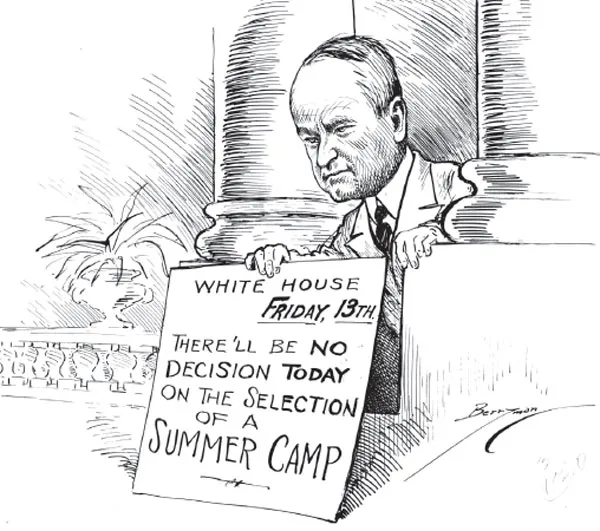
The May 13, 1927 edition of the Washington Evening Star featured this cartoon by Clifford Berryman depicting President Coolidge. National Archives.
National attention turned to the intrigue surrounding the president’s search for a suitable vacation spot. He wanted to go somewhere “on the Western borderland of the corn belt States,” but he did not want to spend the summer on a hot, humid plain surrounded by farm fields and mosquitoes.19
There was no place better situated than the Black Hills of South Dakota to deliver the unique combination of mountains, moderate temperatures, freedom from insects and close access to farmers that the president coveted.
Agriculture was not abundant in the Black Hills, but farmers and ranchers tried to scrape out a living on the surrounding plains of western South Dakota, northwestern Nebraska, northeastern Wyoming and southeastern Montana, a four-state region where a dry climate and less arable land made the effects of depressed crop prices especially severe.
South Dakota was the epicenter of the agricultural depression. The state suffered a 62 percent decline in the total value of its crops between 1919 and 1926, the sharpest drop among all the farm states. South Dakota was also geographically centered among the states considered to be hotbeds of Farm Bloc support, a swath of the country that stretched roughly from Idaho to Wisconsin and from North Dakota to Oklahoma.20
So it seemed that South Dakota was a logical spot for a Summer White House. But could a president effectively conduct the nation’s business so far from Washington, D.C.? That was an open question, and South Dakota had been passed over by Coolidge in 1926 because of that very concern. The president needed convincing, and South Dakotans had the man for the job.
2
A POLITICAL PARTNERSHIP
I have urged his coming to the state so hard that I have nearly worn out my welcome.
—U.S. senator Peter Norbeck, South Dakota21
—U.S. senator Peter Norbeck, South Dakota21
South Dakota’s senior U.S. senator Peter Norbeck seemed more likely to join the Farm Bloc revolt against Coolidge than to invite him to the Black Hills.
Norbeck fervently supported farmers and the McNary-Haugen bill, and he disliked Coolidge even before the McNary-Haugen veto. Norbeck campaigned against Coolidge’s nomination in 1924 and was so effective that the then vice president finished second that year in South Dakota’s six-way Republican presidential primary.
The distance between the two men was a result of fundamental differences in their backgrounds, political philosophies and approaches to governing. Besides their membership in the Republican Party, they had little in common.
Norbeck was a well-driller by trade, the son of Scandinavian immigrant parents and a stout, mustachioed, progressive man of action who idolized Theodore Roosevelt. When Norbeck scrutinized the slight, reserved, conservative Yankee lawyer in the White House, Norbeck saw someone who could “no more run this big machine at Washington than could a paralytic.”22
But Norbeck was a savvy politician with a commitment...
Table of contents
- Front Cover
- Title Page
- Copyright
- Dedication
- Contents
- Acknowledgements
- Introduction
- Acknowledgements
- Introduction
- Part I: Anticipation
- Part II: Adventure
- Part III: Aftermath
- Timeline
- Notes
- Bibliography
- About the Author
Trusted by 375,005 students
Access to over 1.5 million titles for a fair monthly price.
Study more efficiently using our study tools.
Frequently asked questions
Yes, you can cancel anytime from the Subscription tab in your account settings on the Perlego website. Your subscription will stay active until the end of your current billing period. Learn how to cancel your subscription
No, books cannot be downloaded as external files, such as PDFs, for use outside of Perlego. However, you can download books within the Perlego app for offline reading on mobile or tablet. Learn how to download books offline
Perlego offers two plans: Essential and Complete
- Essential is ideal for learners and professionals who enjoy exploring a wide range of subjects. Access the Essential Library with 800,000+ trusted titles and best-sellers across business, personal growth, and the humanities. Includes unlimited reading time and Standard Read Aloud voice.
- Complete: Perfect for advanced learners and researchers needing full, unrestricted access. Unlock 1.5M+ books across hundreds of subjects, including academic and specialized titles. The Complete Plan also includes advanced features like Premium Read Aloud and Research Assistant.
We are an online textbook subscription service, where you can get access to an entire online library for less than the price of a single book per month. With over 1.5 million books across 990+ topics, we’ve got you covered! Learn about our mission
Look out for the read-aloud symbol on your next book to see if you can listen to it. The read-aloud tool reads text aloud for you, highlighting the text as it is being read. You can pause it, speed it up and slow it down. Learn more about Read Aloud
Yes! You can use the Perlego app on both iOS and Android devices to read anytime, anywhere — even offline. Perfect for commutes or when you’re on the go.
Please note we cannot support devices running on iOS 13 and Android 7 or earlier. Learn more about using the app
Please note we cannot support devices running on iOS 13 and Android 7 or earlier. Learn more about using the app
Yes, you can access Calvin Coolidge in the Black Hills by Seth Tupper in PDF and/or ePUB format, as well as other popular books in Historia & Biografías políticas. We have over 1.5 million books available in our catalogue for you to explore.